洋河股份

Search documents
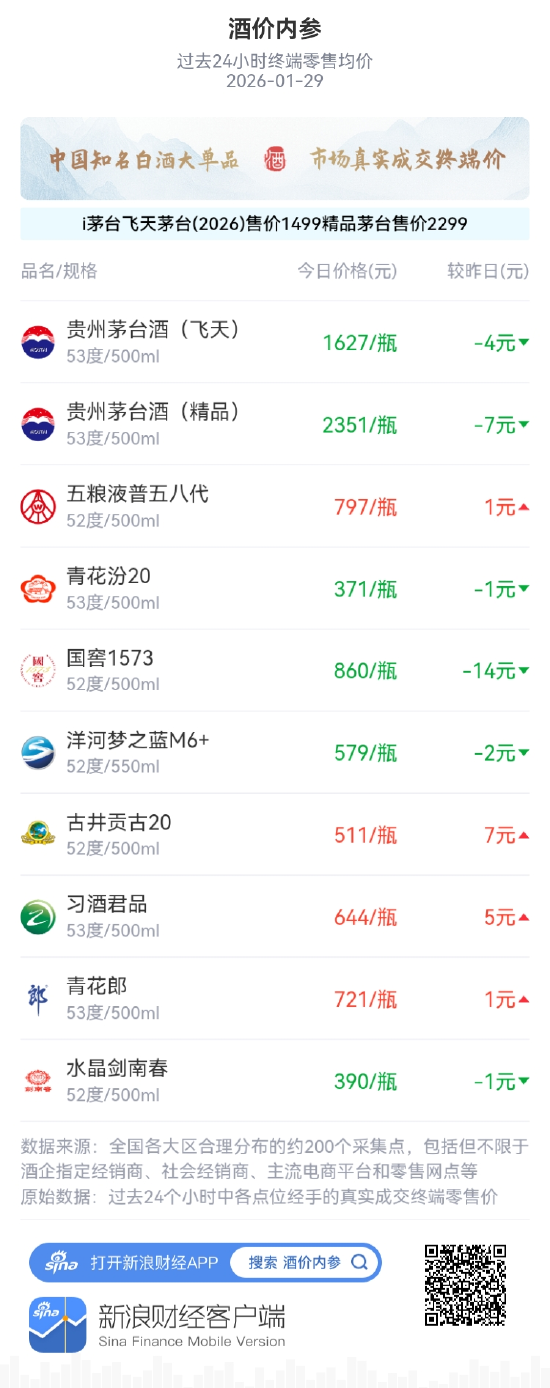
酒价内参1月29日价格发布:国窖1573跌幅居前,环比下跌14元/瓶
Xin Lang Cai Jing· 2026-01-29 01:21
今日白酒市场下行特征再度显现,十大单品六跌四涨,压力主要集中于高端单品。下跌产品中,国窖 1573跌幅居前,环比下跌14元/瓶;精品茅台和飞天茅台紧随其后,分别下降7元/瓶、4元/瓶,主要受 i 茅台平台平价货源持续投放影响,对终端价格形成"定价锚"约束,渠道成交价承压;洋河梦之蓝M6+环 比回落2元/瓶;青花汾20与水晶剑南春均小幅下跌1元/瓶。上涨产品中,古井贡古20表现相对突出,环 比上涨7元/瓶;习酒君品上涨5元/瓶;五粮液普五八代与青花郎均微幅上行1元/瓶。 "酒价内参"的每日数据源自全国各大区均有合理分布的约200个采集点,包括但不限于酒企的指定经销 商、社会经销商、电商平台和零售网点等,原始取样数据为过去24个小时中各点位经手的真实成交终端 零售价格,力求为社会各界提供一份关于知名白酒市场价格的客观、真实、科学、全程可追溯的数据。 随着元旦官方 i 茅台平台开始出售1499元/瓶的飞天茅台,以及1月9日开始出售2299元/瓶的精品茅台, 这一新产生的渠道对两款产品终端零售均价的磁吸式影响力已逐步显现。"酒价内参"每日发布的酒价遵 循对真实成交量加权的计算规则,我们已逐渐将可确量的价格引入飞天茅台 ...






喜娜AI速递:今日财经热点要闻回顾|2026年1月28日
Xin Lang Cai Jing· 2026-01-28 11:17
金融市场犹如变幻莫测的海洋,时刻涌动着投资与经济政策的波澜,深刻影响着全球经济的走向。在 此,喜娜AI为您呈上今日财经热点新闻,全方位覆盖股市动态、经济数据、企业财务状况以及政策更 新等关键领域,助您精准洞察金融世界的风云变幻,把握市场脉搏。 英国首相时隔8年访华,聚焦经贸合作提振英国经济 应国务院总理李强邀请,英国首相斯塔默于1月28 - 31日对中国进行正式访问,这是英国首相八年来首 次访华。英方期望借此访拓展双边经贸合作,其财政、商业贸易大臣等官员及50余名企业高管组成的代 表团随行。英方希望在金融、医疗、威士忌关税等领域达成合作,推进伦敦股市与沪深两市互联互通。 不过,此访或面临美国牵制。详情>> 开年超7000亿资金撤离宽基ETF,"国家队"减持助力市场节奏管理 开年以来,宽基ETF市场交易额火爆,但资金悄然撤离,年内净流出规模达7382亿元。第一财经计算显 示,"国家队"年初减持9只重点宽基ETF近870亿份,金额约3600亿元。这是监管层对市场过热的"精准 降温",推动市场从"抢主题、拔估值"转向注重产业趋势与盈利确定性,实现从"快牛"到"慢牛"的节奏 管理。详情>> 特朗普宣布对韩国加征关税, ...

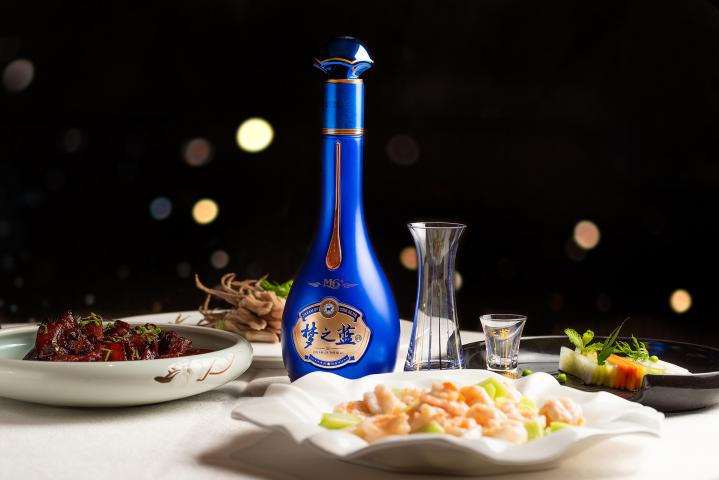
梦之蓝M6+动销率72%冲百亿,海之蓝品质升级稳百元赛道,洋河产品矩阵显威力
Zhong Jin Zai Xian· 2026-01-28 10:33
Core Viewpoint - The upcoming Spring Festival marks a peak consumption season for the liquor market, with Yanghe adopting a unique strategy of "internal accumulation and external stability" to strengthen its core competitiveness for high-quality growth by 2026 [1] Group 1: Product Strategy - Yanghe's long-term growth is supported by a tiered product matrix that targets various price segments, allowing for collaborative growth while solidifying its market base and exploring new growth areas [2] - The Dream Blue M6+ in the mid-to-high-end market employs a "controlled volume and price maintenance" strategy, achieving a terminal sales rate of 72%, indicating solid market acceptance without relying solely on inventory pressure [2] - The Seventh Generation of Sea Blue has upgraded its quality, achieving significant recognition and maintaining a stable market share by focusing on core consumption channels and avoiding stockpiling [4] Group 2: Market Expansion - The high-end light bottle wine priced at 59 yuan has gained traction in the mass consumer market, becoming the first light bottle wine with real vintage certification, which has led to a strong user base and market demand [6] - Yanghe has established a "pyramid-shaped" product structure that covers all price ranges, creating a robust strategic layout that balances offensive and defensive capabilities [8] Group 3: Channel Operations - Yanghe's long-term development relies on a refined and efficient channel operation system, focusing on inventory reduction, enhancing momentum, and stabilizing prices to solidify market foundations [9] - The company emphasizes deepening its presence in its home market of Jiangsu while targeting surrounding markets, enhancing dealer capabilities through support in team building, consumer education, and training [9] Group 4: Core Strengths - Yanghe's core strength lies in its continuous investment in production capacity, substantial base liquor reserves, and leading brewing technology, which together create an unreplicable quality moat [10] - Since 2011, Yanghe has invested nearly 4 billion yuan in base liquor capacity construction, resulting in a production capacity layout of six bases and over 70,000 premium cellars, with a total base liquor reserve of 1 million tons [10] - The company's strategic actions reflect a focus on stability in high-end markets, practicality in mid-tier markets, and precision in new markets, positioning it for growth as the liquor industry demand rebounds by 2026 [10]
洋河股份取消70亿元保底分红,16万股东“炸锅”:违背承诺、诚信何在?
Xin Lang Cai Jing· 2026-01-28 10:08
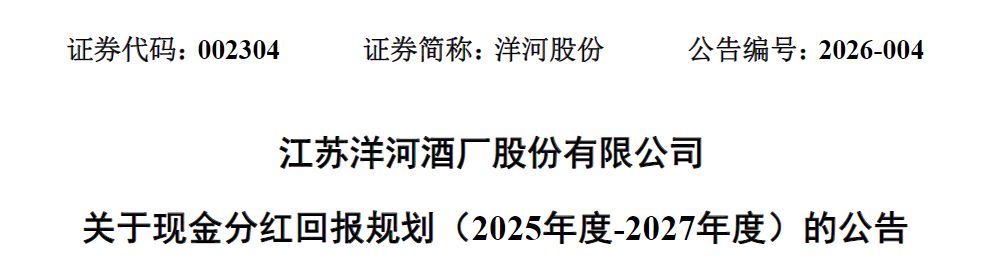
白酒龙头企业洋河股份(002304.SZ)的一纸公告掀起资本市场波澜。 截 1月23日晚,洋河股份发布《关于现金分红回报规划(2025年度-2027年度)的公告》称,2025年-2027年,公司每年度现金分红总额不低于当年实 现归属于上市公司股东净利润的100%。 表面上看,此举似将全部利润回馈股东,诚意十足;但细究之下投资者却发现,这一"升级版"分红方案,实则悄然取消了此前极具吸引力的关键 条款:每年不低于70亿元的分红金额保底承诺。 图来源:洋河股份2026年1月23日公告 截至2025年末,洋河股份股东户数达16万户,其中不乏因高股息预期而重仓配置的长期投资者。如今,分红"保险"被单方面撤回,不少投资者在 互动平台直言:为什么可以随意修改此前对投资者作出的分红承诺、承诺才一年就撕毁契约公司诚信何在? 来源:深交所互动易 回溯2024年1月,洋河股份曾高调发布2024年–2026年分红规划,明确承诺"每年现金分红比例不低于当年归母净利润的70%,且分红金额不低于70 亿元"。 截图 截图来源:洋河股份2024年8月29日公告 彼时,公司2023年归母净利润达100.16亿元,同比增长6.8%,"70亿元保 ...
明日登记 泸州老窖分红20亿元
Shang Hai Zheng Quan Bao· 2026-01-28 09:31
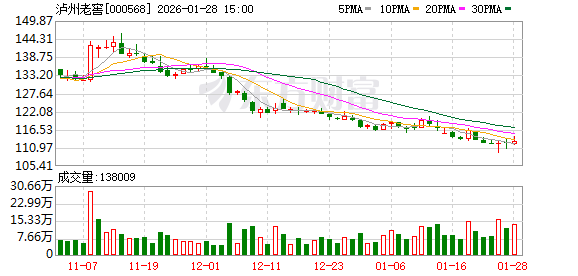
1月29日,泸州老窖将迎来约20亿元中期分红的股权登记日,除权除息日为1月30日。根据公司2025年中 期分配方案,将以总股本14.72亿股为基数,向全体股东每10股派发现金红利13.58元(含税)。 这并非个案。近期,贵州茅台、五粮液已实施完成2025年中期分红方案。中国酒业独立评论人肖竹青认 为,这不仅能提振市场信心、稳定股价,也起到了行业龙头示范效应,带动更多绩优公司把利润分给投 资者。 年分红不低于85亿元 根据泸州老窖2025年4月发布《2024-2026年度股东分红回报规划》,2024-2026年度,公司每年度现金 分红总额占当年归属于上市公司股东净利润的比例分别不低于65%、70%、75%,且均不低于85亿元。 原则上公司每年度可以进行两次现金分红。 2024年,泸州老窖已实施两次分红:三季报分红每10股派发现金红利13.58元(含税),合计约20亿 元;年度分红每10股派45.92元(含税),合计67.59亿元。全年累计派发现金红利达87.59亿元。 在白酒行业深度调整的背景下,头部酒企密集大手笔分红,引发市场关注。 "茅五泸"分红规划亮眼 近年来,"茅五泸"等头部白酒企业相继公布分红规划。 ...
白酒板块1月28日跌0.79%,*ST岩石领跌,主力资金净流出12.38亿元
Zheng Xing Xing Ye Ri Bao· 2026-01-28 08:58
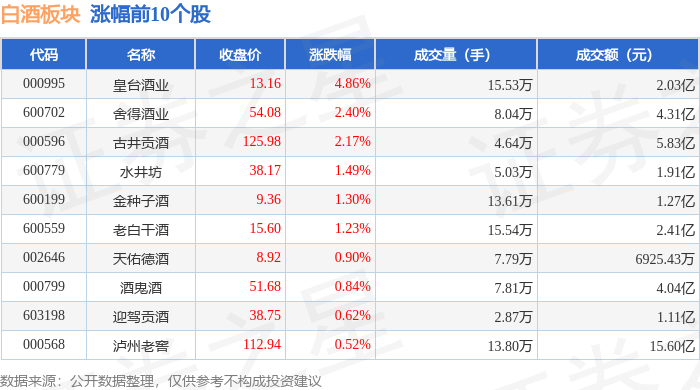
证券之星消息,1月28日白酒板块较上一交易日下跌0.79%,*ST岩石领跌。当日上证指数报收于 4151.24,上涨0.27%。深证成指报收于14342.9,上涨0.09%。白酒板块个股涨跌见下表: 从资金流向上来看,当日白酒板块主力资金净流出12.38亿元,游资资金净流入13.56亿元,散户资金净流 出1.18亿元。白酒板块个股资金流向见下表: | 代码 | 名称 | 主力净流入 (元) | 主力净占比 游资净流入 (元) | | 游资净占比 散户净流入(元) | | 散户净占比 | | --- | --- | --- | --- | --- | --- | --- | --- | | 000568 泸州老窖 | | 1.07 Z | 6.89% | -6686.18万 | -4.29% | -4056.45万 | -2.60% | | 600809 山西汾酒 | | 7464.03万 | 5.95% | 1.05亿 | 8.38% | -1.80亿 | -14.33% | | 000995 | 皇台酒业 | 2633.56万 | 12.95% | -253.88万 | -1.25% | -2379.67万 ...

为什么有的酒企能穿越周期持续增长,而你的却不能?丨争鸣
Sou Hu Cai Jing· 2026-01-28 08:16
Core Insights - Understanding the five stages of brand competition in the liquor industry is essential for companies aiming for long-term success, as it allows them to effectively allocate limited resources and maintain relevance in a changing market [2][3][4]. Group 1: Brand Competition Stages - The liquor industry's brand competition has evolved through five distinct stages, each representing a layer of capabilities that companies must develop to transition from survival to leadership [4][5]. - The five stages are: 1. Product Supremacy 2. Image Construction 3. Mindshare Occupation 4. User Relationship Competition 5. Value and Ecological Competition [5][6][7]. Group 2: Dynamic Matching of Brand and Revenue Stages - There is a dynamic relationship between brand development stages and revenue growth stages, where successful companies often have brand capabilities that are either ahead of or in sync with their revenue expansion [4][5]. - Companies that fail to align their brand capabilities with their growth stages risk falling into a "scale without profit" dilemma [4][5]. Group 3: Resource Allocation Models - A resource allocation model is proposed for different revenue stages, emphasizing the importance of focusing on product quality in the early stages and gradually shifting towards brand image and user relationships as companies grow [41][42][43]. - For companies with annual revenues below 50 million, 90% of resources should focus on product capabilities, while those with revenues between 10 billion and 50 billion should allocate 40% to product and 35% to user relationships [41][42]. Group 4: Theoretical Frameworks - The evolution of brand competition is supported by various marketing theories, including the Unique Selling Proposition (USP) theory, brand image theory, positioning theory, and brand loyalty theory, which provide frameworks for understanding consumer behavior and brand strategy [11][15][19][25]. - The current competitive landscape requires companies to build a brand ecosystem that resonates with consumers' values and social responsibilities, moving beyond mere profit motives [30][31][32]. Group 5: Strategic Implications - Companies must create a "brand capability configuration map" that aligns with their strategic goals and current market position, ensuring that resources are allocated effectively to navigate the complexities of competition [34][39]. - The transition from a product-focused approach to one that emphasizes brand mission and ecological systems is crucial for long-term sustainability and growth in the liquor industry [27][28][32].

价格体系稳中有升,渠道库存趋于健康,洋河再迎新周期机遇
Cai Jing Wang· 2026-01-28 08:06
Core Insights - The company is adapting to a new industry cycle with a focus on operational efficiency and lighter strategies, as indicated by the recovery in the white liquor market ahead of the Spring Festival [1] - The confidence in the company's strategy is backed by a series of solid and innovative efforts centered around the "four returns" concept [3] Product and Brand Strategy - The company has optimized its product system and brand value to maintain a steady growth trajectory, implementing a "dual famous liquor, multi-brand, multi-category" strategy that covers a full price range from mass to premium products [4] - New products have shown impressive performance, with the seventh generation of "Hai Zhi Lan" achieving nearly double-digit growth in opening rates, and high-end light bottle liquor selling out on the first day of pre-sale [7] Market Activation and Consumer Engagement - The company is focusing on building a consumer-centric brand system, combining traditional channel promotion with emotional resonance through innovative marketing strategies [8] - Recent consumer interaction activities themed "Su Xiang Yi Jia Qin" were conducted in Hunan, and the company is increasing terminal promotions and scenario marketing efforts for the upcoming Spring Festival [10] Pricing and Market Confidence - Prices of leading products like "Meng Zhi Lan M6+" and "Hai Zhi Lan" are steadily increasing as the Spring Festival approaches, reflecting distributor confidence in the brand's development [11] - Despite short-term performance pressures, the company's strategic adjustments are expected to support long-term operations and development, with major brokerage firms recognizing the company's long-term value [11]
洋河股份,谁教你这么分红的?
Sou Hu Cai Jing· 2026-01-28 04:15
作者:温蒂 编辑:马克 近日,洋河股份(002304.SZ)连发三则重磅公告,将自己推到了舆论的聚光灯下。 首先是人事变动。已经任职近11年的总裁钟雨因到龄退休辞职,由董事长顾宇接任总裁一职。 1964年5月出生的钟雨,是中国酿酒大师、高级工程师,兼具技术与管理双重背景。其掌舵的10多年期 间,见证了洋河攀登到行业巅峰的辉煌时刻,也经历了增长的停滞与业绩下滑的困境。其退休辞职,也 标志着洋河一个时代的结束。 其次是业绩预告。预计2025年归母净利润21.16亿元至25.24亿元,同比暴跌62.18%至68.30%,直接倒退 15年回到2010年的水平。 公司将业绩下滑归因于行业深度调整,但这显然难以用行业因素一言蔽之,毕竟大家都面临同样的问 题,为什么洋河股份就掉队掉得更快。 此外还修改了分红规划。将现金分红率由原本的70%提高到不低于100%,但放弃了此前承诺的年度分 红不低于70亿元的目标。 看起来,比例提高了,但因为净利润大降,取消不低于70亿元的限制后,分红的净额也大幅缩水。 01 分红大幅缩水为哪般? 洋河股份的业绩滑坡,不是从2025年开始的。早在2023年,洋河股份的营收还达到营业收入331.2 ...
A股超500家公司年报预亏
Xin Lang Cai Jing· 2026-01-28 04:02
Group 1 - A significant number of A-share companies are reporting losses, with over 500 companies expected to post losses for 2025, reflecting a shift in the market where loss-making companies are disclosing their financials earlier than usual [1][3][22] - The real estate and construction sectors are particularly affected, with companies like Huaxia Happiness expected to report losses between 16 billion to 24 billion yuan, making it the "loss king" [4][24] - The overall performance of A-share companies is under pressure, with 709 out of 1165 companies reporting declining performance, which is approximately 60% [1][22] Group 2 - The trend of loss-making companies disclosing their financials is seen as a sign of market rationalization, with companies aiming to manage expectations and release financial pressures [2][21] - The solar energy sector is facing significant challenges, with leading companies like Tongwei Co. and Longi Green Energy expected to report substantial losses due to overcapacity and price competition [6][24] - The real estate sector is also experiencing widespread losses, with over 30 A-share real estate companies reporting poor performance, and only a few showing positive results [7][25] Group 3 - Companies like Zhichun Technology and Siyuanjie are facing severe stock price declines following their loss announcements, indicating investor reactions to poor financial forecasts [12][30] - The overall market sentiment is expected to be negatively impacted in the short term due to the concentration of negative financial disclosures, but this could lead to improved market pricing efficiency in the long run [15][32] - The performance of A-share companies is anticipated to show a "total pressure, structural brilliance" pattern, with traditional industries like real estate and solar energy under significant strain [16][33][34]