
现代牧业

Search documents
现代牧业(01117) - 致非登记股东之通知信函及回条 - 中期报告之发佈通知
2025-09-25 08:36
(Incorporated in the Cayman Islands with limited liability (Stock Code 股份代號: 1117) Dear non-registered shareholder(s), China Modern Dairy Holdings Ltd. (the "Company") – Notice of Availability - Notice of publication of 2025 Interim Report (the "Current Corporate Communication") The English and Chinese versions of the Company's Current Corporate Communication are now available on the Company's website at www.moderndairyir.com and the HKEXnews website at www.hkexnews.hk. You may access the Current Corporate ...
现代牧业(01117) - 致登记股东之通知信函及回条 - 中期报告之发佈通知
2025-09-25 08:34
China Modern Dairy Holdings Ltd. 中國現代牧業控股有限公司 (於開曼群島註冊成立之有限公司) For the registered shareholders who have selected to receive the Company's Corporate Communications (the "Corporate Communications") (Note 1) in printed version, enclosed is the Current Corporate Communication in your selected language. If you have any difficulty in receiving or gaining access to the Current Corporate Communication posted on the Company's website for any reason or wish to receive the Current Corporate Communication in printed fo ...
现代牧业(01117) - 2025 - 中期财报
2025-09-25 08:31
2025 Interim Report 中期報告 INTERIM REPORT 2025 中期報告 CORPORATE PROFILE 公司簡介 China Modern Dairy Holdings Ltd. (the "Company" or "Modern Dairy", stock code: 1117), together with its subsidiaries (the "Group"), is a leading dairy farming operator and raw milk producer in the industry in the People's Republic of China (the "PRC"). We invest in and operate 47 farm companies in Chinese Mainland, spanning 13 provinces and autonomous regions, with approximately 472,000 dairy cows being raised by the end of the current ...
肉牛:大周期、大周期、大周期
2025-09-24 09:35
Summary of the Conference Call on the Beef Cattle Industry Industry Overview - The beef cattle industry is experiencing significant capacity reduction due to deep losses in 2024, leading to the culling of young and pregnant cows. The trend of capacity reduction is expected to continue into 2025, albeit at a slower pace. The southern regions have seen an 8% decline in cow inventory, with some areas experiencing reductions of up to 30% [1][2][3] - The supply of calves has noticeably decreased, with calf prices doubling at the beginning of 2025, indicating a future tightening of beef supply [1][2] Key Supporting Factors for the Beef Cattle Cycle 1. **Capacity Reduction**: The domestic beef cattle farming industry has faced supply shocks, leading to the culling of inefficient cows and the introduction of new breeding stock. The trend of culling continues into 2025, with calf supply significantly reduced [2][3] 2. **Global Price Transmission**: Major beef-producing countries like the US, Brazil, and Australia have also undergone capacity reductions. The CME live cattle futures price has doubled since 2020, and this global price increase is transmitted to the domestic market, supporting domestic beef prices [2][3] 3. **Policy Support**: The Chinese government is implementing measures to protect domestic farming, including an investigation into import safeguards that has affected import volumes, allowing the domestic market time to adjust [3] Market Conditions for 2025 and Beyond - In 2025, there will be a shortage of calves but an adequate supply of fattened cattle and finished meat. The impact of previous capacity reductions has not fully materialized, leading to a continued influx of cow meat into the market [4] - The price uptrend is expected to officially begin in 2026, with prices anticipated to rise significantly due to the effects of the severe capacity reduction in 2024, continuing through 2027 and possibly into 2028 [4] Characteristics of the Beef Cattle Industry Chain - The beef cattle industry chain includes upstream feed, midstream fattening and slaughter, and downstream consumption. Feed costs account for 50%-70% of farming costs, with a long growth cycle and low breeding efficiency [5] - The industry is characterized by low concentration, with the top 50 companies holding a small share of total inventory [5] Global and Domestic Meat Trade Dynamics - The top ten beef-producing countries account for 87% of global production, with the US being the largest producer at over 12 million tons. China produces around 8 million tons but still imports approximately 2.8 million tons, primarily from South America [6] - China's demand significantly influences global trade structures, with Brazil being the largest supplier, followed by Argentina and Australia [6] Cost Disparities in Beef Cattle Farming - Domestic beef cattle farming costs are significantly higher than in Brazil due to factors such as scarce pasture resources and high feed and labor costs. Domestic costs range from 10,000 to 20,000 yuan, while Brazilian costs are between 5,000 to 8,000 yuan [8] - The low level of industrialization and efficiency in domestic beef production contributes to these high costs [7][8] Historical Price Trends - Since 2000, domestic beef prices have generally trended upward, with a notable decline in 2023 due to increased supply and reduced consumption growth. This marked the first historical price drop, with inventory levels declining for two consecutive years [9] Current and Future Supply-Demand Situation - Domestic per capita beef consumption remains low compared to countries like Japan and South Korea, indicating significant growth potential. The consumption of high-quality beef is growing faster than that of regular beef, with premium varieties seeing growth rates of up to 30% [10] Investment Opportunities - The current phase represents a critical price turning point in the Chinese beef cattle market. Companies such as YouRan MuYe, China Shengmu, and Modern Farming are recommended for investment due to their ability to generate cash flow through the culling of dairy cows and their growth potential in the beef market [11][12]
食品饮料里的周期股vs成长股比较
2025-09-24 09:35
食品饮料里的周期股 vs 成长股比较 20250923 摘要 细分赛道竞争格局良好或对手表现较弱,为相关企业带来增长机会,需 关注收入和利润双位数增长趋势,如妙可蓝多、重庆啤酒、银价和东鹏 等案例,在景气上行期实现显著收益。 成长股定价逻辑基于增长空间,复合增速或大单品增速决定估值水平。 例如,30%-50%的大单品增速对应约 30 倍估值,15%-20%的收入增 速且利润双位数增长也对应约 30 倍估值,PEG 估值可作为参考。 成长股预期回报通常以至少翻倍为目标,买入时点至关重要,景气周期 较短。风险管理核心在于选股,组织能力、品类成长趋势和竞争格局是 关键,业绩验证阶段风险降低,此类股票受公募基金青睐。 食品饮料板块存在周期股,如白酒、康师傅、万洲国际和现代牧业,具 有强周期性,可通过理性研究左侧判断买入节点,不要求高增长,但利 润率改善确定性强,价格较好时应大胆买入。 食品饮料周期股特点包括周期规律明确、产业成熟期孕育龙头、分红较 高,受保险资金和外资偏爱。风险管理重点在于周期高点的判断,买入 时点相对容易把握,判断准确应早期重仓。 成长股预期回报通常按照至少翻倍收益来评估,因此买入时间点非常重要,因 ...
天风证券:牛周期演绎时间长&扰动因素少 当前肉牛价格进入上行通道
Zhi Tong Cai Jing· 2025-09-24 08:52
Core Viewpoint - The dairy and beef industries are experiencing significant changes, with dairy prices under pressure and beef prices entering an upward trend, indicating potential investment opportunities in the sector. Dairy Sector - Supply contraction in the dairy sector may be nearing its end, with approximately 8% of dairy cow capacity having been reduced as of August 2025, following four years of declining milk prices and 1.5 years of industry losses [1] - The upcoming third quarter's silage feed procurement season is expected to increase funding demands, potentially accelerating the reduction of dairy farm inventories [1] - The tight supply-demand balance, driven by reduced production capacity and seasonal consumption peaks, is likely to support a rebound in milk prices [2] Beef Sector - The domestic beef production capacity has been thoroughly cleared, with the current loss cycle exceeding 600 days and an average loss of 725 yuan per head, leading to a significant reduction in breeding cows [3] - External factors affecting beef supply are diminishing, with adverse conditions in major foreign production areas contributing to a long-term global beef supply gap [3] - The combination of reduced domestic beef supply and limited imports is expected to lead to a contraction in beef supply by the second half of 2025, indicating a potential super cycle in beef prices [3] Specific Companies - In the beef sector, companies such as China Shengmu, Guangming Meat Industry, and Fucheng Co. are recommended for investment due to the anticipated reduction in beef supply [4] - In the dairy sector, companies like Youran Dairy, China Shengmu, Modern Dairy, Aoya Group, and Tianrun Dairy are suggested for monitoring as the industry approaches a potential price rebound [4]

二十四节气看蒙牛丨秋分走进现代牧业乌兰布和一牧看青贮好“丰”景
Zhong Guo Jing Ji Wang· 2025-09-23 07:19
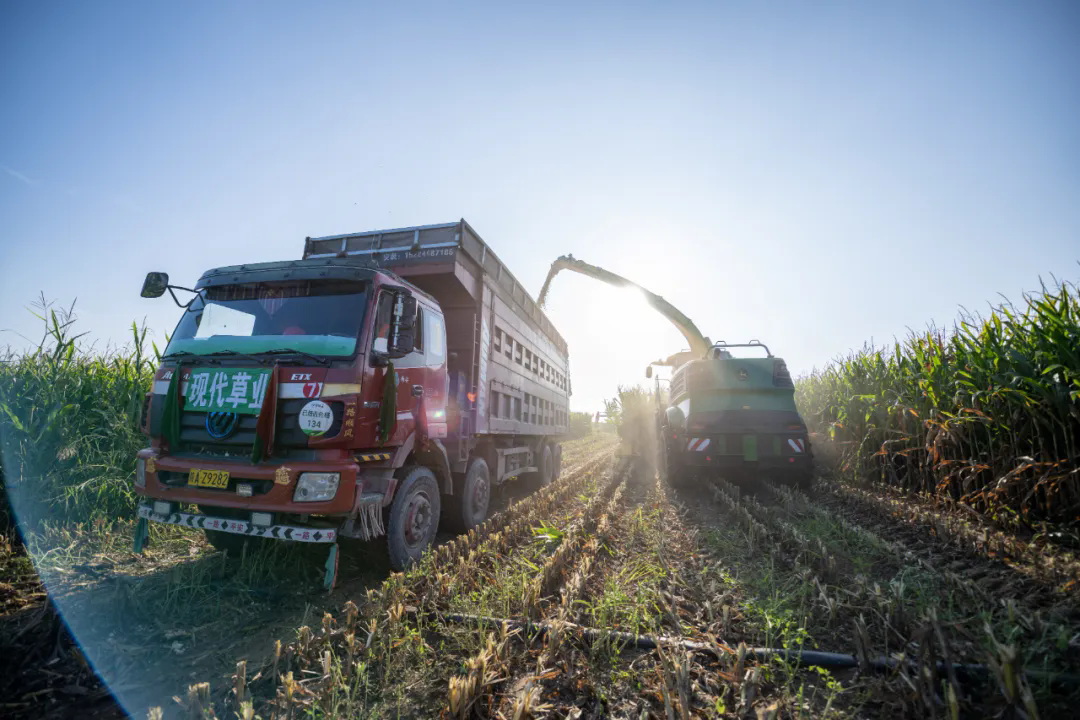
Core Insights - The article highlights the significance of the autumn equinox in the context of modern dairy farming, particularly focusing on the "silage battle" at the Ulan Buh and Yim牧 farm, which is crucial for preparing high-quality feed for dairy cattle [1][10]. Group 1: Silage Production Process - The autumn equinox marks the optimal period for silage production, with the farm harvesting whole corn with a starch content of 33% and moisture content controlled at 67% [3]. - The harvesting process involves cutting and crushing the corn into 2 cm pieces, which are then transported to silage storage [3][5]. - After transportation, the silage is compacted and sealed to ensure proper fermentation, which is essential for preserving the quality of the feed [8][10]. Group 2: Environmental and Agricultural Advantages - The farm benefits from significant environmental factors, including a large temperature difference between day and night, abundant sunlight (averaging 3000 hours annually), and fertile soil from the Yellow River alluvium, which contribute to the growth of high-quality forage [1]. - The natural ecological barriers, such as desert isolation, further enhance the farm's ability to produce organic feed that meets EU standards [1]. Group 3: Quality Assurance and Future Outlook - Quality control measures are in place, with professional equipment used to ensure the harvested silage meets the required standards before being stored [5]. - The fermentation process in the silage pits is expected to yield high-quality organic milk, reflecting the farm's commitment to sustainable practices and the integration of natural resources with human expertise [10].

牛专题深度:肉牛超级大周期、奶牛去化:进展到哪儿?
Tianfeng Securities· 2025-09-23 07:14
Industry Rating - The industry rating is maintained at "Outperform the Market" [2] Core Insights - The dairy sector is experiencing a significant supply contraction, with the potential end of capacity reduction in sight. The milk price has been declining for four years, leading to an industry loss for 1.5 years, resulting in an approximate 8% reduction in dairy cow capacity as of August 2025. The upcoming third-quarter silage feed procurement season may accelerate the clearing of livestock due to increased funding needs [4][27] - The beef sector is at a turning point in a super cycle, with domestic beef cattle capacity being fully cleared. The prolonged loss cycle has driven a deep reduction in breeding cows, which is expected to lead to a decline in beef cattle inventory starting in 2024. The supply of beef is anticipated to enter a contraction phase in the second half of 2025 [5][50] Summary by Sections Dairy Sector - Supply contraction is nearing its end, with milk prices expected to rebound due to a tightening supply-demand balance. The reduction in capacity is expected to stabilize by the end of 2025 or the first half of 2026, supported by seasonal demand during the upcoming holidays and long-term improvements in consumption driven by child-rearing subsidies [4][27] - The financial performance of dairy companies varies, with some showing resilience against falling milk prices due to unique business advantages, while others face significant pressure [6] - The dairy industry is characterized by a longer production cycle compared to other livestock, leading to a more prolonged adjustment period in capacity [6][27] Beef Sector - The beef cattle market is experiencing a super cycle, with a significant reduction in domestic beef cattle capacity. The prolonged loss cycle has led to a decrease in breeding cows, which will impact beef supply in the coming years [5][50] - External factors affecting beef supply are diminishing, with a long-term global beef supply gap emerging due to various pressures on major production areas [5] - The demand for beef is expected to grow steadily, driven by rising income levels and health consciousness among consumers, with a notable reliance on imported beef to meet domestic demand [50][51] Investment Recommendations - The report suggests focusing on companies that are well-positioned to benefit from the anticipated recovery in both the dairy and beef sectors. Specific companies to watch include China Shengmu, Guangming Meat Industry, and Fucheng Co., for beef, and Yuran Dairy, China Shengmu, and Modern Dairy for dairy [6][7]


牧业:肉奶共振,弹性可期
2025-09-18 14:41
Summary of the Conference Call on the Dairy Industry Industry Overview - The dairy sector is experiencing a rebound due to a decrease in feed costs, with companies like YouRan, New South Wood, and Gongji Dairy reporting a 10% year-on-year decline in sales costs, which has helped offset the impact of falling prices per ton. The gross profit margin for raw milk has increased by nearly 2 percentage points [1][4]. Key Points and Arguments - **YouRan Dairy Performance**: In the first half of 2025, YouRan's raw milk revenue grew approximately 8% to 8 billion yuan, driven by increased sales volume and the launch of three new farms. Sales costs decreased by 10%, and feed costs fell by 12%, leading to a gross margin increase of 2.4 percentage points. The reduction of heifer stock and an increase in the proportion of breeding cows also contributed to profit growth [1][5]. - **Modern Dairy Performance**: Modern Dairy has reduced its stock by about 20,000 heads to 18,700 heads by eliminating inefficient cows. Raw milk revenue remained stable at around 5 billion yuan, but the average selling price fell by 10% year-on-year. The solutions business revenue dropped by 23%. Despite a 23% increase in operating cash flow, net profit attributable to shareholders decreased due to biological asset losses [1][6][7]. - **Milk Price Trends**: In early September, milk prices slightly rebounded, ending a downward trend since April, indicating that demand is not as weak as expected. If milk prices stabilize in the fourth quarter, demand may stabilize next year. However, a significant reduction in breeding cow stock is anticipated due to mass culling, which may lead to a supply gap [1][8][10]. - **Supply and Demand Dynamics**: The dairy sector's stock structure has improved, with the proportion of breeding cows increasing by 2.3 percentage points to 53%. Major dairy companies have accelerated stock reduction, with Modern Dairy's heifer stock decreasing by over 20,000 heads [2][9]. - **Impact of Feed Prices**: The price of silage is expected to remain stable or slightly increase, which will affect overall milk prices. Unlike last year, silage prices have not further declined, which may impact the profitability of dairy farmers [12]. - **Meat Cycle Influence**: The meat cycle plays a crucial role, with companies like YouRan and Modern Dairy culling about 30% of their breeding cows annually. The income from culling has nearly doubled in the first half of 2025. The domestic beef supply gap is expected to continue until 2027 due to various market pressures [13]. - **International Market and Policy Changes**: The international market is seeing a decline in production from major exporters like Brazil and New Zealand due to drought and rising costs. Domestic policies are also tightening import regulations, which will increase transportation costs and affect the supply chain [14]. - **Profitability Outlook**: The reversal in milk prices and reduction in unit costs are expected to significantly enhance the profitability of dairy companies. If raw milk prices rebound and unit costs remain stable, leading companies could see gross margins improve by up to 10 percentage points [15]. Additional Important Insights - **Future Trends in Dairy Industry**: The current rebound in milk prices suggests better-than-expected demand. The supply side is also expected to perform well, with significant culling and replenishment of breeding cows. Valuation metrics indicate strong potential for profitability and growth in the dairy sector, with historical price-to-book ratios suggesting room for upward movement [16].
农业板块2025半年报业绩综述:拨云见日
ZHESHANG SECURITIES· 2025-09-15 13:48
Investment Rating - The industry investment rating is "Positive" [3] Core Viewpoints - The report highlights that the agricultural sector is experiencing a recovery, with specific segments such as the pig and beef industries showing signs of improvement. Cost reduction and efficiency enhancement are key drivers for performance improvement in the pig sector, while the beef sector is witnessing a rebound from a cyclical low [6][7][47]. Summary by Sections 1. Pig Industry - The pig sector has shown significant improvement in performance, with 15 listed pig companies achieving a revenue of 196.98 billion yuan in the first half of 2025, a year-on-year increase of 19%. The net profit attributable to shareholders reached 16.33 billion yuan, up 625% year-on-year [9]. - The average pig price has been under pressure, dropping to a low of 13.96 yuan/kg in June 2025. However, leading companies like Muyuan and Wens continue to maintain high profitability per head due to their efficiency advantages [15][42]. - Recommendations include focusing on low-cost, high-certainty leaders such as Muyuan and Wens, as well as high-growth small pig companies like Shennong Group and Juxing Agriculture [7][43]. 2. Beef Industry - The beef sector is experiencing a cyclical recovery, with live cattle prices increasing significantly since mid-February 2025. As of September 8, 2025, the prices for fattened bulls, calves, and cull cows have risen by 2.39, 8.33, and 3.18 yuan/kg respectively [47]. - The report notes that the overall beef market is supported by a trend towards protein upgrading, which is expected to continue despite economic fluctuations [57]. 3. Animal Health Sector - The animal health sector is stabilizing, with a focus on the development of pet business. The rapid release of pet vaccines is anticipated to enhance valuations across companies [7]. 4. Seed Industry - The seed market is shifting from quantity to quality competition, with a focus on superior varieties as the core competitiveness of seed companies. The report emphasizes the importance of resource integration and mergers in the seed industry [7]. Companies with strong variety reserves, such as Dabeinong and Longping High-Tech, are expected to benefit [7].