DeepMind

Search documents
腾讯研究院AI速递 20250828
腾讯研究院· 2025-08-27 16:01
Group 1 - Nvidia's NVFP4 format enables 4-bit precision to achieve 16-bit training accuracy, potentially transforming LLM development with a 7x performance improvement on the Blackwell Ultra compared to the Hopper architecture [1] - NVFP4 addresses issues of dynamic range, gradient volatility, and numerical stability in low-precision training through techniques like micro-block scaling and E4M3 high-precision block encoding [1] - Nvidia collaborates with AWS, Google Cloud, and OpenAI, demonstrating NVFP4's ability to achieve stable convergence at trillion-token scales while significantly reducing computational and energy costs [1] Group 2 - Google's Gemini 2.5 Flash image generation model offers state-of-the-art capabilities at a cost of approximately 0.28 yuan (0.039 USD) per image, making it 95% cheaper than OpenAI [2] - The model supports 32k context and excels in image editing, ranking first in the Artificial Analysis leaderboard for image editing [2] Group 3 - Anthropic's Claude for Chrome browser extension assists users with tasks like scheduling and email management while maintaining browser context [3] - The extension is currently in testing for 1,000 Max plan users, focusing on security against "prompt injection attacks" [3] Group 4 - PixVerse V5 video generation model significantly enhances generation speed, producing 360p clips in 5 seconds and 1080p videos in 1 minute, reducing time and cost for AI video creation [4] - The new version improves dynamics, clarity, consistency, and instruction comprehension, providing results closer to real filming [4] Group 5 - DeepMind's PH-LLM health language model converts wearable device data into personalized health recommendations, outperforming doctors in sleep medicine exams [6] - The model utilizes a two-stage training process for fine-tuning in sleep and health domains, generating highly personalized suggestions based on sensor data [6] Group 6 - Stanford's report indicates that AI exposure has significantly impacted employment growth for young workers in the U.S., particularly those aged 22-25 in high AI exposure jobs [9] - The study suggests that AI's impact on employment is contingent on whether it replaces or enhances human capabilities, with a noted 13% relative employment decline for young workers in high AI exposure roles [9]



Meta万引强化学习大佬跑路,用小扎原话作为离别寄语,扎心了
3 6 Ke· 2025-08-27 06:48
Core Viewpoint - The departure of Rishabh Agarwal from Meta has raised concerns about employee retention and morale within the company, especially as he was a key figure in the reinforcement learning domain and had made significant contributions during his tenure [1][3][15]. Group 1: Rishabh Agarwal's Background and Contributions - Rishabh Agarwal has a strong academic and professional background in reinforcement learning, with over 10,000 citations of his work and an h-index of 34 [5][6]. - He was involved in the development of significant models such as Gemini 1.5 and Gemma 2 during his time at Google and later at Meta [3][11]. - His paper "Deep Reinforcement Learning at the Edge of the Statistical Precipice" won the NeurIPS Outstanding Paper Award in 2021, highlighting his expertise in the field [11][13]. Group 2: Implications of His Departure - Agarwal's exit is seen as part of a broader trend of experienced employees leaving Meta, which may be linked to internal conflicts over compensation disparities between new hires and long-term staff [15][17]. - The departure of Agarwal and other senior employees could impact Meta's research capabilities and innovation in artificial intelligence [1][15]. - There are speculations that Agarwal may pursue entrepreneurial ventures, indicating a potential shift in the competitive landscape of AI research [14]. Group 3: Company Culture and Employee Morale - The recruitment drive at Meta has reportedly created friction among employees, leading to threats of resignation from some researchers [17]. - The situation reflects a challenging environment for Meta as it attempts to balance attracting new talent while retaining its existing workforce [17].

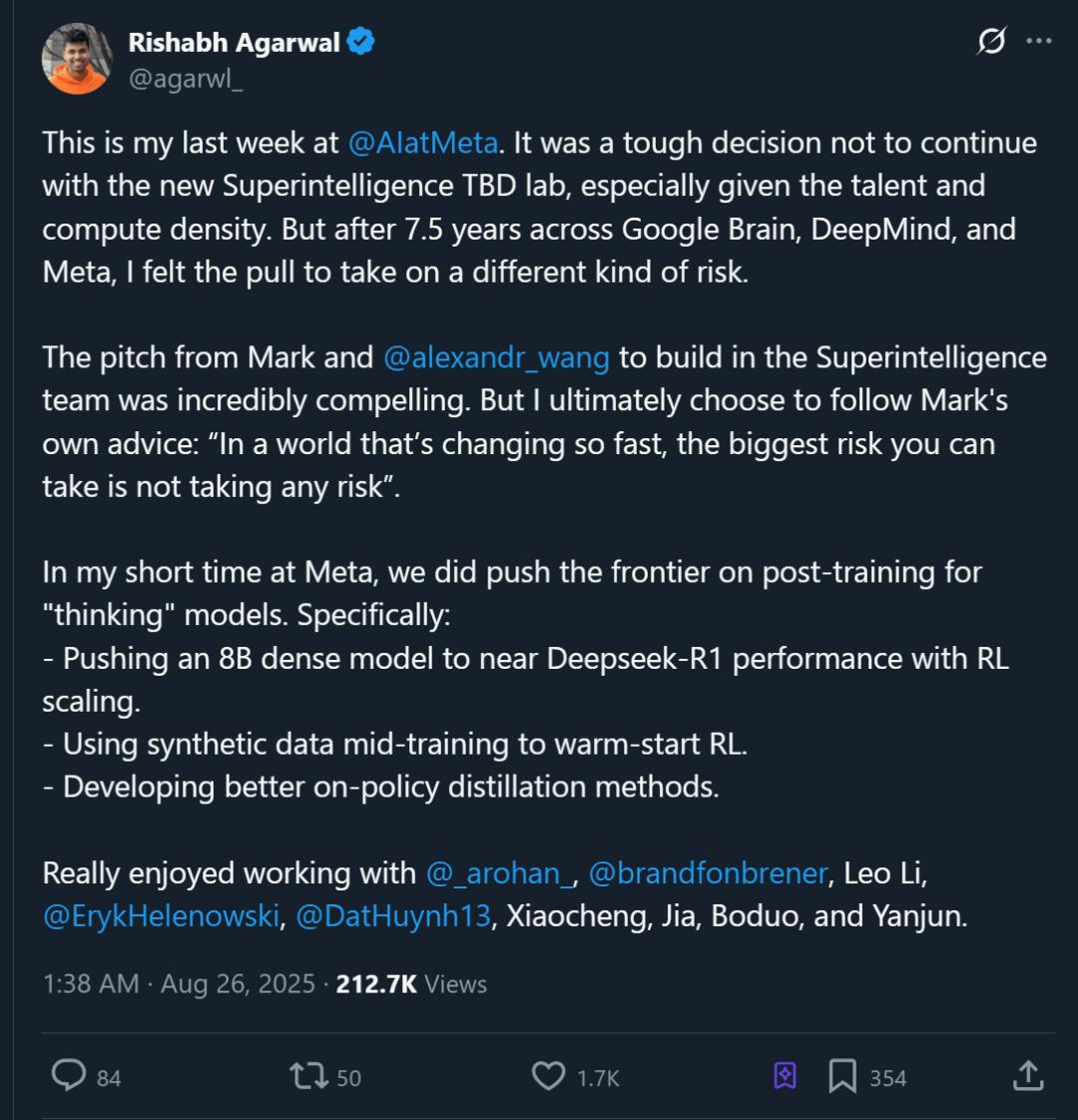
可协作、可部署、可复制,节卡具身家族正在打通工厂柔性协作的“最后一米”
机器人大讲堂· 2025-08-26 11:56
2024 年 8 月 9 日 , 麻 省 理 工 《 技 术 评 论 MIT Technology Review 》 期 刊 的 一 篇 文 章 , 报 道 了 谷 歌 旗 下 DeepMind公司最新研发的 一款 "乒乓机器人"。该机器人以ABB机器人为载体,实现了对于乒乓球的接发球 以及与人类的对抗性 功能 。这个挥舞着 3D打印球拍的机械臂, 最终 在与人类玩家的模拟比赛中,赢得了 29场比赛中的13场(胜率44%),成为首个能够达到人类"业余乒乓选手"技术水平的学习型机器人智能体。 乒乓球有别于国际象棋、围棋等纯战略游戏,这项高难度任务背后的技术挑战非常多,例如其对运动员体力、 实时的决策能力、比赛时快速的眼手协调和高层次策略等要求都很高,需要人类运动员经过多年的训练才能达 到高级水平,因此, 乒乓球机器人也成为了检验机器人综合能力的又一重要标尺,是具身智能技术落地能力 的评估缩影。 据悉,除了乒乓球大赛,节卡机 器人还曾举办 JAKA Lumi杯具身智能大赛 ,参与长三角具身智能大赛并获 奖,在这类瞄准更通用的应用能力的具身智能大赛中证明了其产品实力以及创新力,节卡机器人多次参与各类 赛事,正是将其 ...
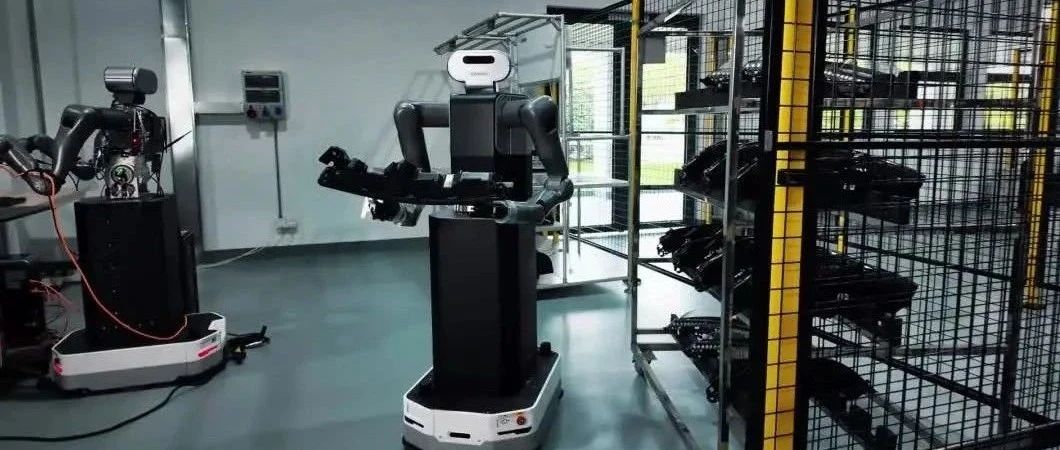
Meta万引强化学习大佬跑路!用小扎原话作为离别寄语,扎心了
量子位· 2025-08-26 04:36
Core Viewpoint - The departure of Rishabh Agarwal from Meta highlights a potential trend of employee attrition within the company, raising concerns about internal conflicts and employee satisfaction amidst a hiring spree [1][22][24]. Group 1: Rishabh Agarwal's Departure - Rishabh Agarwal, a prominent figure in reinforcement learning at Meta, is leaving the company after 7.5 years, expressing a desire to explore a completely different path [1][17]. - His contributions include significant work on models like Gemini 1.5 and Gemma 2, and he received the Outstanding Paper Award at NeurIPS in 2021 for his research on statistical instability in deep reinforcement learning [4][14][13]. - Agarwal's next steps remain uncertain, but speculation suggests he may venture into entrepreneurship [17]. Group 2: Employee Turnover at Meta - Agarwal's exit is part of a broader trend, as another long-term employee with 12 years at Meta also announced their departure, joining a competing firm, Anthropic [18][19]. - Reports indicate that tensions between new and old employees regarding salary disparities have led to dissatisfaction, prompting some researchers to threaten resignation [23][24]. - The current hiring surge at Meta may be exacerbating internal conflicts, contributing to the trend of experienced employees leaving the company [22][24].
最高提效8倍,腾讯游戏发布专业游戏AI大模型,美术师做动画不用辣么“肝”了
3 6 Ke· 2025-08-26 01:52
Core Insights - The article highlights the significant advancements in AI technology within the gaming industry, particularly showcased at the recent Devcom developer conference alongside the Cologne International Game Show. Major companies like Microsoft, Tencent, Google, and Meta presented over 20 discussions focused on how AI can enhance game art production efficiency and integrate seamlessly with traditional workflows [1][3]. Group 1: AI Tools and Solutions - Tencent Games launched its AI-driven comprehensive game creation solution, VISVISE, which includes tools for animation production, model creation, digital asset management, and intelligent NPCs, aimed at alleviating the repetitive and labor-intensive tasks in game art development [3][8]. - The MotionBlink tool within VISVISE can automatically complete animation sequences based on minimal user input, significantly reducing the time required for animation production from several days to just seconds [3][15]. - The GoSkinning tool, part of VISVISE, automates the skinning process for 3D models, improving efficiency by up to 60% in animation skinning tasks, and has been successfully implemented in popular games like "PUBG Mobile" and "Peacekeeper Elite" [8][24]. Group 2: Challenges in Game Art Production - Traditional game art production consumes 50%-60% of time on asset creation, with 3D modeling and animation being the most labor-intensive processes. The complexity of these tasks often leads to inefficiencies, particularly in skinning and animation adjustments [9][10]. - The article discusses the limitations of traditional methods such as manual keyframing and motion capture, which can be time-consuming and require extensive corrections, highlighting the need for AI solutions to streamline these processes [10][11]. Group 3: Development and Future of AI in Gaming - Tencent's approach to developing VISVISE was driven by actual development needs, beginning its exploration of AI in gaming as early as 2016. The system was officially launched in 2024, integrating various AI tools tailored to different aspects of game creation [24][26]. - The future of AI in gaming is seen as a critical area for development, with the potential for AI to enhance NPC interactions and create more immersive gaming experiences. The relationship between gaming and AI is described as symbiotic, with games serving as both a testing ground and a catalyst for AI advancements [29][30][32].

月薪2.8万刀华裔工程师盗密投奔OPPO?美国硅谷陷窃密风暴
凤凰网财经· 2025-08-25 10:50
Core Viewpoint - The article discusses the ongoing talent war in Silicon Valley, particularly focusing on Apple's allegations against OPPO for poaching a key engineer and stealing trade secrets related to health sensor technology [3][4][7][8]. Group 1: Talent War in Silicon Valley - The competition for AI talent has intensified in Silicon Valley, with major companies like Apple, Meta, and Microsoft aggressively recruiting top engineers [3]. - Apple's AI team has seen significant turnover, with core members leaving for competitors, highlighting the fierce battle for skilled professionals in the tech industry [3]. Group 2: Allegations Against OPPO - Apple has filed a lawsuit against OPPO, accusing the company of enticing former Apple Watch sensor architect Chen Shi to steal trade secrets before his departure [4][12]. - Chen Shi allegedly downloaded 63 confidential documents related to health monitoring technologies just before leaving Apple, which Apple claims constitutes systematic theft of trade secrets [9][14][19]. Group 3: Legal Proceedings and Evidence - The lawsuit includes evidence of Chen Shi's communications with OPPO executives, indicating premeditated plans to share proprietary information [18]. - Apple is seeking an injunction to prevent Chen Shi and OPPO from using its confidential health sensor technology in their products, arguing that such actions would undermine Apple's innovation and competitive edge [20][25]. Group 4: Industry Context and Implications - The case reflects broader concerns in the tech industry regarding the protection of trade secrets and the implications of employee mobility on competitive dynamics [31][32]. - Recent high-profile legal disputes over trade secrets in the tech sector have raised awareness about the need for robust protections against corporate espionage [31][36].

OpenAI头号叛徒,竟然是自学的AI???
量子位· 2025-08-22 02:30
Core Viewpoint - The article discusses the journey of Tom Brown, co-founder of Anthropic, who transitioned from a self-taught AI enthusiast to a key player in the AI industry, challenging his former employer, OpenAI, with the success of their model, Claude 3.5 Sonnet [1][2][16]. Group 1: Tom Brown's Journey - Tom Brown initially struggled academically, particularly in linear algebra, but decided to self-study AI after leaving his job [2][35]. - He developed a structured self-learning plan over six months, which included online courses and practical projects, leading to his eventual entry into OpenAI [36][38]. - Brown played a significant role in the development of GPT-3 at OpenAI, focusing on scaling and model architecture improvements [41][45]. Group 2: Anthropic's Competitive Position - Anthropic, founded by former OpenAI employees, has gained significant market share, now holding 32% of the market, particularly excelling in programming capabilities [17][20]. - The release of Claude 3.5 Sonnet marked a turning point for Anthropic, allowing it to compete directly with OpenAI's offerings [16][13]. - Recent developments include the expansion of Claude's context window to 1 million tokens, directly challenging OpenAI's GPT-5 [25][24]. Group 3: Industry Dynamics - The competitive landscape between Anthropic and OpenAI has intensified, with both companies rapidly releasing new models and features [24][26]. - OpenAI's market share has declined by 25%, while Anthropic has positioned itself as a leader in certain AI applications [17][20]. - The article highlights the strategic moves made by both companies, including API access restrictions and model upgrades, indicating a fierce rivalry [21][22][24]. Group 4: Career Advice from Tom Brown - Tom Brown offers five key career tips for aspiring professionals: prioritize networking, seek mentorship, demonstrate value, engage in hands-on experience, and embrace risk-taking [48].

X @Demis Hassabis
Demis Hassabis· 2025-08-22 01:05
AI Development - Google DeepMind 发布 Genie 3,能够通过文本生成交互式 3D 世界 [1] - 用户可以使用键盘导航并进行实时互动 [1] - AI 技术在生成可交互 3D 环境方面取得突破性进展 [1] Potential Applications - Genie 3 能够导航至车辆并打开车门,展示了其在现实世界互动方面的潜力 [1]
X @Demis Hassabis
Demis Hassabis· 2025-08-22 01:05
AI Development & Application - Google DeepMind's Sima agent is trained in environments generated by Genie 3 [1] - Genie 3 responds to the actions taken by SIMA, creating an AI interaction within another AI's simulated world [1] - The system involves an AI playing within the "mind" of another AI [1] Technology & Innovation - Genie 3 is used to create virtual worlds for training AI agents [1] - Sima agent follows instructions within a world generated by Genie 3 [1]
从“内部世界”到虚拟造物:世界模型的前世今生
经济观察报· 2025-08-21 12:29
Core Viewpoint - The article discusses the significant advancements brought by Google's DeepMind with the release of Genie 3, which showcases a new path towards Artificial General Intelligence (AGI) through the concept of "World Models" [4][5][6]. Group 1: Introduction of Genie 3 - On August 5, Google DeepMind launched Genie 3, a model capable of generating interactive 3D virtual environments based on user prompts, demonstrating enhanced real-time interaction capabilities compared to previous AI models [5]. - Genie 3 features a "Promptable World Events" function, allowing users to dynamically alter the generated environment through text commands, showcasing its advanced interactivity [5]. Group 2: Concept of World Models - World Models are inspired by the human brain's ability to create and utilize an "inner world" to simulate future scenarios, which is crucial for decision-making and action [8][9]. - The development of World Models has evolved from early attempts to mimic human cognitive functions to more sophisticated models that can predict and simulate real-world dynamics [10][11]. Group 3: Technical Implementation of World Models - The implementation of World Models involves several key stages: Representation Learning, Dynamic Modelling, Control and Planning, and Result Output, each contributing to the AI's ability to understand and interact with the world [15][16][17][18]. - Representation Learning allows AI to compress external data into an internal language, while Dynamic Modelling enables the simulation of future scenarios based on actions taken [15][16]. Group 4: Applications of World Models - World Models can significantly enhance "embodied intelligence," allowing AI agents to learn through simulated experiences in a safe environment, reducing costs and risks associated with real-world trials [20][21]. - In the realm of digital twins, World Models can create proactive simulations that predict changes and optimize processes in real-time, enhancing automation and decision-making [21][22]. - The education and research sectors can benefit from World Models by creating virtual laboratories for precise predictions and interactive learning environments [22]. Group 5: Potential and Challenges of World Models - While World Models present vast potential for various applications, they also raise ethical and governance concerns, such as the blurring of lines between reality and virtuality, and the potential for behavioral manipulation [24][25][26]. - The debate surrounding World Models as a pathway to AGI highlights differing opinions within the AI community, with some experts advocating for their necessity while others question their effectiveness compared to model-free approaches [28][29][30].