VISVISE

Search documents
腾讯控股:4Q25业绩符合预期,Agent能力改善-20260319
HTSC· 2026-03-19 10:35
Investment Rating - The report maintains a "Buy" rating for Tencent with a target price of HKD 757.33, down from the previous HKD 792 [6][5]. Core Insights - Tencent's 4Q25 performance met expectations, with a revenue growth of 12.7%, slightly above consensus estimates. The company plans to increase AI investments in 2026, with adjusted net profit rising by 17% [1][5]. - The report highlights the improvement in Tencent's agent capabilities, particularly with the launch of AI products like QClaw and WorkBuddy, which are expected to enhance long-term competitiveness in the AI sector [2][3]. - Tencent Cloud achieved an adjusted operating profit of RMB 5 billion in 2025, indicating a turnaround in profitability [3]. Financial Performance - In 4Q25, Tencent's revenue reached RMB 1,944 billion, with a year-over-year growth of 12.7%. The value-added services, advertising, and fintech segments saw growth rates of 14%, 17%, and 8% respectively [12][11]. - The adjusted net profit for 2025 is projected to be RMB 290.6 billion, reflecting a decrease of 2.9% for 2026 and 2.3% for 2027 due to increased AI investment costs [32][5]. - The report forecasts revenue for 2026 to be RMB 845 billion, with a growth rate of 12.4% [10][32]. Game Segment Insights - Domestic game revenue in 4Q25 grew by 15%, with significant contributions from titles like "Valorant" and "Ming Chao" [4][25]. - The upcoming release of "Honor of Kings World" is expected to generate RMB 3-6 billion in its first year, with strong pre-registration numbers [28][29]. AI Investment and Product Development - Tencent plans to double its AI-related investments in 2026, with significant R&D expenditures projected at RMB 180 billion for the year [3][19]. - The company is actively developing its AI product ecosystem, with the OpenClaw series aimed at enhancing user engagement across various applications [13][14]. Advertising and Revenue Growth - Advertising revenue in 4Q25 increased by 17.5%, driven by improvements in eCPM and user engagement on platforms like WeChat and Video Accounts [11][12]. - The report notes that AI-driven advertising has significantly contributed to revenue growth, with a stable increase in exposure and user participation [11].
腾讯控股(00700):4Q25业绩符合预期,Agent能力改善
HTSC· 2026-03-19 06:59
Investment Rating - The report maintains a "Buy" rating for Tencent with a target price of 757.33 HKD, down from the previous 792 HKD, corresponding to a 20.8x PE valuation for 2026 [6][5]. Core Insights - Tencent's 4Q25 performance met expectations, with a revenue growth of 12.7%, slightly above consensus estimates. The company plans to increase AI investments in 2026, with a focus on enhancing its agent capabilities [1][2]. - The report highlights Tencent's strategic shift towards AI products, with the launch of OpenClaw and related applications, indicating a competitive edge in the AI landscape [2][3]. - Tencent Cloud achieved an adjusted operating profit of 5 billion RMB in 2025, marking a turnaround, while the company anticipates a doubling of AI-related investments in 2026 [3][5]. Financial Performance - In 4Q25, Tencent's domestic game revenue grew by 15%, with significant contributions from new titles. The report suggests monitoring the revenue from upcoming games in March and April [4][28]. - The adjusted net profit for Tencent is projected to be 290.6 billion RMB for 2026, reflecting a slight decrease due to increased AI spending [32][5]. - The report forecasts Tencent's revenue for 2026 to be 845.1 billion RMB, with a growth rate of 12.4% [10][32]. AI Product Development - Tencent is intensifying its AI product development, with significant investments in the Claw product line, which includes QClaw and WorkBuddy, aimed at enhancing user engagement and operational efficiency [2][13]. - The company is focusing on integrating AI into its existing platforms, with plans for deeper integration of AI capabilities into WeChat [3][13]. - The report notes that Tencent's AI products are expected to evolve from general models to more specialized applications across various sectors, enhancing long-term competitiveness [2][3]. Game Revenue and Projections - The report emphasizes the strong performance of Tencent's gaming segment, with expectations for new game releases to drive revenue growth in the upcoming quarters [4][28]. - The anticipated launch of "Honor of Kings World" in April 2026 is projected to generate 3-6 billion RMB in its first year, leveraging the existing user base of the original game [28][29]. - Overall, Tencent's gaming revenue is expected to continue its upward trajectory, supported by new titles and seasonal events [25][28].

2026最炸赛道,中国人最快?
3 6 Ke· 2026-01-20 02:42
Core Insights - The application of AI in the gaming industry is rapidly evolving, with independent developers leveraging AI tools to bring their ideas to life, indicating a shift in how games are developed and created [1][3] - The current AI wave is seen as a transformative opportunity, moving from a phase of hype to one of practical application and commercialization [3][4] Industry Trends - The AI industry in China is experiencing significant activity, with companies like Zhiyu and MiniMax successfully listing in Hong Kong, outperforming market expectations [3] - The AGI-Next conference highlighted the advancements in AI, with discussions indicating that China's AI capabilities in commercial applications and engineering design may surpass those of the U.S. [3][4] AI Applications in Gaming - The integration of AI in gaming can be categorized into two types: AI for Game, which enhances the workflow of game development teams, and AI in Game, which directly influences gameplay [4][5] - Tencent's VISVISE, an AI-driven 3D character animation pipeline, exemplifies the efficiency gains possible with AI, reducing the time for skinning from 1-3.5 days to under 5 minutes [4][5] Developer Insights - Many game developers are moving beyond using AI as a mere asset generation tool, instead allowing it to influence game design and development processes [6][7] - A report indicates that 86.36% of game companies in China are utilizing AI in their development processes, showcasing widespread adoption [7] Competitive Landscape - Chinese game developers are reportedly advancing faster in AI applications compared to their Western counterparts, who are often more cautious due to concerns about originality and the impact of AI on creativity [16][18] - The preference for rapid iteration and long-term operational models in China allows for more agile integration of AI technologies into games [18][20] Future Directions - AI NPCs are emerging as a key area of focus, with potential to enhance player experiences by making NPC interactions more dynamic and engaging [21][24] - The development of AI NPCs can address common player complaints about static and repetitive NPC behaviors, thereby improving overall gameplay [24][25] Conclusion - The gaming industry is positioned as a critical testing ground for AI technologies, with the potential for significant advancements in both game development and player experience [42][44] - As AI continues to evolve, its integration into gaming is expected to drive innovation and create new gameplay experiences, making it a competitive frontier for companies [41][44]

押注AI,米哈游投资首战告捷!MiniMax今日再度大涨
Nan Fang Du Shi Bao· 2026-01-12 09:45
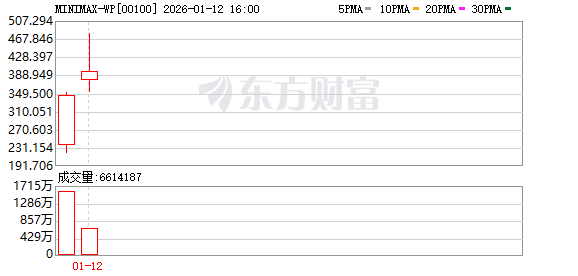
Core Insights - MiniMax, an AI large model company, successfully went public on the Hong Kong Stock Exchange under the code "0100.HK," with its stock price soaring 109.09% on the first day, reaching a market capitalization of over HKD 100 billion, setting a record for institutional subscriptions in recent years [1] - The company has attracted significant investments from top-tier institutions such as Alibaba, Tencent, Hillhouse Capital, and Sequoia China, with cornerstone investors collectively subscribing HKD 27.23 billion, accounting for nearly 70% of the offering size, which supported the stock price [1] - MiHoYo, a gaming industry player, made its first successful investment in a listed company through MiniMax, reflecting the gaming sector's long-term commitment to the AI industry [1][2] Company Overview - MiniMax was established in early 2022 and is a global general artificial intelligence (AGI) company focused on multimodal model development, making it one of the few companies in China with a high international revenue from large models [4] - The company has a young team of 385 members, with an average age of 29, and nearly 74% of its workforce in research and development, including over 30% returning overseas talent [4] - MiniMax's founder and CEO, Yan Junjie, has a strong academic background, holding a PhD from the Chinese Academy of Sciences and experience at SenseTime [4] Financial Performance - MiniMax reported revenue of USD 53.4 million (approximately RMB 380 million) for the first three quarters of 2025, representing a year-on-year growth of 174.7%, with over 70% of its revenue coming from international markets [5] - The company has accumulated over 212 million users for its AI products, with a rapid increase in paying users [5] - Despite its growth, MiniMax is facing significant losses, with a total loss of approximately USD 1.32 billion, highlighting the challenges of maintaining technological leadership and converting its large user base into sustainable profits [6] Industry Trends - The case of MiHoYo exemplifies the gaming industry's broader embrace of AI, as companies seek to enhance content production, user experience, and operational maintenance through AI technologies [7] - Major gaming companies like Tencent and NetEase are integrating AI tools into their games, indicating a strategic shift towards AI as a core component of game development and user engagement [7] - The Chinese large model market is projected to exceed RMB 70 billion by 2026, with the gaming sector viewed as a critical area for the application and commercialization of large model technologies [7][8]
腾讯的AI征程:构筑游戏新纪元,登顶全球霸主
阿尔法工场研究院· 2025-10-30 00:07
Core Viewpoint - Tencent is leveraging AI tools like Hunyuan and VISVISE to revolutionize game development, significantly reducing production time and driving strong revenue growth, positioning itself as a leader in the smart entertainment era [3][4][10]. AI Leadership: Rapid Innovation in Development and Distribution - Tencent's AI capabilities are not theoretical but are reshaping game development on an industrial scale, with tools like VISVISE automating the generation of textures and animations, compressing development time to minutes [6][7]. - The Hunyuan Game AI can generate hyper-realistic characters in seconds, democratizing AAA game development for independent developers and Tencent's studios [6][8]. Global Expansion: From Shenzhen to the World - Tencent is expanding its global footprint as the second-largest game publisher, with international game revenue growing by 35% in Q2 2025, driven by AI innovations [8][9]. - Strategic investments, such as in Antix, are enhancing AI digital human technology, significantly reducing production costs in film and supporting Tencent's metaverse strategy [9]. Long-term Value: Core Asset in the AI-Game Era - Tencent is projected to achieve a revenue of approximately 755 billion RMB by 2025, with a compound annual growth rate (CAGR) of 13%, driven by AI and global expansion [12]. - The company is expected to maintain a robust return on equity (ROE) of 15%+, potentially increasing to 20%-30%+ by 2030, supported by its data-driven business model [12]. Conclusion - Tencent is not just adapting to the AI revolution; it is a key architect of this transformation in the gaming industry, providing developers with liberation, players with immersion, and investors with a solid investment opportunity [13].

人工最高节省90%,AI制作游戏被批“没有灵魂”
第一财经· 2025-10-22 10:12
Core Viewpoint - The article discusses the significant impact of AI on the gaming industry, particularly in enhancing development efficiency and changing production methods. It highlights the ongoing exploration of AI tools that can streamline game creation processes, potentially reducing the time and cost involved in game development [3][4][5]. Group 1: AI's Impact on Game Development Efficiency - AI tools can save approximately 70% to 80% of the workload in game development, especially in art asset processing, with animation and modeling being the most labor-intensive areas [5]. - The use of AI in animation can reduce the time required for tasks such as skinning from 1.5 to 3.5 days to just 1 to 3 hours, achieving a labor saving of 70% to 90% [5]. - AI can also automate the generation of smooth animations from keyframes, increasing efficiency by 3 to 5 times compared to traditional methods [5][6]. Group 2: Adoption and Implementation of AI Tools - Tencent has reported a 40% reduction in character animation production cycles due to AI tools, with some projects reducing prototype validation time from 2 weeks to 3 days [6]. - Over 50 external companies, including major players in the gaming industry, are currently utilizing Tencent's AI tools, which are also being tested by companies in Japan, South Korea, and Europe [6]. - AI tools are particularly beneficial for small to medium-sized teams, allowing them to achieve results that previously required larger teams [11]. Group 3: Cost Reduction and Production Quality - AI can significantly lower production costs; for example, in high-quality 3D games like "Black Myth: Wukong," AI tools can handle 20% to 30% of secondary resources, potentially saving millions in production costs [7]. - The cost of using AI tools is relatively low compared to human labor, making them an attractive option for game developers [7]. Group 4: Industry Perspectives on AI - There are mixed opinions within the industry regarding AI's ability to replace human creativity, with some believing that AI lacks the "soul" necessary for compelling game design [8][10]. - However, some industry professionals have begun to recognize the potential of AI to enhance creativity and provide new avenues for game development [10][11]. Group 5: Future of Game Development with AI - The integration of AI tools is expected to evolve the game development pipeline without completely disrupting existing workflows [12]. - New technologies, such as Google's interactive world models, are emerging, which could further enhance game development processes by allowing for quicker and more effective communication of game concepts [13][14]. - The future may see a convergence of different AI paths, leading to unique workflows in game development over the next few years [14].
人工最高节省90%,AI制作游戏被批“没有灵魂”
Di Yi Cai Jing· 2025-10-22 09:15
Core Insights - The gaming industry is experiencing significant efficiency improvements due to AI tools, which can reduce art production costs by 20% to 30% in high-budget 3D games, leading to savings of millions [5][6][11] - AI is transforming game development processes, allowing for faster production timelines and reducing the reliance on traditional labor-intensive methods [3][4][10] Group 1: AI Impact on Game Development - AI tools can handle 70% to 80% of the art asset processing workload in game development, particularly in animation and modeling [3][4] - The use of AI in animation can reduce the time required for tasks such as skinning from 1.5 to 3.5 days down to just 1 to 3 hours, achieving a labor savings of 70% to 90% [3][4] - AI-generated animations can enhance efficiency by producing 60 frames of smooth animation from just 5 to 10 keyframes, increasing productivity by 3 to 5 times [3][4] Group 2: Adoption and Usage of AI Tools - Tencent has developed and opened its AI tools to over 50 external companies, including major players in the gaming industry [4][11] - The tools have been successfully implemented in Tencent's internal projects, resulting in a 40% reduction in character animation production cycles [4][11] - Smaller teams are more likely to adopt AI tools, as they can significantly enhance workflow efficiency and reduce production costs [10][11] Group 3: Industry Perspectives on AI - There are mixed opinions within the industry regarding AI's ability to replace human creativity, with some believing AI lacks the "soul" necessary for compelling game design [8][9] - Despite skepticism, some industry professionals have noted AI's surprising advancements in generating engaging narratives and creative content [9][10] - AI is seen as a tool that democratizes game development, enabling smaller teams to achieve results that previously required larger, more experienced groups [10][11] Group 4: Future of AI in Gaming - The integration of AI tools is expected to evolve, with new technologies like interactive world models potentially reshaping game production workflows [11][12] - The gaming industry is likely to see a coexistence of various AI tools for the foreseeable future, as companies explore different approaches to automation and intelligence in game development [12]

腾讯比游戏厂商,更需要游戏大模型
Xi Niu Cai Jing· 2025-09-16 05:46
Group 1: AI Tool Launch - Tencent Games has launched an AI creation tool called VISVISE, aimed at enhancing the efficiency of game art production across four major pipelines: animation production, 3D model production, intelligent NPCs, and digital asset management [2] - The tool significantly improves efficiency in various stages of game creation, such as skin binding, which can be reduced from 1-3.5 days per item to over 8 times faster with VISVISE [2] - The core value of VISVISE is to balance quality and efficiency in game production, addressing the industry's need for cost reduction and efficiency improvement [2] Group 2: Revenue Challenges - Tencent's flagship game, Honor of Kings, has experienced a revenue decline, with June's income dropping to $143 million, a nearly 25% decrease month-over-month [3] - Despite maintaining a daily active user count of over 100 million, the game's revenue growth shows significant uncertainty, with no substantial increase in user scale since November 2020 [4] - The revenue for Honor of Kings fell from $2.22 billion in 2022 to $1.48 billion in 2023, with a slight recovery projected for 2024 at $1.87 billion, indicating volatility in earnings [5] Group 3: Competitive Landscape - Tencent faces increasing competition from emerging companies like miHoYo and Eagle Dynamics, which have successfully launched popular titles such as Genshin Impact and Arknights, respectively [6][7] - The contrasting strategies between Tencent's established titles and the innovative approaches of competitors highlight a potential stagnation in Tencent's game development capabilities [8] - miHoYo's Genshin Impact generated $4 billion in revenue in 2023, showcasing the effectiveness of its global content strategy, while Tencent's reliance on traditional revenue models is under scrutiny [9] Group 4: International Expansion - Tencent has invested approximately 978.67 billion yuan in 33 overseas game companies since 2012, indicating a strategy to bolster its game business through international partnerships [9] - The company has successfully acquired rights to popular games like CrossFire and Dungeon & Fighter, which have contributed significantly to its portfolio [9] - However, there are concerns that relying heavily on acquisitions may lead to a lack of focus and potential inefficiencies in Tencent's international strategy [10][11] Group 5: Future Considerations - Tencent must reconsider its dependency on social and channel strategies as it introduces VISVISE to the market, aiming to break free from past reliance [12] - The company faces a critical decision on whether to adapt to changing market dynamics or risk becoming a stable yet unremarkable cash cow [12]
互联网行业2025年9月投资策略:港股互联网已处于全球估值洼地,AI驱动中报业绩释放
Guoxin Securities· 2025-09-03 08:40
Group 1 - The core view of the report indicates that the Hong Kong internet sector is currently undervalued globally, with AI driving the release of mid-term performance results [1][3][21] - The Hang Seng Technology Index rose by 4.1% in August, outperforming the Nasdaq Internet Index, which increased by 2.7% during the same period [1][11] - Key stocks that performed well in August include Reading Group, JD Health, and Weimeng Group in Hong Kong, and iQIYI, BOSS Zhipin, and SEA in the US [1][17] Group 2 - The report highlights that AI has shown significant effects on the advertising business, cloud computing scenarios, and corporate efficiency for internet giants, with Tencent's advertising growth maintaining at 20% and Alibaba Cloud's growth accelerating to 26% [3][4] - The report recommends continued investment in Tencent Holdings, Alibaba, Kuaishou, Meitu, and Tencent Music, which are less correlated with macroeconomic conditions [3][4] - The report provides earnings forecasts and investment ratings for key companies, with Tencent Holdings expected EPS of 23.83 in 2025 and a PE ratio of 23.9, while Alibaba is projected to have an EPS of 6.89 and a PE of 18.7 [4]
国务院发布“人工智能+”行动;马斯克成立「巨硬」针对微软?机器人界最强大脑出世|混沌AI一周焦点
Sou Hu Cai Jing· 2025-08-30 13:42
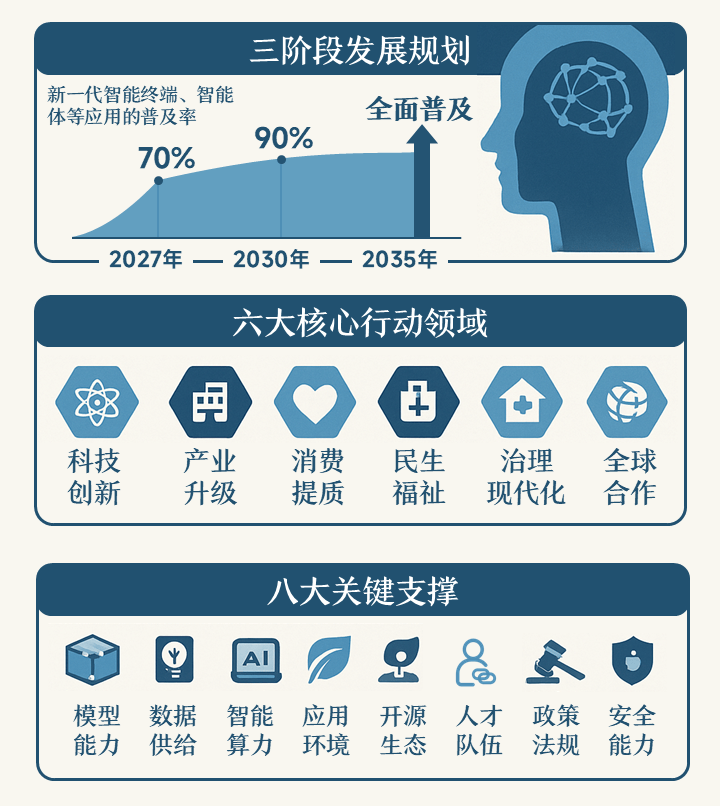
Core Insights - The article discusses the Chinese government's "Artificial Intelligence +" initiative, which aims to integrate AI into six key sectors to enhance productivity and innovation [3][9]. Group 1: Action Plan Overview - The initiative emphasizes a people-centered approach, leveraging China's unique advantages in data, industry scale, and application scenarios [3]. - The strategy focuses on forward-looking planning and systematic layout, encouraging open sharing while ensuring safety and control [3]. Group 2: Goals and Timelines - By 2027, the goal is to achieve over 70% penetration of AI applications in the six key sectors [4]. - This penetration is expected to exceed 90% by 2030 [5]. - By 2035, the initiative aims to transition China into a new phase of intelligent economy and society [6]. Group 3: Key Action Areas - The six core action areas include technology innovation, industrial upgrading, quality improvement in consumption, enhancing public welfare, modernizing governance, and global cooperation [9]. Group 4: Implementation Mechanisms - The plan encourages enterprises to deeply integrate AI into their strategies, organizations, and business processes, fostering a new generation of "intelligent native" companies [11]. - The initiative will be coordinated by the National Development and Reform Commission, with local adaptations and specific implementation plans [12]. Group 5: Technological Support - Eight key supports include enhancing foundational model capabilities, innovating data resource supply, and establishing a national AI application testing base [13].