vivo

Search documents
手机巨头叫停AI眼镜:当下难做差异化
Guan Cha Zhe Wang· 2026-01-23 05:16
Core Insights - Vivo has halted its AI glasses project after six months of secret preparation due to concerns from senior executives about the difficulty of achieving differentiation in the current market [1] - The AI glasses market is expected to be a major trend in consumer electronics by 2025, with several companies, including Xiaomi and Huawei, actively developing their own products [1] - The Chinese smart eyewear market is projected to see significant growth, with shipments expected to reach 623,000 units in Q3 2025, a year-on-year increase of 62.3% [1] Group 1 - The AI glasses market is facing severe homogenization, with products largely following the design of Ray-Ban Meta and focusing on similar core functionalities such as translation and photography [2] - The content ecosystem for AI glasses remains underdeveloped, lacking essential use cases outside of smartphones, which limits the potential for deeper AI integration in diverse scenarios [2] - Major companies, including Vivo and Xiaomi, are reassessing their strategies in the AI glasses market, with Xiaomi reportedly lowering its second-generation AI glasses shipment forecast from 300,000 to approximately 120,000 units [2] Group 2 - Vivo continues to explore new entry points in the market, having launched the Vivo Vision mixed reality headset, which aims to address comfort and content ecosystem issues [3] - The Chinese smart glasses market is projected to reach 4.508 million units by 2026, with a year-on-year growth of 77.7%, driven by audio and audio-capturing glasses [3] - The market for AR/VR devices is also expected to grow, with projected shipments of 1.073 million units in 2026, reflecting a year-on-year increase of 62.1% [3]


华为破了vivo的金身
3 6 Ke· 2026-01-23 03:52
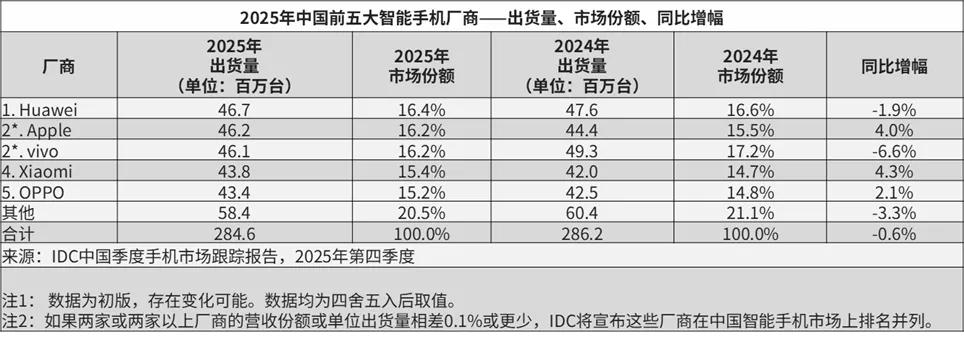
Core Viewpoint - The Chinese smartphone market has experienced significant changes in rankings, with Huawei regaining the top position in market share after several years, despite a slight decline in overall shipment volume [1][4]. Market Overview - In 2025, the total shipment volume of smartphones in China is projected to be 285 million units, reflecting a year-on-year decrease of 0.6% [1][4]. - The competitive landscape is intensifying, with major brands closely contending for market share [3][4]. Key Players and Market Share - The top five smartphone manufacturers in China for 2025 are: 1. Huawei: 46.7 million units, 16.4% market share, down 1.9% from 2024 2. Apple: 46.2 million units, 16.2% market share, up 4.0% from 2024 3. Vivo: 46.1 million units, 16.2% market share, down 6.6% from 2024 4. Xiaomi: 43.8 million units, 15.4% market share, up 4.3% from 2024 5. OPPO: 43.4 million units, 15.2% market share, up 2.1% from 2024 [2]. Vivo's Market Position - Vivo has dropped from first to third place in market share, with a significant year-on-year decline in shipment volume [2][11]. - The brand's strategy of releasing a high number of models (81 in 2025) is under scrutiny as the market shifts towards high-end devices [11][12]. Industry Trends - The smartphone market is transitioning from an incremental growth phase to a saturated market, with a notable increase in the share of high-end devices priced above 4,000 RMB [12][13]. - The competition is expected to intensify in 2026, particularly due to rising costs in components like memory [5][23]. User Experience and Brand Loyalty - Vivo's user retention rate is lower than competitors like Huawei and Apple, indicating potential issues with customer satisfaction [22]. - The brand has faced criticism regarding user experience, particularly in areas such as camera performance and software functionality [16][21]. Future Outlook - Vivo needs to enhance its focus on high-end market segments to remain competitive, especially as the overall market is expected to decline further in 2026 [14][23].
广货行天下 全球开“利是”
2 1 Shi Ji Jing Ji Bao Dao· 2026-01-23 03:31
Core Insights - The article emphasizes the integration of cultural elements into the global marketing strategy of Guangdong products, using the concept of "Li Si" as a cultural symbol to enhance emotional connections with consumers worldwide [1][2][11] - It highlights the transition from a focus on manufacturing scale and efficiency to a narrative that includes emotional and cultural dimensions, positioning Guangdong products as not just goods but as carriers of cultural significance [5][8][11] Group 1: Hard Currency of Guangdong Products - Guangdong products represent a significant portion of China's global manufacturing, with the Greater Bay Area's smart home appliance industry accounting for nearly 30% of the global market [3] - The region's products, such as electronics and traditional foods, are characterized by stringent quality standards, which serve as a passport to international markets [3][4] - Guangdong's manufacturing prowess is evident in various sectors, including consumer electronics and textiles, with a notable share of national exports [3][4] Group 2: Emotional Branding and Cultural Significance - The concept of "Nian Huo" (New Year goods) is evolving into a cultural and emotional branding tool, with Guangdong's agricultural exports leading the nation in value [5][6] - The emotional aspect of these products is crucial, as they are seen as symbols of cultural connection and tradition, enhancing their appeal in international markets [6][8] - Innovative marketing strategies, such as storytelling and cultural narratives, are being employed to resonate with global consumers, transforming products into meaningful gifts [9][10] Group 3: Media+ Ecosystem for Global Reach - The "Media+" initiative is being developed to create a comprehensive ecosystem that connects Guangdong products with global consumers, enhancing the efficiency of supply and demand [9][10] - This platform aims to facilitate storytelling and cultural exchange, making Guangdong products more relatable and desirable in international markets [9][10] - The initiative also addresses practical challenges faced by small and medium enterprises in exporting, providing them with tools and networks to navigate global markets [10][11]
广货行天下 全球开“利是”
21世纪经济报道· 2026-01-23 03:20
Core Viewpoint - The article emphasizes the integration of cultural elements into the global marketing strategy of Guangdong products, using the concept of "利是" (red envelopes) as a symbol of warmth and emotional connection in international trade [1][2]. Group 1: Hard Power of Guangdong Products - Guangdong products have established themselves as a core representative of Chinese manufacturing in global competition, with the Guangdong-Hong Kong-Macao Greater Bay Area's smart home appliance industry accounting for nearly 30% of the global market [3]. - The region produces a significant portion of China's consumer electronics, with brands like Huawei, OPPO, and vivo leading innovation, and Guangdong's exports in textiles and toys making up nearly 20% of the national total [3][4]. - The true "hard currency" attribute of Guangdong products lies in their stringent quality control and standards, which serve as a passport to international markets [3][4]. Group 2: Soft Power and Emotional Connection - The concept of "年货" (New Year goods) is evolving from mere products to carriers of culture, emotion, and blessings, with Guangdong's agricultural products leading in export value during the 14th Five-Year Plan period [6]. - The emotional aspect of "年货" is highlighted as a key factor in consumer purchasing decisions, with products like Guangdong lychees and traditional dishes becoming symbols of cultural connection for overseas Chinese [6][7]. - Digital technology is reshaping the export of "年货," allowing for precise market targeting and enhancing consumer engagement through storytelling and cultural narratives [7][8]. Group 3: Media+ Ecosystem for Global Reach - The "Media+" ecosystem is being developed in Guangdong to enhance the connection between products and global consumers, focusing on storytelling and cultural representation [10][11]. - This platform aims to improve supply-demand connectivity and address challenges faced by small and medium enterprises in international markets, facilitating easier access to global procurement networks [11][12]. - The initiative is expected to create a continuous narrative around Guangdong products, aligning with seasonal themes to maintain engagement and cultural relevance throughout the year [12].
传vivo叫停AI眼镜项目 官方暂无回应
Ju Chao Zi Xun· 2026-01-23 02:48
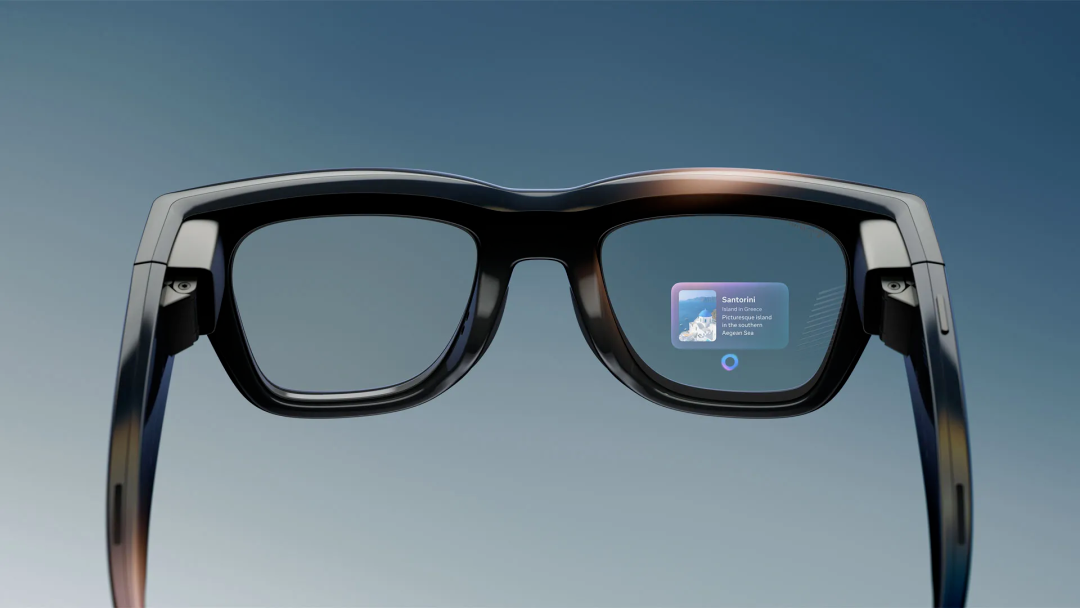
Core Viewpoint - Vivo has halted its AI glasses project after about six months of secret preparation, indicating a strategic shift towards mixed reality (MR) development instead of pursuing AI glasses due to concerns over product differentiation and market competition [1][3][5] Group 1: Project Details - The AI glasses project involved collaboration with several well-known ODMs, including GoerTek and Zhongke Chuangda, to develop prototype products but did not reach mass production [1] - Internal discussions at Vivo explored various forms and technical paths for the AI glasses, including integrating audio and video functions and equipping a single green display [3] - The decision to pause the project was influenced by the assessment from Vivo's management, led by Executive Vice President Hu Baishan, who concluded that the current AI glasses lacked significant differentiation in user experience and core functionality compared to existing and potential competitors [3] Group 2: Strategic Shift - The halt of the AI glasses project does not signify a withdrawal from exploring new human-computer interaction interfaces; rather, it reflects a reallocation of resources and a clearer strategic focus [3][5] - Vivo will continue to concentrate on MR research and development, having already launched a substantial product in this area, the "Vivo Vision Exploration Edition" MR headset, set to be released in August 2025 [3][4] - The Vivo Vision Exploration Edition emphasizes comfort with a weight of 398 grams and features a Qualcomm Snapdragon XR2+ platform, which reportedly offers 2.5 times the performance of its predecessor [4] Group 3: Market Implications - Vivo's decisive adjustment to the AI glasses project highlights the cautious approach of consumer electronics giants in the face of cutting-edge hardware innovation, emphasizing the need to avoid homogenized competition and find paths with genuine user value and technological barriers [5] - The focus on the MR sector, which is perceived to have greater differentiation potential, illustrates Vivo's strategic choices and prioritization of resources [5] - As MR/AR/VR technologies continue to evolve and market education deepens, Vivo's future actions in the MR field and its strategy to build a collaborative ecosystem centered around smartphones and MR devices will be of significant interest to the industry [5]
曝阿里旗下芯片公司拟独立上市;苹果新 CEO 人选或曝光;比亚迪李云飞:公司是黑水军最大受害者 | 极客早知道
Sou Hu Cai Jing· 2026-01-23 02:13
Group 1 - Alibaba Group has decided to support the independent listing of its chip company, T-head, with no comments from Alibaba at this time [1] - T-head's self-developed GPU chip, named PPU, features 96GB of HBM2e memory, a bandwidth of 700GB/s, and a power consumption of only 400W, surpassing Nvidia's A800 and mainstream domestic GPUs [1] - The first generation of T-head's PPU matches the performance of Nvidia's popular H20, while the upgraded version outperforms Nvidia's A100, leading to high demand in the market [1] Group 2 - Apple has expanded hardware chief John Ternus's responsibilities to include design management, signaling his potential as a successor to CEO Tim Cook [2] - Ternus's new role encompasses critical functions that have historically been held by senior leaders, emphasizing the importance of product design in Apple's success since the Steve Jobs era [2] Group 3 - UTree Technology reported that its humanoid robot shipments exceeded 5,500 units in 2025, with over 6,500 units of the main body produced, clarifying that these figures only include humanoid robots [4] - UTree emphasized the importance of not conflating different types of robots when comparing shipment numbers [4] Group 4 - Xiaomi Group announced a share buyback plan of up to HKD 2.5 billion, set to begin on January 23, 2026, and aims to demonstrate confidence in its business outlook [6][7] - The buyback will end on the earliest of the day before the 2026 annual shareholder meeting, when the buyback amount reaches HKD 2.5 billion, or if terminated under the brokerage agreement [6] Group 5 - BYD's brand and public relations manager stated that the company has been a major victim of black public relations and will pursue legal action against false information and malicious attacks [8] - BYD recently won a court case against a blogger for spreading false information, resulting in a compensation order of CNY 2.01 million [8] Group 6 - Vivo has reportedly halted its AI glasses project after six months of secret preparation, as executives determined that differentiation in the current market is challenging [9] - Following the project cancellation, Vivo will continue to focus on mixed reality (MR) technology [9] Group 7 - Meitu announced a stock reward of 1,357 shares for each employee, totaling over CNY 20 million, marking the third time since its IPO in 2016 that it has issued stock rewards to all employees [10] - The stock price has risen from below HKD 1 to over HKD 8, reflecting the company's improved performance [10] Group 8 - Hyundai Motor Group plans to deploy humanoid robots, specifically the Atlas robot developed by Boston Dynamics, with a factory set to produce 30,000 units annually by 2028 [11] - The announcement led to a positive market reaction, with Hyundai's stock reaching new highs, although the labor union expressed concerns about potential job losses due to automation [11] Group 9 - Nvidia's CEO Jensen Huang stated at the Davos Forum that the investment in AI infrastructure is just beginning, with several trillion dollars needed to fully develop the ecosystem [18] - Huang compared the investment in AI infrastructure to historical large-scale infrastructure projects, emphasizing the long-term vision for AI development [19]

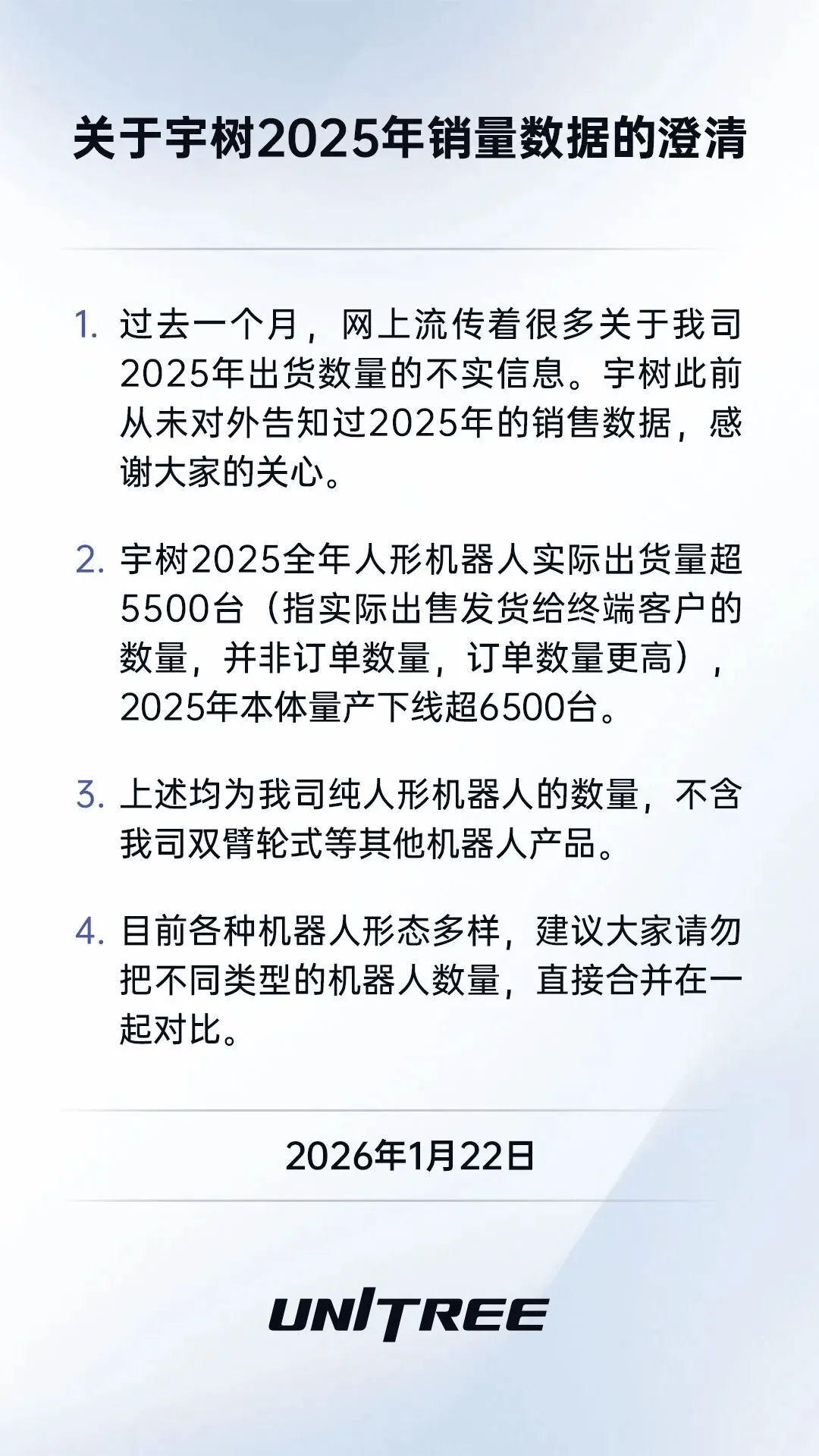
vivo叫停AI眼镜项目
Xin Lang Cai Jing· 2026-01-23 01:57
Core Viewpoint - Vivo has halted its AI glasses project, which had been in secret preparation for six months and involved collaborations with several ODM manufacturers, including Goer and Zhongke Chuangda. The decision was made by senior executives, including Vice President Hu Baishan, who concluded that the AI glasses would struggle to achieve differentiation in the current market [1]. Group 1 - The AI glasses project was in development for six months and involved multiple ODM partnerships [1]. - Various solutions, including audio-video and single green display options, were discussed but not finalized before the project was stopped [1]. - The decision to halt the project was based on the assessment that differentiation in the AI glasses market is currently challenging [1].
因做不出差异化,vivo叫停AI眼镜项目丨智能涌现独家
3 6 Ke· 2026-01-23 01:50
Core Insights - Vivo has halted its AI glasses project after six months of secret preparation, indicating challenges in achieving differentiation in the current market [2][3] - The AI glasses industry faces significant hurdles, including high hardware standards and a lack of unique product offerings [3][6] Industry Challenges - The hardware requirements for AI glasses are more demanding than other categories, where even minor issues can severely impact user experience [3] - Many companies, such as "Shanji" and Baidu, have faced setbacks due to poor chip selection, leading to product failures and high return rates [4][5] - A lack of innovation has resulted in a homogenized market, with many products mimicking the design and functionality of Ray-Ban Meta glasses [6] Market Dynamics - The content ecosystem for AI glasses remains underdeveloped, with no clear essential use cases outside of mobile devices [7] - Some industry players are adopting a more rational approach, with companies like Xiaomi reducing their second-generation AI glasses shipment forecasts from 300,000 to approximately 120,000 units [9] Future Outlook - Experts believe there is still significant room for exploration in technology and content ecosystems for AI glasses over the next three to five years [8] - Despite halting the AI glasses project, Vivo continues to explore new hardware entry points, such as the Vivo Vision exploration version, which focuses on lightweight and natural interaction experiences [10] Strategic Positioning - Vivo's executive, Hu Bosheng, has emphasized the importance of accumulating data for future robotics applications, indicating a long-term vision for integrating AI glasses with robotics [11] - The company possesses a competitive advantage in transitioning to next-generation hardware due to its extensive experience in the mobile sector [11][12]
8点1氪丨错版“马年茅台”二手价格被炒至2800元 ;“黑白颠周媛”账号被封;兰博基尼2025销量创历史新高,卖出10747辆
3 6 Ke· 2026-01-23 00:03
Group 1 - The "Year of the Horse" Moutai liquor has a printing error, leading to a surge in second-hand prices reaching up to 2800 yuan, compared to the original price of 1899 yuan [2][3] - The account of influencer Zhou Yuan, known for controversial content, has been banned after generating over 24 million yuan in revenue from paid courses [2][3] - Lamborghini announced a record delivery of 10,747 vehicles in 2025, marking a 60-unit increase from the previous year and achieving growth for the fifth consecutive year [3] Group 2 - Yonghui Supermarket expects a net loss of 2.14 billion yuan for 2025 due to significant strategic adjustments and asset write-offs [4][6] - The company has a high debt ratio of 88.96% and a low liquidity ratio of 0.63, indicating financial strain [6] - The company plans to complete its strategic adjustments by 2026 [6] Group 3 - Gold prices have reached a new high of 4950 USD per ounce, with a 0.28% increase [11] - Goldman Sachs raised its gold price target for December 2026 from 4900 USD to 5400 USD, citing increased demand for gold as a hedge against macroeconomic uncertainties [12] - Nvidia has overtaken Apple as TSMC's largest customer, accounting for 13% of TSMC's total revenue [12] Group 4 - The Chinese government has implemented a subsidy program for elderly individuals with moderate to severe disabilities, providing up to 800 yuan per month [13] - The subsidy is aimed at supporting various elderly care services, including home and institutional care [13] Group 5 - SpaceX plans to launch its second-generation Starlink system by 2027 [16] - Amazon is preparing to lay off thousands of corporate employees as part of its restructuring efforts [17] - Tesla's CEO Elon Musk indicated plans to sell the Optimus robot to the public by the end of next year [18]





8点1氪:错版“马年茅台”二手价格被炒至2800元 ;“黑白颠周媛”账号被封;兰博基尼2025销量创历史新高,卖出10747辆
36氪· 2026-01-23 00:00
Group 1 - The "Majiang Maotai" with printing errors has attracted attention, with second-hand prices being sold at 2800 yuan, significantly higher than the original price of 1899 yuan [3] - The error in the packaging of the "Majiang Maotai" was identified as a misprint of the character "昴" as "昂", leading to its rarity and potential appreciation in value [3] - Multiple sellers on second-hand platforms are listing the "error version" Maotai at prices ranging from 2300 yuan to 2800 yuan, indicating a strong market demand [3] Group 2 - Walmart and Xiaohongshu have reached a deep cooperation agreement, launching nearly 20 co-branded products and the first co-branded store [7] - The collaboration aims to explore a new customer-centric business model, enhancing the shopping experience [7] - The first batch of co-branded products has been officially launched, marking a significant step in the partnership [7] Group 3 - Yonghui Supermarket has announced a projected net loss of 2.14 billion yuan for 2025, primarily due to significant operational strategy adjustments [6] - The losses are attributed to asset write-offs and one-time investments related to store renovations, exceeding 1.2 billion yuan [6] - The company is undergoing a transformation inspired by the "Fat Donglai" business model, with expectations to recover in 2 to 3 years [6] Group 4 - Lamborghini announced a record global delivery of 10,747 vehicles in 2025, marking a 60-unit increase from the previous year and the second consecutive year of exceeding 10,000 units [5] - The success is attributed to the implementation of a hybrid strategy across its entire model range and strong performance in key markets [5] - This achievement highlights Lamborghini's continuous growth over the past five years, with a significant increase from 3,245 units sold in 2015 [5] Group 5 - Intel reported a 4.1% year-on-year decline in revenue for Q4, totaling 13.67 billion USD, slightly above market expectations [24] - The adjusted earnings per share for the quarter were 0.15 USD, compared to 0.13 USD in the same period last year [24] - Intel anticipates Q1 revenue between 11.7 billion and 12.7 billion USD, with adjusted earnings per share expected to be 0.0 USD [24]