中金基金

Search documents
从中金出走的人,去了哪里?
YOUNG财经 漾财经· 2026-01-20 12:21
Core Viewpoint - The article discusses the recent trends of talent outflow from China International Capital Corporation (CICC), highlighting the shift in employee preferences and the impact of regulatory changes on the investment banking landscape in China [4][5][6]. Group 1: Employee Outflow Trends - CICC, once a prestigious institution attracting top talent, has seen a significant decline in its appeal due to increased competition, regulatory tightening, and a reduction in compensation packages [5][6]. - Employees are leaving CICC for other brokerages, often following two paths: "high-level lateral moves" to similar top-tier firms or "strategic downshifts" to smaller firms for greater decision-making power [8][9]. - Notable examples of former CICC executives transitioning to other firms include Liang Hong, who moved to Huatai Securities, and Yang Sulan, who joined China Galaxy Securities, both continuing to leverage their expertise in the capital markets [8][9]. Group 2: Transition to Real Economy - A growing number of former CICC employees are leaving the financial sector entirely to join the real economy, driven by the 2023 "827 policy" which has cooled the IPO market and led to a contraction in investment banking activities [12]. - The demand for professionals with capital market experience in the real economy has surged, as companies seek expertise in compliance and market operations for financing and investor relations [12][13]. - Many former CICC employees are taking on key roles such as company secretaries, leveraging their backgrounds to manage corporate governance and investor relations effectively [13][14]. Group 3: Movement to Foreign Investment Banks - There is a notable trend of CICC talent moving to foreign investment banks, capitalizing on their international experience and networks [16]. - For instance, Jiang Zhiwei, a former CICC executive, joined Deutsche Bank, reportedly for a significantly higher salary, reflecting the competitive compensation landscape in foreign firms [16]. - This trend is not limited to CICC's core business lines but extends to its subsidiaries and affiliated institutions, indicating a broader talent migration within the financial services sector [16][17]. Group 4: Challenges and Issues - CICC Capital, once a leading player in alternative investments, has faced significant turmoil, including the fall of key executives due to allegations of misconduct, which has tarnished the reputation of the CICC brand [19]. - The issues within CICC Capital highlight serious governance and compliance failures, raising concerns about the integrity of the investment management industry as a whole [19].



开山股份股价涨6.08%,中金基金旗下1只基金重仓,持有3.3万股浮盈赚取3.27万元
Xin Lang Cai Jing· 2026-01-19 01:52
Group 1 - The core point of the news is that Kaishan Group Co., Ltd. has seen a stock price increase of 6.08%, reaching 17.28 CNY per share, with a total market capitalization of 17.17 billion CNY [1] - The company, established on July 11, 2002, and listed on August 19, 2011, specializes in the research, manufacturing, and sales of screw air compressors and related equipment, with its main business revenue composition being 63.84% from compressor products, 22.72% from geothermal power generation, and 13.45% from other sources [1] Group 2 - From the perspective of fund holdings, one fund under China International Capital Corporation (CICC) has a significant position in Kaishan shares, with the CICC CSI 1000 Index Enhanced Fund A holding 33,000 shares, accounting for 0.54% of the fund's net value [2] - The CICC CSI 1000 Index Enhanced Fund A, established on March 14, 2023, has a current scale of 53.54 million CNY and has achieved a year-to-date return of 7.6%, ranking 1893 out of 5579 in its category [2] Group 3 - The fund managers of the CICC CSI 1000 Index Enhanced Fund A are Geng Shuaijun and Wang Yangfeng, with Geng having a tenure of 5 years and 91 days and a total fund asset size of 4.295 billion CNY, achieving a best return of 65.67% during his tenure [3] - Wang has a tenure of 4 years and 7 days with a total fund asset size of 1.306 billion CNY, achieving a best return of 41.56% during his tenure [3]

最新!个人养老金基金再扩容
Zhong Guo Ji Jin Bao· 2026-01-18 05:20
Core Viewpoint - The personal pension fund list in China has expanded, with 7 new products added, bringing the total to 309 funds as of the end of last year [1][3]. Group 1: Fund Expansion - The latest list of personal pension funds includes 309 products, an increase of 7 from the end of the third quarter last year [3]. - The newly added products consist of ordinary index funds, enhanced index funds, stable pension target funds, and target date funds [3]. Group 2: Sales Institutions - The number of sales institutions for personal pension funds remains unchanged at 52 [3]. - Securities companies lead with 25 institutions, followed by commercial banks with 19, and independent fund sales institutions with 8 [3]. Group 3: Performance and Scale - The personal pension funds have seen significant performance and scale growth, with an average net value growth rate of 17.54% for 279 funds that have been established for over a year [5]. - As of the end of the third quarter of 2025, the total scale of personal pension fund Y shares reached 15.107 billion yuan, marking a 65.32% increase from the end of 2024 [5]. Group 4: Industry Insights - Public funds are recognized as pioneers in the personal pension business and play a crucial role in the personal pension ecosystem [6]. - The industry is expected to enhance product diversity, demonstrate long-term investment value, and foster collaborative efforts among market participants to promote effective operation of personal pensions [6].
公募REITs奔向万亿级
Xin Lang Cai Jing· 2026-01-14 21:47
Core Viewpoint - The introduction of public Real Estate Investment Trusts (REITs) in China, particularly in the commercial real estate sector, is expected to revitalize existing commercial properties and stimulate the real economy [3][4][6]. Group 1: Public REITs Overview - Public REITs serve as a new financing tool connecting the real economy with capital markets, promoting investment stability and growth [4]. - The recent pilot program for commercial real estate REITs expands the scope of public REITs beyond infrastructure, allowing for market-driven operations and active management [6][7]. Group 2: Financing and Asset Management - Commercial real estate companies can utilize public REITs to activate existing assets, broaden financing channels, and reduce debt ratios [7]. - The China Securities Regulatory Commission (CSRC) emphasizes the significant demand for activating commercial real estate through REITs, given the large scale of existing assets [7][11]. Group 3: Market Potential and Growth - The public REITs market in China is projected to reach a total market value of at least 1.5 trillion yuan by the end of the 14th Five-Year Plan, driven by the substantial scale of existing infrastructure and commercial real estate assets [15]. - The market is expected to see a significant increase in the participation of individual investors, with projections indicating that their share could rise from under 10% to over 20% in the next five years [21]. Group 4: Investment Characteristics - Public REITs differ from traditional mutual funds in that they primarily invest in real estate assets that generate stable cash flows, with returns coming from operational income and asset appreciation [20]. - The investment value of public REITs is becoming increasingly prominent, with over 70% of listed REITs experiencing an increase in market value last year [19].

泽璟制药股价涨5.37%,中金基金旗下1只基金重仓,持有2.95万股浮盈赚取14.77万元
Xin Lang Cai Jing· 2026-01-07 02:11
1月7日,泽璟制药涨5.37%,截至发稿,报98.39元/股,成交1.22亿元,换手率0.48%,总市值260.45亿 元。 资料显示,苏州泽璟生物制药股份有限公司位于江苏省昆山市玉山镇晨丰路262号,香港湾仔皇后大道东 183号合和中心46楼,成立日期2009年3月18日,上市日期2020年1月23日,公司主营业务涉及化学新药 及生物新药的研发、生产及销售。主营业务收入构成为:药品99.97%,医药中间体及原辅料0.02%,资 产租赁0.00%。 从基金十大重仓股角度 截至发稿,丁天宇累计任职时间5年10天,现任基金资产总规模2.31亿元,任职期间最佳基金回报 13.55%, 任职期间最差基金回报-25.34%。 风险提示:市场有风险,投资需谨慎。本文为AI大模型自动发布,任何在本文出现的信息(包括但不 限于个股、评论、预测、图表、指标、理论、任何形式的表述等)均只作为参考,不构成个人投资建 议。 责任编辑:小浪快报 数据显示,中金基金旗下1只基金重仓泽璟制药。中金新医药A(006981)三季度减持3.65万股,持有股 数2.95万股,占基金净值比例为3.15%,位居第十大重仓股。根据测算,今日浮盈赚取约1 ...

掘金公募REITs:基础通识与资产图谱
ZHESHANG SECURITIES· 2026-01-06 10:40
1. Report Industry Investment Rating No industry investment rating information is provided in the report. 2. Core Viewpoints of the Report - Publicly - offered REITs have the characteristics of "high dividends + inflation resistance + asset growth". With the "bond floor" of mandatory dividends and the "equity wing" of asset appreciation, they provide a scarce tool for enhancing returns and hedging risks, and are ideal "fixed - income +" tools to solve the current "asset shortage" [1][39]. - Through the differentiation of income sources, publicly - offered REITs effectively diversify portfolio risks. The market is still in its early stage of development, with broad space for asset expansion, category innovation, and platform growth, and has long - term strategic allocation value [39]. 3. Summary According to the Directory 3.1 REITs Definition and Market Overview - Publicly - offered REITs are standardized financial products that pool the funds of multiple investors by issuing income certificates, hold the ownership or management rights of real estate assets in the structure of "public fund + asset - backed securities", and are publicly traded on stock exchanges. Their multi - layer structure effectively achieves the key goals of risk isolation, tax neutrality, and public offering [2][17]. - As of December 2025, the total market value of China's publicly - offered REITs market was nearly 220 billion yuan, with 79 listed products. The market has shown a continuous expansion trend, and the asset types have gradually diversified [3][24]. - The market investors of publicly - offered REITs include strategic investors, offline investors, and public investors. General legal persons are the largest holders, accounting for 59.09%, followed by securities firms' proprietary trading with a 19.42% share [2][37]. 3.2 Reasons to Focus on Publicly - offered REITs - Solving the "asset shortage" as a "fixed - income +" tool: In the low - interest - rate environment, REITs offer a more attractive asset option, with higher initial distribution yields than traditional bonds. From early 2024 to the end of 2025, the cumulative increase of the CSI REITs Total Return Index was 18.82%, providing higher returns than pure - bond assets and having anti - decline and defensive properties [4][40]. - Dual income sources: Publicly - offered REITs achieve an optimized income structure through the compound model of "bottom - position dividends + potential growth", combining the stability of bonds and the growth potential of stocks. Regulatory requirements mandate that over 90% of distributable amounts be used for dividends, and asset value growth gives them "equity" potential [5][42]. - Huge expansion potential and innovation space: The expansion mechanism is becoming more normalized, and the entry of incremental funds is expected. The market has broad growth prospects, and new products such as REITs ETFs are being explored [6][46]. 3.3 Core Differences between REITs and Bonds - Legal relationship: REITs investors are shareholders, with a residual claim on the underlying real estate assets and operating cash flows. Bond investors are creditors, with a clear contractual relationship with the issuer [49][50]. - Income source: REITs' investment returns are mainly driven by operating dividends, with capital gains reflecting asset valuation changes. Bond returns mainly come from contractual coupon income, and secondary - market price differences reflect interest rate and credit spread changes [51]. - Risk characteristics: REITs face operating and market risks, while bonds are mainly affected by interest rate and credit risks [52][53]. - Report perspective: REITs focus on the sustainability of asset - operating cash flows, while bonds focus on the issuer's solvency and credit safety margin [55]. 3.4 Asset Type "Atlas" of China's Publicly - offered REITs - The underlying assets can be divided into two categories: property rights and franchise rights. The market shows a pattern of dominance by leading assets and insufficient supply at the tail end. The top three in terms of market - value proportion are transportation infrastructure, consumer infrastructure, and park infrastructure, which together account for 59.56% of the total market scale [9]. - Key points of different underlying assets: Transportation assets emphasize policies and location; consumer assets focus on the economic cycle and operation; park assets depend on industries and the ecological environment; warehousing and logistics rely on location and leases; energy infrastructure is related to policies and technology; and affordable rental housing needs to balance policies and people's livelihoods [9]. 3.5 Investment Strategies - REITs market performance is differentiated. Consumer infrastructure, affordable rental housing, and warehousing and logistics REITs show relatively high investment value. Consumer infrastructure REITs have an average increase of 32.48% since their establishment, with strong cash - flow stability and growth elasticity [10][68]. - An investment strategy of "dumbbell - shaped" allocation and "high - dividend - yield" tactics can be adopted. In the short term, focus on "defensive and stable" sectors, and gradually make left - hand side investments in "long - duration high - quality assets" [10][69].
星网锐捷股价跌5.05%,中金基金旗下1只基金重仓,持有2.15万股浮亏损失3.42万元
Xin Lang Cai Jing· 2026-01-06 02:59
Group 1 - The core point of the news is that Xingwang Ruijie experienced a decline of 5.05% in its stock price, reaching 29.92 yuan per share, with a trading volume of 8.09 billion yuan and a turnover rate of 4.52%, resulting in a total market capitalization of 175.24 billion yuan [1] - Xingwang Ruijie, established on November 11, 1996, and listed on June 23, 2010, operates in various fields including network communication, cloud terminal and payment, digital entertainment, integrated communication, vehicle networking, and wireless communication systems [1] - The company's main business revenue composition includes enterprise-level network equipment at 72.69%, communication products at 13.69%, other services at 10.02%, and network terminals at 3.60% [1] Group 2 - According to data, a fund under CICC holds a significant position in Xingwang Ruijie, with the CICC CSI 1000 Index Enhanced Fund A (017733) holding 21,500 shares, accounting for 0.69% of the fund's net value, making it the largest holding [2] - The CICC CSI 1000 Index Enhanced Fund A was established on March 14, 2023, with a latest scale of 53.541 million yuan, and has achieved a year-to-date return of 1.96%, ranking 3026 out of 5488 in its category, while its one-year return is 44.58%, ranking 1379 out of 4193 [2] Group 3 - The fund managers of CICC CSI 1000 Index Enhanced Fund A are Geng Shuaijun and Wang Yangfeng, with Geng having a tenure of 5 years and 78 days, managing assets totaling 4.295 billion yuan, achieving a best return of 53.8% and a worst return of -34.59% during his tenure [3] - Wang has a tenure of 3 years and 359 days, managing assets of 1.306 billion yuan, with a best return of 32.4% and a worst return of -15.97% during his tenure [3]

中船防务股价涨5.76%,中金基金旗下1只基金重仓,持有27.07万股浮盈赚取44.39万元
Xin Lang Cai Jing· 2026-01-05 05:41
资料显示,中船海洋与防务装备股份有限公司位于广东省广州市南沙区鸡抱沙北路10号,成立日期1994 年10月21日,上市日期1993年10月28日,公司主营业务涉及高端船用动力装备研发、制造、系统集成、 销售及服务。主营业务收入构成为:船舶产品92.37%,船舶修理及改造4.39%,其他(补充)1.37%,机电 产品及其他1.20%,海工产品0.34%,钢结构0.33%。 1月5日,中船防务涨5.76%,截至发稿,报30.09元/股,成交7.08亿元,换手率2.96%,总市值425.32亿 元。 中金中证500指数增强A(003016)基金经理为耿帅军。 截至发稿,耿帅军累计任职时间5年77天,现任基金资产总规模42.95亿元,任职期间最佳基金回报 53.8%, 任职期间最差基金回报-34.59%。 风险提示:市场有风险,投资需谨慎。本文为AI大模型自动发布,任何在本文出现的信息(包括但不 限于个股、评论、预测、图表、指标、理论、任何形式的表述等)均只作为参考,不构成个人投资建 议。 责任编辑:小浪快报 从基金十大重仓股角度 数据显示,中金基金旗下1只基金重仓中船防务。中金中证500指数增强A(003016)三 ...

【公募基金】“春季躁动”抢跑,成长和周期占优——公募基金指数跟踪周报(2025.12.22-2025.12.26)
华宝财富魔方· 2025-12-29 11:02
Group 1 - The core viewpoint of the article emphasizes the positive performance of the equity market, with the Shanghai Composite Index achieving an "eight consecutive days" rebound, driven by expectations of a "spring market" and increased trading volumes [3][7] - The macroeconomic environment is characterized by global liquidity easing, particularly in the U.S., which is expected to support financial asset prices. Domestic monetary policy aims for cross-cycle adjustments, with a long-term easing bias remaining intact [3][8] - The bond market showed signs of stabilization, with short-term yields declining while long-term yields remained volatile. The current economic recovery is still uncertain, limiting the potential for significant adjustments in the bond market [4][9] Group 2 - The public fund market is witnessing significant interest, as evidenced by the successful subscription of the 华夏中核清洁能源 REIT, which attracted over 160 billion yuan in subscriptions, indicating strong investor confidence [11][12] - The REITs market is experiencing a broad increase, with the 中证 REITs total return index rising by 1.56%, driven by sectors such as affordable housing and industrial parks [10] - The article highlights the performance of various fund indices, with the growth stock fund index showing a notable increase of 4.20% for the week, reflecting strong investor interest in growth-oriented investments [14][22]

哪些基金公司还在冲量?
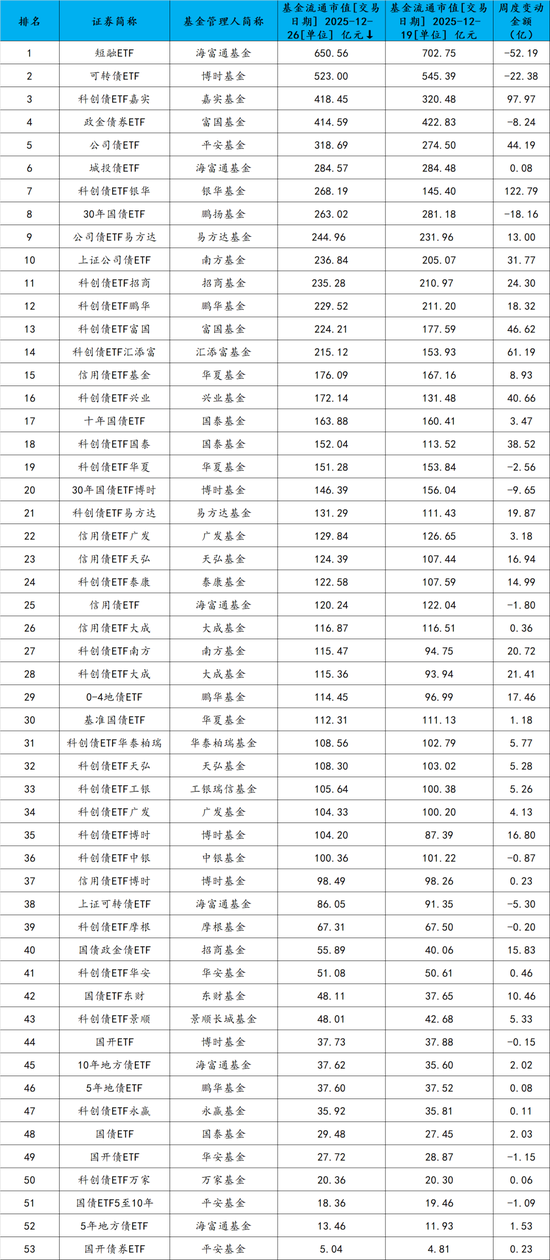
Xin Lang Cai Jing· 2025-12-29 01:36
Core Insights - Despite the industry's focus on high-quality development, many fund companies are still pushing for year-end performance boosts, which contradicts the principles of quality growth [1][10] - The management scale remains a crucial metric for fund companies to secure resources, influence industry rankings, and attract talent, especially at year-end [1][10] Fund Performance - A500 ETF products saw significant growth in scale within a week (December 19 to December 26): - Southern A500 ETF increased from 35.714 billion to 47.339 billion, a rise of 11.625 billion - Zhongzheng A500 ETF (Guotai) grew from 26.761 billion to 38.299 billion, an increase of 11.538 billion - The top five A500 ETFs all experienced growth exceeding 7 billion [10] - The Sci-Tech Bond ETF also showed a "sprint" trend: - Silver Hua Sci-Tech Bond ETF grew by 12.279 billion (from 14.540 billion to 26.819 billion) - Jia Shi Sci-Tech Bond ETF increased by 9.797 billion (from 32.048 billion to 41.845 billion) - A total of 14 bond ETFs saw growth exceeding 1 billion [10] Bond ETF Rankings - The top bond ETFs by scale as of December 26 include: 1. Short-term Bond ETF (Hai Futong) - 65.056 billion, down by 5.219 billion 2. Convertible Bond ETF (Bosera) - 52.300 billion, down by 2.238 billion 3. Sci-Tech Bond ETF (Jia Shi) - 41.845 billion, up by 9.797 billion 4. Government Bond ETF - 41.459 billion, down by 0.824 billion 5. Corporate Bond ETF - 31.869 billion, up by 4.419 billion [11][12]