
Wistron

Search documents
全球关税:10 月更新聚焦中国-Global Economic Briefing-Global Tariffs China Focus for Oct update
2025-10-29 02:52
Summary of Key Points from the Conference Call Industry Focus - The conference call primarily discusses the **US-China trade relations** and the implications of **tariff policies** on global trade patterns, particularly focusing on **Asian economies** and their trade dynamics with the US. Core Insights and Arguments 1. **Impact of Government Shutdown on Data**: The lack of data due to the government shutdown complicates the measurement of US effective tariff rates, leading to a focus on trade trends between the US and China instead [7] 2. **Supply Chain Strain Hypothesis**: The hypothesis that product complexity, rather than tariff levels, is the primary driver of trade patterns is supported by recent data [7] 3. **US-China Trade Equilibrium**: A more stable US-China trade equilibrium is expected to be established in 2026, with Chinese market share of US imports stabilizing around **10%** due to China's leadership in key supply chains [12] 4. **Tariff Dynamics**: The US is likely to maintain higher tariffs on China compared to the rest of the world, with rates in the **20-45%** range, as part of a strategy to de-risk from key supply chains [10] 5. **Negotiation Framework**: Progress in US-China negotiations is expected on various topics, including maritime logistics, agricultural trade, and export controls, aligning with the anticipated negotiation framework [11] 6. **Supply Chain Reorientation**: The shift in supply chains has been categorized into three phases, with the current phase (2022-2025) focusing on regional production bases globally due to rising labor costs and supply chain risk mitigation [20] 7. **Tariff Effects on Trade Patterns**: The initial response to tariffs has been a diversion of trade around Asia rather than to the US or Mexico, indicating a significant impact of tariffs on trade dynamics [22] 8. **Product Complexity as a Trade Driver**: Analysis shows that product complexity is a better predictor of trade shifts than tariff levels, with less complex products experiencing a greater contraction in imports [25] Additional Important Insights 1. **Market Share Shifts**: There have been notable shifts in US imports from China to countries like India and Vietnam, particularly in sectors like smartphones and laptops, indicating a potential mean reversion in trade data [14][19] 2. **Long-term Supply Chain Challenges**: The success of onshoring production to the US will take time due to high labor costs and the lack of a comprehensive supply chain ecosystem in the US [21] 3. **Chinese Export Capacity**: China accounts for over **50%** of global capacity for approximately one-third of US imports, making it challenging for the US to diversify away from reliance on Chinese goods [30] 4. **Tariff Convergence**: As Chinese tariffs converge with broader Asian tariffs, the incentives for trade diversion are expected to diminish, emphasizing the need for supply chain efficiencies [27] This summary encapsulates the key points discussed in the conference call, highlighting the ongoing complexities and dynamics of US-China trade relations and their broader implications for global trade.
NVIDIA and US Manufacturing and Robotics Leaders Drive America’s Reindustrialization With Physical AI
Globenewswire· 2025-10-28 17:40
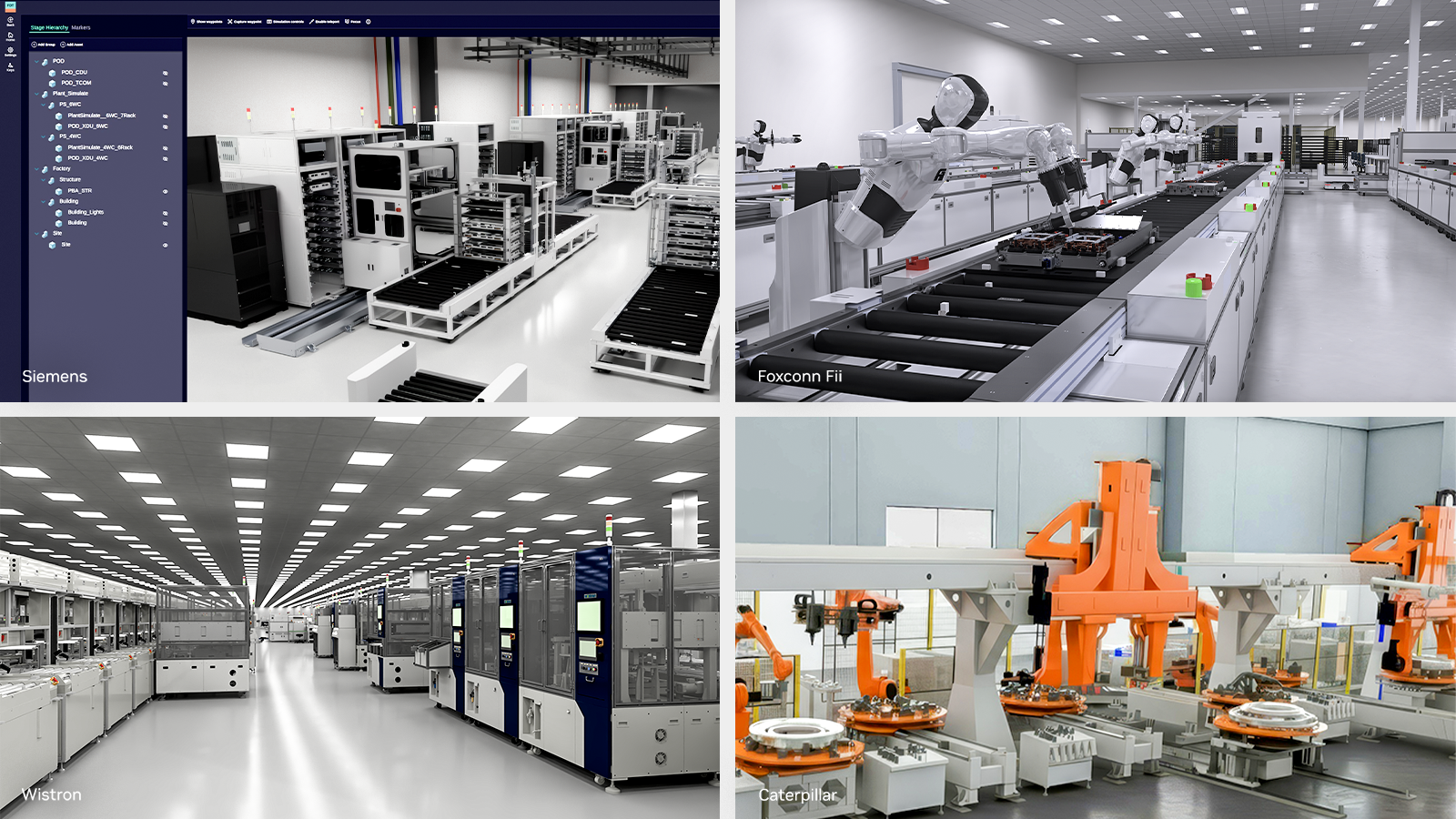
Core Insights - NVIDIA is collaborating with leading manufacturers and robotics companies to utilize Omniverse technologies for building advanced robotic factories and autonomous collaborative robots, addressing labor shortages and promoting reindustrialization in the U.S. [1][18] Group 1: NVIDIA Omniverse Technologies - NVIDIA's Omniverse technologies are being adopted to create digital twins of factories, enhancing simulation and operational efficiency [2][19] - The "Mega" NVIDIA Omniverse Blueprint is expanding to include tools for designing and simulating factory digital twins, with Siemens being the first to support this initiative [2][3][19] Group 2: Industry Adoption and Applications - Major companies like Caterpillar, Lucid Motors, and TSMC are implementing Omniverse for real-time factory planning, predictive maintenance, and supply chain optimization [7][8][9] - Belden is utilizing Accenture's Physical AI Orchestrator, which integrates NVIDIA technologies for safety monitoring and quality inspection in manufacturing environments [6] Group 3: Robotics Development - Robotics firms are leveraging NVIDIA's architecture to develop advanced robotic fleets aimed at improving productivity and safety in various industries [10][19] - Collaborations with companies like Figure and Agility Robotics are focused on creating next-generation humanoid robots using NVIDIA's simulation and training platforms [11][12] Group 4: Investment and Economic Impact - In 2025, a total of $1.2 trillion in investments was announced to enhance U.S. production capacity, primarily from electronics, pharmaceuticals, and semiconductor sectors [5] - The integration of physical AI and simulation technologies is expected to significantly accelerate the manufacturing process and enhance competitiveness in the industrial sector [5][19]


中国科技-2025 年 OCP 全球峰会 -规模化是核心焦点-Greater China Technology Hardware-2025 OCP Global Summit – Scale Up the Key Focus
2025-10-21 01:52
Summary of Key Points from the 2025 OCP Global Summit Industry Overview - The conference focused on the Greater China Technology Hardware sector, particularly in the Asia Pacific region, highlighting advancements in AI data center infrastructure and power-efficient solutions [1][3][4]. Major Releases and Innovations - Key product launches included: - AMD Helios rack featuring a double-wide form factor to support larger scale-up domains, expected to start shipping in the second half of 2026 [7][12]. - 800 VDC power architecture, which allows over 150% more power transmission through the same copper, improving power usage effectiveness by approximately 5% compared to conventional 50V systems [19]. - Google Deschutes 2MW coolant distribution unit (CDU) designed for advanced cooling solutions in AI data centers [21]. Scaling Up Infrastructure - Meta's Vice President highlighted the need for massive GPU clusters, stating that the company has scaled from 128 GPUs to 129,000 GPUs, indicating a significant demand for compute capacity [8]. - Meta plans to build more 5GW data centers, emphasizing the industry's need for increased manufacturing velocity to meet compute demands [8]. Hardware Diversity and Standardization - Meta advocates for a diverse hardware portfolio to ensure resilience in its supply chain and optimize performance for specific workloads [9]. - The company is contributing to the Open Compute Project (OCP) to drive standardization and reduce complexity in manufacturing supercomputers [9]. Challenges in Rack Design - The introduction of larger racks (Open Rack Wide form factor) presents challenges such as increased design complexity, higher transportation costs, and operational difficulties in serviceability [10]. - The industry is currently limited by copper technology, but there is a push towards optical solutions for future disaggregation [11]. Networking Innovations - The Ethernet for Scale-Up Networking (ESUN) initiative aims to enhance AI compute networking by leveraging mature Ethernet protocols [23]. - Accton and Celestica showcased new 1.6T network switches, with early adoption expected by late 2026 or early 2027 [24]. Cooling Technologies - Immersion cooling technology is projected to see a market inflection around 2028, while cold plate technology remains the mainstream solution [22]. - Google’s CDU features advanced cooling capabilities, showcasing the industry's shift towards more efficient cooling solutions [21]. Key Beneficiaries - Major beneficiaries from the AMD Helios rack include Wistron and Wiwynn, while Delta and BizLink are expected to benefit from the 800 VDC power solutions [7]. Conclusion - The 2025 OCP Global Summit underscored the critical need for scaling up AI data center infrastructure, the importance of hardware diversity, and the ongoing innovations in power and cooling technologies, setting the stage for future developments in the technology hardware industry [1][3][4].
亚洲人工智能供应链将从科技巨头看涨的人工智能资本支出中迎来多年增长-AI supply chain to embrace multi-year growth from tech giants‘ bullish AI capex
2025-10-16 13:07
Summary of Conference Call Notes Industry Overview - The technology sector, particularly focusing on AI supply chains, is expected to experience multi-year growth driven by increased capital expenditures (capex) from hyperscalers, sovereign AI projects, and enterprise AI adoption. [1][9] - Global cloud capex is projected to reach US$1.2 trillion by 2030, nearly tripling from the 2025 level, with the top five cloud service providers (CSPs) contributing 60-70% of this capex. [1][9] - OpenAI is anticipated to deploy up to 250GW of computing capacity by 2033, indicating a significant expansion in AI ecosystems. [1][9] Key Financial Projections - The top five CSPs' capex is estimated to grow by 60% and 22% year-over-year (YoY) in 2025 and 2026, respectively. [2][11] - The consensus for global cloud capex for 2025 and 2026 has increased by 26% and 47% since January 2025. [2][14] - Nvidia's investments in AI, including a partnership with OpenAI and Stargate, are expected to generate additional annual revenue of US$67-97 billion for original design manufacturers (ODMs) and US$1-2 billion for power and cooling suppliers. [2][12][15] Beneficiaries of AI Growth - Taiwanese companies are positioned to benefit significantly from the AI boom, supplying nearly all AI GPUs and over 90% of AI server and power supply components. [3][16] - Key players such as Hon Hai, Quanta, and Wistron are expected to see substantial growth due to their strong market positions and increasing demand for AI servers. [3][16] - Dell's AI server revenue is projected to grow at a compound annual growth rate (CAGR) of 33% from 2025 to 2030, indicating robust enterprise AI growth. [1][9] Investment Recommendations - Buy ratings are reiterated for several Taiwanese companies: - **Hon Hai**: Strong demand from CSPs and sovereigns, compelling valuation. [4][33] - **Quanta**: Benefiting from rising capex among top CSPs. [4][33] - **Wistron**: Strong demand for AI servers from Dell. [4][33] - **Delta**: Growth in AI power and cooling content. [4][33] - **AVC**: Increasing adoption of liquid cooling solutions. [4][33] - **King Slide**: Broad project base with Nvidia and ASICs. [4][33] Additional Insights - The report highlights the customization capabilities and proven track records of Taiwanese suppliers, which position them favorably in the AI platform migration. [3][16] - The financial health of these companies is underscored by their net cash positions and positive operating cash flows since 2010, indicating strong balance sheets. [16][17][19][21][25][27][29][31] Conclusion - The AI supply chain is poised for significant growth, with Taiwanese companies likely to be the primary beneficiaries due to their established market positions and the increasing demand for AI infrastructure. The investment outlook remains positive, with several companies recommended for purchase based on their growth potential and market dynamics. [4][33]
台湾供应链有望迎来强劲的人工智能动能及 GB300 出货量增长-TW supply chain poised for strong AI momentum & rising GB300 shipments
2025-10-16 13:07
Summary of Conference Call Notes Industry Overview - **Industry**: Technology - Asia Pacific, specifically focusing on the AI server supply chain in Taiwan - **Key Observations**: - Taiwanese AI ODMs' sales bottomed out in August 2025, with a subsequent ramp-up in GB200/GB300 server shipments starting in September 2025 [1] - Quanta and Wistron reported month-over-month sales growth of 20% and 18% respectively in September, following declines in July and August [1] - Hon Hai's sales increased by 14% quarter-over-quarter and 11% year-over-year in Q3 2025, with a notable 38% month-over-month increase in September [1] Sales Growth and Projections - **Component Sales**: - Strong monthly sales growth recorded in Q3 2025, driven by component restocking for GB200/GB300 AI server shipments [2] - Delta's Q3 2025 sales reached a record high, increasing by 21% quarter-over-quarter and 34% year-over-year, with September sales up 19% month-over-month [2] - AVC and Auras also reported significant sales growth of 32% and 12% quarter-over-quarter in Q3 2025 [2] Potential Slowdown in ASIC AI Server Shipments - **Observations**: - A potential slowdown in ASIC AI server shipments was noted in September, contrasting with the ramp-up of GB200/GB300 servers [3] - EMC's sales declined by 9% month-over-month in September after four months of growth, while Wiwynn and Accton experienced declines of 10% and 5% respectively [3] - Despite the month-over-month declines, year-over-year sales growth remained high, with expectations for a resumption of growth momentum into 2026 [3] Future Sales Expectations - **Sales Projections**: - Anticipated peak sales for Taiwanese AI supply chain in Q4 2025 due to increased demand from top US CSPs [4] - Continued growth momentum expected into 2026, supported by solid demand from CSPs, enterprises, and sovereigns [4] - Buy ratings maintained for leading AI server companies including Hon Hai, Quanta, Wistron, Delta, AVC, and King Slide [4] Company-Specific Insights - **Delta**: - Q3 2025 preliminary sales reached NT$150 billion, with a 21% quarter-over-quarter and 34% year-over-year increase [15] - EPS estimates for 2025-2027 adjusted upwards by 7-9%, with a price objective raised to NT$1,130 [15][16] - Expected to see continued robust sales momentum into 2026, with a projected sales and earnings CAGR of 22% and 30% respectively [19] - **Quanta**: - Reported Q3 2025 preliminary sales of NT$495 billion, reflecting a 2% quarter-over-quarter decline but a 17% year-over-year increase [20] - Sales growth of 20% month-over-month in September indicates a ramp-up in GB300 AI server shipments [20] - EPS estimates for 2025-2027 trimmed by 1-6%, but price objective maintained at NT$360, with a projected sales and earnings CAGR of 24% and 15% respectively [20] Key Takeaways - The Taiwanese AI server supply chain is experiencing a significant recovery with strong sales growth in Q3 2025, driven by increased demand for AI servers from major cloud service providers. - While there are signs of a slowdown in ASIC server shipments, the overall outlook for the AI server market remains positive, with expectations for continued growth into 2026. - Companies like Delta and Quanta are well-positioned to benefit from this growth, with revised earnings projections reflecting their strong sales performance and market demand.
中国加大稀土出口管制,美方计划对中加征100%关税 | 投研报告
Zhong Guo Neng Yuan Wang· 2025-10-14 02:24
重大事件 1)中国具有针对性的稀土出口管制措施,新增对钼、锰、铽、铑、镭五种关键稀土元 素的管制,并规定只要产品含中国稀土原料,无论是否出口均需许可。2)美国总统特朗普 表示将于11月1日起对中国加征100%的额外关税并管制所有关键软件的出口,以此回应中国 实施稀土出口管制。3)特朗普政府正加大力度,将联邦政府对企业的拨款转换为股权,以 保障美国关键矿产和半导体供应链的安全,旨在减少对中国的依赖。以下公司与此次战略投 报告要点: 期间(2025.9.29-2025.10.12)市场回顾 1)海外AI芯片指数期间上涨2.66%,只有博通小幅度下跌3%,其余成分股均出现上 涨。2)国内AI芯片指数下跌0.6%,其中通富微电涨幅超20%,兆易创新与澜起科技涨幅超 过10%。3)英伟达映射指数上涨0.2%,相关产业链公司股票多数出现下滑的情况。4)服务 器ODM指数上涨5.8%,成分股大都呈现上涨情况,其中Wistron、超微以及Wiwynn涨幅超 10%。Quanta下跌23.1%,为唯一下跌成分股。5)存储芯片指数上涨12.2%,近期存储芯片 板块受AI需求驱动持续活跃,但企业级需求增长与供应链调整导致市场波动加 ...
Astera Labs Showcases Rack-Scale AI Ecosystem Momentum at OCP Global Summit
Globenewswire· 2025-10-13 13:00
Core Insights - Astera Labs is leading the development of semiconductor-based connectivity solutions for rack-scale AI infrastructure, emphasizing the shift towards unified computing platforms rather than individual servers [1][2] - The company is showcasing its ecosystem collaborations at the 2025 OCP Global Summit, highlighting the importance of open standards for AI Infrastructure 2.0 [1][2] Industry Trends - The AI infrastructure landscape is transitioning from server-level architectures to rack-scale systems, driven by significant investments from hyperscalers [2] - Open standards are essential for integrating diverse accelerators, interconnects, and management tools, enabling optimized solutions for specialized AI workloads [2] Ecosystem Collaborations - Astera Labs is collaborating with various industry leaders, including AMD, Arm, and Molex, to enhance AI infrastructure through high-performance connectivity solutions [3][4][9] - These partnerships focus on delivering reliable, high-speed cable solutions and ensuring robust signal integrity across rack-scale distances [3][9] Technical Innovations - The company is presenting technical sessions on UALink deployment strategies and PCIe 6 security considerations at the OCP Global Summit [2] - Astera Labs' Intelligent Connectivity Platform integrates multiple semiconductor-based technologies, including CXL, Ethernet, PCIe, and UALink, to create cohesive systems [13] Market Position - Astera Labs positions itself as a key player in the AI infrastructure market by providing purpose-built connectivity solutions grounded in open standards [13] - The company's collaborations aim to accelerate the adoption of open rack architectures, enhancing performance, interoperability, and scalability for customers [10][12]


台湾 ODM 品牌 - 3 个月前瞻:苹果供应链势头持续强劲;人工智能服务器增长趋势喜忧参半-Taiwan ODM_Brands_ 3-month Preview_ Apple supply chain sustained strong momentum; AI server growth trend mixed
2025-10-09 02:00
Summary of Conference Call Notes Industry Overview - The conference call focuses on the Taiwan ODM/Brands sector, particularly in the AI servers and PCs supply chain, with a specific emphasis on companies such as Hon Hai, Wistron, Quanta, Asus, AVC, and Wiwynn. Key Points and Arguments Revenue Growth Expectations - **Month-over-Month (MoM) Growth**: - Average revenue growth for the 10 companies is projected at **16%** in September, **-1%** in October, and **0%** in November 2025, with Hon Hai expected to see a **33%** MoM increase in September due to new smartphone models [3][17]. - Compal and Asus are also expected to experience MoM growth of **28%** and **17%**, respectively, driven by customer demand at the end of the September quarter [3]. - **Year-over-Year (YoY) Growth**: - Average revenue growth is anticipated at **31%** in September, **29%** in October, and **32%** in November 2025, primarily due to the ramp-up of rack-level AI servers and increased penetration of liquid cooling technology [4]. Company-Specific Insights - **Hon Hai**: - Expected to achieve **NT$2.0 trillion** in revenues for 3Q25, reflecting a **9% YoY** and **13% QoQ** growth, supported by AI server demand and new smartphone launches [17]. - September revenues are projected to grow **33% MoM** and **10% YoY** [18]. - **Wistron**: - Anticipated to see **53% YoY** growth in September, driven by rising demand for ASIC AI servers [4]. - **AVC**: - Expected to grow **90% YoY** and **22% QoQ** in 3Q25, with September revenues projected at **NT$36 billion** [39]. - The company is benefiting from the increasing adoption of liquid cooling technology, which is expected to contribute significantly to its revenue [39]. - **Wiwynn**: - Projected to achieve **141% YoY** growth in 3Q25, with September revenues expected to normalize to **NT$69 billion**, still reflecting a **100% YoY** increase [48]. - **Quanta**: - Expected to see a **19% YoY** growth in 3Q25, with revenues ramping up from September due to new AI server models [23][25]. Market Trends - The AI server market is experiencing mixed growth trends, with some companies like Hon Hai gaining market share while others may face challenges due to model transitions [3]. - The penetration rate of liquid cooling technology is rising, which is expected to drive growth in companies like AVC [39]. Risks and Challenges - Key risks identified include: - Slower-than-expected ramp-up of AI server business [21][47]. - Weaker-than-expected performance in electric vehicle (EV) solutions and competition in consumer electronics [22]. - Potential challenges in the recovery of general server demand and increased competition in the server ODM market [55]. Additional Important Information - The conference highlighted the importance of new product cycles and technological advancements in driving revenue growth across the sector. - Analysts maintain a positive outlook on companies like Hon Hai, AVC, and Wiwynn, with buy ratings reflecting confidence in their growth trajectories [2][39][54].
大中华区科技硬件:人工智能科技硬件全面升级-Investor Presentation-Greater China Technology Hardware AI Tech Hardware Upgrades Across the Board
2025-10-09 02:00
Summary of Investor Presentation on Greater China Technology Hardware: AI Tech Industry Overview - The presentation focuses on the Greater China Technology Hardware sector, particularly in AI technology hardware upgrades [4][5][6] - The overall industry view is categorized as "In-Line" [1] Core Insights and Arguments - **AI GPU and ASIC Server Upgrades**: There are significant opportunities in AI GPU and ASIC server/rack design upgrades, with major design upgrades anticipated for the GB300, Vera Rubin platform, and Kyber architecture [4][5] - **Enhanced Computing Power**: AI ASIC servers are expected to enhance computing power and increase rack density, with demand growth projected for 2026-2027 [4][5] - **Power Solutions**: Upgrades to 800V HVDC power architecture and the growing adoption of liquid cooling solutions are highlighted as key trends [4][5] - **PCB/Substrate Capacity Expansion**: A wave of capacity expansion in PCB/substrate is necessary to support ongoing design upgrades [4][5] - **Data Network Improvements**: Upgrades in data and power interconnects will lead to increased data network transmission speed and capacity [4][5] - **Consumer Electronics Demand**: Demand in consumer electronics remains lukewarm, with anticipation for upcoming foldable iPhone models in the second half of 2026 [4][5] - **AI PC Proliferation**: The proliferation of AI PCs is expected to take time, indicating a gradual market adoption [4][5] - **Supply Chain Reorientation**: The status of supply chain reorientation and its potential impacts are noted as important considerations [4][5] Key Stock Ideas - **AI Server Components**: Companies such as Delta Electronics, AVC, BizLink, King Slide, Chenbro, and Gold Circuits are identified as key players in AI server components [4][5] - **AI Server ODM/OEMs**: Wistron, Hon Hai/FII, Quanta, Lenovo, and Accton are highlighted as significant ODM/OEMs in the AI server space [4][5] Valuation Comparison - A detailed valuation comparison of various companies within the sector is provided, including metrics such as EPS, P/E ratios, P/B ratios, and trading volumes [5] - Notable companies include: - **Delta Electronics**: Closing price of 942.00 with a target of 1111.0 and a P/E ratio of 21.05 for 2025 [5] - **Hon Hai**: Closing price of 226.50 with a target of 250.0 and a P/E ratio of 13.83 for 2025 [5] - **Foxconn Tech**: Closing price of 70.60 with a target of 54.00 and a P/E ratio of 2.93 for 2025 [5] Additional Important Points - The report emphasizes the potential for share price upside in the context of the discussed upgrades and market trends [4][5] - The overall sentiment reflects cautious optimism regarding the future of AI technology hardware in Greater China, with specific attention to the evolving landscape of consumer electronics and server technology [4][5]


长江存储开发TSV封装技术,台积电2nm制程涨价 | 投研报告
Zhong Guo Neng Yuan Wang· 2025-09-30 02:15
Market Overview - The overseas AI chip index increased by 0.54% this week, with Marvell rising over 10% while Broadcom fell by 3.0% [2] - The domestic AI chip index rose by 5.2%, with Langchao Technology increasing over 10%, while Rockchip and Cambricon experienced slight declines [2] - The Nvidia mapping index decreased by 3.2%, with Wolong Materials rising over 20% and Taicheng Technology falling close to 10% [2] - The server ODM index increased by 0.7%, with Wistron rising by 4.9%, the highest among its constituents, while Quanta continued its downward trend with a 7.5% decline [2] - The storage chip index rose by 6.1%, with Jucheng shares increasing over 50% and Demingli rising by 22.2%, while Baiwei Storage and Jiangbolong both saw increases over 10% [2] - The power semiconductor index increased by 7.0%, with all constituent stocks showing an upward trend; the A-share Apple index rose by 1.5%, while the Hong Kong Apple index fell by 0.6% [2] Industry Data - The high bandwidth memory (HBM) market is expected to grow nearly threefold between 2024 and 2026, with HBM3E being the dominant product and HBM4 set to enter the market in 2026, indicating a rapid pace of technological iteration [3] - The global VR headset market continues to decline due to weak consumer demand, while the AR smart glasses market shows strong growth, with shipments increasing by 50% year-on-year in the first half of the year [3] - Despite pressures on shipment growth, the average selling price of smartphones globally is expected to rise steadily, with market revenue growth outpacing shipment growth [3] Major Events - Yangtze Memory Technologies, a leading flash memory manufacturer in China, is actively seeking technological breakthroughs and plans to develop key technologies for HBM production, considering using its new Wuhan factory for DRAM chip production [4] - TSMC plans to increase its 2nm process pricing by 50%, putting significant cost pressure on its customers, while Samsung Electronics intends to offer 2nm foundry services at two-thirds the price of TSMC to capture market share [4] - OpenAI has signed an agreement with Apple's assembler, Luxshare Precision, to jointly develop a consumer device that can collaborate deeply with AI models [4]