
中国软件

Search documents
计算机行业事件点评:国产核心软硬件当自强
Minsheng Securities· 2025-10-12 05:37
Investment Rating - The report maintains a "Recommended" rating for the industry [4] Core Insights - The report highlights the significant impact of U.S. tariffs and export controls on Chinese products, particularly in the software and hardware sectors, emphasizing the need for domestic innovation and self-reliance [1] - The Chinese government is actively promoting domestic products through favorable procurement policies, including a 20% price deduction for local products in competitive bidding [1] - The report indicates that the domestic chip industry is gaining traction, particularly in the financial sector, with major projects like the Industrial and Commercial Bank of China's procurement of Huaguang chip servers valued at approximately 3 billion yuan [1] - The report notes a substantial increase in domestic server procurement by China Unicom, with 90.1% of the servers being domestically produced, reflecting a strong trend towards localization [2] - The report anticipates a turning point for the domestic innovation industry (Xinchang) driven by supportive policies and improving performance of listed companies in the sector [2][3] Summary by Sections - **Policy Support**: The government emphasizes high-level technological self-reliance as a key development focus, aiming to enhance core technology research and innovation capabilities [2] - **Market Performance**: Several listed companies in the Xinchang sector have shown improved performance compared to the previous year, indicating a positive outlook for the industry [3] - **Investment Recommendations**: The report suggests focusing on key players in the Xinchang sector, including China Software, Dameng Data, and others, as well as leaders in specific sub-sectors like industrial software and the Harmony OS ecosystem [3]



关税战再起,半导体板块走向会和4月有所不同
是说芯语· 2025-10-12 02:07
芯片小韭菜 . 以下文章来源于芯片小韭菜 ,作者芯片小韭菜 专注芯片行业及公司基本面研究,不提供操作建议。 先回顾一下4月的情况,我们在长假期间,特朗普宣布对全球的对等关税,我们宣布反制,然后长假后 第一个交易日(4月7号),我们大跌。之后双方继续互相加关税,但市场已经没有反应了,4月8号在底 部震荡,4月9号直接拉起,之后一路向上。 再看板块,4月7号是普跌。 半导体板块,4月8号企稳,9号拉出大阳线。 达链果链,8号继续大跌,9号大跌以后V起来。 红利消费等:8号大涨,9号震荡。 可以说,当时关税战初期,很多资金跑去红利避险,之后则是大力资金冲进了半导体,自主可控走得最 好,当周就实现了反包。 再详细回顾一下当时的半导体各分支。 当时因为反制加税,市场的龙头板块是模拟芯片。它们有些甚至4月7号就已经低开高走收红。龙头是纳 芯微。 再看自主可控的分支,代工,中芯国际7号中等跌幅,8号小涨,9号直接大阳线反包。设备,北方华创7 号,8号小跌,9号直接大阳线反包。算力,寒武纪7号大跌,8号企稳,9号大阳线差一点反包。EDA, 华大九天,7号小跌,8号9号连续大涨。 针对很多人对过去的学习,个人认为这次的最大跌幅 ...



计算机行业周观点第41期:OpenAI动作不断AI迎密集催化,美国或将对所有关键软件实施出口管制-20251012
Western Securities· 2025-10-12 00:39
Investment Rating - The report assigns an "Overweight" rating to the computer industry, indicating an expected increase in the sector's performance exceeding the market benchmark by over 10% in the next 6-12 months [7]. Core Insights - OpenAI's release of the Sora 2 AI video generation model marks a significant advancement in physical accuracy, consistency, and controllability, potentially leading to a new era in video technology akin to the "GPT-3.5 moment" [1]. - The Sora app, based on Sora 2, has achieved over 1 million downloads within five days of its launch, surpassing the download speed of ChatGPT, indicating its potential as a landmark application in the AI era [1]. - OpenAI's collaboration with AMD to deploy 6GW of AMD GPUs, starting with an initial 1GW, highlights the growing demand for advanced computing power in AI applications [3]. - The U.S. government's announcement of export controls on all critical software emphasizes the urgency for domestic software alternatives, creating opportunities for local software companies [3]. Summary by Sections AI Developments - The Sora 2 model introduces improvements in adherence to physical laws, logical consistency in virtual environments, and audio-visual synchronization [1]. - The Sora app allows users to create and remix AI-generated content, enhancing user engagement and creativity [1]. Strategic Partnerships - OpenAI's partnership with AMD includes a potential acquisition of up to 160 million shares, which could result in OpenAI holding a 10% stake in AMD if fully executed [3]. Market Implications - The U.S. export controls on software are expected to create a "golden window" for domestic software development, accelerating the self-sufficiency of China's software industry [3]. - The report suggests monitoring various companies in the software and AI sectors, including Hikvision, Cambricon, and Kingsoft, among others, for potential investment opportunities [4].
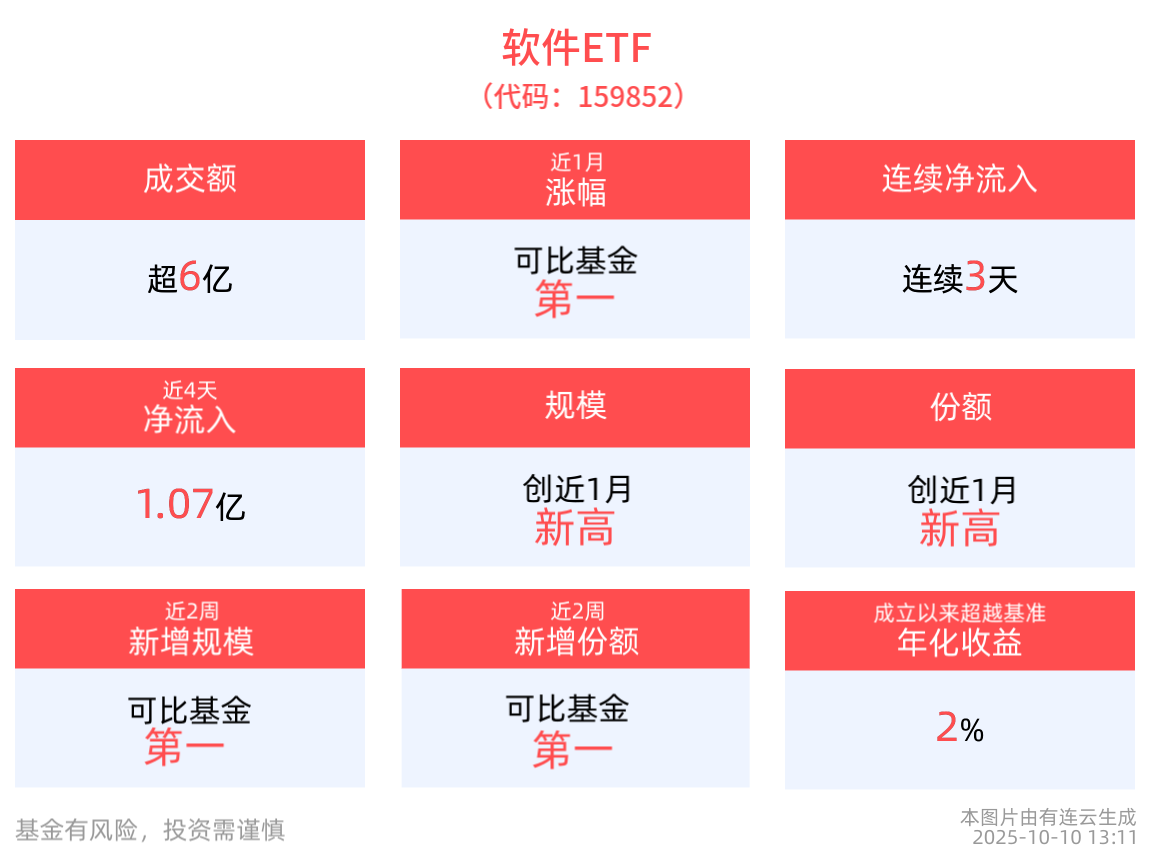
软件ETF(159852)近3天获资金连续净流入超亿元,规模、份额均创近1月新高!
Xin Lang Cai Jing· 2025-10-10 05:44
Core Insights - The software service index has declined by 3.92% as of October 10, 2025, with major stocks like Hongsoft Technology and UFIDA leading the drop [1] - The software ETF has seen significant trading activity, with a turnover rate of 11.35% and a transaction volume of 602 million yuan, indicating a vibrant market [2] - OpenAI has launched a new video generation model, Sora2, which accurately simulates real-world physics and generates environmental sound effects, marking a significant advancement in the video generation field [3] Group 1: Software ETF Performance - The software ETF's latest scale reached 5.189 billion yuan, a one-month high, and it ranks first among comparable funds [2] - The ETF has experienced continuous net inflows over the past three days, with a peak single-day net inflow of 72.5536 million yuan, totaling 113 million yuan [2] - Over the past three years, the software ETF's net value has increased by 37.90%, with the highest monthly return since inception being 39.35% [2] Group 2: Major Stocks in Software Index - The top ten weighted stocks in the software service index account for 62.41% of the index, with Keda Xunfei, Tonghuashun, and Kingsoft being the most significant contributors [2] - Keda Xunfei has seen a decline of 4.86%, while Kingsoft has dropped by 6.02%, indicating a challenging environment for these companies [5] - Other notable declines include Tonghuashun at -2.27% and Hengsheng Electronics at -2.52%, reflecting a broader trend of decreasing stock prices in the sector [5] Group 3: AI and Investment Opportunities - The rapid iteration of large models in architecture, efficiency optimization, and GPU chip adaptation presents substantial investment returns in the large model industry chain [3] - Recent positive changes in the model, application, and computing infrastructure sectors are expected to boost investor confidence in the industry's future [3] - Investors are encouraged to focus on multi-modal AI applications, domestic computing power, and storage sectors as potential growth areas [3]
中国软件 - 8 月营收同比增长达 15% 且环比上升;人工智能支出增加将支撑后续环比增长-China Software_ Aug rev up to 15% YoY with MoM increase; Rising AI spending to support sequential growth ahead
2025-10-10 02:49
Summary of China Software Industry Conference Call Industry Overview - The China software industry experienced a growth of **15.1% YoY** in August 2025, an increase from **14.9%** in July and **14.0%** in June 2025, indicating a positive trend in the sector [1][10] - Cumulative revenues for the first eight months of 2025 (8M25) grew by **12.6% YoY**, compared to **11.2% YoY** in the same period of 2024 [1][18] Key Insights - The growth in the software market is supported by increased spending on AI tools by consumer clients and successful project wins in the business sector, particularly in enterprise and government [1][10] - The **Small and Medium Business (SMB) Purchasing Managers' Index (PMI)** improved to **48.2** in September 2025 from **46.6** in August, although it remains below the **49.3** level seen in May 2025, suggesting a gradual recovery in client IT spending [10][17] - The integration of AI capabilities into software applications is expected to drive sequential growth in the coming months [1][10] Segment Performance - In August, segments such as **semi design**, **cloud computing**, and **basic software** outperformed others [2] - The **AI software products** segment showed strong performance, with notable increases in Monthly Active Users (MAU) for productivity tools and video/image generation tools [2][5] Financial Metrics - The aggregate revenue of software companies in China reached **Rmb1.3 trillion (US$183 billion)** in August 2025, with a net margin of **17.4%**, slightly down from **18.2%** in July [18][19] - The net income for the software sector in August was **Rmb230 billion (US$32 billion)**, contributing to an 8M25 net margin of **13.7%**, which is an improvement from **13.1%** in 7M25 [19][26] Market Dynamics - The IT services segment remains the largest contributor to revenue, accounting for **68%** of total revenues, followed by software products at **22%** and embedded system software at **8%** [25][29] - The revenue from non-China markets increased to **US$6.5 billion**, representing an overseas exposure of **3.5%**, up from **3.2%** in July 2025 [25][30] Investment Recommendations - Companies highlighted for potential investment include **Sensetime** (AI), **Kingsoft Office** (Office Software), **Kingdee** (ERP), **Hundsun** (Finance), **TUYA** (IoT software), and **Empyrean** (EDA software) [3] Conclusion - The China software industry is on a positive trajectory with strong growth in AI spending and improving SMB sentiment, indicating a favorable environment for investment and expansion in the sector [1][10][18]
软件ETF(159852)涨近3%!成交额破4亿,软件国产替代将加速
Jin Rong Jie· 2025-10-09 07:25
Group 1 - The core viewpoint of the articles highlights the positive performance of the software industry in China, with significant growth in revenue and profits, as well as a favorable government policy promoting domestic products in procurement [1][2]. Group 2 - As of 13:21, the Shenzhen Component Index rose by 1.54%, the ChiNext Index increased by 1.34%, and the CSI Software Index saw a rise of 2.87%. Notable individual stock performances included Keda Xunfei up over 6% and several others like 360 and China Software rising over 3% [1]. - The software business revenue reached 96,409 billion yuan in the first eight months of 2025, marking a year-on-year increase of 12.6%. The total profit of the software industry was 13,186 billion yuan, reflecting a 13.0% year-on-year growth [2]. - Software business exports amounted to 404.4 million USD, showing a year-on-year growth of 6.4% [2]. - The Software ETF (159852) tracking the CSI Software Service Index had a management fee rate of 0.50% and a custody fee rate of 0.10% annually. The top ten weighted stocks in the ETF account for over 62.41% of the total weight [2].
中国软件涨2.03%,成交额7.32亿元,主力资金净流出37.58万元
Xin Lang Cai Jing· 2025-10-09 03:31
Core Viewpoint - China Software's stock has shown a positive trend with an 8.72% increase year-to-date, reflecting strong market performance and investor interest [1][2]. Financial Performance - For the first half of 2025, China Software reported revenue of 2.242 billion yuan, a year-on-year increase of 13.01% [2]. - The company experienced a net profit loss of 74.5263 million yuan, but this represented a significant year-on-year improvement of 72.67% [2]. Stock Market Activity - As of October 9, the stock price was 50.76 yuan per share, with a trading volume of 732 million yuan and a market capitalization of 47.399 billion yuan [1]. - The stock has seen a 1.56% increase over the last five trading days and a 12.52% increase over the last 60 days [1]. Shareholder Information - As of June 30, the number of shareholders decreased by 9.92% to 156,200, while the average number of circulating shares per person increased by 11.02% to 5,401 shares [2][3]. - The top ten circulating shareholders include significant institutional investors, with Hong Kong Central Clearing Limited holding 12.5531 million shares, an increase of 535,800 shares from the previous period [3]. Business Segmentation - The company's revenue composition includes 42.43% from industry solutions, 33.08% from proprietary software products, and 23.86% from service-oriented business [1].
20%价格优惠支持,政府采购将采用本国产品标准,国产化进程有望提速
Xuan Gu Bao· 2025-10-08 15:13
Group 1 - The State Council issued a notice on September 30, 2023, regarding the implementation of domestic product standards in government procurement, effective from January 1, 2026 [1] - The notice specifies that domestic products must be produced within China and meet a certain cost ratio for components produced domestically, with additional requirements for key components and processes [1] - A 20% price evaluation discount will be granted to domestic products compared to non-domestic products during government procurement activities, enhancing the price competitiveness of domestic products [1] Group 2 - Changjiang Securities noted that the 20% price evaluation discount acts as an "invisible subsidy," potentially altering the existing market competition landscape [1] - The introduction of domestic product standards is expected to improve the fairness and transparency of government procurement policies and promote the localization of supply chains in key industries [1] - Key sectors such as the domestic chip industry, domestic operating systems, and Huawei's supply chain are anticipated to benefit from this policy [1] Group 3 - China Software has a complete business chain covering operating systems, middleware, security products, and application systems across important sectors of the national economy [2] - Kirin Trust's operating system is based on the domestic openEuler community and has received recognition from national and industry authorities, ensuring compliance with government procurement standards [2]

中国软件国际(00354.HK):主席增持彰显长期信心
Ge Long Hui· 2025-09-30 11:06
Core Insights - Company Chairman Dr. Chen Yuhong has increased his shareholding, demonstrating confidence in the company's long-term development [1] - The company has been appointed as a city partner for the open-source HarmonyOS innovation application and ecosystem construction in the intelligent transportation sector in Xi'an [1] - The company is positioned as a full-stack service provider in the HarmonyOS ecosystem, covering hardware access, software adaptation, and scenario development [1] - The company has deep-rooted technology in operating systems, having developed the KaihongOS and the distributed heterogeneous robot operating system M-Robots OS, leading in contributions to the open-source Harmony community [1] - The company has developed the "Hongyun Virtual Machine" to ensure compatibility with the Windows ecosystem, supporting the initial promotion of HarmonyOS in the PC sector [1] - The company has secured new orders in its ERP business, winning a bid for the 2025-2027 human outsourcing service centralized procurement project from Sinochem Information Technology Co., Ltd [1] - The company has partnered with Silicon-based Flow to launch an AI platform that integrates heterogeneous computing power and vector databases, facilitating the large-scale implementation of AI in various industries [1] Industry Developments - The company is building an AI-native digital foundation by integrating cloud and computing power, establishing a "new triangle" model with Huawei and local governments [2] - The company continues to lead in the Huawei cloud ecosystem, maintaining the largest scale and market share in cloud services and CTSP cloud transformation services [2] - The company is expanding its computing power operations from simple leasing to comprehensive AI services, including model training and scenario development [2] - Revenue projections for the company are set at 17.8 billion, 19.46 billion, and 22.14 billion yuan for 2025-2027, with net profits expected to be 610 million, 730 million, and 890 million yuan respectively [2]
申万宏源:维持中国软件国际“买入”评级鸿蒙生态建设全栈领跑
Xin Lang Cai Jing· 2025-09-30 09:01
Core Viewpoint - The report from Shenwan Hongyuan maintains the profit forecast for China Software International (00354), projecting revenues of 17.8 billion, 19.46 billion, and 22.14 billion yuan for 2025-2027, with net profits attributable to ordinary shareholders of 610 million, 730 million, and 890 million yuan respectively, and maintains a "buy" rating [1] Group 1: Hongmeng Ecosystem Development - The company has been selected as a city partner for the open-source Hongmeng innovation application and ecosystem construction in the field of intelligent transportation in Xi'an, playing a full-stack service role in "hardware access + software adaptation + scenario development" within the Hongmeng ecosystem [1] - The company has deep-rooted core technologies in operating systems, building an IoT digital foundation based on KaihongOS and releasing the distributed heterogeneous robot operating system M-Robots OS, while continuing to lead in code contributions to the open-source Hongmeng community [1] - The company has a significant advantage in the PC ecosystem, having developed the "Hongyun Virtual Machine" solution to achieve compatibility with the Windows ecosystem, providing crucial support for the initial promotion of Hongmeng in the PC sector and the trust-based market expansion [1] Group 2: ERP Business and New Orders - The company has recently won a bid for the centralized procurement project for human outsourcing services from Sinochem Information Technology Co., Ltd. for 2025-2027, covering three key categories: consulting services, ERP, and implementation and operation maintenance [1] Group 3: AI Model Implementation and Cloud Computing - On June 21, the company collaborated with Silicon-based Flow to launch a joint solution that includes four core platforms: a high-performance AI platform integrating heterogeneous computing power and vector databases, a graph database, and a search engine, unifying model training and deployment processes to facilitate efficient knowledge retrieval [1] - The company is developing a native AI digital foundation by integrating cloud and computing power, with Huawei Cloud continuing to lead in cloud business scale, ecosystem share, and CTSP cloud transformation service provider share [1] - The company's computing power operation business is expanding its footprint in collaboration with Huawei and local governments [1]