鹏华基金

Search documents
ETF午评 | 电网设备领涨,电网设备ETF、电网ETF涨5%
Ge Long Hui· 2026-01-19 04:16
Market Performance - The A-share market showed mixed performance in the morning session, with the Shanghai Composite Index up by 0.13%, the Shenzhen Component down by 0.01%, and the ChiNext Index down by 0.64% [1] - The Northbound 50 Index increased by 0.32%, while the total trading volume in the Shanghai and Shenzhen markets reached 180.65 billion yuan, a decrease of 20.37 billion yuan compared to the previous day [1] - Over 3,300 stocks in the market experienced gains [1] Sector Performance - The top-performing sectors included electric grid equipment, precious metals, tourism and hotels, glyphosate, minor metals, airport and shipping, and military equipment [1] - Conversely, sectors that saw declines included insurance, cultural media, state-owned cloud services, computing power leasing, and weight loss drugs [1] ETF Performance - The electric grid concept ETFs performed strongly, with Huaxia Fund's electric grid equipment ETF, Guotai Fund's electric grid ETF, and GF Fund's electric grid ETF rising by 5.27%, 5.13%, and 5.1% respectively [1] - The tourism sector also saw gains, with the Fortune Fund's tourism ETF and Huaxia Fund's tourism ETF increasing by 3.92% and 3.5% respectively [1] - The chemical sector was active, with Penghua Fund's chemical ETF and Guotai Fund's leading chemical ETF rising by 3% and 2.94% respectively [1] Hong Kong Market - The Kexin 100 ETF enhanced index fund fell by 5% [2] - The Hong Kong innovative drug sector declined, with the Hong Kong Stock Connect innovative drug ETF and the Hong Kong Stock Connect medical ETF from Fortune both dropping by 3.07% and 3.02% respectively [2]
佳驰科技股价涨5.09%,鹏华基金旗下1只基金重仓,持有11.28万股浮盈赚取37.67万元
Xin Lang Cai Jing· 2026-01-19 04:01
Group 1 - The core viewpoint of the news is that Jiachi Technology has seen a significant increase in stock price, rising 5.09% to 69.00 CNY per share, with a total market capitalization of 27.601 billion CNY and a trading volume of 1.30 billion CNY [1] - Jiachi Technology specializes in the EMMS industry, focusing on independent innovation and breaking foreign technology monopolies, with a product revenue composition of 71.46% from electromagnetic functional structural components, 25.71% from electromagnetic functional coating materials, and 2.58% from electromagnetic compatibility materials [1] - The company has experienced a cumulative stock price increase of 1.55% over the past three days, indicating positive market sentiment [1] Group 2 - Penghua Fund has a significant holding in Jiachi Technology, with its Penghua Core Advantage Mixed A fund holding 112,800 shares, representing 5.11% of the fund's net value, making it the fifth-largest holding [2] - The fund has generated a floating profit of approximately 376,700 CNY today, with a floating profit of 112,800 CNY during the three-day stock price increase [2] - The Penghua Core Advantage Mixed A fund has a total asset size of 155 million CNY and has achieved a year-to-date return of 3.83% and a one-year return of 49.65% [2]
基金早班车丨AI应用公司成公募“打卡地”,调研热度领跑开年赛道
Sou Hu Cai Jing· 2026-01-19 00:54
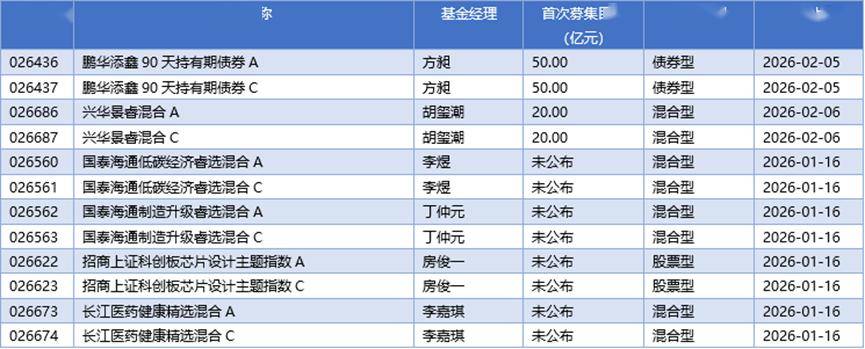
(1)01月16日新发基金共有12只,主要为混合型基金和债券型基金,其中鹏华添鑫90天持有期债券A募集目标金额达50.00 亿元;基金分红100只,多为债券型,派发红利最多的基金是鹏华丰锐债券型证券投资基金(LOF),每10份基金份额派发红 利20.2320元。 (2)1月16日,沪深300ETF、A500ETF等多只宽基产品早盘高开后震荡放量,午后成交再度活跃,9只核心宽基ETF合计成 交突破百亿元,多只创历史天量。量能激增多由机构资金借道快速调仓所致:部分资金为应对规则变化或博弈春季行情, 通过一级申购与二级交易同步加仓宽基,既保持组合流动性,又避免个股踩雷,短期放量或成为行情风向标。 (3)震荡市中再现"冰火两重天":一方面,科技、红利等主题权益基金因申购火爆相继提前结募,5只产品启动比例配 售;另一方面,沪深300、中证500等宽基ETF单日成交破百亿,却伴随大额净赎回。业内人士指出,机构借道宽基快速兑 现收益,并转向高景气赛道主动产品,资金"腾挪"显示春季行情布局提前启动,投资者应关注产业趋势而非盲目追高。 (3)数据显示,截至1月16日,2026年以来已有超200只基金宣布分红,总金额311.56 ...

这些主题,资金大幅净流入
Zhong Guo Zheng Quan Bao· 2026-01-18 23:34
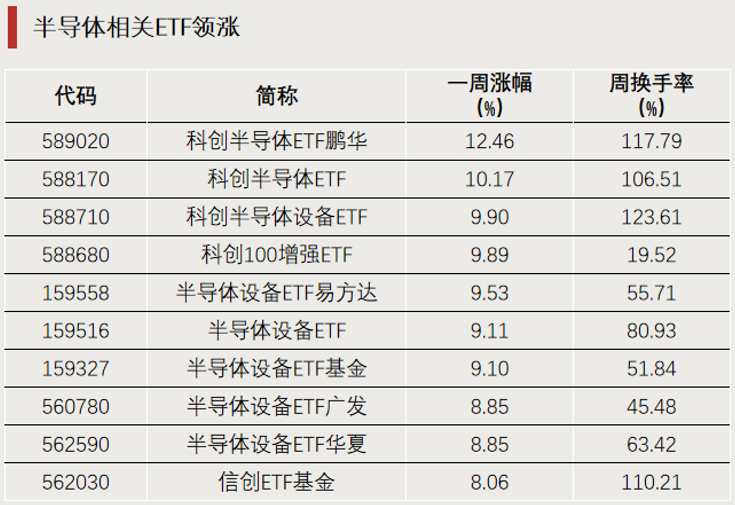
Group 1: ETF Performance - Semiconductor-related ETFs led the gains from January 12 to 16, with the Penghua Semiconductor ETF and the Sci-Tech Semiconductor ETF both exceeding a weekly increase of 10% [1][3] - The top ten ETFs by weekly increase were predominantly semiconductor-related, with several ETFs showing gains over 8% [3] - Year-to-date, as of January 16, multiple semiconductor ETFs have already increased by over 20%, outperforming the broader market [3] Group 2: Fund Flows - From January 12 to 16, the software ETF (159852) saw the highest net inflow of 7.543 billion yuan, followed by the non-ferrous metals and media ETFs, each exceeding 6 billion yuan [2][8] - The overall trading activity was robust, with broad-based ETFs like the A500 ETF and the CSI 300 ETF leading in transaction volumes [9] Group 3: Sector Performance - Aerospace and satellite-related ETFs experienced significant declines, with several ETFs dropping over 6% during the same period [6][7] - High turnover rates were noted in many aerospace and satellite ETFs, exceeding 100% [6] Group 4: Market Outlook - The market is expected to maintain a stable and positive trend, supported by a strengthening yuan and improving fundamental expectations [11][12] - The easing of monetary policies in major economies is providing a favorable external funding environment for emerging market assets [12]
新基金发行加速 多只产品提前结募
Zhong Guo Zheng Quan Bao· 2026-01-18 20:45
Core Viewpoint - The public fund issuance market has shown significant growth since the beginning of the year, characterized by rapid increases in both volume and efficiency, reflecting a recovery in market confidence and changes in product strategies and investor allocation concepts [1][4]. Group 1: Fund Issuance Trends - Over 80 new funds have been launched as of January 18, 2023, marking an increase compared to the same period last year [1]. - In the week from January 12 to January 18, 36 new funds were launched, indicating sustained high demand for new products [1]. - Equity funds, including ordinary stock, mixed, and QDII stock funds, dominate the new fund landscape, accounting for over 70% of total new issuances [1]. Group 2: Focus on Equity Funds - Most newly issued ordinary stock funds are index funds, with only two actively managed funds focusing on technology sectors [2]. - Approximately 40% of active equity funds are sector-focused, targeting areas such as low-carbon economy, manufacturing upgrades, pharmaceuticals, semiconductors, and technology [2]. - In the QDII stock fund category, two new products focus on the Hong Kong market, investing in popular sectors like healthcare and technology [2]. Group 3: Fundraising Efficiency - The efficiency of new fund fundraising has improved, with many equity funds completing their fundraising in just 1 to 3 trading days [3]. - Several funds, including the Penghua CSI Industrial Nonferrous Metals Theme ETF, completed their fundraising in just one day, indicating strong market interest [3]. - The trend of early fundraising closures has become more common, reflecting a shift in market dynamics [3]. Group 4: FOF Product Highlights - FOF products have also seen rapid fundraising, with some funds completing their fundraising in as little as two days, such as the GF Yueying Stable Three-Month Holding Period Mixed FOF, which raised over 3.2 billion yuan [4]. - The Wanji Qi Tai Stable Three-Month Holding Period Mixed FOF reached nearly 2.1 billion yuan in just one day, showcasing the strong demand for these products [4]. Group 5: Underlying Factors for Growth - The surge in new fund issuance is attributed to a combination of policy support, favorable market conditions, increased investor interest, and heightened competition within the industry [5]. - Recent policies have aimed to enhance the scale and proportion of equity investments in public funds, improving registration and issuance efficiency [5]. - The positive performance of the A-share market and expectations of economic recovery have further fueled investor enthusiasm for new fund products [5].
细分赛道激战正酣 公募竞相发行行业主题ETF
Xin Lang Cai Jing· 2026-01-18 18:28
Group 1 - The A-share market has entered a new round of structural trends in 2026, with sectors like commercial aerospace, new energy, and artificial intelligence (AI) applications showing strong performance, leading to a significant increase in the issuance of thematic ETFs [1][3] - The Satellite ETF from Yongying Fund has achieved a return of 17.92% year-to-date and a 99.10% increase over the past six months, with its scale rising from 2.4 billion to 17 billion, becoming the first thematic ETF in the market to exceed 10 billion [1] - The gold and silver prices have been rising, leading to increased interest in precious metal thematic ETFs, with the Huaan Gold ETF surpassing 100 billion, becoming the first gold ETF in China to enter the "100 billion club" [1] Group 2 - Recent thematic ETF issuance shows strong interest in the electric utility sector, with the Invesco Great Wall Fund's electric utility ETF raising 1.667 billion in just 7 days, indicating investor preference for this sector [2] - The semiconductor and AI sectors have also seen significant fundraising, with Tianhong Fund's semiconductor ETF raising 607 million and Southern Fund's AI ETF raising 514 million within short subscription periods [2] - The battery thematic ETF has experienced intense competition, with Dachen Fund's ETF raising 442 million in just 4 days, the shortest in the market, while Southern Fund's similar product raised 322 million [2] Group 3 - The recent surge in thematic ETF issuance is closely linked to the structural trends in the A-share market in 2026, with institutional investors rapidly deploying capital into popular sectors through these products [3] - Over the past five years, the number of new ETFs has increased significantly, from 281 in 2021 to 363 in 2025, with technology, new energy, and healthcare thematic ETFs showing remarkable performance [3] - The AI thematic ETF has seen explosive growth, with the Guangfa Shanghai Stock Exchange AI ETF's issuance increasing from 326 million to 3.476 billion [3] Group 4 - There is a noticeable trend of differentiation within thematic ETFs, with some products experiencing rapid shrinkage in scale post-issuance, particularly in sectors like consumer leaders and biotechnology, where some products have seen reductions exceeding 96% [4] - The ability of thematic ETFs to attract and retain capital depends on the long-term viability of the sector, product differentiation, and market conditions [4] - Fund companies need to focus on the sustainability and market demand alignment of their products while expanding into new sectors [4]

北美“电荒”催生大机遇 基金抢筹电力赛道
Zheng Quan Shi Bao· 2026-01-18 18:08
Group 1 - The core viewpoint of the articles highlights the increasing demand for AI computing power leading to a power crisis in North America, which presents new opportunities for public funds to invest in Chinese power equipment assets [1][3] - Public funds are intensively increasing their positions in the power equipment sector, with several leading funds focusing on smart distribution and gas turbine segments, indicating a strategic shift towards this traditional yet technologically relevant sector [2][4] - The ongoing power gap in North America has prompted fund managers to recognize the critical role of traditional power sources, with projections indicating a significant increase in power demand for data centers [3][6] Group 2 - The strong performance of individual stocks in the power equipment sector is reflected in the overall rise of the sector, with a reported increase of over 40% in 2025, and specific segments like smart distribution and gas turbine components seeing gains exceeding 60% [5][6] - The demand for power equipment is further supported by the capital market's profit effects, with companies like Siyuan Electric experiencing substantial stock price increases and significant overseas revenue contributions [4][5] - The consensus among industry experts is that the intersection of AI and energy is crucial, with the need for stable power sources driving investments in gas turbines and related technologies, highlighting the importance of the power equipment sector in the context of AI expansion [7][8]


券商开年密集发债,重资本业务扩张需求激增
Zhong Guo Ji Jin Bao· 2026-01-18 12:35
Group 1 - The core viewpoint of the article highlights a significant surge in bond issuance by securities firms at the beginning of 2026, driven by a strong A-share market and an increase in capital demand, with a total issuance of 119.52 billion yuan, representing a year-on-year growth of 71.87% [1][2] - The bond issuance is characterized by diversification, with both traditional leading firms like China Galaxy and internet brokers like East Money participating, and various types of products being issued, including conventional corporate bonds and perpetual subordinated bonds [2][3] - The bond issuance trend is a continuation from 2025, where the total issuance exceeded 1.89 trillion yuan, with both the number and scale of bonds issued showing over 44% year-on-year growth [3] Group 2 - The increase in bond issuance is attributed to a combination of business transformation, policy guidance, and a low-cost environment, with firms transitioning from traditional channel businesses to capital-intensive models [4][5] - The active A-share market has led to a growing demand for capital-intensive business expansion, prompting firms to leverage debt financing to seize profit opportunities [4][6] - The current low interest rate environment has made bond issuance an attractive option for firms to refinance high-interest debt and optimize financial structures, thereby enhancing profit margins for future business expansion [4][6] Group 3 - The regulatory environment has positively influenced the expansion of financing channels, with securities firms being included in the issuance of technology innovation bonds, aligning fundraising with national strategic goals [5][6] - The bond issuance trend is expected to continue in the short to medium term, as long as market activity remains robust, sustaining the demand for capital [6][7] - The competitive landscape is shifting towards a "stronger gets stronger" dynamic, where leading firms are better positioned to capitalize on low-cost debt financing, potentially widening the gap between them and smaller firms [7][8]





部分宽基指数依旧看多,后市或震荡向上:【金工周报】(20260112-20260116)-20260118
Huachuang Securities· 2026-01-18 11:43
Quantitative Models and Construction Methods 1. Model Name: Volume Model - **Construction Idea**: The model uses trading volume data to predict market trends - **Construction Process**: The model analyzes the trading volume of various broad-based indices to determine market sentiment. If the trading volume increases significantly, it indicates a bullish trend - **Evaluation**: The model is effective in capturing short-term market movements based on trading volume[1][14] 2. Model Name: Feature Longhu Board Institution Model - **Construction Idea**: This model uses institutional trading data from the Longhu Board to predict market trends - **Construction Process**: The model tracks the trading activities of institutions listed on the Longhu Board. A higher level of institutional buying indicates a bullish trend - **Evaluation**: The model is useful for understanding the impact of institutional trading on market trends[1][14] 3. Model Name: Feature Volume Model - **Construction Idea**: Similar to the Volume Model, this model uses specific volume features to predict market trends - **Construction Process**: The model analyzes specific volume features such as spikes or drops in trading volume to determine market sentiment - **Evaluation**: The model provides additional insights by focusing on specific volume features rather than overall volume[1][14] 4. Model Name: Intelligent Algorithm Model (CSI 300 and CSI 500) - **Construction Idea**: The model uses machine learning algorithms to predict market trends for the CSI 300 and CSI 500 indices - **Construction Process**: The model employs various machine learning techniques to analyze historical data and predict future trends for the CSI 300 and CSI 500 indices - **Evaluation**: The model is effective in capturing complex patterns and trends in the market using advanced algorithms[1][14] 5. Model Name: Limit Up and Down Model - **Construction Idea**: The model uses the frequency of limit up and down events to predict market trends - **Construction Process**: The model tracks the number of stocks hitting their daily limit up or down to gauge market sentiment. A higher number of limit up events indicates a bullish trend - **Evaluation**: The model is useful for capturing extreme market movements and sentiment[1][15] 6. Model Name: Up and Down Return Difference Model - **Construction Idea**: The model uses the difference between upward and downward returns to predict market trends - **Construction Process**: The model calculates the difference between the returns of stocks moving up and those moving down. A positive difference indicates a bullish trend - **Evaluation**: The model provides a balanced view of market sentiment by considering both upward and downward movements[1][15] 7. Model Name: Calendar Effect Model - **Construction Idea**: The model uses calendar-based patterns to predict market trends - **Construction Process**: The model analyzes historical data to identify recurring patterns based on the calendar, such as monthly or quarterly trends - **Evaluation**: The model is useful for capturing seasonal trends and patterns in the market[1][15] 8. Model Name: Long-term Momentum Model - **Construction Idea**: The model uses long-term momentum to predict market trends - **Construction Process**: The model tracks the long-term momentum of stocks to determine market sentiment. A positive momentum indicates a bullish trend - **Evaluation**: The model is effective in capturing long-term trends and movements in the market[1][16] 9. Model Name: Comprehensive Weapon V3 Model - **Construction Idea**: The model combines multiple indicators and models to provide a comprehensive market prediction - **Construction Process**: The model integrates various short-term, medium-term, and long-term models to generate a comprehensive market outlook - **Evaluation**: The model provides a holistic view of the market by combining multiple indicators and models[1][17] 10. Model Name: Comprehensive National Certificate 2000 Model - **Construction Idea**: Similar to the Comprehensive Weapon V3 Model, this model focuses on the National Certificate 2000 index - **Construction Process**: The model integrates various indicators and models specifically for the National Certificate 2000 index - **Evaluation**: The model is effective in providing a comprehensive outlook for the National Certificate 2000 index[1][17] Model Backtesting Results - **Volume Model**: All broad-based indices are bullish[1][14] - **Feature Longhu Board Institution Model**: Bullish[1][14] - **Feature Volume Model**: Bullish[1][14] - **Intelligent Algorithm Model (CSI 300)**: Bullish[1][14] - **Intelligent Algorithm Model (CSI 500)**: Bullish[1][14] - **Limit Up and Down Model**: Bullish[1][15] - **Up and Down Return Difference Model**: All broad-based indices are bullish[1][15] - **Calendar Effect Model**: Neutral[1][15] - **Long-term Momentum Model**: Neutral[1][16] - **Comprehensive Weapon V3 Model**: Bullish[1][17] - **Comprehensive National Certificate 2000 Model**: Bullish[1][17]
ETF周成交超1.28万亿,资金加速“弃宽基追主题”
Di Yi Cai Jing· 2026-01-18 11:23
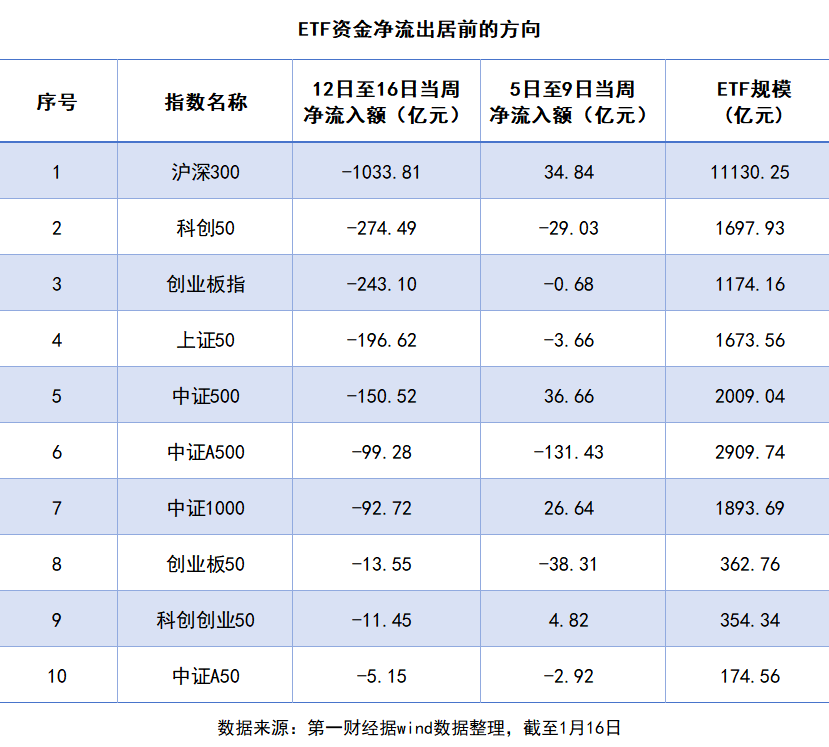
Core Viewpoint - A significant shift in the A-share ETF market has occurred, with over 200 billion yuan withdrawn from core broad-based ETFs and nearly 70 billion yuan flowing into thematic industry ETFs, indicating a potential turning point in market trends [1][2][7]. Group 1: ETF Market Dynamics - From January 12 to 16, over 2 trillion yuan was withdrawn from broad-based ETFs, marking a 15-fold increase compared to the previous week and setting a record for weekly net outflows [2][3]. - The core broad-based ETFs, including the CSI 300 and STAR 50, were the main targets for fund withdrawals, with the CSI 300 ETF alone experiencing a net outflow of over 1 trillion yuan [2][3]. - The total trading volume of stock ETFs reached 1.28 trillion yuan during the same week, the highest in five years, reflecting intense trading activity and rapid fund turnover [7]. Group 2: Thematic ETF Inflows - In contrast to the broad-based ETFs, thematic ETFs saw a net inflow of nearly 70 billion yuan, with 117 products receiving over 1 billion yuan in net subscriptions [3][4]. - Key sectors attracting investment included software, media, and semiconductors, with specific products like the Harvest CSI Software Service ETF receiving a net inflow of 75.43 billion yuan, reaching a record size of 146 billion yuan [3][6]. - The satellite internet sector emerged as a focal point for investment, with six satellite-themed ETFs attracting 74.71 billion yuan in net inflows, highlighting a growing interest in this area [3][4]. Group 3: Market Sentiment and Future Outlook - Analysts suggest that the significant outflows from broad-based ETFs and inflows into thematic ETFs may indicate a healthy market adjustment rather than a downturn, as investors seek more flexible and growth-oriented investment opportunities [7][8]. - The recent regulatory environment is seen as a corrective measure to excessive market speculation, with expectations that market sentiment will improve within a couple of weeks [8]. - The ongoing trend of reallocating funds from broad-based to thematic ETFs reflects a broader shift in investor strategy, moving towards long-term asset allocation rather than short-term trading [9].