银华基金

Search documents
12月3日124只基金净值增长超1%
Zheng Quan Shi Bao Wang· 2025-12-04 02:03
Core Viewpoint - The stock and mixed funds experienced a decline on December 3, with only 15.04% achieving positive returns, while 236 funds saw a net value drop exceeding 2% [1][2]. Fund Performance Summary - On December 3, the average net value growth rate for stock and mixed funds was -0.49%, with 124 funds reporting a growth rate exceeding 1% [1]. - The top-performing fund was Yongying Resource Selection Mixed Initiation A, with a net value growth rate of 2.63%, followed by Yongying Resource Selection Mixed Initiation C and Baoying Development New Momentum Stock C, both at 2.55% and 2.54% respectively [1][2]. - Among the funds with a growth rate over 1%, 61 were equity funds, 36 were flexible allocation funds, and 18 were standard equity funds [2]. Fund Decline Summary - A total of 236 funds experienced a net value decline exceeding 2%, with the largest drop recorded by Taixin Development Theme Mixed at -3.67% [2][4]. - Other notable declines included Dongfang Alpha Ruifeng Mixed Initiation C and A, both at -3.44%, and Yongying Low Carbon Environmental Intelligent Selection Mixed Initiation A at -3.31% [4][5].
不急于打满仓位逾八成次新基金有序建仓
Zheng Quan Shi Bao· 2025-12-03 23:34
Group 1 - The core viewpoint of the articles indicates that over 80% of newly established active equity funds have shown signs of building positions, with cautious strategies due to market volatility and year-end style shifts [1][2][4] - As of December 3, 61 new active equity funds were established in the fourth quarter, with 51 showing varying degrees of net value fluctuations, particularly among those launched in October [2][3] - The market consensus suggests a clear trend towards AI applications, with expectations of significant breakthroughs by 2026, highlighting sectors like smart driving and robotics as areas of potential growth [6][7] Group 2 - Many newly established funds are adopting a cautious approach to building positions, with most maintaining low levels of investment due to increased market volatility and rapid sector rotation [4][5] - The average fundraising scale for newly established floating fee rate funds is approximately 1.23 billion, with most showing minimal net value fluctuations [5] - The investment community is optimistic about AI and related technologies, with expectations of sustained growth in AI computing demand and applications, supported by strong capital expenditure from leading cloud service providers [6][7]
不急于打满仓位 逾八成次新基金有序建仓
Zheng Quan Shi Bao· 2025-12-03 22:09
Group 1 - The core viewpoint of the articles indicates that over 80% of newly established active equity funds have shown signs of building positions, with cautious strategies due to market volatility and year-end style shifts [1][2][4] - As of December 3, 61 new active equity funds were established in the fourth quarter, with 57 being mixed equity funds, and 51 of these funds have experienced net value fluctuations [2][3] - The most notable building activity is observed in funds established in October, with some achieving over 10% returns, while others have faced slight losses due to November's market volatility [2][3] Group 2 - Fund managers are adopting a cautious approach to building positions, with many funds maintaining low levels of investment due to increased market volatility and rapid sector rotation [4][5] - The average decline in 34 core A-share indices has exceeded 3%, with some indices dropping over 11%, prompting fund managers to take a longer-term view on investments [4] - New floating fee rate funds have emerged, with an average fundraising scale of approximately 1.23 billion, and most of these funds have shown minimal net value fluctuations [5] Group 3 - The industry consensus is that AI applications will be a key focus area, with expectations for significant breakthroughs by 2026, particularly in sectors like smart driving and robotics [6][7] - Market analysts suggest that the upcoming central political bureau and economic work meetings may influence market recovery, with a focus on both new and traditional economic sectors [7] - The global AI computing market is expected to continue its strong growth, supported by increasing capital expenditures from leading cloud service providers [7]
消费主题基金业绩“掉队” “出海”成选股关键词
Zheng Quan Shi Bao· 2025-12-03 17:51
Core Viewpoint - The A-share market has been buoyed by the technology sector, aiming for the 4000-point mark, while traditional consumer stocks have underperformed, leading to significant losses for funds heavily invested in these areas [1] Group 1: Performance of Consumer Stocks - Traditional consumer sectors like liquor and home appliances have shown weak performance, with some consumer-themed funds declining over 10% this year [2] - A specific consumer-themed fund in East China saw a 17% drop in the first half due to heavy investments in Moutai and Wuliangye, and despite shifting focus to consumer electronics in the second half, performance remained lackluster [2] - New consumption stocks also faced a downturn in the third quarter, with companies like Pop Mart and Laopu Gold experiencing significant pullbacks after reaching yearly highs, impacting funds that had built positions at elevated levels [2] Group 2: Market Sentiment and Valuation - Fund managers believe that the consumer sector is showing signs of bottoming out, with the past four years of bear market attributed to declining birth rates, damaged consumer confidence, and negative wealth effects, which may stabilize by 2025 [3] - Current valuations in the consumer sector are seen as attractive, with the dynamic price-to-earnings ratio at 23.42, placing it in the 28.52% percentile over the past five years, indicating a potential for recovery [4] - Funds like the Huabao CSI Subdivision Food and Beverage ETF have seen significant inflows, suggesting a growing interest in consumer stocks despite recent underperformance [4] Group 3: Investment Strategy and Focus - Fund managers are increasingly focusing on companies with international expansion potential, emphasizing the importance of "going overseas" as a key selection criterion [6] - The competitive advantages of Chinese consumer companies in global markets are highlighted, including supply chain efficiency, product innovation, and cultural adaptability, particularly in the gaming sector [7] - The long-term growth potential of Chinese companies in international markets is viewed as significant, with many expected to stabilize their revenue structures through overseas operations [7]


港股高股息ETF(159302)跌0.66%,成交额1936.00万元
Xin Lang Cai Jing· 2025-12-03 10:34
Group 1 - The Hong Kong High Dividend ETF (159302) closed down 0.66% on December 3, with a trading volume of 19.36 million yuan [1] - The fund was established on August 23, 2024, with an annual management fee of 0.50% and a custody fee of 0.10% [1] - As of December 2, 2024, the latest share count for the ETF was 95.7976 million shares, with a total size of 130 million yuan [1] Group 2 - The ETF's share count decreased by 11.95% and its size increased by 7.95% compared to December 31, 2024 [1] - Over the last 20 trading days, the ETF had a cumulative trading amount of 354 million yuan, with an average daily trading amount of 17.71 million yuan [1] - Year-to-date, the ETF has a cumulative trading amount of 2.914 billion yuan, with an average daily trading amount of 13.07 million yuan [1] Group 3 - The current fund manager is Zhang Yichi, who has managed the fund since its inception, achieving a return of 36.18% during the management period [2] - The ETF's top holdings include COSCO Shipping Holdings, Yancoal Australia, and China Petroleum, with respective holding percentages of 7.63%, 5.59%, and 3.55% [2] - The total market value of the top holdings includes 8.59 million yuan for COSCO Shipping Holdings and 6.29 million yuan for Yancoal Australia [2]


天府证券ETF日报 2025.12.03-20251203
天府证券· 2025-12-03 09:05
1. Report Industry Investment Rating - No relevant content provided 2. Core View of the Report - On December 3, 2025, the A-share market declined, with the Shanghai Composite Index down 0.51% to 3878.00 points, the Shenzhen Component Index down 0.78% to 12955.25 points, and the ChiNext Index down 1.12% to 3036.79 points. The total trading volume of A-shares in the two markets was 1683.7 billion yuan. Industries with the highest gains were transportation (0.69%), non-ferrous metals (0.63%), and coal (0.57%), while those with the largest losses were media (-2.86%), computer (-2.26%), and real estate (-1.53%) [2][6] 3. Summary by Relevant Catalogs Market Overview - The Shanghai Composite Index, Shenzhen Component Index, and ChiNext Index all decreased, with trading volume reaching 1683.7 billion yuan. Transportation, non-ferrous metals, and coal led the gains, while media, computer, and real estate led the losses [2][6] Stock ETF - The top trading volume stock ETFs were mainly those tracking the CSI A500 Index, such as Huaxia CSI A500ETF (down 0.35%, premium rate -0.42%), Huatai-PineBridge CSI A500ETF (down 0.33%, premium rate -0.39%), and Guotai CSI A500ETF (down 0.52%, premium rate -0.53%) [3][7] Bond ETF - The top trading volume bond ETFs included Haifutong CSI Short-term Financing ETF (up 0.01%, premium rate 0.00%), Huaxia Shanghai Stock Exchange Benchmark Market-making Treasury Bond ETF (down 0.05%, premium rate 0.03%), and China Merchants CSI AAA Science and Technology Innovation Corporate Bond ETF (down 0.04%, premium rate -0.29%) [4][9] Gold ETF - Gold AU9999 fell 0.51% and Shanghai Gold fell 0.23%. The top trading volume gold ETFs were Huaan Gold ETF (down 0.18%, premium rate -0.36%), Boshi Gold ETF (down 0.24%, premium rate -0.36%), and E Fund Gold ETF (down 0.20%, premium rate -0.34%) [12] Commodity Futures ETF - Dacheng Non-ferrous Metals Futures ETF rose 0.38% (premium rate 0.51%), Huaxia Feed Soybean Meal Futures ETF had a 0.00% change (premium rate 0.65%), and China Construction Bank Yisheng Zhengzhou Commodity Exchange Energy and Chemical Futures ETF fell 0.73% (premium rate -1.09%) [15] Cross-border ETF - The previous trading day saw increases in the Dow Jones Industrial Average (0.39%), NASDAQ (0.59%), S&P 500 (0.25%), and Germany's DAX (0.51%). On December 3, the Hang Seng Index fell 1.28% and the Hang Seng China Enterprises Index fell 1.68%. The top trading volume cross-border ETFs included E Fund CSI Hong Kong Securities Investment Theme ETF (down 1.23%, premium rate -1.44%), Huatai-PineBridge Hang Seng Technology ETF (down 1.49%, premium rate -1.85%), and GF CSI Hong Kong Innovative Drug ETF (down 1.73%, premium rate -1.70%) [17] Money ETF - The top trading volume money ETFs were Yin Hua Rili ETF, Hua Bao Tian Yi ETF, and Money ETF [19]
企业年金近三年赚12.08%!规模突破4万亿元,两家公募管理超3000亿元
Sou Hu Cai Jing· 2025-12-03 05:20
Core Insights - The national enterprise annuity fund investment assets net value has exceeded 4 trillion yuan, reaching approximately 4.06 trillion yuan by the end of Q3 2025, showing an increase from about 3.8 trillion yuan at the end of Q2 2025 [2][3] - The cumulative return rate for enterprise annuity funds over the past three years is 12.08% [3][4] - Pension products achieved a return of 3.11% in Q3 2025, with a year-to-date return of 4.66% [9] Enterprise Annuity Fund Data - As of the end of Q3 2025, the net value of enterprise annuity fund investment assets is 40,629.99 billion yuan, with 6,057 established portfolios [3][4] - The cumulative return rate for fixed income portfolios is 10.48%, while equity-inclusive portfolios have a cumulative return rate of 12.53% [3][4] - In single plans, there are 1,410 fixed income portfolios with assets of 3,365.64 billion yuan, and 4,289 equity-inclusive portfolios with approximately 33,253.83 billion yuan in assets [4][5] Fund Management Scale - Two fund companies manage over 300 billion yuan in assets: ICBC Credit Suisse Asset Management and E Fund Management, with their scales increasing from Q2 to Q3 2025 [6] - ICBC Credit Suisse Asset Management increased from 332.5 billion yuan to 370.4 billion yuan, while E Fund Management grew from 318.8 billion yuan to 332.6 billion yuan [6] - Other companies managing over 100 billion yuan include Southern Fund, Fortune Fund, Guotai Fund, and Huaxia Fund, all showing slight growth [6][7] Pension Product Performance - By the end of Q3 2025, there are 649 registered pension products, with 568 actively operating, and a net asset value of approximately 2.46 trillion yuan [9][10] - Ordinary stock-type products have a net asset value of 1,804.92 billion yuan, achieving a Q3 return of 22.56% and a year-to-date return of 27.24% [9][10] - Hong Kong stock-type products have a net asset value of 208.35 billion yuan, with a Q3 return of 25.41% and a year-to-date return of 43.97% [9][10]

督察长与财务负责人同日卸任!融通基金“二次成长”成效待考
Sou Hu Cai Jing· 2025-12-03 05:15
机构之家注意到,继副总经理邹曦离任后,融通基金又迎来高管变动。 12月2日,融通基金接连发布两则高级管理人员变更公告,在公司任职超过十四年督察长涂卫东因"个人原因"卸任,与此同时,财务负责人王智鲲亦宣布离 任。在公募基金行业竞争日趋白热化的背景下,两名分别执掌"合规"与"财务"两大核心命脉的高管同时离任,这不仅是继2025年10月任职超24年的投研"元 老"邹曦离职后的又一次重大人事变动,更是将融通基金近年来持续动荡的高管团队问题推向了舆论风口浪尖。 | 因任高级管理人员职务 | 图席长 | | --- | --- | | 以任高级管理人员姓名 | 徐卫东 | | 风任给国 | 个人原因 | | 风任日期 | 2025年12月2日 | | 转任本公可具也工作岗位的说明 | | 图片来源:融通基金官网 从股权变更到高管"大换血" 提及融通基金近年来的高管频繁变动,还要追溯到其股权结构的变革。2022年4月13日,融通基金实际控制人正式变更为中国诚通控股集团有限公司(以下 简称诚通集团)。自此,融通基金正式进入"央企公募时代"。 | 肉任高级管理人员职务 | 财务负 | | --- | --- | | 离任高级管 ...

A股赚钱效应显著公募百亿定增扫货
2 1 Shi Ji Jing Ji Bao Dao· 2025-12-03 00:57
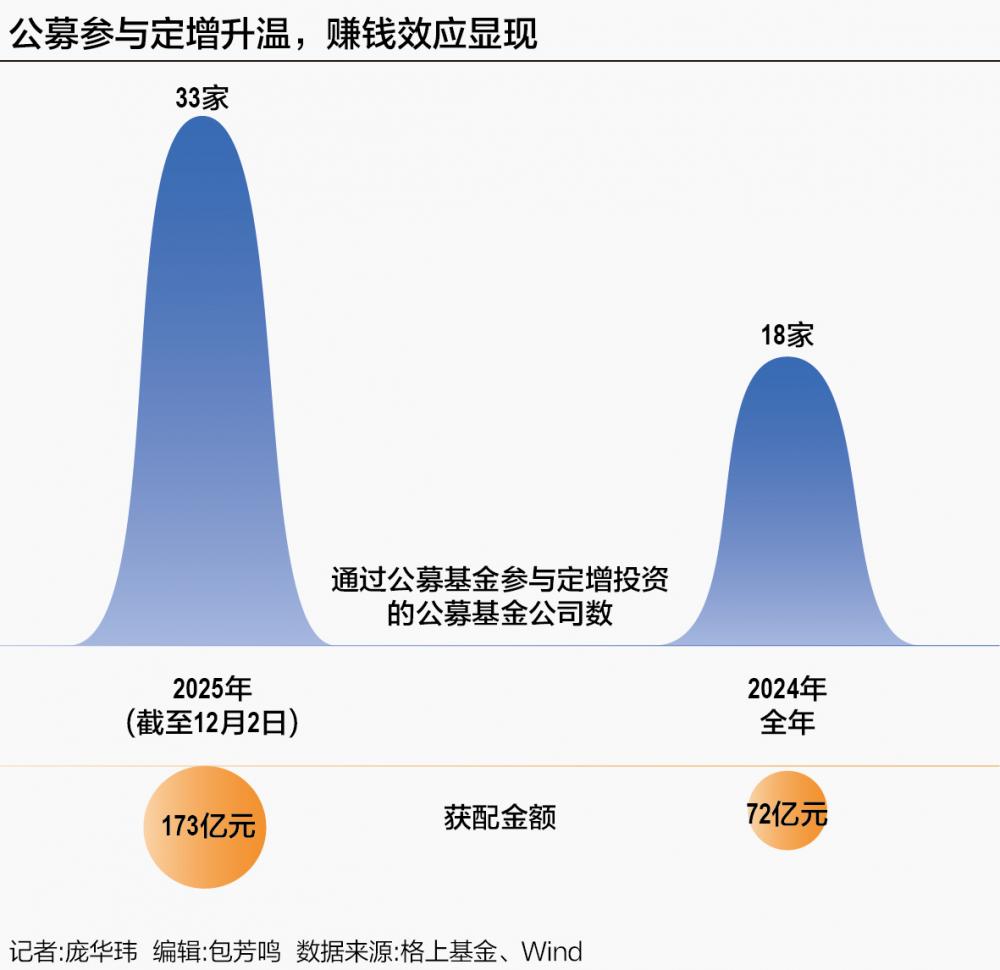
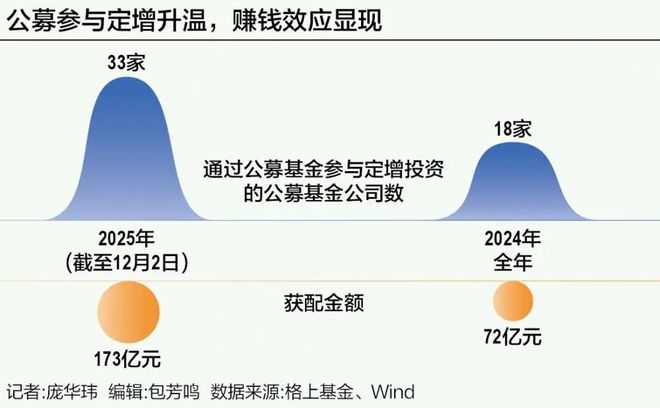
Core Insights - The A-share private placement market is experiencing significant participation from public funds in 2025, with 33 fund companies involved and a total allocation amounting to 17.3 billion yuan, representing a 140% increase compared to the entire year of 2024 [1][5][8] Group 1: Market Participation - Public funds have shown a marked increase in enthusiasm for private placements, with a total allocation of 17.3 billion yuan in 2025, up from 7.2 billion yuan in 2024, indicating a growth of over 100 billion yuan [5][6] - Leading public fund companies include E Fund with 3.687 billion yuan, followed by GF Fund, Fortune Fund, and China Universal Fund with allocations of 2.288 billion yuan, 1.529 billion yuan, and 1.463 billion yuan respectively [5][6] Group 2: Investment Focus - The investment focus of public funds is heavily concentrated in hard technology sectors, particularly in semiconductors, artificial intelligence, and innovative pharmaceuticals, reflecting a strong alignment with the ongoing "technology bull" market [6][8] - Notable allocations in the electronics sector reached 7.45 billion yuan, while the biopharmaceutical sector saw allocations of 5.6 billion yuan, targeting companies like Cambricon, Chipone, and innovative drug firms [6][8] Group 3: Market Drivers - The resurgence of private placements is driven by three main factors: policy incentives, a safety margin due to discount pricing, and significant profit potential observed by participating public funds [8] - The current trend shows increased participation, improved returns, and a strong focus on technology and high-end manufacturing sectors, with expectations for continued growth in public fund involvement in private placements [8]




豪掷173亿 年内33家公募参与定增,硬科技成“最强磁场”
2 1 Shi Ji Jing Ji Bao Dao· 2025-12-03 00:01
Core Insights - The A-share private placement market is experiencing significant participation from public funds in 2025, with a total allocation amount reaching 17.3 billion yuan, marking a 140% increase compared to the entire year of 2024 [1][7]. Group 1: Market Participation - A total of 33 public fund companies have participated in private placements in 2025, with the leading company, E Fund, securing 3.687 billion yuan [3][10]. - Other notable participants include GF Fund, Fortune Fund, and China Universal Fund, with allocations of 2.288 billion yuan, 1.529 billion yuan, and 1.463 billion yuan respectively [3][10]. - The trend shows a competitive landscape where larger firms dominate, but smaller firms are also actively participating [3][10]. Group 2: Investment Focus - Public fund investments are heavily concentrated in hard technology sectors, particularly semiconductors, artificial intelligence, and innovative pharmaceuticals [5][12]. - In the electronics sector, public funds have allocated 7.45 billion yuan, while in the biopharmaceutical sector, the allocation reached 5.6 billion yuan [5][13]. - Key companies receiving significant allocations include Baile Tianheng, Cambricon, Chipone, and Dizhe Pharmaceutical, each exceeding 1 billion yuan in public fund allocations [5][14]. Group 3: Drivers of Growth - The resurgence in private placements is driven by three main factors: policy incentives, a safety margin from discounts, and significant profit potential [6][14]. - The favorable policy environment encourages capital market support for the real economy, particularly in technology sectors [6][14]. - The overall performance of public funds in private placements has been strong, further motivating institutional participation [6][14].