
三只松鼠

Search documents
近一个月超140只个股评级调整 食品饮料行业上调最多
Zhong Guo Zheng Quan Bao· 2025-11-21 22:20
近期A股市场存量资金博弈特征愈发明显,板块轮动节奏加快。近一个月,券商密集调整个股评级,超 50只个股获上调评级,食品饮料行业的标的最多;同时,超90只个股被下调评级,涉及汽车、化工等多 个行业。 食品饮料行业方面,招商证券11月3日发布研报表示,巴比食品第三季度收入增长提速,店效延续改 善,将个股评级由增持上调至强烈推荐;西麦食品、妙可蓝多、东鹏饮料个股评级均由增持上调至买 入;青岛啤酒、千味央厨个股评级均由持有上调至增持;甘源食品个股评级由中性上调至优于大市。 受益于终端需求逐步回暖,电子行业有望迎来估值修复与成长契机。在电子行业中,晶晨股份、中微公 司、源杰科技、水晶光电、绿联科技个股评级均由增持上调至买入。 对于2026年电子行业投资策略,中原证券表示,展望2026年,AI算力需求持续景气,云侧AI算力硬件 基础设施仍处于高速成长中,AI眼镜、具身智能、智能驾驶等端侧AI创新百花齐放;AI推动半导体周 期继续上行,存储器或迎来超级周期,半导体自主可控有望加速推进。 超90只个股被下调评级 近一个月,券商还下调92只个股评级,涵盖25个行业。其中,汽车、食品饮料、基础化工行业被下调评 级的个股数量居前, ...
近一个月超140只个股评级调整食品饮料行业上调最多
Zhong Guo Zheng Quan Bao· 2025-11-21 20:09
Core Viewpoint - The A-share market is experiencing a notable shift towards stock selection and sector rotation, with over 50 stocks upgraded and more than 90 downgraded in ratings, indicating a more cautious market sentiment and a focus on structural opportunities in technology, consumption, and dividend sectors [1][2][3]. Stock Rating Adjustments - Over the past month, 52 stocks have been upgraded, with the food and beverage sector having the highest number of upgrades at 7 stocks, followed by electronics and power equipment with 5 each, and pharmaceuticals and light industry with 4 each [1]. - Conversely, 92 stocks have been downgraded across 25 industries, with the automotive sector leading with 12 downgrades, followed by food and beverage with 10, and basic chemicals with 9 [2][3]. Sector Analysis - In the food and beverage sector, several companies such as Baba Foods and Ximai Foods have seen their ratings upgraded due to improved revenue growth and store efficiency [2]. - The electronics sector is expected to benefit from a recovery in terminal demand, with companies like Crystal Technology and Green Link Technology receiving upgrades [2]. - The automotive sector has faced downgrades due to short-term performance pressures, with companies like Meihu and New Spring seeing their ratings lowered [3]. Market Trends and Strategies - Analysts suggest that the market is moving towards a balanced style, with a preference for large-cap stocks and a potential shift towards value stocks [4]. - The focus on growth stocks remains, but the key is whether the underlying valuation logic changes, which could drive future performance [4]. - Investment opportunities are seen in themes such as anti-involution and dividend stocks, with a particular emphasis on technology sectors that align with national strategies and possess real technological barriers [5].



休闲食品板块11月21日跌1.94%,麦趣尔领跌,主力资金净流出1.21亿元
Zheng Xing Xing Ye Ri Bao· 2025-11-21 09:33
Market Overview - The leisure food sector experienced a decline of 1.94% on November 21, with Maiqu'er leading the drop [1] - The Shanghai Composite Index closed at 3834.89, down 2.45%, while the Shenzhen Component Index closed at 12538.07, down 3.41% [1] Individual Stock Performance - Nanjiao Food (605339) saw a significant increase of 10.03%, closing at 20.96, with a trading volume of 81,500 shares and a turnover of 166 million yuan [1] - Maiqu'er (002719) dropped by 8.32%, closing at 8.71, with a trading volume of 140,600 shares and a turnover of 127 million yuan [2] - Other notable declines include Guifaxiang (002820) down 5.51% and Ximai Food (002956) down 4.82% [2] Capital Flow Analysis - The leisure food sector experienced a net outflow of 121 million yuan from institutional investors, while retail investors saw a net inflow of 157 million yuan [2] - The capital flow for Nanjiao Food showed a net inflow of 72.78 million yuan from institutional investors, while it faced a net outflow of 32.42 million yuan from retail investors [3] - Maiqu'er had a net inflow of 4.29 million yuan from institutional investors, but a net outflow of 12.79 million yuan from retail investors [3]




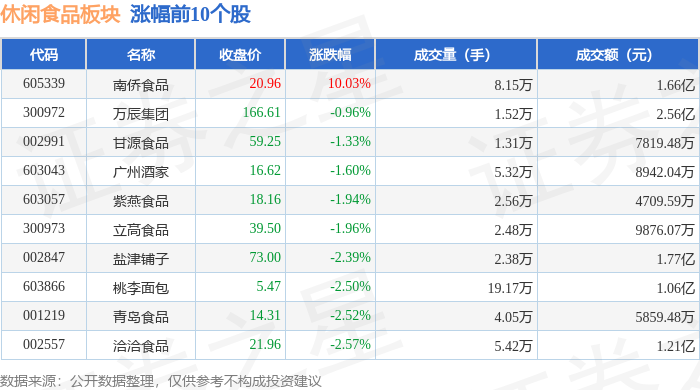
休闲食品板块11月20日跌2.33%,南侨食品领跌,主力资金净流出1.78亿元
Zheng Xing Xing Ye Ri Bao· 2025-11-20 09:09
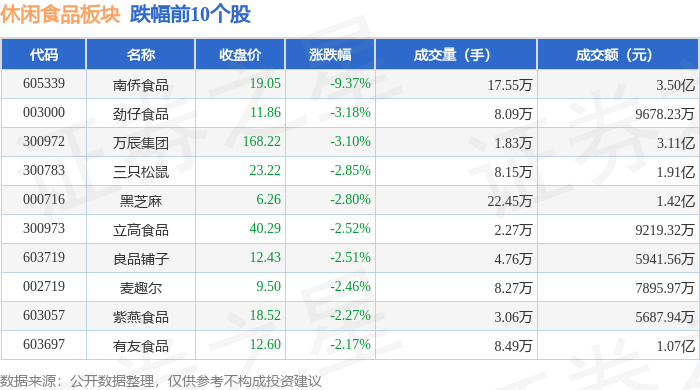
Market Overview - The leisure food sector experienced a decline of 2.33% on November 20, with Nanjiao Food leading the drop [1] - The Shanghai Composite Index closed at 3931.05, down 0.4%, while the Shenzhen Component Index closed at 12980.82, down 0.76% [1] Individual Stock Performance - Nanjiao Food (605339) closed at 19.05, down 9.37% with a trading volume of 175,500 shares [1] - Jin Zai Food (003000) closed at 11.86, down 3.18% with a trading volume of 80,900 shares [1] - Wanchen Group (300972) closed at 168.22, down 3.10% with a trading volume of 18,300 shares [1] - Three Squirrels (300783) closed at 23.22, down 2.85% with a trading volume of 81,500 shares [1] - Black Sesame (000716) closed at 6.26, down 2.80% with a trading volume of 224,500 shares [1] - Other notable declines include Lihai Food (300973) down 2.52% and Liangpinpuzi (603719) down 2.51% [1] Capital Flow Analysis - The leisure food sector saw a net outflow of 178 million yuan from main funds, while retail investors contributed a net inflow of 118 million yuan [1] - Speculative funds recorded a net inflow of 60.43 million yuan [1] Detailed Capital Flow for Selected Stocks - Lihai Food (300973) had a main fund net inflow of 5.90 million yuan, but a retail net outflow of 13.17 million yuan [2] - Ziyan Food (603057) experienced a main fund net inflow of 42,400 yuan, with a retail net outflow of 1.79 million yuan [2] - Maquur (002719) had a negligible main fund net inflow of 4,364 yuan, with a retail net outflow of 127,690 yuan [2] - Other stocks like Guangzhou Restaurant (603043) and Huangshanghuang (002695) also reported net outflows from main funds [2]



宠物经济救得了光明乳业吗?
3 6 Ke· 2025-11-20 00:20
Core Viewpoint - The recent launch of the pet food brand "Guangming Youyi" by Guangming Food International at the China International Import Expo indicates the company's strategic move to tap into the growing pet economy, aiming to create differentiated competitive advantages amidst declining performance in its core dairy business [1][12]. Group 1: Company Performance - Guangming Dairy's financial performance has been declining, with a reported revenue of 18.23 billion yuan for the first three quarters of 2025, a year-on-year decrease of 0.99%, and a net profit of 87 million yuan, down 25.05% [2][3]. - In Q3 2025, Guangming Dairy achieved a revenue of 5.76 billion yuan, showing a slight growth of 1.04%, but reported a net loss of 130 million yuan [3]. - The company's revenue has been declining for four consecutive years since 2022, with liquid milk revenue dropping to 10.15 billion yuan in the first three quarters of 2025, a decrease of 8.57% year-on-year [4]. Group 2: Market Challenges - Guangming Dairy faces intense competition from major players like Yili and Mengniu, which are eroding its market share, particularly in the low-temperature milk segment [5]. - The rise of regional dairy companies and alternative products like new tea drinks is further complicating the competitive landscape, impacting Guangming's traditional market [5]. - The company's overseas investment in Newlight has also been problematic, with significant losses reported, leading to the sale of its North Island assets for $170 million due to underutilization and losses [5]. Group 3: Pet Economy Potential - The pet economy is seen as a potential growth avenue for Guangming Dairy, with the number of pets in urban China expected to exceed 120 million by 2024, and the pet industry market size projected to surpass 580 billion yuan [10]. - The pet food market has shown significant growth, with the market size increasing from 28 billion yuan in 2015 to an expected 227.2 billion yuan by 2024, indicating a strong demand for pet food products [11]. - Guangming Dairy's entry into the pet food sector is a strategic choice to broaden its business scope and create new growth curves, leveraging its expertise in food safety and nutrition [9][12]. Group 4: Competitive Landscape in Pet Food - The pet food market is highly competitive, with established brands like Mars and Nestlé dominating, alongside new entrants from various sectors, making it challenging for Guangming to gain market share [13]. - The high repurchase rate in pet food sales means that new brands often struggle to penetrate established consumer bases, as pet owners tend to stick with brands that have worked for them [14]. - Despite the challenges, Guangming Dairy's commitment to R&D, with a reported expenditure of 100 million yuan in 2025, reflects its focus on innovation and product development [18].

三只松鼠创始人回应花名文化争议称以消费者为中心
Xin Lang Ke Ji· 2025-11-19 15:35
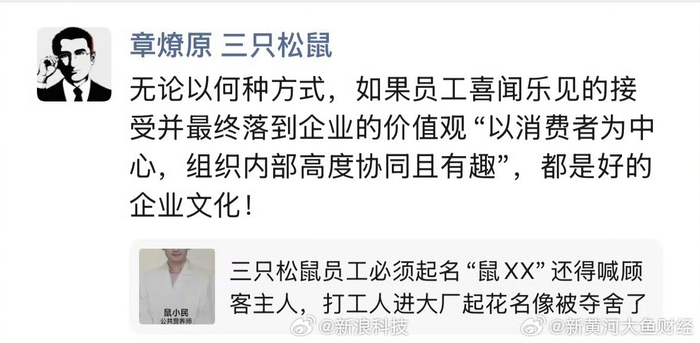
Core Viewpoint - The founder and CEO of Three Squirrels, Zhang Liaoyuan, responded to recent discussions regarding the company's culture, emphasizing that a good corporate culture is one that is accepted by employees and aligns with the company's values, focusing on consumer-centricity and internal collaboration [1] Group 1: Company Culture - The recent controversy arose from a consumer's complaint about a potentially spoiled product, where the return recipient was humorously named "Return Mouse," leading to concerns about the name's negative connotation [1] - Zhang Liaoyuan stated that regardless of the method, if employees find the culture enjoyable and it ultimately reflects the company's values, it is considered a positive corporate culture [1]
便宜零食,到底便宜了谁?
远川研究所· 2025-11-19 13:14
Core Viewpoint - The article discusses the challenges faced by snack brands like Three Squirrels in the e-commerce era, highlighting a shift in consumer preferences towards "bulk snack stores" and the impact of rising competition and costs in the online market [4][9][12]. Group 1: Industry Overview - The snack industry has low entry barriers but is highly fragmented, with the top five companies holding only 5.9% market share [8]. - The rise of bulk snack stores has significantly changed the competitive landscape, with these stores capturing 37% of the market share in 2024, surpassing e-commerce and supermarkets [13][15]. - The average profit margin in the snack industry is around 5%, making it sensitive to rising costs and competition [11]. Group 2: Company Performance - Three Squirrels has seen a decline in profitability, with net profit dropping from 411 million to 129 million in 2022 [9]. - The company has shifted its focus back to e-commerce, particularly on platforms like Douyin, which now accounts for 26.98% of its revenue [11]. - Despite the challenges, Three Squirrels remains a significant player, but its growth has stagnated, with revenue increasing without corresponding profit growth [6][9]. Group 3: Market Dynamics - The emergence of bulk snack stores has led to a price war, with these stores offering products at prices 20%-75% lower than supermarkets and 7%-59% lower than e-commerce [18][20]. - The rapid expansion of bulk snack stores, such as "Mingming Very Busy," has resulted in over 40,000 locations across China, with a significant number of stores located in lower-tier cities [15][22]. - The competition between bulk snack store brands has intensified, leading to aggressive marketing strategies and store openings in close proximity to competitors [30]. Group 4: Consumer Behavior - Consumers are increasingly drawn to lower-priced options, leading to a decline in brand loyalty among traditional snack brands [8][26]. - The rise of private label and lesser-known brands in bulk snack stores has contributed to the profitability of these stores, with private label products accounting for 60-65% of their inventory [26][30]. - The shift in consumer preferences towards bulk purchasing and lower prices has created a challenging environment for established snack brands [23][30].

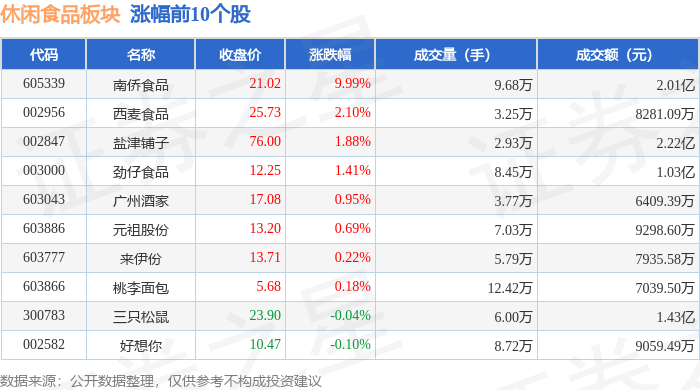
休闲食品板块11月19日涨0.46%,南侨食品领涨,主力资金净流入1459.03万元
Zheng Xing Xing Ye Ri Bao· 2025-11-19 08:52
从资金流向上来看,当日休闲食品板块主力资金净流入1459.03万元,游资资金净流入373.66万元,散户 资金净流出1832.69万元。休闲食品板块个股资金流向见下表: | 代码 | 名称 | 主力净流入(元) | 主力净占比 游资净流入 (元) | | 游资净占比 散户净流入 (元) | | 散户净占比 | | --- | --- | --- | --- | --- | --- | --- | --- | | 605339 南侨食品 | | 5658.99万 | 28.12% | -3049.55万 | -15.15% | -2609.44万 | -12.97% | | 003000 劲仔食品 | | 1168.52万 | 11.37% | 540.91万 | 5.26% | -1709.43万 | -16.63% | | 002847 盐津铺子 | | 625.88万 | 2.82% | -1510.81万 | -6.82% | 884.94万 | 3.99% | | 300783 | 三只松鼠 | 304.02万 | 2.12% | -117.08万 | -0.82% | -186.95万 | -1.3 ...
福建女首富正式接班,能否重振“乡镇之王”达利食品?
Guan Cha Zhe Wang· 2025-11-19 08:05
Core Insights - Dali Food Group announced that Xu Yangyang, daughter of founder Xu Shihui, officially took over as president in November 2025, leading the company during a challenging period of declining performance and industry transformation [1][9] Company History and Development - Xu Shihui's entrepreneurial journey began in 1989 when he invested his entire savings to buy a second-hand biscuit production line, establishing the precursor to Dali Food [2] - Dali Food was officially founded in 1992, but faced significant competition from brands like Wangwang and Lays as they entered the Chinese market [2] Business Strategy - Dali Food adopted a unique "Dali Model" to compete against foreign brands, focusing on low-priced products, celebrity endorsements, and deep channel penetration [3][5] - The company has historically leveraged aggressive marketing strategies, utilizing popular celebrities for endorsements and maintaining a pricing strategy that undercuts competitors by 30% to 50% [6][8] Financial Performance - Dali Food's revenue peaked at 222.94 billion yuan in 2021 but fell to 199.57 billion yuan in 2022, marking the beginning of a downward trend [10][12] - The company initiated a privatization process in 2023 due to its stock price being undervalued, but subsequent revenue figures for 2023 and 2024 showed continued decline [12][13] Market Challenges - Dali Food has struggled to adapt to new market dynamics, including the rise of e-commerce and competition from direct-to-consumer models, which have eroded its traditional channel advantages [14][16] - The company's reliance on a "pressuring inventory" model has led to issues with distributor relationships and inventory management, further complicating its market position [14] Leadership Transition and Future Strategy - Xu Yangyang aims to transition Dali Food from a "follower" to an "innovator," focusing on brand rejuvenation and product innovation to meet evolving consumer demands [16][17] - The company is pursuing an international expansion strategy, targeting Southeast Asia, with plans to establish production bases in Indonesia, Thailand, Vietnam, and Saudi Arabia [19][20]
休闲食品概念盘初走强,南侨食品涨停
Xin Lang Cai Jing· 2025-11-19 01:37
Group 1 - The leisure food sector has shown initial strength, with notable stocks such as Nanchao Food hitting the daily limit up [1] - Other companies in the sector, including Guifaxiang, Three Squirrels, Yanjinpuzi, Qingdao Food, Oufu Egg Industry, and Yuanzhuo, also experienced gains [1]