浦发银行

Search documents
追光浦发人|自贸金融“夺冠”征程,一场不落幕的接力赛
Sou Hu Cai Jing· 2026-01-31 07:23
Core Insights - The establishment of the Shanghai Free Trade Zone in 2013 marked the beginning of China's financial reform and innovation, with the introduction of the Free Trade Account system facilitating cross-border transactions and financing for numerous market participants [4][18] - SPDB has been a leader in the free trade financial sector, successfully launching multiple first-of-their-kind services and products, demonstrating its commitment to financial innovation and support for national open policies [3][18] Group 1: Strategic Positioning - SPDB established a dedicated branch for the Shanghai Free Trade Zone and created specialized teams to enhance its capabilities in cross-border financial services, reflecting its strategic commitment to financial innovation [4][5] - The bank's approach to self-regulation and the establishment of management guidelines for free trade accounts have laid a solid foundation for its business operations [5][6] Group 2: Execution of First Transactions - The concept of "first transactions" has become a core strategy for SPDB, allowing it to capture new market opportunities arising from regulatory innovations, which in turn drives sustainable business growth [6][8] - The bank's proactive engagement in policy discussions and early preparations for new regulations have enabled it to quickly capitalize on emerging opportunities, exemplified by its successful launch of upgraded FT accounts [8][9] Group 3: Collaborative Strategy - SPDB has shifted from a "single-point breakthrough" strategy to a "nationwide collaboration" approach, encouraging all branches to work together to maximize business opportunities across the country [11][12] - The implementation of a unified management model for FT accounts has enhanced operational efficiency and responsiveness to regulatory changes, allowing for rapid deployment of services in new markets [12][14] Group 4: Data-Driven Decision Making - The bank has developed a comprehensive data analysis system to monitor and evaluate its free trade business, providing insights into operational challenges and opportunities for improvement [15][16] - The team's strong commitment to continuous learning and collaboration has been crucial in adapting to the fast-paced changes in policies and market conditions [16][18] Group 5: Achievements and Recognition - SPDB has achieved significant milestones, including being among the top three in the market for free trade deposit and loan business, and has successfully launched over 50 innovative first transactions [18] - The bank has received multiple awards for its contributions to cross-border financial services, underscoring its role in supporting the development of the real economy and promoting institutional openness [18]


宁波金田铜业(集团)股份有限公司 关于以集中竞价交易方式回购公司股份的 回购报告书
Xin Lang Cai Jing· 2026-01-30 23:30
Core Viewpoint - The company plans to repurchase shares with a total amount between RMB 200 million and RMB 400 million, primarily to convert its convertible bonds, using funds from a special loan and its own capital [2][6][13]. Group 1: Repurchase Plan Details - The repurchase amount will not exceed RMB 400 million and will be sourced from a special loan of up to RMB 360 million from Shanghai Pudong Development Bank and the company's own funds [2][13]. - The repurchase price will not exceed RMB 16.84 per share, which is 150% of the average trading price over the previous 30 trading days [2][11]. - The repurchase will be conducted through centralized bidding and is set to occur within 12 months from the board's approval date [2][9]. Group 2: Purpose and Impact - The purpose of the repurchase is to enhance investor confidence and reflect the company's belief in its future development [6]. - The repurchased shares will be used for converting the company's convertible bonds, and the company does not anticipate any significant impact on its financials or operations from this repurchase [15][20]. Group 3: Shareholder Plans - As of the announcement date, key shareholders, including directors and senior management, have no plans to reduce their holdings in the next three to six months [2][18]. - The controlling shareholder plans to increase their stake in the company within the next 12 months, with a total investment between RMB 50 million and RMB 100 million [16][18]. Group 4: Regulatory Compliance and Disclosure - The company will comply with all relevant regulations regarding share repurchase and will disclose information as required during the repurchase period [25]. - A special account for the share repurchase has been established with the China Securities Depository and Clearing Corporation [25].

并购贷款新规落地“满月” 参股型模式成创新焦点
Zhong Guo Jing Ying Bao· 2026-01-30 18:53
Core Insights - The implementation of the new regulations on merger loans has led to increased demand for acquisition financing, particularly in the technology and green sectors [1][2] - The introduction of "equity acquisition loans" has become a focal point for market innovation, prompting banks to explore new opportunities while facing heightened risk management requirements [1][6] Group 1: Market Dynamics - The new regulations have revitalized the merger loan business, with major banks like Industrial and Commercial Bank of China (ICBC) quickly launching compliant acquisition loan products across various provinces [2] - The demand for merger loans is driven by the need for consolidation among state-owned enterprises and large investment firms, as well as the increasing management needs of quality listed companies [2][3] - Competition among banks for high-quality projects has intensified, with multiple banks often participating in the approval process for the same project [3] Group 2: Regulatory Impact - The new regulations set tiered standards for conducting merger loans, with higher thresholds for equity acquisition loans, which may limit access for smaller banks [4] - Major banks have the advantage of robust capital and risk management capabilities, allowing them to quickly implement new loan products, while smaller banks tend to focus on local businesses and conservative lending practices [4] Group 3: Loan Structure and Risk - The new regulations allow for equity acquisition loans, which require a minimum stake of 20% in the target company, thus lowering barriers while ensuring strategic alignment [6] - The maximum loan-to-value ratio for equity acquisition loans is set at 60%, compared to 70% for control-type loans, reflecting a cautious regulatory approach to mitigate risks [6][7] - Banks face unique risks with equity acquisition loans, including potential information asymmetry and limited decision-making power, necessitating stricter risk assessment and management protocols [7][8] Group 4: Risk Management Strategies - Banks are advised to enhance their risk management frameworks, focusing on thorough due diligence, compliance monitoring, and ongoing evaluation of target companies post-acquisition [8] - A specialized management team with expertise in merger financing is recommended to ensure effective implementation of risk control measures across all stages of the loan process [8]




卫星扎堆「上天」,银行风控卷出「新高度」
Xin Lang Cai Jing· 2026-01-30 10:41
Core Insights - The commercial space industry is experiencing a surge in interest and investment, driven by increased policy support and the active participation of various sectors, including traditional banking [1][25][27]. Group 1: Policy and Industry Trends - Beijing has issued measures to promote the development and utilization of commercial satellite remote sensing data from 2026 to 2030, encouraging the construction of differentiated commercial satellite constellations with clear commercial value and application prospects [2][26]. - The banking sector, traditionally seen as unrelated to space, is now actively engaging in commercial space initiatives, with banks like China Merchants Bank and Shanghai Pudong Development Bank launching their own satellites [3][28]. Group 2: Satellite Launches and Applications - On January 16, 2024, China Merchants Bank's "Zhaoyin Jinkui" and Shanghai Pudong Development Bank's "Pudong Smart" satellites were successfully launched, both part of China's first global low-orbit satellite IoT constellation, "Tianqi Constellation" [4][29]. - The "Zhaoyin Jinkui" satellite is designed for high-precision monitoring of construction progress for first-hand mortgage properties, while the "Pudong Smart" satellite aims to enhance intelligent risk control and provide critical financial services during extreme scenarios like natural disasters [6][31]. Group 3: Evolution of Banking Risk Control - The trend of banks launching satellites signifies a shift from traditional ground-based data reliance to a "heaven and earth collaboration" model, enhancing risk control capabilities in response to complex and changing realities [12][45]. - Satellites provide high-resolution optical, radar, and multispectral sensors, offering banks a stable and objective "God's eye view" to address the core pain point of information asymmetry in traditional risk control [13][36]. Group 4: Innovations in Risk Management - The "Zhaoyin Jinkui" satellite can increase monitoring accuracy to over 95%, significantly improving traditional post-loan inspection efficiency [38]. - The integration of satellite technology with AI and deep learning, as seen in the "Dashanque" system by WeBank, allows for precise analysis of agricultural data, aiding in the determination of reasonable credit limits for farmers [38][40]. Group 5: Future Implications for Banking and Space - The banking sector's involvement in commercial space may lead to deeper due diligence and value discovery, as banks seek to understand and engage with the complexities of the commercial space industry [21][43]. - The future of financial competition may hinge on the ability to create intelligent collaborative networks between "starry skies" and "real ground," positioning banks to leverage new opportunities in the evolving commercial space landscape [24][46].



股份制银行板块1月30日跌0.53%,华夏银行领跌,主力资金净流出6.65亿元
Zheng Xing Xing Ye Ri Bao· 2026-01-30 08:54
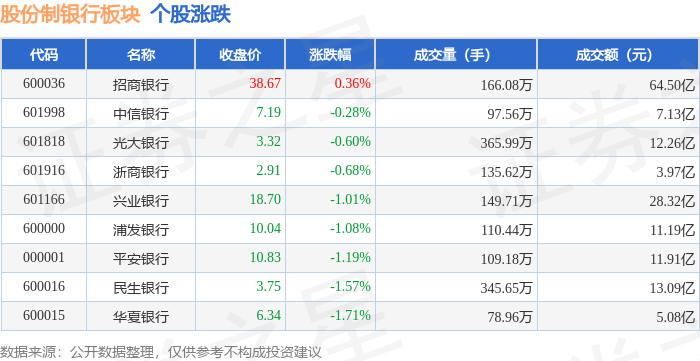
Group 1 - The banking sector experienced a decline of 0.53% on January 30, with Huaxia Bank leading the drop [1] - The Shanghai Composite Index closed at 4117.95, down 0.96%, while the Shenzhen Component Index closed at 14205.89, down 0.66% [1] - Major banks such as China Merchants Bank and CITIC Bank showed mixed performance, with China Merchants Bank slightly up by 0.36% and CITIC Bank down by 0.28% [1] Group 2 - The banking sector saw a net outflow of 665 million yuan from institutional investors, while retail investors contributed a net inflow of 564 million yuan [1] - Specific banks like Huaxia Bank and Minsheng Bank faced significant net outflows from institutional investors, with Huaxia Bank seeing a net outflow of 67 million yuan [1] - Retail investors showed a preference for certain banks, with significant net inflows into banks like Ping An Bank and Zhejiang Commercial Bank [1]





10家银行业绩速览:浦发业绩回暖,8家下调拨备
2 1 Shi Ji Jing Ji Bao Dao· 2026-01-30 07:45
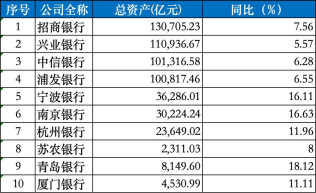
Core Viewpoint - The overall performance of the banking industry shows a steady improvement in asset scale expansion, profitability, and risk management as ten listed banks report their preliminary performance for 2025 [1] Group 1: Asset Scale Expansion - Ten banks achieved steady growth in total asset scale, with some banks reaching new milestones; for instance, China Merchants Bank's total assets exceeded 13 trillion yuan for the first time, reaching 13.07 trillion yuan, an increase of 918.49 billion yuan or 7.56% year-on-year [3][5] - CITIC Bank and Shanghai Pudong Development Bank both surpassed the 10 trillion yuan mark in total assets, indicating a significant expansion in their asset scale [5][4] - By the end of 2025, the total assets of CITIC Bank reached 10.13 trillion yuan, growing by 6.28%, while Shanghai Pudong Development Bank's total assets reached 10.08 trillion yuan, increasing by 6.55% [5][6] Group 2: Profitability Performance - Nine banks reported both revenue and net profit growth, with notable performances from Hangzhou Bank, Shanghai Pudong Development Bank, and Qingdao Bank, which achieved double-digit growth in net profit [8] - In 2025, Hangzhou Bank's operating income was 38.80 billion yuan, a year-on-year increase of 1.09%, with net profit attributable to shareholders reaching 19.03 billion yuan, up 12.05% [8] - Shanghai Pudong Development Bank's operating income was 173.96 billion yuan, an increase of 1.88%, while net profit attributable to shareholders rose by 10.52% to 50.02 billion yuan [9][10] Group 3: Risk Management - Half of the banks reported a decline in non-performing loan (NPL) ratios, indicating effective risk management; for example, CITIC Bank's NPL ratio was 1.15%, down by 0.01 percentage points [12][11] - The overall NPL ratio for the ten banks remained stable, with five banks showing a decrease, while others maintained their ratios, reflecting strong asset quality management [12][11] - The provision coverage ratio for eight banks decreased, but remained at sufficient levels to absorb potential risks, with Shanghai Pudong Development Bank and Qingdao Bank being the exceptions, as their ratios increased [15][14]
10家银行业绩速览:9家营收净利双增长,城商行两位数扩表
2 1 Shi Ji Jing Ji Bao Dao· 2026-01-30 07:39
中信、浦发资产规模破十万亿,城商行保持两位数高增 具体来看,中信银行、浦发银行资产规模双双迈入十万亿关口;9家银行实现营收净利双增长,城商行 增速表现亮眼;半数银行不良率下行,拨备出现回调但风险缓冲空间依旧充足。 截至目前,10 家上市银行 2025 年业绩快报首批亮相。整体上,行业规模扩张、盈利表现、风险管控三 大核心维度均呈现稳健向好态势。 2025年,10家银行总资产规模均实现了稳步增长,且部分银行资产规模上了新台阶。其中,招商银行资 产总额首次超过13万亿元,截至2025年12月31日,招商银行资产总规模13.07万亿元,较上年末增加 9184.87亿元,增幅7.56%;负债总额11.79万亿元,较上年末增加8710.63亿元,增幅7.98%。 兴业银行总资产也突破11万亿元,截至年末达11.09万亿元,同比增长5.57%。从核心业务来看,其各项 贷款余额5.95万亿元,同比增长3.70%;各项存款余额5.93万亿元,同比增速达7.18%,存款端增长势头 强劲。 值得关注的是,中信银行、浦发银行的资产规模双双迈进10万亿元大关。 而截至2025年末,中信银行、浦发银行双双迈过十万亿门槛,使该俱乐部成员 ...
【行业分析】中国绿色信贷行业政策汇总、发展现状及投资前景预测报告——智研咨询发布
Sou Hu Cai Jing· 2026-01-30 05:41
Core Viewpoint - Under the national "dual carbon" strategy, listed banks in China are integrating Environmental, Social, and Governance (ESG) concepts into their development strategies, promoting a green financial system to facilitate the low-carbon transition of the economy and society [2] Group 1: Green Credit Overview - Green credit is a financial service provided by institutions to support environmental protection, energy conservation, emission reduction, and renewable energy industries, optimizing resource allocation and mitigating environmental risks [5] - The green credit policy was jointly proposed by the Ministry of Environmental Protection, the People's Bank of China, and the China Banking Regulatory Commission on July 30, 2007, to curb the blind expansion of high-energy-consuming and high-polluting industries [3][5] Group 2: Development History of Green Credit - The green credit sector in China has evolved from a policy-driven approach to a more standardized and institutionalized financial tool, progressing through the stages of emergence, exploration, and growth [7] - The issuance of the "Guiding Opinions on Building a Green Financial System" in 2016 marked a significant step in the development of green finance, with the sector now entering a mature phase [7] Group 3: Green Credit Policies - Since the 2016 issuance of the "Guiding Opinions on Building a Green Financial System," various local governments have introduced specific green credit policies to refine development directions and promote best practices [9] - In February 2025, the National Financial Supervision Administration and the People's Bank of China issued a plan to enhance the quality of green finance, encouraging banks to explore various green financing methods [11] Group 4: Green Credit Industry Chain - The upstream of the green credit industry chain includes product innovation, project assessment and certification, and project development and operation [12] - The midstream involves financial institutions providing funding and services for green projects, while the downstream encompasses applications in clean energy, environmental protection, green transportation, and more [12] Group 5: Green Building Development - By the end of 2024, the cumulative area of green buildings in urban areas reached 13.54 billion square meters, with new green building area in 2024 accounting for 97.9% of all new construction [14] - The growing emphasis on green buildings is expected to create substantial financing demand, providing a stable asset market for green credit [14] Group 6: Market Data - The balance of green loans in both domestic and foreign currencies increased from 7.1 trillion yuan in 2017 to 36.6 trillion yuan in 2024, with a compound annual growth rate of 26.4% [2] - As of the end of Q3 2025, the balance of green loans reached 43.51 trillion yuan, representing a 17.5% increase from the beginning of the year and accounting for 43.9% of the total loan increment during the same period [2]
首都在线20260129
2026-01-30 03:11
Summary of Conference Call for Capital Online Company Overview - **Company**: Capital Online - **Industry**: Cloud Computing and Data Center Services Key Points Financial Performance and Projections - **2025 Performance Forecast**: Expected net profit loss of **CNY 160 million to 175 million** with revenue between **CNY 1.2 billion to 1.3 billion** [2][3] - **Strategic Shift**: Reduction of low-margin IPC business, with revenue share dropping from **55%** to focus on computing cloud and intelligent computing cloud, which are expected to account for **28%** and **20-24%** of revenue respectively [2][3] - **Intelligent Computing Cloud Growth**: Anticipated growth rate of **40%-60%** for intelligent computing cloud business [2][3] Pricing Strategy - **Cloud Service Price Increase**: Planned price increase of **15%-20%** for cloud services due to rising hardware costs (storage and memory prices up **50%-70%**, other hardware up **15%-20%**) and increased market demand [2][3][9] - **Future Price Trends**: Expected continuation of price increases in **Q2 2026** driven by rising base equipment costs and sustained demand, particularly from advancements in large model technologies [3][6][12] Market Demand and Supply Chain - **Strong Demand for Intelligent Computing**: Increased demand driven by the launch of technologies like Zhiyu Huazhang and MiniMax, with government support for application scenarios [2][7] - **IDC Business Recovery Potential**: IDC prices are stabilizing despite previous competition and price wars, with rising costs for new data centers due to commodity price increases [8][23] Strategic Developments - **Expansion Plans**: Active development of intelligent computing centers in locations such as Dallas, Hebei, Anhui, and Hainan, with plans for global service nodes and exploration of commercial aerospace computing [4][16] - **Collaboration with Major Clients**: Ongoing discussions with large enterprises for tailored services, contrasting with standardized offerings from larger competitors [20] Future Outlook - **Growth Expectations**: Optimistic internal growth target of **50%-60%** for 2026, despite supply chain challenges [4][14] - **Investment in Infrastructure**: Significant capital investment planned for building computing centers, with potential funding through new financial instruments and industry funds [21] - **Focus on Domestic and International Markets**: Plans to expand services internationally, particularly in the US and Europe, while enhancing competitiveness through localized service offerings [16] Additional Insights - **Client Order Management**: 90% of orders are on short-term contracts, allowing for quicker adjustments to pricing strategies [11][10] - **Sustainability of Price Increases**: Price increases are expected to be sustainable due to ongoing demand and rising costs, with potential for additional increases in the future [6][25] - **Adaptation to Market Changes**: The company is adapting its strategies to meet evolving client needs and market conditions, particularly in the context of AI advancements and the fourth industrial revolution [25]

11 家大行去年理财代销增超万亿
Jing Ji Guan Cha Wang· 2026-01-30 02:45
Core Viewpoint - The report highlights a decline in the scale of bank wealth management sales in December 2025, with a total of 13.46 trillion yuan, a decrease of 1.05% from November, but an increase of 10% from the beginning of the year. The growth is attributed to a "deposit migration" logic, indicating a shift in customer preferences towards wealth management products [2][6]. Group 1: Bank Performance - Postal Savings Bank showed a remarkable growth rate of 27.2%, leading among the 11 national banks, while China Merchants Bank followed with a 12.2% increase [2][4]. - In absolute terms, China Merchants Bank led with a wealth management sales scale of 4.41 trillion yuan, followed by CITIC Bank and Industrial Bank, each exceeding 1 trillion yuan [2][4]. - The ranking of the 11 banks remained relatively stable, with Postal Savings Bank rising from 7th to 4th place by the end of the year [2][4]. Group 2: Market Dynamics - The overall wealth management sales scale of the 11 banks increased by 1.22 trillion yuan, reflecting a 10% growth from the beginning of the year, with three banks (Postal Savings, China Merchants, and Huaxia) achieving growth rates above 10% [5][6]. - The average yield of wealth management products fell below 2% for the first time, at 1.98%, yet the number of investors increased by 14.37%, indicating a strong demand for stable-return products [8][9]. - The "deposit migration" narrative remains a key driver for the growth of wealth management, as banks focus on deeper market penetration and optimizing customer service [9][10]. Group 3: Future Outlook - Predictions suggest that by the end of 2026, the wealth management scale could reach approximately 38 trillion yuan, with a growth rate of around 12% [11]. - The average risk index is expected to gradually rise, and the proportion of long-term products is anticipated to increase, while T+0 products will decrease [11].