兔宝宝

Search documents
兔 宝 宝(002043) - 内部审计制度
2025-10-28 08:27
内部审计制度 第一章 总 则 德华兔宝宝装饰新材股份有限公司 第一条 为规范德华兔宝宝装饰新材股份有限公司(以下简称"公司"或"本 公司")内部审计工作,提高内部审计工作质量,保护投资者合法权益,根据《中 华人民共和国审计法》《审计署关于内部审计工作的规定》《深圳证券交易所股 票上市规则》《深圳证券交易所上市公司自律监管指引第 1 号——主板上市公司 规范运作》等法律法规、规章和《德华兔宝宝装饰新材股份有限公司章程》(以 下简称"《公司章程》")的规定并结合公司实际,制定本制度。 第二条 本制度所称内部审计,是指由公司内部机构或人员,对本公司财政 财务收支、经济活动、内部控制、风险管理实施独立、客观的监督、评价和建议, 以促进公司完善治理、实现目标的活动。 第三条 本制度所称内部控制,是指公司董事会、高级管理人员及其他有关 人员为实现下列目标而提供合理保证的过程: (一)遵守国家法律、法规、规章及其他相关规定; (四)确保公司信息披露的真实、准确、完整和公平。 第四条 公司董事会对内部控制制度的建立健全和有效实施负责,重要的内 部控制制度应当经董事会审议通过。公司董事会及其全体成员保证内部控制相关 信息披露内 ...

兔 宝 宝(002043) - 内部控制制度
2025-10-28 08:27
德华兔宝宝装饰新材股份有限公司 内部控制制度 第一章 总则 第一条 为加强德华兔宝宝装饰新材股份有限公司(以下简称"公司") 的内部控制,促进公司规范运作和健康发展,保护股东合法权益,根据《中 华人民共和国公司法》(以下简称"《公司法》")、《中华人民共和国证 券法》(以下简称"《证券法》")、《深圳证券交易所股票上市规则》(以 下简称"《上市规则》")、《深圳证券交易所上市公司自律监管指引第1号— —主板上市公司规范运作》等法律、行政法规、部门规章和《德华兔宝宝装 饰新材股份有限公司章程》(以下简称"《公司章程》")等规定,结合公 司实际,特制定本制度。 (四)确保公司信息披露的真实、准确、完整和公平。 第三条 公司董事会对公司内部控制制度的制定和有效执行负责。 第二章 内部控制的内容 第四条 公司的内部控制主要包括:环境控制、业务控制、会计系统 控制、电子信息系统控制、信息传递控制、内部审计控制等内容。 第五条 公司不断完善其治理结构,确保董事会和股东会等机构的合 法运作和科学决策;公司将逐步建立健全有效的激励约束机制,树立风险防 1 范意识,提升企业精神和企业文化,调动广大员工的积极性,创造全体员工 充 ...
兔 宝 宝(002043) - 重大信息内部报告制度
2025-10-28 08:27
德华兔宝宝装饰新材股份有限公司 重大信息内部报告制度 第一章 总则 第一条 为规范德华兔宝宝装饰新材股份有限公司(以下简称"公司")重 大信息内部报告工作,保证信息披露的及时、准确、完整、充分,维护投资者合 法权益,根据《中华人民共和国公司法》(以下简称"《公司法》")、《中华 人民共和国证券法》(以下简称"《证券法》)、《深圳证券交易所股票上市规 则》(以下简称"《上市规则》")、《深圳证券交易所上市公司自律监管指引 第 1 号—主板上市公司规范运作》(以下简称"《规范运作指引》")、《上市 公司信息披露管理办法》等有关法律法规,以及《德华兔宝宝装饰新材股份有限 公司章程》(以下简称"《公司章程》")等有关公司制度的规定,并结合公司 实际情况,制定本制度。 第二条 公司重大信息内部报告制度是指当出现、发生或即将发生可能对公 司股票及其衍生品种的交易价格产生较大影响的情形或事件时,按照本制度规定 负有报告义务的单位、部门、人员(即"报告义务人"),应第一时间将相关信 息向公司董事长报告,并知会董事会秘书报告的制度。 第三条 本制度所称"报告义务人"包括: 第四条 报告义务人应及时向董事长履行信息报告义务并知会 ...
兔 宝 宝(002043) - 信息披露暂缓与豁免制度
2025-10-28 08:27
德华兔宝宝装饰新材股份有限公司 信息披露暂缓与豁免制度 第一章 总 则 第一条 为规范德华兔宝宝装饰新材股份有限公司(以下简称"公司")信 息披露暂缓与豁免行为,确保公司及相关信息披露义务人(以下简称"信息披露 义务人")依法合规地履行信息披露义务,保护投资者的合法权益,根据《中华 人民共和国公司法》《中华人民共和国证券法》《上市公司信息披露管理办法》 《上市公司信息披露暂缓与豁免管理规定》《深圳证券交易所股票上市规则》(以 下简称"《股票上市规则》")以及有关法律、法规、规章和《德华兔宝宝装饰 新材股份有限公司章程》(以下简称《公司章程》)《信息披露管理制度》的规 定,结合公司信息披露工作的实际情况,制定本制度。 第二条 公司及信息披露义务人按照《股票上市规则》及证券交易所其他相 关业务规则的规定,办理信息披露暂缓、豁免业务的,适用本制度。 第六条 本制度所称"商业秘密"是指国家有关反不正当竞争法律法规及部 门规章规定的,不为公众所知悉、能为权利人带来经济利益、具有实用性并经权 利人采取保密措施的技术信息和经营信息。 本制度所称"国家秘密"是指国家有关保密法律法规及部门规章规定的,关 系国家安全和利益,依照 ...
绿色创新重构高端家居产品价值体系 兔宝宝领跑家居消费新潮流
Quan Jing Wang· 2025-10-27 10:54
Core Viewpoint - The decorative materials industry is gaining social attention as it closely relates to family health and well-being, with companies like Rabbit Baby focusing on sustainable and eco-friendly home solutions [1][2]. Group 1: Company Overview - Rabbit Baby is a leading comprehensive service operator in decorative materials, emphasizing eco-friendly furniture boards and expanding its custom home furnishing business [1]. - The company has over 30 years of industry experience and a nationwide network of over 6,000 terminals, earning broad market and social recognition [1]. - Rabbit Baby is one of the largest producers and sellers of high-end eco-friendly furniture boards in China, achieving a top ESG rating of 8 points, ranking first among 73 companies in the building materials sector [1][4]. Group 2: Market Trends - There is a continuous demand for improved living environments, with the construction of "good houses" expected to drive quality upgrades in building materials [2]. - The building materials industry is currently facing a short-term supply-demand imbalance due to cyclical adjustments in the real estate market and previous over-expansion of production capacity [2]. - The dual impact of national policies and market mechanisms is leading to the elimination of outdated and non-compliant production capacities, paving the way for high-quality, eco-friendly production to thrive [2]. Group 3: Product Innovation - The company's flagship product, the fragrance antibacterial board, breaks the traditional limitations of single-function boards by integrating health protection and sensory experience [3]. - This innovative board uses a composite formula of nano-silver ions and nano-silicon sheets to effectively inhibit and kill common pathogens, achieving an antibacterial rate exceeding 99% [3]. - The product also incorporates advanced surface embedding technology, achieving a 90% inactivation rate of microbes within 5-30 minutes, addressing modern households' health needs [3]. Group 4: Sustainability Initiatives - Rabbit Baby is committed to green and low-carbon transformation, prioritizing ecological and resource-efficient practices [4]. - The company has established over 350,000 acres of economic forest by the end of 2024, supporting local farmers and reinforcing its commitment to green development [4]. - The brand has received numerous accolades, including the Zhejiang Provincial Government Quality Award and recognition as a top eco-friendly brand, solidifying its position as an industry leader [4]. Group 5: Strategic Direction - Positioned at the intersection of green development and consumer upgrades, Rabbit Baby aims for high-end and sustainable growth in the building materials sector [5]. - The company focuses on creating a sustainable development loop, balancing technological breakthroughs with humanistic care in its product philosophy [5]. - Rabbit Baby is dedicated to providing consumers with healthy, comfortable, and warm home environments while promoting high-quality and sustainable development across the industry [5].
建筑材料:1-9月地产销售压力仍大,期待后续政策发力
Huafu Securities· 2025-10-27 10:46
Investment Rating - The industry rating is "Outperform the Market" [7][66] Core Viewpoints - The report emphasizes the ongoing pressure in real estate sales and anticipates policy support in the future [3][12] - The Central Committee's recent announcements focus on promoting high-quality development in real estate and addressing market fragmentation [3][12] - The report highlights a significant decline in real estate investment and sales, with a 13.9% year-on-year drop in development investment and a 5.5% decrease in new housing sales area from January to September [3][12] - The report suggests that the construction materials sector may benefit from supply-side reforms and a potential recovery in demand as monetary policies ease [5][12] Summary by Sections Investment Highlights - The report notes that the real estate market is expected to stabilize due to anticipated policy measures, including interest rate cuts and tax reductions [3][5] - It identifies four key factors that could support the market: easing monetary policy, demand-side policy measures, sensitivity to policy changes, and supply-side reforms [3][12] Recent High-Frequency Data - As of October 24, 2025, the average price of bulk P.O 42.5 cement is 342.1 RMB/ton, showing a 0.5% decrease from the previous week and a 15.3% decline year-on-year [4][13] - The average price of glass (5.00mm) is 1184.3 RMB/ton, reflecting a 4.9% decrease from the previous week and a 3.9% year-on-year decline [4][21] Sector Review - The report indicates that the Shanghai Composite Index rose by 2.88%, while the Shenzhen Composite Index increased by 3.94%, with the construction materials index up by 1.6% [4][53] - Sub-sectors such as fiberglass manufacturing and pipe manufacturing showed significant gains, while cement manufacturing experienced a slight decline [4][53] Investment Recommendations - The report suggests focusing on three main investment lines: high-quality companies benefiting from stock renovations, undervalued companies with long-term growth potential, and leading cyclical construction material firms [5][12]
建材行业报告(2025.10.20-2025.10.26):管网新增投资超5万亿,关注低位题材机会
China Post Securities· 2025-10-27 06:03
Industry Investment Rating - The investment rating for the construction materials industry is "Outperform the Market" and is maintained [1] Core Views - The report highlights that during the 14th Five-Year Plan period, China is expected to construct and renovate over 700,000 kilometers of underground pipelines, with new investment needs exceeding 5 trillion yuan. This initiative is a key focus for the government and is expected to significantly boost investment and consumption, creating substantial domestic demand opportunities. Recommended companies to watch include China Liansu, Qinglong Pipeline, and Donghong Co [4] - In the cement sector, the demand recovery is slow, with a year-on-year decline of 8.6% in cement production in August 2025, totaling 154 million tons. The industry is currently in a low demand and price phase, but capacity utilization is expected to improve due to policies limiting overproduction. Companies to focus on include Conch Cement and Huaxin Cement [5][10] - The glass industry is experiencing a downward trend in demand due to the real estate sector's impact, with prices showing signs of weakening post-holiday. The report suggests that while environmental regulations may not lead to a drastic reduction in capacity, they will increase costs and accelerate industry adjustments. Key players to monitor include Qibin Group [5][15] - The fiberglass sector is seeing a positive trend driven by demand from the AI industry, with expectations for explosive growth in low-dielectric products. Companies like China Jushi and China National Building Material are highlighted as potential beneficiaries [5] - The consumer building materials sector has reached a profitability bottom, with no further price declines expected. The report anticipates a recovery in profitability for leading companies in the second half of the year, with firms like Oriental Yuhong and Sanke Tree recommended for attention [5] Summary by Sections Cement - The cement market is gradually entering its peak season, but overall demand recovery is slow. The construction sector's demand has not fully materialized due to weather disruptions and the pace of demand release. The report notes that the industry is currently at a low point in both demand and prices [10] - In August 2025, cement production was 154 million tons, reflecting an 8.6% year-on-year decline [10] Glass - The glass industry is facing weak demand post-holiday, with significant inventory increases affecting price stability. The report indicates that the supply-demand imbalance persists, and future performance will depend on policy changes and downstream inventory replenishment [15] Fiberglass - The fiberglass sector is benefiting from the AI industry's growth, with expectations for a significant increase in demand and prices for low-dielectric products. The report emphasizes a positive outlook for the industry [5] Consumer Building Materials - The consumer building materials sector is expected to see a recovery in profitability, with leading companies actively pursuing price increases. The report suggests that the sector has reached a profitability bottom, and improvements are anticipated in the latter half of the year [5]
中国木材保护工业协会绿色家居分会执行会长兼秘书长李卓:以“公检新常态”筑牢家居安全防线,推动行业质量范式革命
Zhong Guo Zhi Liang Xin Wen Wang· 2025-10-27 06:00
Core Insights - The article highlights the launch of the "Quality Safety Journey" initiative, which aims to enhance industry trust and quality standards through collaborative inspections and transparency [1][3][5] Group 1: Industry Trends - The application of flame-retardant boards is expanding in high-end residential projects, driven by stricter policies, market demand, and technological advancements [3] - The implementation of the "General Specification for Building Fire Protection" (GB55037-2022) has shifted high-performance fireproof materials from a recommended option to a mandatory requirement [3] - Consumer awareness regarding safety and health in living environments is increasing, making fire safety and environmental protection core elements of high-quality living [3] Group 2: Technological Advancements - Companies like Rabbit Baby have achieved breakthroughs in technology, balancing performance and cost, allowing for the production of flame-retardant boards that meet both B1-level fire resistance and ENF-level environmental standards [3] - The transition of flame-retardant boards from luxury items in high-end projects to standard features in ordinary residences is underway [3] Group 3: Quality Assurance Mechanisms - The establishment of a "sunshine supervision" mechanism is proposed to enhance industry quality, moving away from traditional self-inspection practices [5][6] - A standardized public inspection process will be developed to ensure transparency and reliability in quality assessments [5] - A dynamic quality credit platform will be created, linking authoritative testing results with corporate integrity systems [5][6] Group 4: Digital Transformation - The industry is exploring digital solutions to create traceable quality records for key building materials, ensuring accountability across the supply chain [6][8] - A unique, immutable digital identity code will be established for each batch of materials, allowing homeowners to access comprehensive quality information [6][8] Group 5: Future Vision - The ultimate goal is to create a healthy ecosystem where quality products are distinguished by verifiable standards, enhancing overall project quality and credibility in the industry [8] - The emphasis is on achieving safety and environmental goals through rigorous sampling, authentic reporting, and responsible processes [8]


破局与重构——建筑材料行业上市公司中期报告投研分析
Sou Hu Cai Jing· 2025-10-27 05:44
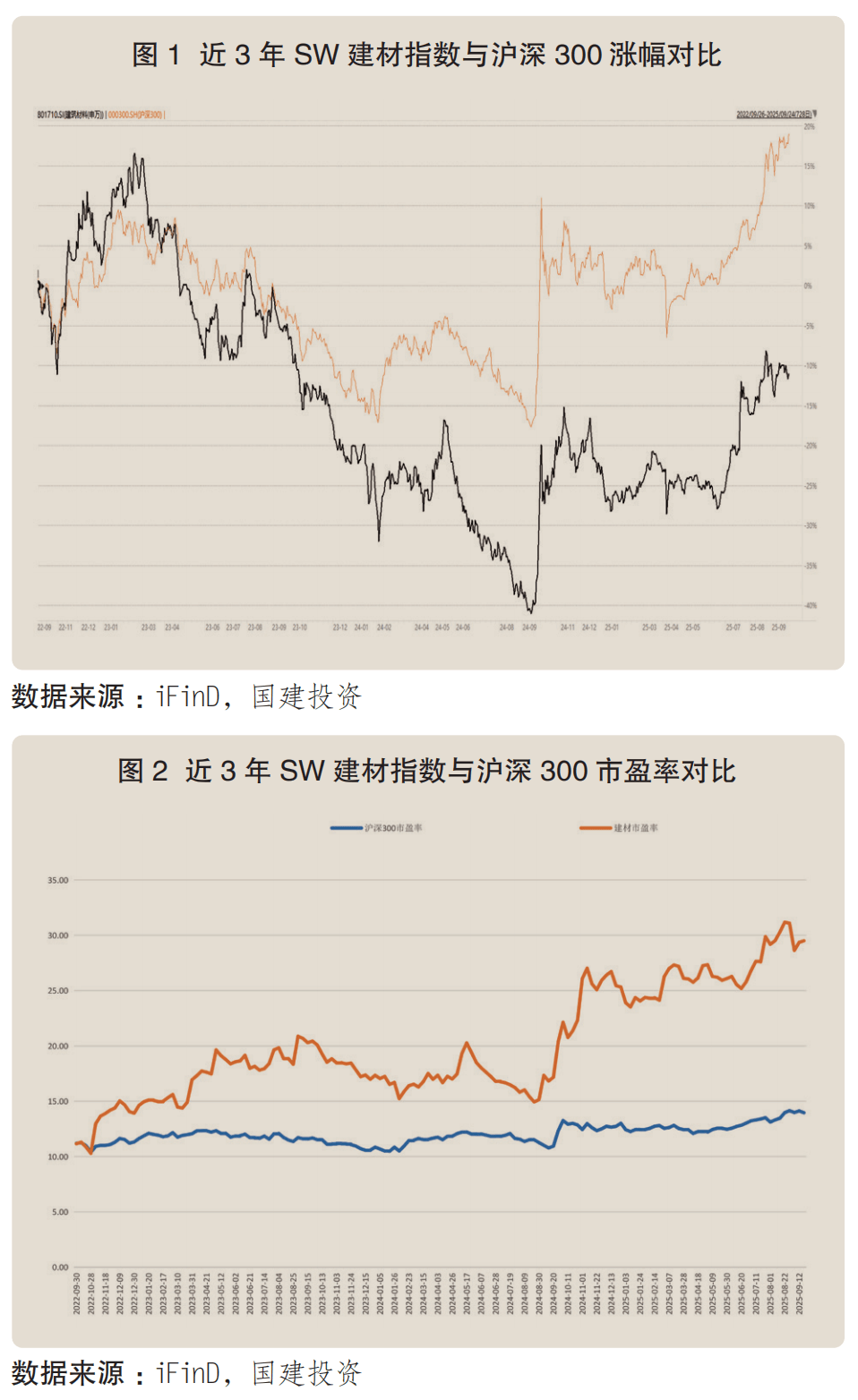
Core Insights - The construction materials sector is experiencing significant structural differentiation, with varying performance across sub-industries, driven by factors such as real estate adjustments and demand contraction [1][2][6][19]. Overall Industry Performance - Since 2022, the SW construction materials index has underperformed compared to the CSI 300 due to adjustments in the real estate supply chain and demand shrinkage [2]. - In the first half of 2025, the total market capitalization of listed companies in the SW construction materials sector reached 862.68 billion yuan, with operating revenue of 690.43 billion yuan, a year-on-year decline of 4.92%, and a net profit attributable to shareholders of 21.69 billion yuan, a year-on-year increase of 43.58% [2]. Sub-Industry Analysis Cement Manufacturing - The cement manufacturing sector is in a severe downturn, with a three-year CAGR of -28.35% for total revenue and -77.85% for net profit, indicating a significant mismatch between high supply and weak demand [10][11]. - The national cement capacity utilization rate was only 55.8% in the first half of 2025, well below the 75% threshold for reasonable operation [10]. Cement Products - The cement products sector shows a contrasting performance with a three-year CAGR of -15.58% for revenue and -152.26% for net profit, but a gross margin of 25.67% and a high inventory turnover rate of 7.99 times [12]. - The sector benefits from new infrastructure and major engineering investments, supporting demand for cement products [12][13]. Glass Fiber Manufacturing - Glass fiber manufacturing is the only sub-industry showing positive growth across all dimensions, with a three-year CAGR of 18.72% for revenue and 23.47% for net profit [14]. - The growth is driven by expanding downstream demand in sectors like wind power and photovoltaics, supported by favorable industrial policies [14]. Glass Manufacturing - The glass manufacturing sector has reported an overall loss for the first time, with a three-year CAGR of -10.23% for revenue and -35.87% for net profit, facing challenges from overcapacity and strict environmental regulations [15]. Refractory Materials - The refractory materials sector remains relatively stable, with a three-year CAGR of -1.87% for revenue and -15.62% for net profit, benefiting from rigid demand in high-energy-consuming industries [16]. Pipe Materials - The pipe materials sector is driven by infrastructure investments, with a three-year CAGR of -5.67% for revenue and -12.35% for net profit, but a gross margin of 22.45% [17]. Other Construction Materials - The other construction materials sector, covering gypsum boards, artificial boards, and decorative materials, shows strong anti-cyclical properties due to its low correlation with real estate [18]. Investment Value and Strategy - The report suggests focusing on three core investment tracks: high-growth manufacturing represented by glass fiber, high-turnover engineering products like cement products, and comprehensive service transformations in waterproofing and decoration [19][20]. - Emphasis is placed on selecting industry leaders with strong cash flow and balance sheet quality, advocating for a diversified cross-sector allocation to mitigate cyclical risks [20]. Future Outlook - The construction materials industry is expected to shift from quantity competition to quality competition, with increasing concentration as a trend [22]. - New infrastructure investments and green building initiatives are projected to become significant growth drivers, with a planned investment of 1.5 trillion yuan in new infrastructure by 2025 [22].
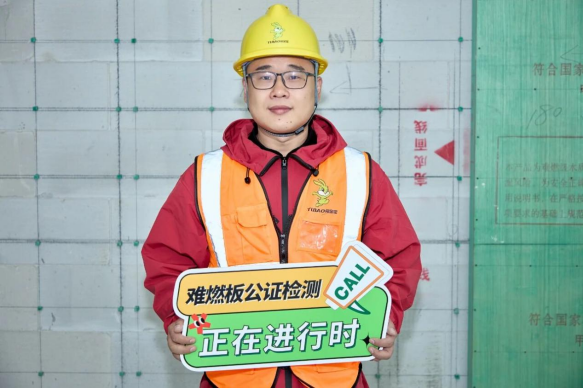
沪材通装饰新材料有限公司总经理张伟:以“可视化公检”破局区域市场,共筑品质供应链新生态
Zhong Guo Zhi Liang Xin Wen Wang· 2025-10-27 05:33
Core Insights - The construction of the Tianan Haoyuan Phase II project in Shanghai's Qibao area is underway, with a joint inspection of Rabbit Baby's fire-resistant boards taking place, highlighting the project's quality assurance and strategic market impact [1] Group 1: Brand and Product Strength - The collaboration between local service provider Hu Cai Tong and Rabbit Baby is viewed as a win-win decision, leveraging Rabbit Baby's brand power to access high-end projects and reduce communication costs [3] - Rabbit Baby's fire-resistant boards meet national quality standards, addressing key customer concerns regarding burning performance, environmental indicators, and long-term stability, thus providing a strong negotiation advantage [3] Group 2: Trust and Transparency - The public inspection report serves as a credible "certificate of trust," enhancing sales efficiency by alleviating customer concerns and providing a dynamic quality assurance tool [5] - Continuous public inspection activities are advocated to maintain a robust supervision mechanism, ensuring that Rabbit Baby's products can withstand random checks and solidifying brand reputation [5] Group 3: Evolving Competitive Landscape - The competitive logic in the industry is shifting from price and brand recognition to verifiable quality and transparent supply chains, with high-end project owners increasingly favoring third-party inspections over self-reported results [7] - The move towards visualized quality assurance transforms product reliability from static documents to a traceable and verifiable process, promoting a healthier and more transparent industry environment [7]