
中航西飞

Search documents
中航西飞(000768) - 2025 Q3 - 季度财报
2025-10-29 09:20
Financial Performance - The company's operating revenue for the third quarter reached ¥10,828,016,465.15, representing a year-on-year increase of 27.51% compared to ¥8,491,605,029.50[4] - Net profit attributable to shareholders was ¥303,482,693.03, reflecting a 5.89% increase from ¥286,595,642.29 in the same period last year[4] - The basic earnings per share increased by 5.80% to ¥0.1095 from ¥0.1035 in the previous year[4] - The net profit for the current period is CNY 992,365,352.94, representing an increase from CNY 943,752,097.27 in the previous period, which is a growth of approximately 5.9%[34] - The total profit for the current period is CNY 1,175,506,726.01, compared to CNY 1,089,361,628.31 in the previous period, indicating an increase of about 7.9%[34] - The operating profit for the current period is CNY 1,173,632,639.58, up from CNY 1,083,100,421.86, reflecting a growth of approximately 8.3%[34] - The total comprehensive income for the current period is CNY 998,900,894.21, compared to CNY 958,124,409.86 in the previous period, reflecting an increase of about 4.2%[35] Cash Flow - Cash flow from operating activities showed a significant increase of 40.04%, amounting to ¥8,229,406,087.19 compared to ¥5,578,850,000.00 in the previous year[4] - Operating cash inflow increased by 12.45% year-on-year, totaling approximately ¥19.65 billion[20] - The cash flow from operating activities shows a net outflow of CNY -8,229,406,087.19, an improvement from CNY -13,725,655,578.85 in the previous period[39] - The cash flow from investing activities has a net outflow of CNY -474,523,923.55, compared to CNY -1,075,098,498.73 in the previous period, indicating a reduction in outflow[39] - The cash flow from financing activities shows a net outflow of CNY -791,681,909.73, a decrease from CNY 1,744,556,036.87 in the previous period[39] Assets and Liabilities - Total assets as of September 30, 2025, were ¥74,111,646,496.64, a slight increase of 0.41% from ¥73,810,707,203.02 at the end of the previous year[4] - The company's equity attributable to shareholders rose by 3.71% to ¥21,804,531,710.75 from ¥21,024,209,129.41 at the beginning of the year[4] - Total liabilities decreased to ¥52,307,114,785.89 from ¥52,786,498,073.61, a decline of 0.9%[31] Operational Efficiency - The company reported a net profit margin improvement, with net profit increasing due to cost management strategies and operational efficiencies[33] - Total operating costs amounted to ¥29,139,186,926.05, up from ¥28,035,883,448.11, reflecting a year-over-year increase of 3.9%[33] - Research and development expenses increased to ¥88,741,730.50, compared to ¥73,493,526.14 in the previous period, marking a growth of 20.7%[33] Changes in Financial Position - The company experienced a 53.12% decrease in cash and cash equivalents, dropping to ¥8,385,451,859.58 from ¥17,888,015,711.72 at the start of the year[12] - The company's cash and cash equivalents decreased to ¥8,385,451,859.58 from ¥17,888,015,711.72, a decline of 53.2%[28] - Accounts receivable rose significantly to ¥21,717,888,361.69, up from ¥12,465,115,883.51, representing an increase of 74.3%[28] - Inventory decreased to ¥20,033,158,855.82 from ¥22,692,440,744.35, a reduction of 11.7%[28] Government and Other Income - The company reported a total of ¥2,016,205.55 in government subsidies related to normal business operations during the reporting period[7] - Other income decreased by 65.95% year-on-year, mainly due to changes in the VAT policy for advanced manufacturing enterprises[18] - Fair value changes in income increased by 222.22% year-on-year, attributed to fluctuations in the prices of held securities investments[18] Impairment Losses - Credit impairment losses increased by 88.34% year-on-year, primarily due to an increase in bad debt provisions[18] - Asset impairment losses surged by 249.42% year-on-year, mainly due to increased provisions for contract asset impairments[18] Accounting Adjustments - The company has made adjustments to its accounting policies, impacting the internal structure of costs without affecting the main financial data[5]

中航西飞:第三季度净利润为3.03亿元,同比增长5.89%
Xin Lang Cai Jing· 2025-10-29 09:19
Core Insights - The company reported a third-quarter revenue of 10.828 billion yuan, representing a year-on-year increase of 27.51% [1] - The net profit for the third quarter was 303 million yuan, showing a year-on-year growth of 5.89% [1] - For the first three quarters, the total revenue reached 30.244 billion yuan, with a year-on-year increase of 4.94% [1] - The net profit for the first three quarters was 999.2 million yuan, reflecting a year-on-year growth of 5.15% [1]
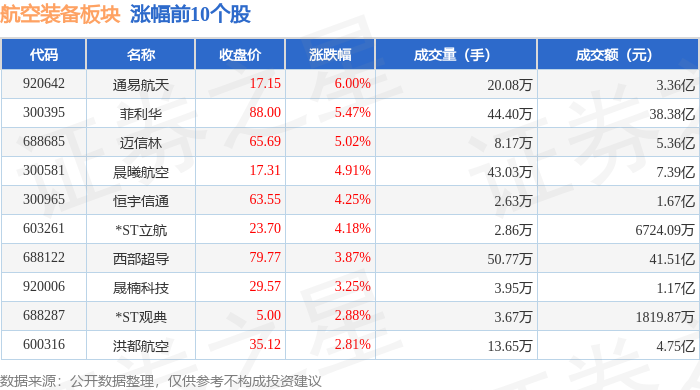
航空装备板块10月28日涨1.11%,通易航天领涨,主力资金净流入3.08亿元
Zheng Xing Xing Ye Ri Bao· 2025-10-28 08:40
Core Viewpoint - The aviation equipment sector experienced a rise of 1.11% on October 28, with Tongyi Aerospace leading the gains, while the overall market indices showed a decline [1]. Group 1: Market Performance - The Shanghai Composite Index closed at 3988.22, down 0.22%, and the Shenzhen Component Index closed at 13430.1, down 0.44% [1]. - Key stocks in the aviation equipment sector showed significant gains, with Tongyi Aerospace rising by 6.00% to a closing price of 17.15 [1]. Group 2: Stock Performance - Notable performers included: - Filihua, which increased by 5.47% to 88.00, with a trading volume of 444,000 shares and a transaction value of 3.838 billion [1]. - Maixinlin, up 5.02% to 65.69, with a trading volume of 81,700 shares and a transaction value of 536 million [1]. - Chengxi Aviation, which rose by 4.91% to 17.31, with a trading volume of 430,300 shares and a transaction value of 739 million [1]. Group 3: Capital Flow - The aviation equipment sector saw a net inflow of 308 million from institutional investors, while retail investors experienced a net outflow of 360 million [2][3]. - Key stocks with significant capital inflows included: - Filihua with a net inflow of 318 million, accounting for 8.30% of its trading volume [3]. - Zhonghang Shenfei with a net inflow of 284 million, representing 11.17% of its trading volume [3].


突破4000点后A股怎么走?
雪球· 2025-10-28 08:38
Core Viewpoint - The article discusses the historical context and implications of the A-share market breaking through the 4000-point mark, analyzing past bull markets in 2007 and 2015 to draw insights for the current market situation [2][4][9]. Historical Analysis - In the history of A-shares, there have been 16 instances of breaking through 4000 points, with seven instances based on closing prices, notably five times in 2007 and two times in 2015 [2][3]. - The maximum increase after breaking 4000 points in 2007 was 51.8%, taking 160 days, while in 2015, the maximum increase was 28.06%, occurring in just 63 days [4][6]. 2007 Bull Market - The 2007 bull market was driven by resource and financial real estate sectors, with significant gains in non-ferrous metals (250%), coal (220%), and financial sectors (190%) [6]. - Macroeconomic indicators supported this bull market, including a GDP growth rate of 11.4%, fixed asset investment growth of 24.8%, and a trade surplus of $262.2 billion [6]. 2015 Bull Market - The 2015 bull market was characterized by the "Internet+" policy and the rise of new industries, with notable stock performances from companies like Dongfang Finance (600% increase) and China CNR (500% increase) [7][8]. - However, this market was marked by excessive leverage and regulatory shortcomings, leading to a peak in margin financing of 2.27 trillion yuan in June 2015 [8]. Current Market Context - The current A-share market exhibits characteristics of a "water bull," with structural features in both the economy and capital markets, indicating a shift towards high-end manufacturing [9]. - Despite economic challenges, there is a noticeable change in fiscal spending towards long-term projects, suggesting a more sustainable growth trajectory compared to previous bull markets [9].

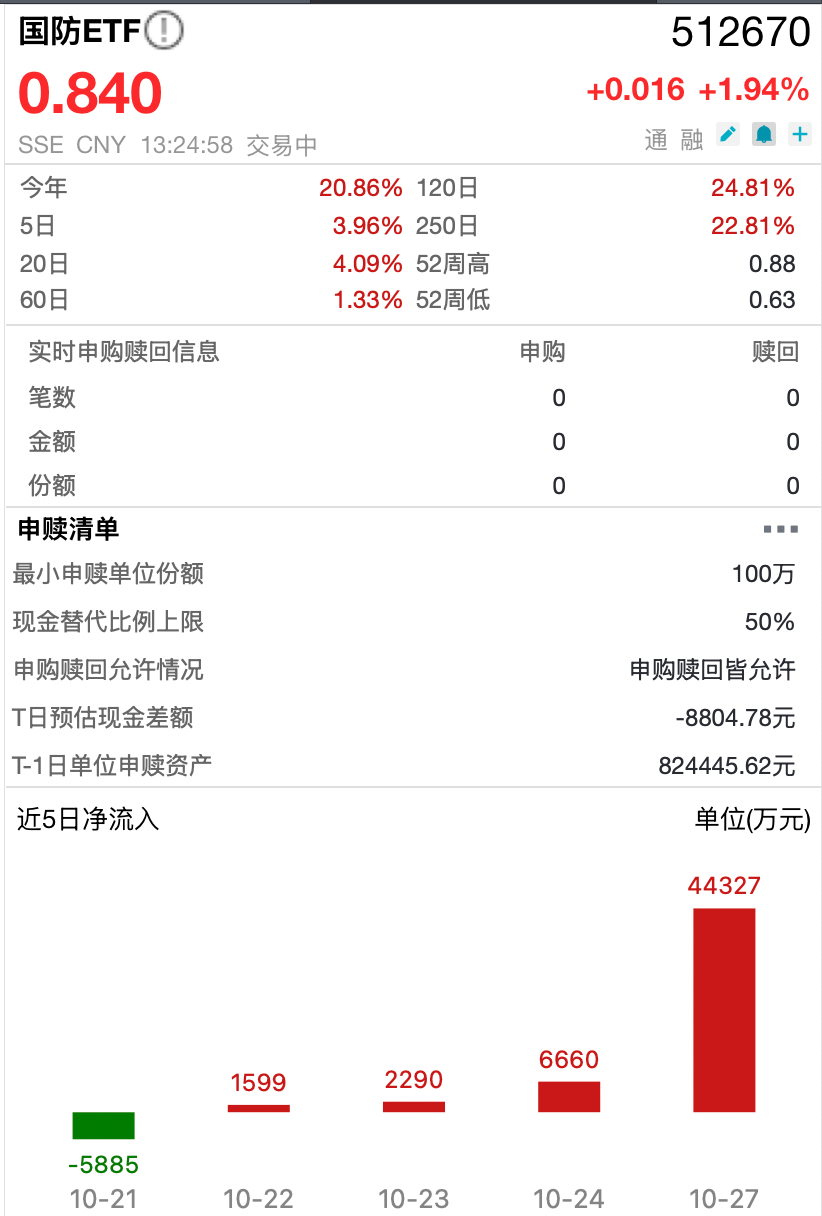
国防ETF(512670)涨超2%位列ETF榜第一,已连续4日获资金净申购
Xin Lang Cai Jing· 2025-10-28 05:42
Group 1 - The core viewpoint of the news highlights the increasing importance of commercial aerospace in China's strategic development, with a focus on technological breakthroughs and capital acceleration in the industry [1][2]. - The Fourth Plenary Session of the Central Committee added the term "aerospace power," indicating a renewed emphasis on commercial aerospace following the mention of "new growth engines" [1]. - The 14th Five-Year Plan suggests accelerating the development of strategic emerging industries, including new energy, new materials, aerospace, and low-altitude economy, which is expected to create several trillion-yuan markets [1]. Group 2 - The commercial aerospace sector is entering a high-density launch period, with significant advancements in satellite deployment and launch frequency, closely approaching the launch density of SpaceX's Starlink system [2]. - The recent successful launch of the Tianlong-3 large liquid carrier rocket, achieving the simultaneous separation of 36 satellites, marks a significant milestone in China's commercial aerospace capabilities [2]. - The procurement announcement from Yuanxin in July indicates plans for multiple rocket launches, with a total of 94 satellites to be deployed by 2026, further accelerating the launch schedule [2]. Group 3 - According to Xinda Securities, the military industry sector is becoming more attractive in terms of valuation, with recommendations to overweight the military industry, focusing on new combat systems, unmanned equipment, satellite internet, and commercial aerospace [3]. - The National Defense ETF closely tracks the CSI National Defense Index, which includes listed companies under major military groups and those providing equipment to the armed forces, reflecting the overall performance of the defense industry [3]. - The management and custody fees for the National Defense ETF are the lowest among similar ETFs, at only 0.40% [3]. Group 4 - As of September 30, 2025, the top ten weighted stocks in the CSI National Defense Index include companies like AVIC Shenyang Aircraft (600760) and Aero Engine Corporation of China (600893), collectively accounting for 45.45% of the index [6].
十五五新增“国防实力大幅跃升”为目标,高端装备ETF(159638)盘中涨超1.6%,冲击3连涨
Xin Lang Cai Jing· 2025-10-28 03:55
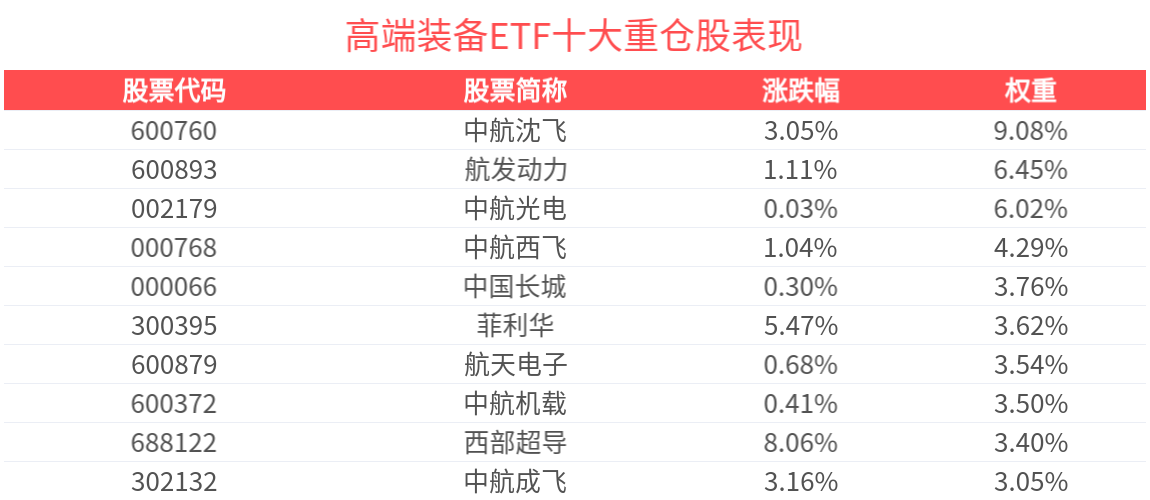
Core Insights - The high-end equipment sector is experiencing significant growth, with the CSI High-End Equipment Sub-Index rising by 1.70% as of October 28, 2025, and notable increases in individual stocks such as Aerospace Development and Aerospace Intelligent Equipment [1][2] - The High-End Equipment ETF (159638) has shown a strong performance, achieving a 21.30% increase in net value over the past six months and a total fund size of 1.01 billion [1][2] - The strategic emphasis on national defense capabilities has been highlighted in the 14th and 15th Five-Year Plans, indicating a substantial leap in defense strength by 2035 [2] Market Performance - As of October 27, 2025, the High-End Equipment ETF has an average daily trading volume of 57.94 million over the past year, with a turnover rate of 4.25% on the trading day [1] - The ETF has recorded a maximum monthly return of 19.30% since its inception, with an average monthly return of 6.43% during rising months [1] Key Stocks - The top ten weighted stocks in the CSI High-End Equipment Sub-Index account for 46.85% of the index, with notable performers including AVIC Shenyang Aircraft, Aero Engine Corporation, and AVIC Electromechanical [2][4] - Specific stock performances include AVIC Shenyang Aircraft up by 3.05% and Aerospace Intelligent Equipment up by 8.09% [4]
中航西飞(000768):军贸领域沧海遗珠,民机市场中坚力量
Changjiang Securities· 2025-10-27 15:38
Investment Rating - The investment rating for AVIC Xi'an Aircraft Industry Group Co., Ltd. is "Buy" and is maintained [11]. Core Viewpoints - AVIC Xi'an is significantly undervalued in the large aircraft military trade market, with its core model Y-20 having notable scarcity on the supply side, as comparable models like the US C-17 have been discontinued and the Russian IL-76 is in low production [3][7]. - The medium transport aircraft market has greater potential compared to large transport aircraft, with the Y-9 model having a significant market opportunity in military trade [3][9]. - The company has focused on its main aircraft manufacturing business after multiple restructurings, and its management team has become notably younger, which may bring new dynamics to the company [6][20]. Summary by Sections Company Overview - AVIC Xi'an has undergone several asset restructurings and has become the only listed platform for large and medium transport aircraft in China [20]. - The company has a diverse product line including military transport aircraft, bombers, and civil aircraft, as well as international subcontracting business [22]. Financial Performance - The company's revenue has shown steady growth, with a compound annual growth rate (CAGR) of 6.59% from 2020 to 2024, increasing from 33.484 billion to 43.216 billion [24]. - In the first half of 2025, the company achieved a revenue of 19.416 billion, a year-on-year decrease of 4.49%, while net profit attributable to shareholders increased by 4.83% to 689 million [24][28]. Market Position and Opportunities - The Y-20 model is positioned as a leading strategic transport aircraft, with a maximum takeoff weight of 200 tons, filling a gap in the market as many comparable models have ceased production [46][49]. - The company is expected to benefit from the growth of the domestic large aircraft market, particularly with the C919 model, which is projected to have a production capacity increase by 33% by 2029 [8][9]. Management and Investor Relations - The new management team, predominantly composed of younger individuals, is expected to enhance investor relations and market value management [20][36]. - The company is actively working on value creation, realization, and management to improve operational efficiency and shareholder returns [36].
二十届四中全会高度重视装备建设,首提航天强国,关注内需景气
Orient Securities· 2025-10-27 15:37
Investment Rating - The report maintains a "Positive" outlook for the defense and military industry [6] Core Insights - The 20th Central Committee's Fourth Plenary Session emphasizes the importance of military equipment construction, indicating that the military equipment development is expected to accelerate with the implementation of the 14th Five-Year Plan [9][12] - The successful testing of the Zhuque-3 rocket marks a significant advancement in reusable rocket technology, which is anticipated to lower launch costs and accelerate satellite networking [14][17] - The military sector's stock prices have stabilized recently, with a focus on both domestic and international demand, highlighting the investment value in the military industry [18] Summary by Sections Investment Suggestions and Targets - The report suggests focusing on military electronics, new domains, and the aerospace propulsion chain, with specific stock recommendations including: - Military Electronics: Aerospace Electric (002025, Buy), Zhonghang Optical (002179, Buy), and others [18] - New Domains: Haige Communication (002465, Buy) and others [18] - Aerospace Propulsion Chain: Xibei Superconductor (688122, Buy) and others [18] - Military Trade/Main Equipment: Zhonghang Shenfei (600760, Unrated) and others [18] Industry Performance - The defense and military industry index increased by 2.81%, underperforming compared to the Shanghai Composite Index [21][22] - The report notes that the military industry has shown resilience, with a focus on key components and materials as demand rises [18][21] Recent Developments - The report highlights significant recent events in the military sector, including successful military exercises and advancements in military technology [30][31]


国防军工:军工本周观点:关注四中新方向-20251027
Huafu Securities· 2025-10-27 05:11
Investment Rating - The industry rating is "Outperform the Market" indicating that the overall return of the industry is expected to exceed the market benchmark index by more than 5% in the next 6 months [57]. Core Insights - The report emphasizes the importance of national security and the goals set for the military by the 20th Central Committee, highlighting the need for modernization in defense and military capabilities [41][42]. - The report identifies significant growth opportunities in emerging industries such as aerospace, new energy, and low-altitude economy, which are expected to drive economic growth over the next decade [41][42]. - The military industry is anticipated to experience strong demand recovery from 2025 to 2026, supported by various catalysts including the "14th Five-Year Plan" and the "100-Year Military Goal" [42]. Summary by Sections 1. Industry Performance Review - The military industry index (801740) increased by 2.81% from October 20 to October 24, while the CSI 300 index rose by 3.24%, resulting in an underperformance of 0.43 percentage points [15][17]. - Since the beginning of 2025, the military index has risen by 16.47%, compared to an 18.44% increase in the CSI 300 index, indicating a relative underperformance of 1.98 percentage points [17]. 2. Market and Valuation - As of October 24, the military industry index has a TTM price-to-earnings ratio of 74.63, placing it in the 96.86 percentile, suggesting a high valuation relative to historical levels [42][27]. - The report notes a slight net outflow of passive funds, with expectations of a recovery in demand leading to a positive outlook for future fund inflows [42][27]. 3. Key Investment Opportunities - The report suggests focusing on specific companies within various segments of the military industry, including land equipment, stealth materials, deep-sea technology, engines, unmanned systems, AI, and nuclear fusion [44]. - Notable companies to watch include Tianqin Equipment, Gaode Infrared, and Aerospace Technology among others [44]. 4. Important News and Announcements - The report highlights recent successful launches in the aerospace sector, including the successful deployment of satellites by the Li Jian No. 1 rocket [45]. - It also discusses advancements in nuclear fusion technology and the establishment of new policies to support the low-altitude economy [46][49].
军工行业周复盘、前瞻:四中全会落幕,新增国防实力跃升目标
CMS· 2025-10-27 01:37
Investment Rating - The report provides a strong recommendation for several companies in the military industry, indicating a positive outlook for their stock performance [9]. Core Insights - The recent Fourth Plenary Session of the 20th Central Committee emphasized new goals for national defense capabilities, including the enhancement of "national defense strength" and "international influence" [21]. - The report highlights the aerospace sector as a key focus area for military investment, particularly in the context of the newly stated goal of becoming a "space power" [21]. - Upcoming quarterly reports are expected to show a turning point in industry performance, with several companies already reporting significant year-on-year revenue and profit growth [24]. Industry Overview - The military industry consists of 118 listed companies with a total market capitalization of 2,092.9 billion and a circulating market value of 1,736.7 billion [4]. - The SW National Defense and Military Industry Index has shown a performance increase of 16.47% year-to-date, although it has underperformed compared to the CSI 300 Index by 1.97% [12][20]. - The industry is currently valued at a PE (TTM) of 85.77 times, with a five-year percentile of 78.63% [20]. Key Events - The Fourth Plenary Session concluded with new national defense goals, including a focus on high-quality military modernization and the integration of advanced combat capabilities [21]. - The report notes that the aerospace equipment sector has been particularly responsive to the recent policy announcements, showing strong performance [16][21]. Performance Summary - The report identifies several companies with notable performance, including North Navigation with a revenue increase of 210% and a net profit increase of 268.8% [25]. - The top-performing stocks in the military sector include North Shares (+25.20%) and Feili Hua (+17.92%) [19].


