建信基金

Search documents
个人养老金,最新业绩规模来了
Zhong Guo Ji Jin Bao· 2025-10-19 13:51
Core Insights - The personal pension system has shown significant results in its three years of implementation, becoming an important pillar of the multi-tiered pension security system in China [1][2][3] - The system has positively impacted individuals, financial institutions, and capital markets, establishing a mature framework of "policy guidance + market operation" [2][3] - Public funds have played a crucial role in the personal pension sector, contributing to product innovation and performance support, thereby promoting long-term investment strategies [5][6] Group 1: System Implementation and Impact - The personal pension system has expanded the participant base significantly, providing a crucial supplement to the first and second pillars of pension security [3][4] - The introduction of tax incentives, such as a pre-tax deduction limit of 12,000 yuan per year, has provided tangible benefits to participants [3][4] - The system is expected to introduce more stable, long-term capital into the market, aligning with national policies aimed at increasing medium to long-term funds in the market [3][4] Group 2: Public Fund Contributions - Public funds are identified as the core vehicle for the personal pension system, with a focus on low fees and long-term assessments to reduce costs for investors [5][6] - The public fund industry has developed a diverse product line that meets various risk preferences and age groups, enhancing the appeal of pension investment [6][7] - The high proportion of rights in public fund Y shares is advantageous for long-term investment, allowing investors to benefit from the growth of listed companies [7][8] Group 3: Performance and Growth - Personal pension funds have experienced significant performance recovery, with an average net value increase of over 15% this year, and the total scale of Y shares reaching 12.405 billion yuan, a 35.7% increase from last year [8][10] - The number of personal pension funds has continued to grow, with 302 funds reported by the end of September, including new products launched in the third quarter [12][13] - Over 98% of personal pension funds have achieved positive returns since inception, with nearly 20% of products seeing net value increases exceeding 20% [10][12] Group 4: Challenges and Future Directions - Despite the growth in account openings, actual contribution rates remain low, indicating a need for improved investor education and product innovation [18][19] - The industry faces challenges in enhancing investor participation, particularly among low to middle-income groups, due to perceived complexity and limited appeal of tax incentives [19][20] - Future innovations in the personal pension sector are expected to focus on product segmentation, strategy upgrades, and enhanced service offerings to transition from single investment products to comprehensive pension solutions [21][22]


个人养老金,最新业绩规模来了
中国基金报· 2025-10-19 13:14
Core Viewpoint - The implementation of the personal pension system over the past three years has shown significant results, becoming an important pillar of the multi-level pension security system in China [3][5][7]. Group 1: Impact on Individuals and Financial Institutions - The personal pension system has positively influenced individuals, financial institutions, and the capital market, establishing a mature framework of "policy guidance + market operation" [5][6]. - The system has solidified the professional position of public funds in the third pillar of pensions, with a product system evolving from single fund-of-funds (FOF) to index funds, catering to diverse investor risk preferences [5][6]. - The introduction of tax deductions of 12,000 yuan per year for participants has provided tangible benefits for investors, while institutional investors can manage assets from a long-term perspective due to the stability of personal pensions [7][8]. Group 2: Performance and Growth of Personal Pension Funds - Personal pension funds have experienced significant performance recovery, with an average net value increase of over 15% this year, and the total scale of personal pension Y shares reaching 12.405 billion yuan, a growth of 35.7% from the previous year [14][19]. - The number of personal pension funds has expanded, with 302 funds reported by the end of September, including eight new products in the third quarter [19][20]. - Over 98% of personal pension funds have achieved positive returns since inception, with nearly 20% of products seeing net value increases exceeding 20% [14][19]. Group 3: Role of Public Funds - Public funds play a crucial role in the personal pension system, providing high equity ratios suitable for long-term investment and helping to achieve stable growth of pension assets [10][11]. - The public fund industry has contributed significantly through product innovation, performance support, and investor education, promoting the "long money long investment" concept [10][11][12]. - Public funds are seen as the core vehicle for the implementation of personal pensions, with a diverse product line that meets the needs of different age groups and risk preferences [10][11]. Group 4: Future Directions and Challenges - The personal pension system is expected to continue expanding, with a focus on product diversification to cater to different risk preferences and life cycles [20][30]. - Challenges remain in enhancing investor participation and addressing the low actual contribution rates, with suggestions for improved education, product innovation, and policy support [28][29]. - Future innovations in personal pensions may include product segmentation, strategy upgrades, and enhanced services, transitioning from single investment to comprehensive pension solutions [30][32].

性价比与确定性凸显 红利资产获资金青睐
Shang Hai Zheng Quan Bao· 2025-10-19 12:31
Core Viewpoint - Following the holiday, there is a shift in funds towards dividend assets due to "high cut low" demand, adjustments in the tech sector, and the calendar effect in Q4, leading to a concentration of purchase limits on several dividend funds [1] Group 1: Dividend Fund Purchase Limits - Multiple dividend funds have recently announced purchase limits, with Manulife Fund stating that from October 17, single accounts cannot exceed 1 million yuan in purchases [2] - Similarly, Jianxin Fund has set a limit of 10 million yuan for its dividend-focused fund, while other funds have varying limits ranging from 10 million to 250,000 yuan [2] - The frequent implementation of purchase limits is attributed to the need to protect existing fund holders and ensure stable fund operations [2] Group 2: Increased Demand for Dividend Assets - Recent data indicates a rising preference for dividend assets, with the net subscription of Huabao CSI Bank ETF reaching 4.9 billion units, the highest among all ETFs [3] - The Huatai-PB CSI Dividend Low Volatility ETF also saw a significant increase in net subscriptions, totaling 1.88 billion units in October compared to only 390 million units in September [3] Group 3: Defensive Investment Strategies - In light of global trade uncertainties, there is a heightened demand for defensive asset allocations, benefiting large financial and dividend assets [4] - Analysts suggest that dividend assets have returned to relatively low levels, and with upcoming quarterly reports and potential dividend distributions, these assets may drive A-share market growth [4] - A fund manager indicated a consensus in the industry that Q4 will see a "high cut low" strategy, with a shift from tech stocks to financial technology sectors, which are expected to offer better investment value and certainty [4] Group 4: Investment Strategies in Low-Interest Environments - In a low-interest-rate environment, a "barbell strategy" combining high-dividend assets with high-valuation tech growth remains effective in Q4 [5] - The attractiveness of dividend assets, particularly for institutional investors like insurance funds, has significantly increased following the tech growth phase [5]
黄金ETF本周涨幅居前 ETF资金整体净流入605.85亿元
Sou Hu Cai Jing· 2025-10-19 11:13
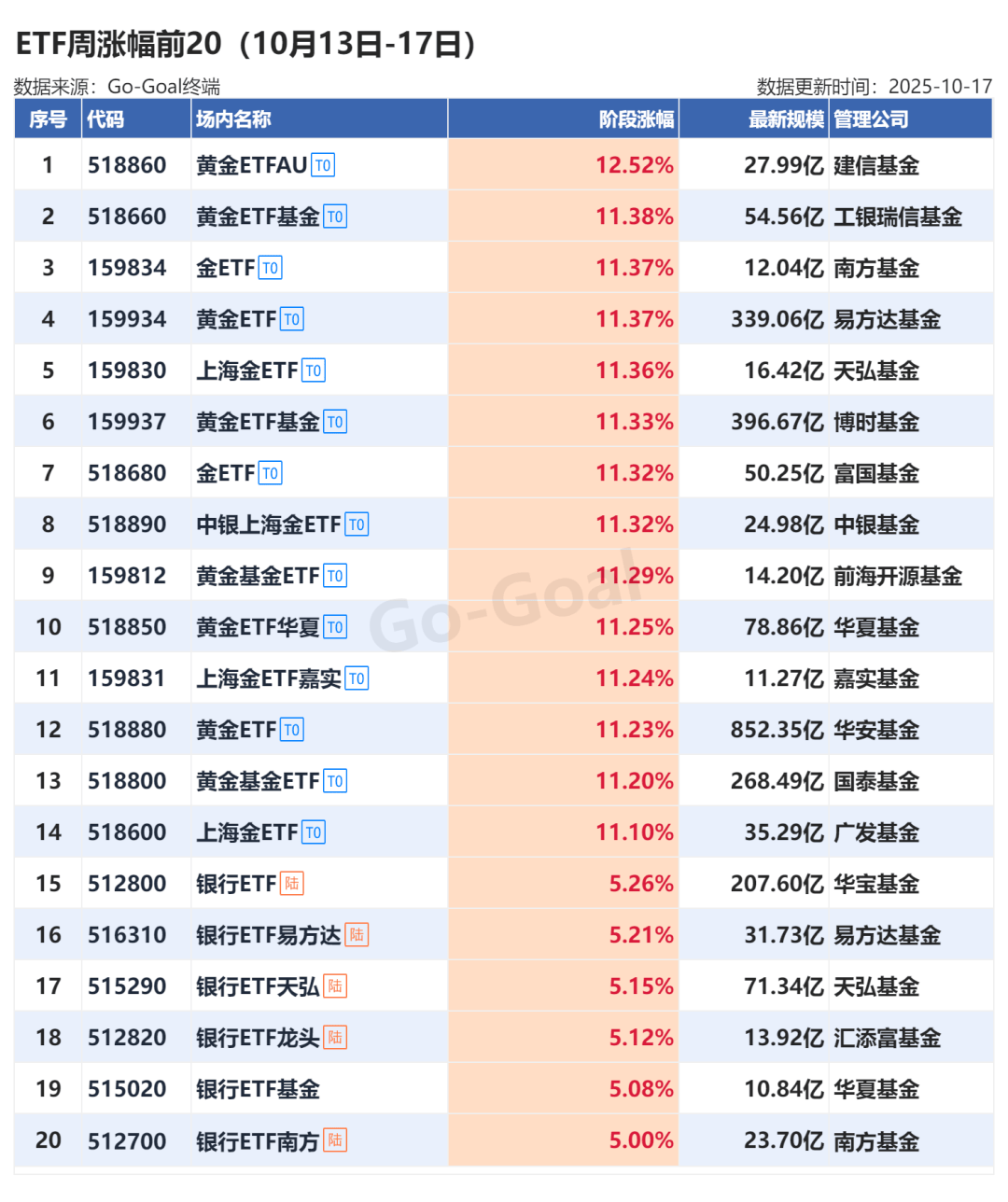
Core Insights - The article highlights a significant increase in gold ETFs, with the Gold ETF AU rising by 12.52%, marking it as the top performer for the week [1][2] - Overall, the A-share market experienced a decline, with the Shanghai Composite Index down by 1.47%, Shenzhen Component down by 4.99%, and the ChiNext Index down by 5.71% [1] - There was a net inflow of 605.85 billion yuan into ETFs this week, indicating strong investor interest [2] ETF Performance - Gold ETFs showed remarkable performance, with several funds reporting substantial gains: - Gold ETF AU: +12.52% (27.99 billion yuan) [2] - Other notable gold ETFs include: - Gold ETF Fund TO: +11.38% (54.56 billion yuan) [2] - Gold ETF TO: +11.37% (12.04 billion yuan) [2] - Shanghai Gold ETF TO: +11.36% (16.42 billion yuan) [2] - Bank-related ETFs also saw positive performance, with increases around 5% [2] Sector Trends - The article notes a significant outflow in sectors related to robotics and smart driving, with declines exceeding 9% [1] - The overall ETF market saw a net inflow of 442.37 billion yuan into industry ETFs, while broad-based ETFs experienced a net outflow of 170.91 billion yuan [2] Upcoming ETFs - Seven new ETFs are set to be issued next week, focusing on popular sectors such as internet and artificial intelligence [3] - Upcoming ETFs include: - Hong Kong Stock Connect Internet ETF by Southern Fund [4] - ChiNext Artificial Intelligence ETF by China Merchants Fund [4] - ChiNext ETF by Huatai-PineBridge Fund [4] Upcoming Listings - Four ETFs are scheduled to be listed next week, including: - Private Enterprise 300 ETF by Qianhai Kaiyuan Fund [5] - Shanghai 580 ETF by E Fund [5] - Satellite ETF by GF Fund [5] - Hong Kong Stock Connect Consumer ETF by Huaan Fund [5]
首尾差异超40个百分点!“固收 +”基金的冰与火
Zhong Guo Zheng Quan Bao - Zhong Zheng Wang· 2025-10-19 03:51
Core Insights - The "fixed income +" products have gained popularity due to their combination of stability and yield flexibility, with several large fund companies launching new "fixed income +" funds and intensifying marketing efforts for existing products [1][9] - Over the past year, the overall performance of "fixed income +" products has been impressive, but there is significant performance disparity among them, with some funds achieving over 20% returns while others have negative returns [1][6] Performance Disparity - The performance difference among mixed bond-type secondary funds has exceeded 42 percentage points over the past year [2][7] - As of October 16, 79 mixed bond-type primary and secondary funds have achieved returns exceeding 20%, with median returns of 3.18% for primary funds and 6.02% for secondary funds [3] Fund Characteristics - Funds with returns over 20% typically have high allocations in convertible bonds and a significant equity position, actively investing in technology stocks [4] - The top-performing mixed bond-type secondary fund, Huashang Fengli Enhanced Open-End Bond, achieved a return of 39.48%, with an equity allocation of approximately 18.93% [4] - The Huabao Enhanced Income Bond Fund also showed strong performance with over 37% returns, focusing on aggressive allocations in small and mid-cap technology stocks [4] Investment Strategies - The best-performing mixed bond-type primary funds are primarily convertible bond funds, with notable returns such as 29.81% for Everbright High-Grade Bond Fund and over 23% for Minsheng Jia Yin Xinxiang Bond Fund [5] - The performance of "fixed income +" funds is significantly influenced by stock allocation, bond configuration, and yield enhancement strategies [7][9] Market Trends - Since September, the equity market has entered a volatile phase, making "fixed income +" products a hot topic for fund companies, with several large firms launching new products [9] - The current low-risk interest rates make pure bond products less appealing, while the high volatility of equity products does not suit all investors, positioning "fixed income +" as a compromise solution [9][10]
10/17财经夜宵:得知基金净值排名及选基策略,赶紧告知大家
Sou Hu Cai Jing· 2025-10-17 16:02
Core Insights - The article provides an objective ranking of open-end funds based on their net asset value changes, highlighting the top and bottom performers in the market [2][3][4]. Fund Performance Summary Top Performing Funds - The top 10 funds with the highest net value growth as of October 17 include: - Tianhong Shanghai Gold ETF Initiated Link A: 2.2577, up 3.19% - Tianhong Shanghai Gold ETF Initiated Link C: 2.2293, up 3.18% - Fortune Shanghai Gold ETF Link A: 2.1334, up 3.09% - Fortune Shanghai Gold ETF Link C: 2.0946, up 3.09% - GF Shanghai Gold ETF Link F: 2.1433, up 3.03% - GF Shanghai Gold ETF Link A: 2.1435, up 3.03% - GF Shanghai Gold ETF Link C: 2.1049, up 3.02% - Jianxin Shanghai Gold ETF Link A: 2.3524, up 3.02% - Jianxin Shanghai Gold ETF Link D: 2.3057, up 3.02% - Jianxin Shanghai Gold ETF Link C: 2.3041, up 3.01% [2][4]. Bottom Performing Funds - The bottom 10 funds with the lowest net value growth as of October 17 include: - GF CSI Photovoltaic Leader 30 ETF: 0.6394, down 6.73% - Harvest Low Carbon Selected Mixed Initiated A: 0.8031, down 6.49% - Harvest Low Carbon Selected Mixed Initiated C: 0.7952, down 6.48% - E Fund National Certificate New Energy Battery ETF: 1.9379, down 6.47% - GF National Certificate New Energy Battery ETF: 1.7197, down 6.47% - AVIC Smart Selection Leading Mixed Initiated C: 1.0066, down 6.42% - AVIC Smart Selection Leading Mixed Initiated A: 1.0091, down 6.42% - CITIC Construction Investment Low Carbon Growth Mixed C: 0.5025, down 6.25% - CITIC Construction Investment Low Carbon Growth Mixed A: 0.5102, down 6.25% - Tianhong National Certificate New Energy Battery Index Initiated A: 1.3389, down 6.12% [4][6]. Market Analysis - The Shanghai Composite Index opened lower and experienced a downward trend, with a trading volume of 1.95 trillion. The number of advancing stocks was 602, while declining stocks reached 4783. The only sectors that gained were telecommunications, transportation equipment, banking, and transportation services [6]. - The Tianhong Shanghai Gold ETF Initiated Link A showed significant net value growth, attributed to the rise in gold prices, while the GF CSI Photovoltaic Leader 30 ETF underperformed due to a decline in its major holdings [6][7].

年内多家银行上调部分代销公募基金风险评级
Zheng Quan Ri Bao Zhi Sheng· 2025-10-17 15:38
Core Viewpoint - Multiple banks in China, including CITIC Bank, are adjusting the risk ratings of their asset management products, primarily to comply with regulatory requirements and enhance investor protection [1][4]. Group 1: Risk Rating Adjustments - CITIC Bank announced an adjustment of risk ratings for 17 asset management products, with 15 products seeing an increase in their risk ratings and 2 experiencing a decrease [2]. - The adjustment covers a wide range of product types, including passive index bond funds, mixed equity funds, and flexible allocation funds, indicating a comprehensive approach to risk assessment [2]. - This marks the fourth adjustment by CITIC Bank in 2023, reflecting ongoing regulatory compliance and the need for consistent risk rating practices [2]. Group 2: Regulatory and Market Influences - The adjustments are driven by the dual factors of deepening regulatory requirements and changes in market conditions, necessitating a more accurate reflection of risk levels [4]. - The regulatory framework established by the National Financial Supervision Administration in March 2023 mandates banks to independently assess the risk of asset management products and align them with appropriate customer profiles [4]. - As market volatility increases, the underlying risk-return characteristics of certain funds have changed, prompting banks to adjust ratings accordingly [4]. Group 3: Implications for the Banking and Asset Management Industry - In the short term, banks may experience fluctuations in sales revenue from high-risk products due to these adjustments, but long-term benefits include reduced legal disputes and enhanced reputation through improved compliance [5]. - The dynamic rating system is expected to encourage asset management companies to optimize product design and risk control, shifting the industry focus from "scale expansion" to "high-quality development" [5]. - Banks are advised to enhance their due diligence capabilities to better manage risks associated with asset management product sales [5].

中证A500一周年:ETF稳中有升,增强基金分化拉开
Sou Hu Cai Jing· 2025-10-17 09:55
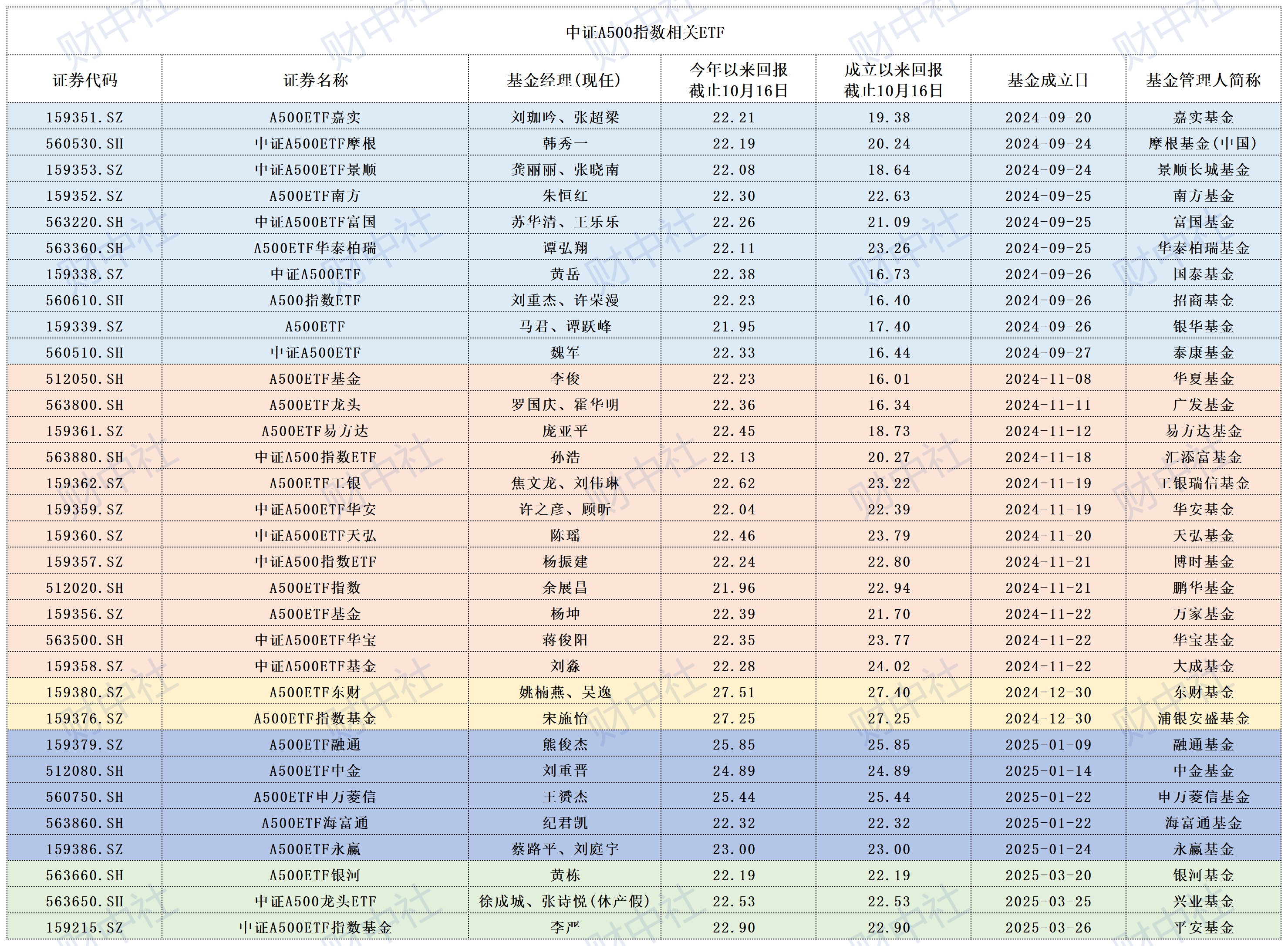
Core Insights - The CSI A500 Index has rapidly grown from 20 billion to 300 billion RMB, becoming the second-largest core broad-based index in the A-share market within a year, reflecting market expectations for mid-cap blue chips and structural transformation in the economy [1] - As of October 16, 2025, the A500 ETF has shown stable returns, with an average return of approximately 22.9% year-to-date, outperforming the CSI 300 Index [2][12] - The A500 index has become a key indicator of China's economic transformation, with over 35% of its constituent companies classified as "specialized, sophisticated, and innovative" [12] ETF Performance - The average return of 32 A500 ETFs year-to-date is about 22.9%, with the index itself rising by 23.05% over the past year, indicating strong resilience in the mid-cap blue-chip sector [2][12] - The performance differences among the three batches of ETFs are attributed to their respective launch timings, with the first batch averaging returns of 21.4% since inception [2][5] - The leading A500 ETFs by size include Huatai-PB A500 ETF and E Fund A500 ETF, with sizes of 24.9 billion and 22.6 billion RMB respectively [6] Index Enhancement Funds - The average return of over 50 A500 index enhancement funds is approximately 15.94%, with significant performance disparities exceeding 30 percentage points [7][8] - The best-performing fund, Huitianfu CSI A500 Index Enhancement A, achieved a return of 31.27% year-to-date, while some funds have underperformed significantly [7][8] - The performance of enhancement funds is influenced by model stability and market timing, with many newer funds missing out on key market movements [12] Market Structure and Future Outlook - The A500 index has become the second-largest core broad-based index in terms of investment scale, with a total fund size of 319.3 billion RMB as of October 17, 2025 [12] - The index reflects a shift in China's economic structure, with a lower allocation to traditional sectors like banking and a higher focus on technology and high-end manufacturing [12] - International interest in the A500 index is growing, with foreign asset managers looking to offer products tracking this index, indicating its potential as a channel for overseas investors [12][13]
华润微股价跌5.01%,建信基金旗下1只基金重仓,持有24.06万股浮亏损失64.97万元
Xin Lang Cai Jing· 2025-10-17 06:55
Core Viewpoint - Huazhu Microelectronics experienced a decline of 5.01% on October 17, with a stock price of 51.24 CNY per share and a total market capitalization of 68.023 billion CNY [1] Company Overview - Huazhu Microelectronics Co., Ltd. is located in Wuxi, Jiangsu Province, and was established on January 28, 2003, with its listing date on February 27, 2020 [1] - The company specializes in the design, production, and sales of power semiconductors, smart sensors, and smart control products, as well as providing open wafer manufacturing and packaging testing services [1] - The revenue composition of the company is as follows: 54.34% from products and solutions, 42.92% from manufacturing and services, and 2.74% from other sources [1] Fund Holdings - According to data, one fund under Jianxin Fund has a significant holding in Huazhu Microelectronics. The Jianxin SSE STAR Market Comprehensive ETF (589880) held 240,600 shares in the second quarter, accounting for 0.91% of the fund's net value, ranking as the tenth largest holding [2] - The estimated floating loss for the fund today is approximately 649,700 CNY [2] - The Jianxin SSE STAR Market Comprehensive ETF (589880) was established on February 20, 2025, with a latest scale of 1.248 billion CNY and a cumulative return of 29.48% since inception [2] Fund Manager Information - The fund manager of Jianxin SSE STAR Market Comprehensive ETF (589880) is Ge Luyu, who has been in the position for 2 years and 297 days [3] - The total asset size of the fund is 1.477 billion CNY, with the best fund return during the tenure being 35.84% and the worst being 30.74% [3]

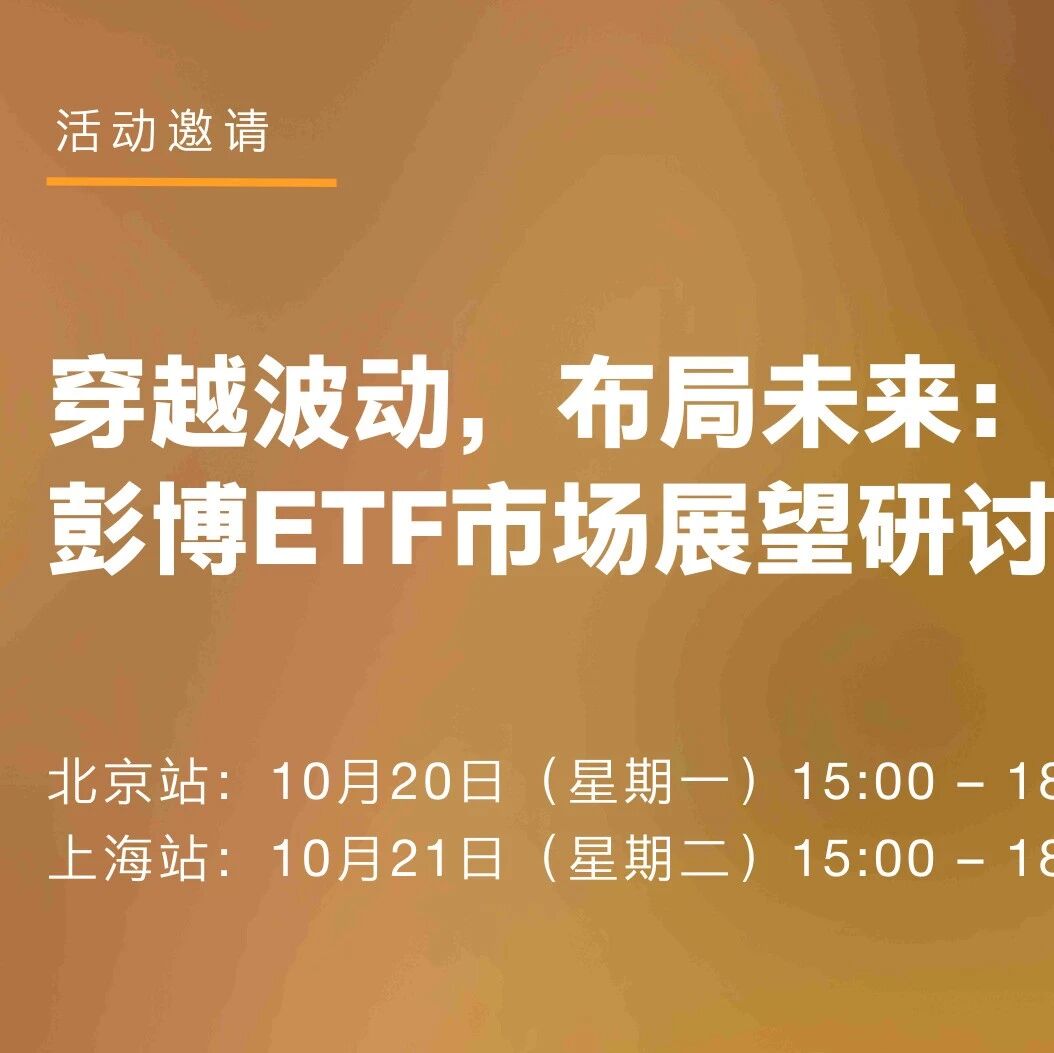
报名即将截止 | 穿越波动,布局未来:彭博ETF市场展望研讨会
彭博Bloomberg· 2025-10-17 06:04
Core Insights - The trading volume of ETFs in China is expected to continue growing by 2025, attracting more global market makers and enhancing market liquidity and pricing efficiency [2] - The widespread application of quantitative investment research is injecting new growth momentum into the ETF market in China, Asia-Pacific, and globally [2] Group 1: Event Overview - Bloomberg is hosting a seminar focusing on the future growth points of the ETF market in China and other key global markets, as well as practical experiences in quantitative research and risk management [2][3] - The seminar aims to provide insights into the future landscape of ETFs and capture diverse investment opportunities [2] Group 2: Agenda Highlights - The event will feature discussions on customized indices empowering ETF investment strategies and include interactive exchanges [7] - Key topics include the future blueprint of ETFs, opportunities and risks in quantitative research, and strategy optimization through various market cycles [3][7] Group 3: Featured Speakers - The seminar will host industry experts from various financial institutions, including senior managers and directors from major asset management firms [8][9][10]