
IBM

Search documents
IBM Announces Defense-Focused AI Model to Accelerate Mission Planning and Decision Support
Prnewswire· 2025-10-29 12:00
Core Insights - IBM has launched the IBM Defense Model, an AI model specifically designed for defense and national security applications, developed in collaboration with Janes [1][2] - The model is optimized for defense-specific tasks and can be deployed in secure environments, emphasizing IBM's commitment to responsible AI [2][6] Features and Benefits - The IBM Defense Model is built on IBM's Granite foundation models and is delivered via IBM watsonx.ai, supporting various defense-related functions such as planning and reporting [2][6] - It is trained on military doctrine and Janes data, allowing it to interpret real-time data effectively, reducing inaccuracies and maintaining relevance [6] - The model supports air-gapped and classified environments, ensuring maximum security for sensitive operations [6] - Continuous updates from Janes dynamic defense intelligence data enhance operational relevance [6] - Use cases include defense planning, analyst reporting, document enrichment, wargaming, and simulation [6] Collaboration and Market Position - The partnership with Janes combines trusted defense intelligence with advanced AI capabilities, enabling timely and relevant insights for defense organizations [4] - IBM's focus on smaller, fit-for-purpose AI models aims to drive innovation and deliver exceptional value in specific domains [2]



\十五五\规划将量子科技列为未来产业核心赛道,关注北交所量子科技产业链企业:北交所科技成长产业跟踪第四十八期(20251026)
Hua Yuan Zheng Quan· 2025-10-29 05:21
Group 1 - The "14th Five-Year Plan" includes quantum technology as a core future industry, with a focus on quantum computing, communication, and measurement [7][8][10] - By 2025, China's quantum technology market is expected to exceed 20 billion yuan, with a compound annual growth rate of 35%-40% [2][33][35] - The global quantum computing market was valued at 1.1 billion USD in 2022 and is projected to grow to approximately 7.6 billion USD by 2027 [14][16] Group 2 - The median price-to-earnings (P/E) ratio for the information technology sector on the Beijing Stock Exchange increased by 5.26% to 62.4X [43][54] - The median market capitalization for electronic device companies on the Beijing Stock Exchange rose from 2.28 billion yuan to 2.43 billion yuan [45][48] - The median P/E ratio for mechanical equipment companies on the Beijing Stock Exchange increased from 52.5X to 54.4X, with total market capitalization rising from 117.67 billion yuan to 123.18 billion yuan [50][52]
International Business Machines Corporation (IBM) Has A “Commercial Quantum Program,” Says Jim Cramer
Insider Monkey· 2025-10-28 18:17
Core Insights - Artificial intelligence (AI) is identified as the greatest investment opportunity of the current era, with a strong emphasis on the urgent need for energy to support its growth [1][2][3] Industry Overview - Wall Street is investing hundreds of billions into AI technologies, but there is a critical question regarding the energy supply needed to sustain this growth [2] - AI technologies, particularly data centers for large language models, consume vast amounts of electricity, comparable to the energy needs of small cities [2] - The energy demands of AI are expected to increase, leading to potential strain on power grids and rising electricity prices [2] Company Insights - A specific company is highlighted as a key player in the AI energy sector, owning critical energy infrastructure assets that are essential for meeting the anticipated energy spike from AI [3][6] - This company is not a chipmaker or cloud platform but is positioned to benefit significantly from the increasing demand for electricity driven by AI [3][6] - The company is involved in U.S. LNG exportation and is well-positioned to capitalize on the onshoring trend driven by tariffs [5][7] Financial Position - The company is noted for being debt-free and holding a substantial cash reserve, which is nearly one-third of its market capitalization [8] - It has a significant equity stake in another AI-related company, providing investors with indirect exposure to multiple growth opportunities without high premiums [9] Market Sentiment - There is a growing interest from hedge funds in this company, which is considered undervalued and off the radar compared to other AI and energy stocks [10][11] - The company is trading at less than 7 times earnings, indicating a potentially attractive investment opportunity [10] Future Outlook - The future of AI is closely tied to energy infrastructure, with the company positioned at the heart of America's next-generation power strategy [7][14] - The influx of talent into the AI sector is expected to drive continuous innovation and advancements, making investments in AI a strategic move for the future [12][13]

X @Wendy O
Wendy O· 2025-10-28 16:31
Crypto things you might have missed:- @HederaFndn + IBM-$1B $XRP treasury launch incoming-Coinbase partners with Citi-Buy & sell crypto/precious metals with @iTrustCapital-Chainlink partners with Circle-Gold dumpsJOIN THE DAILY 10:30 AM LIVESTREAM ON YOUTUBE AND X ...
国信证券荀玉根:“买好的”看科技主线 “买得好”关注地产、券商、白酒消费
Zhi Tong Cai Jing· 2025-10-28 11:47
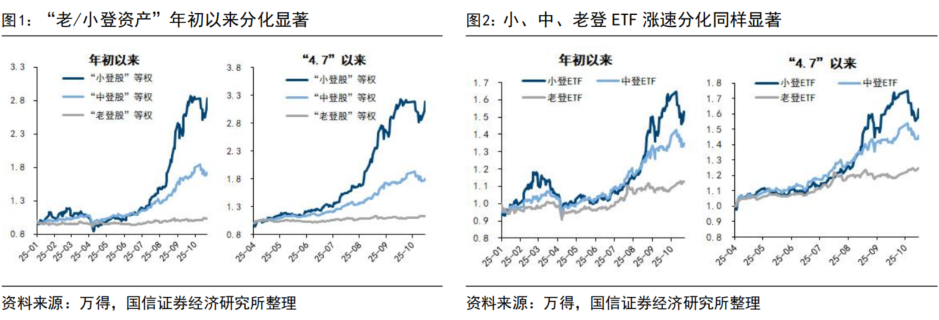
Core Viewpoint - The report by Guosen Securities highlights an extreme divergence between "old" and "new" assets in the market, emphasizing that high growth does not necessarily equate to high investment returns, and that finding fundamentally sound valuation opportunities can lead to significant returns [1][2]. Group 1: Performance Divergence - Since 2025, "small new stocks" have significantly outperformed "old stocks," with the "small new stock" portfolio rising by 183.8% compared to just 3.9% for "old stocks" [2]. - From April 7, 2025, "small new stocks" surged over 200%, while "old stocks" only increased by 13.6% [2]. - The "small new ETF" has risen by 53.1% since 2025, while the "old ETF" has only seen a 13.1% increase [2]. Group 2: Valuation and Market Activity - As of October 24, the PE ratio for "small new" sectors like electronics and computing is at the 99th percentile since 2019, while "old" sectors like real estate and liquor are at the 56th percentile [8]. - The trading volume for "small new" sectors has increased to 33%, while "old" sectors have dropped to below 2.8%, indicating a significant divergence in market activity [8]. Group 3: Investment Strategy - The report stresses the importance of not only selecting high-quality stocks ("buy good") but also ensuring they are purchased at favorable valuations ("buy well") to achieve high returns [11]. - Historical examples illustrate that higher growth does not guarantee better returns, as seen in the comparison between IBM and New Jersey Standard Oil from 1950 to 2003 [11][12]. - The banking sector has shown resilience, with a decline of only 3.9% compared to a 31.1% drop in the overall market, highlighting the potential for finding undervalued stocks with solid fundamentals [15]. Group 4: Market Trends and Seasonal Effects - The current market is characterized by a "small new stock" era, but there are seasonal opportunities for "old stocks," particularly in real estate, liquor, and brokerage sectors [20][29]. - Historical bull markets have shown that each cycle has a leading sector that aligns with prevailing economic trends, with AI and technology being the current focus [21]. - Seasonal effects suggest that value sectors may outperform in the fourth quarter, with historical data indicating a 64% success rate for value over growth during this period [23].

X @Bitget
Bitget· 2025-10-28 06:00
Market Watch:🚀 Strategy bought ~$43.4M in $BTC.🏛️ SEC has approved the first spot $SOL ETF.🇯🇵 JYPC launches the first yen-pegged stablecoin.🔥 The S&P 500 closed above 6,800 for the first time.🏦 IBM unveils Digital Asset Haven for institutions to manage their digital assets.#SmartDelivery ...
Two-thirds of surveyed enterprises in EMEA report significant productivity gains from AI, finds new IBM study
Prnewswire· 2025-10-28 05:00
Core Insights - A new IBM study indicates significant productivity gains from AI across enterprises in EMEA, with many expecting ROI within the next year [1][2] - Small to medium-sized enterprises (SMEs) and public sector organizations are lagging behind larger private sector firms in AI-driven productivity improvements [5] Summary by Categories AI Adoption and ROI - 66% of surveyed senior executives reported significant operational productivity improvements due to AI [2][10] - Approximately 20% of respondents have already achieved ROI from AI initiatives, with 42% expecting to do so within 12 months [2][10] - 92% of leaders anticipate measurable ROI from AI Agents within two years [3] Productivity Gains - The sectors with the highest AI-driven productivity gains include software development and IT (32%), customer service (32%), and procurement (27%) [4] - The top benefits of enhanced productivity are greater operational efficiency (55%), improved decision-making (50%), and augmented workforce capabilities (48%) [4] Organizational Disparities - 72% of large enterprises reported productivity gains from AI, compared to only 55% of SMEs [5][10] - Public sector organizations are still in the early stages of realizing AI's potential, with only 55% reporting significant productivity improvements [5] Business Transformation - Nearly 24% of organizations credit AI with fundamentally changing their business models [6] - About one-third of respondents are using AI to accelerate innovation timelines (36%) and shift to continuous AI-driven decision-making (32%) [7] Workforce Impact - 48% of senior leaders believe AI is enhancing workforce capabilities, allowing employees to focus more on strategic tasks and creative work [8] Priorities for AI Implementation - 85% of respondents emphasize the importance of transparency in AI systems, while 84% stress the need for interoperability [11] - Flexibility in choosing and adapting AI solutions is valued by 85% of organizations [12] Challenges and Barriers - Security, privacy, and ethical concerns are cited as the top barriers to scaling successful AI pilots by 68% of respondents [13] - IT complexity, particularly integrating AI with legacy systems, is also a significant challenge [13] Recommendations for Enterprises - Establish an effective operating model for AI and cultivate AI literacy across all levels of the organization [17] - Develop a culture that embraces change and uncertainty to thrive in an AI-driven environment [17] - Implement AI governance to monitor and mitigate risks associated with AI deployment [17]

X @Cointelegraph
Cointelegraph· 2025-10-28 02:30
🗞️ Need to catch up on the news? Here's our top 10 from today:🔸 Solana, Litecoin and Hedera ETFs are set to launch Tuesday, according to Bloomberg’s Eric Balchunas.🔹 ETHZilla sold $40M in Ethereum to fund $12M in stock buybacks.🔸 MetaMask registers domain for token claims, hinting its long-awaited airdrop may be near.🔹 Canada is set to unveil stablecoin rules in its next federal budget to mirror the U.S. GENIUS Act.🔸 Citi partners with Coinbase to test stablecoin payments for faster cross-border transfers.🔹 ...
IBM Set to Launch Platform for Managing Digital Assets
PYMNTS.com· 2025-10-27 14:49
Core Insights - IBM is set to launch a platform called IBM Digital Asset Haven, aimed at enabling financial institutions, governments, and corporations to manage digital assets across multiple blockchains while ensuring compliance with regulatory requirements [1][2] - The platform is being developed in collaboration with Dfns, which has created 15 million wallets for 250 clients, combining IBM's infrastructure and security with Dfns' digital asset custody capabilities [2][4] Group 1 - The platform will feature transaction lifecycle management supporting blockchain transactions across over 40 connected public and private blockchains, governance and entitlement management for wallet access, and integrated third-party solutions to accelerate deployment [3] - IBM Digital Asset Haven will enable secured cold storage operations, which are increasingly required by regulatory bodies, and is expected to be released via software-as-a-service and hybrid SaaS in Q4 2024, with on-premises availability in Q2 2026 [4] - Tom McPherson from IBM stated that the platform delivers resilience and data governance, empowering governments and enterprises to develop next-generation financial services [4] Group 2 - Dfns CEO Clarisse Hagège emphasized that the collaboration with IBM has resulted in a platform that orchestrates the full digital asset ecosystem, facilitating the transition of digital assets from pilot programs to global production [5] - Dfns raised $16 million in a Series A funding round to enhance the adoption of its crypto wallet infrastructure for institutional clients, having shifted focus to institutional clients two years prior [5][6] - IBM's LinuxONE 4 Express, launched in February 2024, is designed to assist clients in addressing both new and traditional use cases, including digital assets [6]

盟云全息(HOLO.US)预计全年净利润超3.5亿元 拟斥资4亿美元投向量子计算等前沿领域
Zhi Tong Cai Jing· 2025-10-27 13:29
Group 1: Company Overview - Mengyun Holography (HOLO.US) expects to achieve a net profit exceeding RMB 350 million for the year 2025, a significant turnaround from a net loss in the previous year [1] - The company reported a net loss of approximately RMB 63 million for the entire year of 2024 [1] - Mengyun Holography currently holds over RMB 3 billion in cash, cash equivalents, and short-term investments [1] - The company plans to allocate over $400 million from its cash reserves to invest in quantum computing, blockchain, and quantum holography technologies [1] Group 2: Industry Trends - The quantum computing sector in the U.S. stock market has seen a strong performance, with Mengyun Holography experiencing a pre-market surge of over 17% following positive news [2] - Recent developments, including the U.S. government's consideration of using federal funds to acquire equity in quantum computing companies, have led to a collective rise in quantum sector stocks [2] - Key players in the quantum computing field, such as IonQ, Rigetti, and D-Wave, have also seen significant stock price increases, reinforcing expectations of a "national-level track" premium [2] - Industry experts believe that the quantum computing field is approaching critical milestones, with the potential for achieving "quantum advantage" and "quantum supremacy" within the next three to five years [2][3] - IonQ's CEO has indicated that the era of "quantum supremacy" is imminent, marking a significant threshold where quantum processors can outperform classical supercomputers on specific tasks [3] - Quantum computing systems leverage quantum mechanics properties, such as superposition and entanglement, to provide a new computing paradigm that could vastly exceed traditional binary computers in certain areas [3]
