中信保诚基金

Search documents
年内225只基金涨超50%,近两成限购!绩优基金“闭门”为哪般?
Sou Hu Cai Jing· 2025-07-29 11:01
Core Viewpoint - The recent trend of fund subscription limits reflects a response to significant performance gains in the active equity fund sector, with many funds experiencing substantial inflows and subsequently implementing restrictions to manage investor behavior and maintain stability [1][2][5]. Fund Subscription Limits - Da Cheng Fund has reduced the subscription limit for its Da Cheng Global USD Bond Fund's RMB share to 50,000 yuan as of July 29 [1]. - A total of 225 funds have seen year-to-date growth exceeding 50%, with 12 funds currently suspended from subscriptions and 21 funds limiting large subscriptions [2]. - Notable funds like Huatai-PineBridge Hong Kong Advantage Select have reported year-to-date returns of 134.72% and 135.08% for their A and C classes, respectively [2]. Performance and Market Trends - The active equity fund sector has rebounded significantly, with many funds experiencing over fivefold growth in size during the second quarter [2]. - Small-cap stocks have outperformed large-cap stocks in the first half of 2025, driven by favorable industry trends and macroeconomic conditions [2]. - Despite the positive performance, some funds are limiting subscriptions to prevent investors from chasing high returns and to manage volatility [2][4]. Fund Management Strategies - Funds like Nuon Multi-Strategy have focused on small-cap stocks, which have contributed to their net value growth, although they also exhibit higher volatility [3][4]. - The strategy of limiting subscriptions is aimed at maintaining portfolio stability and preventing forced adjustments due to large inflows [5]. - Some funds have implemented subscription limits to mitigate the impact of large institutional investments and to avoid dilution of returns [5].


“恐高症”消失了?基民狂追高收益基金,什么信号?
券商中国· 2025-07-28 03:48
Core Viewpoint - The active equity fund market has shown significant recovery in performance, with a notable increase in net asset values and a majority of funds achieving positive returns in 2023 [2][3][10]. Performance Summary - In July, nearly 800 active equity funds reached historical net asset value highs, with 94% of products achieving positive returns and an average annual return of 13.89% [1][2][3]. - The number of funds that doubled their returns this year reached four, with the top-performing fund, Huatai-PB Hong Kong Advantage Selection, achieving a return of 135.23% [2][3]. - The Wind偏股混合基金指数 recorded a return of 14.49% this year, indicating that most active equity fund holders who entered the market in 2023 are now profitable [3]. Fund Manager Performance - Several veteran fund managers have successfully turned around their funds, with notable performances such as Guangfa Growth Navigator achieving an annual return of 88.44% [5]. - Fund managers with over 20 years of experience, such as Guo Jun, have also delivered high returns, with the Bosera New Income fund achieving 27.85% this year [5][6]. - The trend of "using feet to vote" is evident, as funds with sustained excess returns are attracting significant capital inflows, with some funds seeing their sizes increase by over five times in the second quarter [7][10]. Market Dynamics - The recovery in fund performance has led to a weakening of the constraints imposed by fund size on performance, with several large funds reaching new net asset value highs [6]. - Investors are increasingly willing to pursue high-performance funds, moving away from the "fear of heights" mentality that previously dominated the market [8][10]. - Funds that failed to outperform the偏股混合基金指数 have seen their sizes shrink, becoming "mini" funds with less than 50 million yuan in assets [9]. Trust Rebuilding Efforts - Despite the positive performance, many investors remain cautious due to past experiences, leading to a continued decline in the size of some active equity funds [10]. - Fund companies are implementing measures to rebuild trust, including enhancing research capabilities, ensuring transparency, and binding fund manager interests to performance [10][11]. - Regulatory initiatives are also expected to promote high-quality development in the public fund sector, further enhancing investor confidence in active equity funds [11].

锁定量化指增 中小公募寻觅“逆袭密码”
Zhong Guo Zheng Quan Bao· 2025-07-27 21:07
Core Viewpoint - The public quantitative investment products are gaining traction as they demonstrate superior performance and stability in generating excess returns compared to traditional actively managed funds, especially in a rapidly changing market environment [1][2][3]. Group 1: Market Trends - The shift towards quantitative index-enhanced products is driven by the challenges faced by traditional active management funds, which struggle with frequent market style changes and the diminishing appeal of star fund managers [1][2]. - Since the release of the regulatory framework in May, many public fund companies have prioritized the development of quantitative index-enhanced products, particularly among smaller firms [1][2]. Group 2: Performance Metrics - Over 90% of public quantitative products achieved positive returns in the first half of the year, with notable products like the 创金合信北证50成份指数增强A/C and 诺安多策略A showing over 100% cumulative net asset value growth in the past year [2][3]. - In the first half of the year, more than 80% of public quantitative funds outperformed their benchmarks, with a specific excess return rate of approximately 82.9% for quantitative index-enhanced funds [3]. Group 3: Product Development - As of June 2025, there are 683 public quantitative funds with a total scale of approximately 2927.59 billion, indicating a growing interest in this investment strategy [4][6]. - The number of newly registered quantitative index-enhanced funds has surged, with over 100 applications submitted this year alone, reflecting a strong market demand [6][7]. Group 4: Investment Strategies - Quantitative index-enhanced products utilize systematic investment strategies, including multi-factor models for stock selection and risk control, to capture market inefficiencies and generate excess returns [5][6]. - The focus on stable and high excess returns aligns with the regulatory direction for public funds, making quantitative index-enhanced products increasingly relevant in the current market landscape [6][7]. Group 5: Future Outlook - Major asset management firms, including international players like BlackRock, are expanding their quantitative product offerings in the Chinese market, indicating a robust growth trajectory for this segment [7][8]. - The ongoing emphasis on quantitative strategies is expected to continue, with fund managers adapting their approaches to capture emerging market opportunities and maintain competitive advantages [7][8].
公募量化“逆袭”,超额收益亮眼,基金经理提示小市值股票回调风险
news flash· 2025-07-26 09:29
Core Insights - Since July, a significant number of public quantitative funds, including NuAn Multi-Strategy, Jianxin Flexible Allocation, and CITIC Prudential Multi-Strategy, have seen their unit net values reach historical highs [1] - According to Wind statistics, over 90% of public quantitative products had positive unit net value growth in the first half of the year [1] - The cumulative unit net value growth rate of Chuangjin Hexin North Certificate 50 Index Enhanced A/C and NuAn Multi-Strategy A exceeded 100% in the past year [1] - The positive sentiment in the A-share market and the continuous rotation of sector hotspots have been favorable for quantitative products to achieve excess returns [1] - Recently, many public quantitative fund managers have begun to warn about the risk of a pullback in small-cap stocks [1]
可预测可研究!这类产品成基金经理新宠儿
券商中国· 2025-07-26 09:14
Core Viewpoint - Index funds are becoming increasingly favored by public FOF (Fund of Funds) managers as they shift away from actively managed equity funds, primarily due to the predictable and researchable nature of index products [2][6]. Group 1: Performance of FOFs - As of July 23, the top seven performing public FOFs have all achieved returns exceeding 18% this year, with the highest return reaching approximately 22% [3]. - The top-performing FOFs have significantly reduced their holdings in actively managed equity products, with the core positions primarily consisting of index funds [4]. Group 2: Investment Strategy Changes - The investment strategy of FOFs has undergone a major shift, with a notable preference for index funds over active equity products, as evidenced by the holdings of the top-performing FOFs [4][5]. - For instance, the Guotai Fund's Guotai Preferred Navigation FOF has a core holding of nine funds, with 66.2% of its portfolio in index products, and only a minimal allocation to an active equity fund [4]. Group 3: Predictability and Research Efficiency - The stability, transparency, and predictability of index funds are key reasons for their growing preference among FOFs, as they require less research time compared to actively managed funds [6][7]. - FOF managers emphasize the importance of historical performance and the predictability of fund holdings, which are more easily observed in index products [7]. Group 4: Market Opportunities - FOFs are also capitalizing on opportunities in sectors experiencing significant downturns, focusing on index funds and ETFs to capture potential rebounds [8][9]. - The strategy includes maintaining a high equity position while diversifying across various sectors, such as military and non-bank financials, to enhance overall portfolio returns [9].

公募基金2025Q2季报分析:抱团松动,头部持仓集中度回落
Xinda Securities· 2025-07-24 09:59
Fund Market Overview - The total scale of public funds exceeded 33.67 trillion yuan as of Q2 2025, with a quarter-on-quarter growth of 6.71% [6][11] - The growth structure indicates a clear preference for bond funds, money market funds, and passive index products, while actively managed equity funds continue to face net redemption pressure [6][11] - The number of newly established funds in Q2 2025 was 378, with a total fundraising scale of 286.12 billion yuan, marking an increase of approximately 29.2 billion yuan from Q1 [11][12] Fund Performance - The median return for various fund types was positive, with cross-border equity products performing particularly well; QDII mixed and QDII equity funds had median returns of 9.25% and 8.05%, respectively [2][6] - Active equity funds had a total scale of approximately 3.34 trillion yuan, remaining stable quarter-on-quarter but showing a continuous decline in share, reflecting cautious investor sentiment [2][15] Active Equity Fund Configuration - Active equity funds showed a clear trend of increasing positions, with the average stock position rising to 88.13%, indicating a rebound in risk appetite [2][6] - The allocation to Hong Kong stocks continued to rise, reaching 17.01%, while the concentration of holdings decreased for three consecutive quarters, indicating a weakening of the "hugging" effect [2][6] Heavyweight Stocks Analysis - As of the end of Q2 2025, the top five heavy holdings in active equity funds included Ningde Times, Kweichow Moutai, Midea Group, Zijin Mining, and Luxshare Precision [2][3] - The report highlighted a shift in holding structure towards technology growth, with significant increases in positions for stocks like Zhongji Xuchuang and Xinyi Sheng [3][26] Market Analysis and Outlook - Fund managers expressed structural optimism, noting that the macroeconomic environment is gradually improving, despite challenges such as weak domestic demand and external uncertainties [4][6] - The "barbell strategy" remains popular, focusing on high-dividend assets and technology growth sectors as key areas for excess returns [4][6]
公募基金2025年二季报解读点评
2025-07-23 14:35
Summary of Key Points from the Conference Call Industry Overview - The report focuses on the public fund industry in China, specifically analyzing the performance and trends of various fund types in the second quarter of 2025. Core Insights and Arguments Public Fund Performance - In Q2 2025, the number and scale of newly launched active equity funds significantly increased, with an average fundraising scale of 520 million yuan, focusing on dividend value and technology growth [1][2] - Despite a market rebound, the overall share of active equity funds decreased by 2.2% due to redemptions of older products, maintaining a scale of 3.33 trillion yuan [1][2] - Fixed income plus products surpassed the levels of the second half of 2023, reaching 2.16 trillion yuan, with a notable expansion in mixed bond FOFs [1][2] Fund Categories - Active equity funds showed strong performance, with a 3.1% increase in the equity fund index, outperforming broad-based indices [1][5] - The new issuance of FOF products continued at a high level, with a total new scale of 18.6 billion yuan, leading to a 10% increase in the overall market scale of FOFs to 166.2 billion yuan [1][4] Investment Trends - Active equity funds increased their stock positions slightly, with a notable rise in holdings of Hong Kong stocks, which now account for 17% of their portfolios [3][26] - The communication and financial sectors received increased allocations, while consumer and manufacturing sectors saw reductions [27] Performance Metrics - The median returns for active equity funds in Q2 were strong, with ordinary stock, mixed equity, and flexible allocation products achieving median returns of 2.0%, 2.1%, and 1.8% respectively, all outperforming major indices [19][20] - Fixed income plus funds achieved positive returns across all subcategories, with convertible bond funds leading in performance [22][23] Additional Important Insights - The competitive landscape for FOF products shows a slight decrease in the market share of the top ten managers, which now account for 60.8% of the market [4][8] - The concentration of holdings in active equity funds has decreased, indicating a more diversified investment approach, with the CR10 and CR20 ratios at 17.5% and 25.8% respectively [28] - Notable stock holdings include Ningde Times, which remains the most favored stock among funds, despite a slight reduction in holdings [29] Market Dynamics - The passive index product market reached a total scale of 5.79 trillion yuan by the end of Q2, with a 12.6% quarter-on-quarter growth [11] - The issuance of passive stock products hit a historical high, with 109 new products launched in Q2 2025 [9][10] Sector-Specific Performance - The innovative pharmaceutical sector led the market in Q2, with corresponding theme funds achieving a median return of 10.1% [21] - The report highlights the strong performance of small-cap growth and value products, with median returns of 3.4% and 3.2% respectively [20] This summary encapsulates the key findings and insights from the conference call regarding the public fund industry, highlighting performance metrics, investment trends, and sector-specific dynamics.
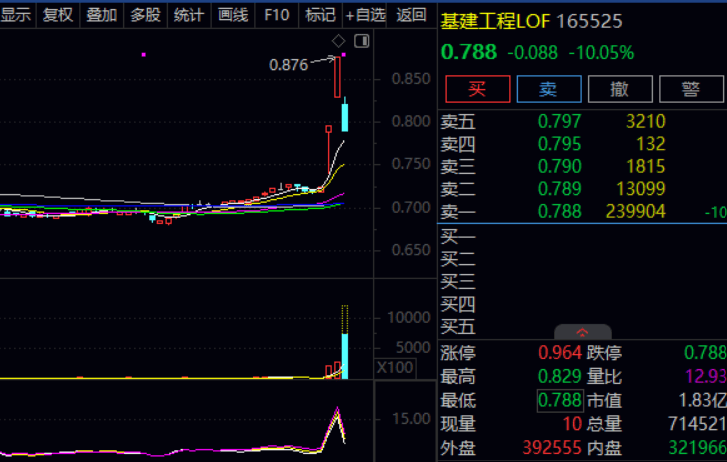
溢价风险爆发?这只基建工程LOF暴涨两天后突然跌停!多只产品连发风险警示
Sou Hu Cai Jing· 2025-07-23 08:20
Core Viewpoint - The infrastructure sector has seen significant activity, with several thematic funds experiencing substantial increases, particularly the CITIC Prudential Infrastructure Engineering LOF, which previously hit two daily price limits but faced a sharp decline today due to premium pricing and arbitrage opportunities [1][2][4]. Group 1: Fund Performance - The CITIC Prudential Infrastructure Engineering LOF achieved consecutive daily price limits on Monday and Tuesday but fell to a daily limit down today despite the China Securities Infrastructure Engineering Index being positive [2][4]. - The fund's price reached a significant premium, leading to arbitrage opportunities for investors who could have purchased at a lower net value and sold at a higher market price, resulting in a potential gain of over 15% [4]. Group 2: Market Dynamics - Other LOF products also experienced significant declines today, attributed to similar premium pricing issues, indicating a broader trend in the market [5][6]. - The CITIC Prudential Fund issued a notice highlighting that the trading price of the Infrastructure Engineering LOF was significantly above its net asset value, warning investors about the risks associated with high premium purchases [5]. Group 3: Investor Behavior - The influx of capital into the infrastructure sector led to rapid price increases, but investors unaware of the premium risks may find themselves facing losses when prices correct [7]. - The market for LOF products typically has low trading volumes, making them susceptible to rapid price movements when specific themes attract investor interest, which can lead to situations where investors inadvertently buy into inflated prices [7].
A股大反弹 又有LOF溢价!
Zhong Guo Jing Ji Wang· 2025-07-23 07:27
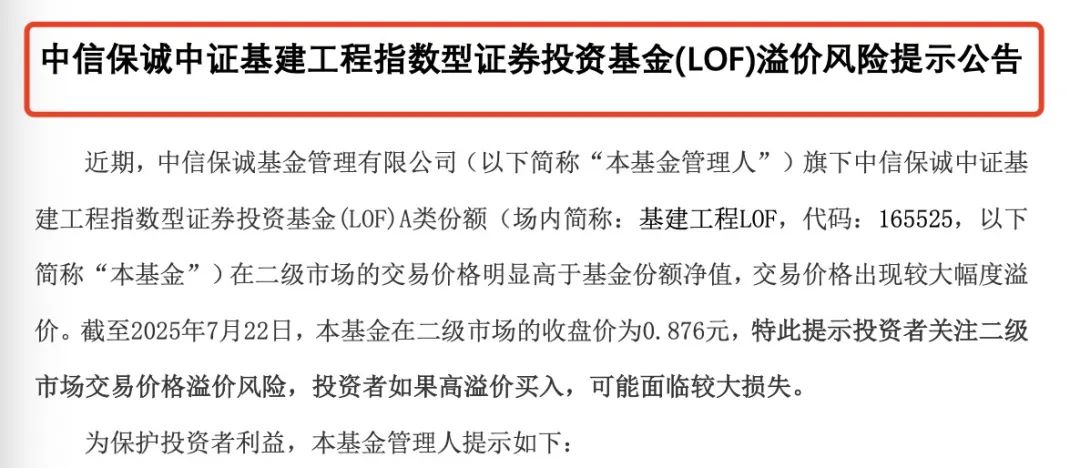
Core Viewpoint - The A-share market has shown significant recovery, with the Shanghai Composite Index recently surpassing the 3600-point mark [1] Group 1: Market Trends - The A-share market has been on an upward trend, particularly influenced by the news of the Yajiang Hydropower Station project, leading to increased activity in related sectors such as infrastructure, cement, steel, and coal [6][11] - Several industry-themed ETFs have attracted substantial capital inflows due to this market momentum [6] Group 2: Fund Premium Risks - Multiple funds have issued warnings regarding premium risks, indicating that the trading prices of certain funds are significantly higher than their net asset values (NAV) [2][3] - For instance, the CITIC Prudential Infrastructure Engineering Index Fund had a market price of 0.876 yuan while its NAV was 0.782 yuan, resulting in a premium rate exceeding 12% [4][5] - The Penghua Steel Industry Index Fund also reported a premium, with a market price of 1.844 yuan against an NAV of 1.6837 yuan, leading to an estimated premium rate close to 10% [9] Group 3: Investor Cautions - Fund companies have cautioned investors about the instability of premium conditions, which could lead to significant losses if investors buy at high premiums [2][11] - The liquidity issues of many listed funds may exacerbate trading difficulties, especially if a large number of investors follow the trend of buying at high premiums [12] Group 4: Market Outlook - Analysts suggest that the recent surge in the A-share market may be influenced by capital inflows seeking to capitalize on rebounds or arbitrage opportunities [11] - Future market movements may be affected by changes in tariff policies and domestic monetary policies, with expectations of structural opportunities remaining in the market [12]
A股大反弹 又有LOF溢价!
中国基金报· 2025-07-23 07:09
Core Viewpoint - Multiple LOF funds have issued warnings regarding the risk of premium in the secondary market as the A-share market shows significant recovery, with the Shanghai Composite Index surpassing 3600 points [2][3]. Group 1: Fund Premium Risks - Several fund companies have indicated that the premium status of listed funds is unstable and may disappear at any time, leading to potential losses for investors who buy at high premiums [4][8]. - For instance, the CITIC Prudential Infrastructure Engineering Index Fund reported a secondary market closing price of 0.876 yuan against a net asset value of 0.782 yuan, resulting in a premium rate exceeding 12% as of July 22 [4]. - Similarly, the Penghua Steel Industry Index Fund noted a secondary market price of 1.844 yuan compared to a net value of 1.6837 yuan, estimating a premium rate close to 10% [5][6]. Group 2: Market Dynamics and Investor Behavior - The recent surge in A-share market, particularly driven by the news of the Yajiang Hydropower Station project, has attracted significant capital into thematic ETFs related to infrastructure, cement, steel, and other sectors [4][8]. - Analysts suggest that when LOFs exhibit premiums, it indicates that investors are purchasing at prices above the actual net value, which is a precarious situation as premiums can vanish, causing fund prices to revert to net values and resulting in investor losses [8][9]. - The liquidity issues of many LOFs may also lead to trading difficulties if a large number of investors follow the trend and buy at high premiums [9]. Group 3: Market Outlook - Industry experts from Fuguo Fund believe that fluctuations in A-share markets will continue to be influenced by tariff impacts and subsequent policy changes, while domestic policy initiatives may provide positive support for the market [9]. - Wanji Fund indicates that despite recent valuation increases, major indices remain within a relatively reasonable range, suggesting limited downside risk, with expectations of a strong oscillating pattern for A-share indices in the second half of the year [9].