中国卫星

Search documents
神二十飞船舷窗裂纹维修,细节披露!
证券时报· 2026-01-20 07:36
Core Viewpoint - The Shenzhou 20 spacecraft experienced a delay in its return due to a crack in the window caused by suspected impact from small space debris, leading to a series of tests and a subsequent unmanned return to Earth [1][4]. Group 1: Unmanned Return vs. Manned Return - The Shenzhou 20 spacecraft utilized an unmanned return process, relying entirely on ground commands, eliminating the need for manual operation by astronauts [4]. - This marks the first unmanned spacecraft return during the space station phase, with a focus on ensuring the spacecraft's stability through careful mass balance during material transfer [4]. - The search and recovery operation for the return capsule incorporated drones and unmanned ground vehicles, emphasizing resource efficiency and coordination between manned and unmanned efforts [4]. Group 2: Window Repair and Safety Measures - The window of the Shenzhou spacecraft consists of a three-layer composite glass structure, with the outer layer designed to withstand temperatures exceeding 1000 degrees Celsius during re-entry [6]. - A penetrating crack was discovered, prompting the crew to switch to Shenzhou 21 for return. Repairs were conducted from inside the capsule, enhancing thermal and sealing capabilities [6]. - Future improvements will focus on enhancing the window structure to better resist impacts from space debris, with monitoring of small debris being a priority [6]. Group 3: Cargo Returned by Shenzhou 20 - The Shenzhou 20 spacecraft returned with a record amount of cargo due to the absence of three astronauts, including an extended-use extravehicular suit and several large components for space applications [11]. - The extravehicular suit, which has been used by 11 astronauts across 8 missions, is expected to contribute to lunar suit research and may be publicly displayed after its scientific mission [11].

航天发展、中国卫星盘中逼近跌停!航空航天ETF天弘(159241)逆市获1300万份净申购
2 1 Shi Ji Jing Ji Bao Dao· 2026-01-20 07:01
Core Viewpoint - The aerospace and defense sector in China is experiencing significant fluctuations, with a notable decline in major indices and specific stocks, while the aerospace ETF shows positive net inflows and growth potential in the commercial space sector by 2026 [1][2]. Group 1: Market Performance - On January 20, the three major indices collectively declined, with the Shanghai Composite Index down 0.31%, the Shenzhen Component down 1.47%, and the ChiNext Index down 2.36% [1]. - The CN5082 Aerospace and Defense Industry Index fell by 3.86%, with significant declines in stocks such as Aerospace Development and China Satellite approaching their daily limit down [1]. Group 2: ETF Activity - The Tianhong Aerospace ETF (159241) had a trading volume of 132 million yuan, with a net subscription of 13 million shares during the session [1]. - The ETF saw a net inflow of over 21 million yuan on the previous trading day (January 19), with a current circulation of 531 million shares and a total market size of 814 million yuan [1]. Group 3: Industry Outlook - The Tianhong Aerospace ETF closely tracks the CN5082 index, which encompasses various sectors including aerospace equipment, military electronics, and emerging technologies like satellite internet and low-altitude economy [1]. - According to Open Source Securities, the domestic commercial space sector is expected to experience a "triple resonance" of policy, technology, and capital by 2026, highlighting the importance of the rocket and satellite industry chains [1]. - Guotai Junan Securities noted that the China Aerospace Science and Technology Corporation has announced plans to focus on reusable rocket technology and the development of commercial space by 2026, indicating a significant acceleration in the commercial space sector [2].




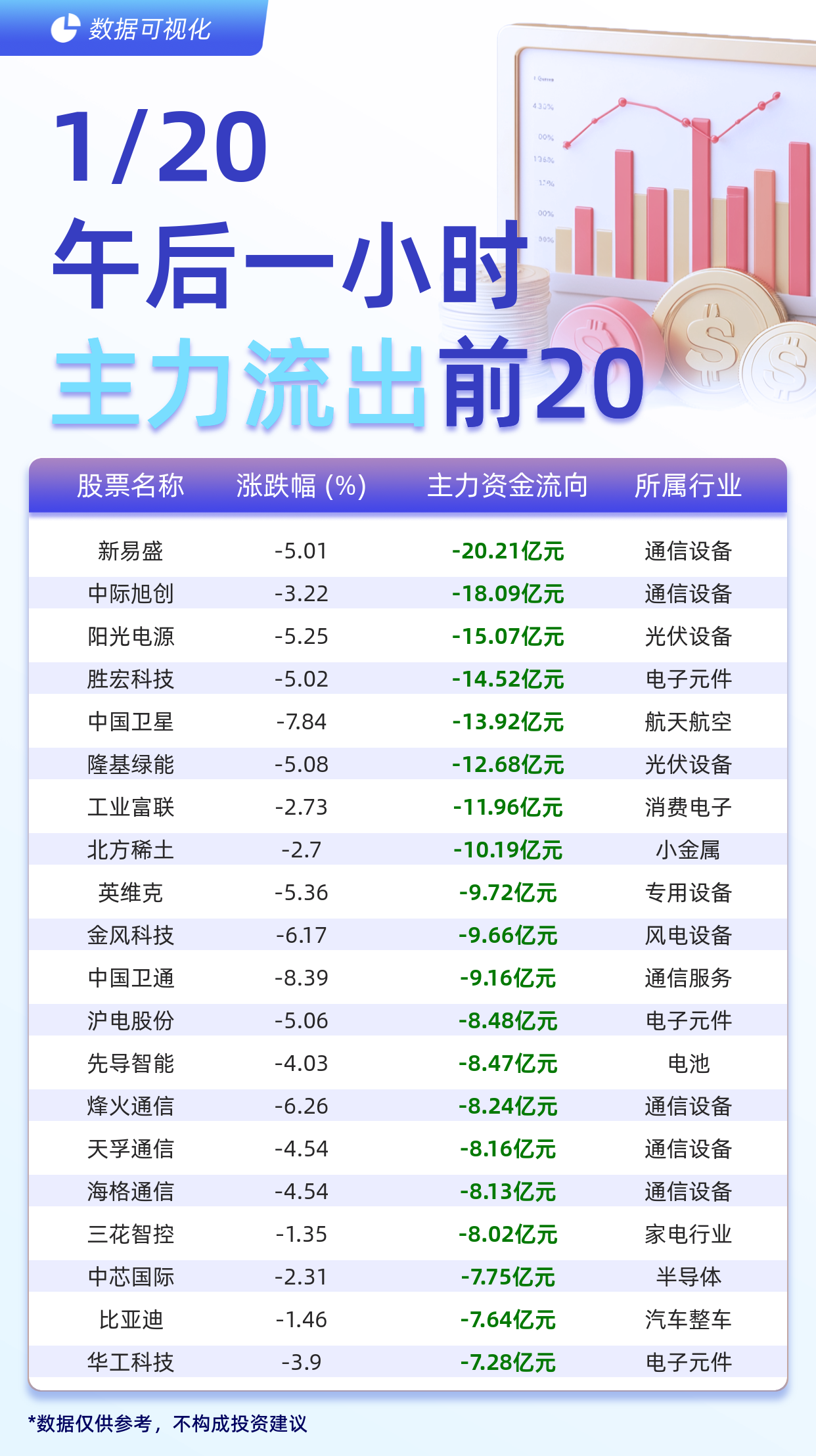
主力个股资金流出前20:新易盛流出20.21亿元、中际旭创流出18.09亿元
Jin Rong Jie· 2026-01-20 06:26
Core Viewpoint - The data indicates significant outflows of main funds from various stocks, particularly in the communication equipment and renewable energy sectors, suggesting a potential shift in investor sentiment and market dynamics [1][2][3] Group 1: Stock Performance and Fund Outflows - The top stock with the largest fund outflow is Xinye Technology, with a decrease of 20.21 billion yuan and a drop of 5.01% [2] - Zhongji Xuchuang follows with an outflow of 18.09 billion yuan and a decline of 3.22% [2] - Yangguang Electric Power experienced an outflow of 15.07 billion yuan, with a decrease of 5.25% [2] - Shenghong Technology saw a fund outflow of 14.52 billion yuan and a drop of 5.02% [2] - China Satellite had an outflow of 13.92 billion yuan, with a significant decline of 7.84% [2] Group 2: Sector Analysis - The communication equipment sector is notably affected, with multiple companies like Xinye Technology, Zhongji Xuchuang, and Fenghuo Communication experiencing substantial fund outflows [2][3] - The photovoltaic equipment sector, represented by Yangguang Electric Power and Longi Green Energy, also shows significant outflows, indicating potential challenges in this industry [2][3] - The electronic components sector, including Shenghong Technology and Huadian Co., is facing similar trends with notable fund withdrawals [2][3]





卫星互联网低轨19组卫星发射成功,航空航天ETF(159227)单日“吸金”超1亿
Xin Lang Cai Jing· 2026-01-20 06:23
Group 1 - The aerospace industry index (CN5082) shows mixed performance among constituent stocks, with Hangfa Technology leading at a 10.00% increase, followed by Hangya Technology at 7.04% and Beimo High-tech at 4.25%, while Aerospace Development is the biggest loser [1] - The Aerospace ETF (159227) is currently priced at 1.45 yuan, with an intraday turnover rate of 18.89% and a transaction volume of 565 million yuan, indicating active market trading [1] - As of January 19, the average daily transaction volume for the Aerospace ETF over the past week was 999.5 million yuan, with a net inflow of 128 million yuan [1] Group 2 - Oriental Securities notes that recent adjustments in commercial aerospace do not alter the long-term industry trend, with a focus on manned lunar missions and deep space exploration, and a push for reusable rocket technology [2] - The successful static ignition test of Long March 12B and the completion of the suborbital flight test by Lihong No. 1 demonstrate advancements in China's commercial aerospace capabilities [2] - The competition for near-Earth orbit resources is intensifying, with low Earth orbit satellite constellations becoming a new arena for major powers, and China is accelerating the scale and systematization of low Earth orbit satellite construction [2]
盘中,涨停!A股,突然异动!
Zhong Guo Ji Jin Bao· 2026-01-20 04:23
Market Overview - A-shares opened high but closed lower, with the Shanghai Composite Index down 0.3% at 4101.62 points, Shenzhen Component down 1.22%, and ChiNext Index down 1.83% [1] - The total trading volume in the Shanghai and Shenzhen markets reached 1.85 trillion yuan, an increase of 568 billion yuan compared to the previous trading day [2] Sector Performance - The communication equipment, aerospace military, electronic components, basic metals, and energy equipment sectors experienced significant declines [2] - The banking and insurance sectors saw a notable rise, with food and beverage, real estate, and semiconductor sectors also performing well [2] Banking and Insurance Sector - The banking and insurance sector showed resilience, with major insurance stocks like China Life and Ping An rising over 1% [3] - Key banking stocks such as CITIC Bank increased by over 2%, while other banks like China Construction Bank and Bank of China rose by over 1% [5] - A report from China Galaxy Securities indicated that structural monetary policy tools and a marginal improvement in RMB credit could support bank lending [5] Food and Beverage Sector - The food and beverage sector was active, with food processing stocks leading the gains, including Hongmian Co., Jingji Zhino, and Weizhi Xiang, all hitting the daily limit [6] - Notable performers included Hongmian Co. with a 10.13% increase and Jingji Zhino with a 10.01% increase [7] Real Estate Sector - The real estate sector showed a rebound, with stocks like Dayue City and Chengtou Holdings hitting the daily limit, and others like China Merchants Shekou and Binjiang Group rising over 5% [8] - Recent data from the National Bureau of Statistics indicated a slight decrease in new residential sales prices in first-tier cities, which may influence market sentiment [10] Aerospace and Military Sector - The aerospace and military sector faced significant declines, with stocks like Tongyu Communication and Aerospace Power hitting the daily limit down, and Aerospace Hongtu dropping 13% [11] - Other companies in the sector, such as China Satellite and China Aerospace, also saw declines exceeding 6% [12]







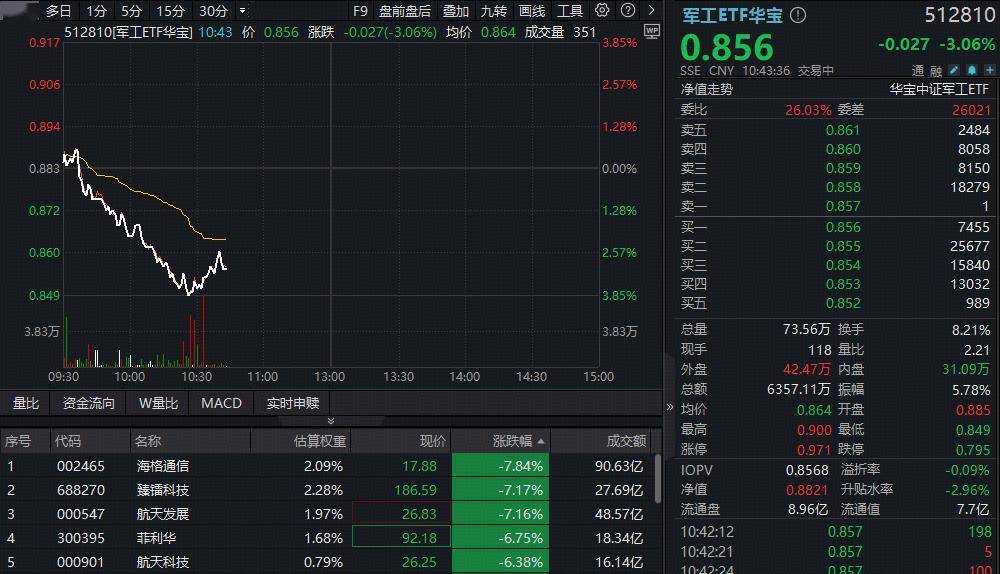
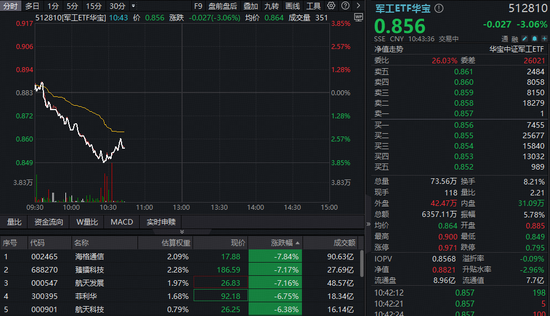
ETF盘中资讯|军工急跌,什么情况? 512810盘中下探3.85%!商业航天热门股齐挫,中国卫星跌超5%
Sou Hu Cai Jing· 2026-01-20 03:06
Core Viewpoint - The military industry sector experienced a decline in early trading on January 20, with the military ETF Huabao (512810) dropping by 3.85%, and several commercial aerospace stocks falling over 7% [1][3]. Market Performance - The A-share market saw a shift in market sentiment, with all three major indices declining, indicating a rapid change in risk appetite among investors [1]. - As of January 19, the financing balance in the A-share market was reported at 2.7059 trillion yuan, a decrease of 8.5 billion yuan, marking the first decline since December 31 of the previous year [3]. Industry Analysis - The military sector is characterized by high volatility and is significantly influenced by short-term sentiment, although the fundamental outlook remains positive [4]. - According to Fangzheng Securities, the military industry is expected to enter a new upward cycle driven by domestic demand and foreign trade, with ongoing orders anticipated due to the transition to mass production of new models [4]. - The military trade market in China is evolving from a focus on cost-effectiveness to becoming a technology benchmark and a rule-maker in the global arms race, presenting historical opportunities for growth [4]. Investment Opportunities - The military industry is expected to enter a long-term prosperous phase, with traditional military sectors showing advantages in positioning, event catalysts, and improving fundamentals [4]. - The Huabao military ETF (512810) covers various hot themes such as commercial aerospace, low-altitude economy, large aircraft, satellite navigation, military informationization, and controllable nuclear fusion, serving as an efficient tool for investing in core military assets [4][6].


军工急跌,什么情况? 512810盘中下探3.85%!商业航天热门股齐挫,中国卫星跌超5%
Xin Lang Ji Jin· 2026-01-20 02:55
Core Viewpoint - The military industry sector experienced a decline in early trading on January 20, with significant drops in key stocks related to commercial aerospace and military technology, indicating a rapid shift in market sentiment and risk preference [1][3]. Market Performance - The military ETF Huabao (512810) saw a drop of 3.85% during intraday trading, reflecting a broader trend where major indices in the A-share market fell simultaneously [1][2]. - Key stocks such as Aerospace Development, Aerospace Science and Technology, China Satellite, and Haige Communication experienced declines exceeding 7% [1]. Financing Trends - As of January 19, the financing balance in the A-share market was reported at 27,059 billion CNY, a decrease of 8.5 billion CNY, marking the first decline since December 31 of the previous year [3]. - The military sector, characterized by high volatility, was among the areas where financing clients reduced their holdings, alongside electronics and communications [3]. Industry Outlook - Despite short-term fluctuations, the fundamental outlook for the military industry remains positive, with expectations of entering a new growth cycle driven by domestic demand and foreign trade [3]. - The military industry is anticipated to benefit from a combination of traditional military advantages, event-driven catalysts, and improving fundamentals, presenting a significant investment opportunity [3]. Investment Tools - The military ETF Huabao (512810) provides exposure to various themes such as commercial aerospace, low-altitude economy, large aircraft, satellite navigation, military information technology, and controllable nuclear fusion, serving as an efficient tool for investing in core military assets [4].
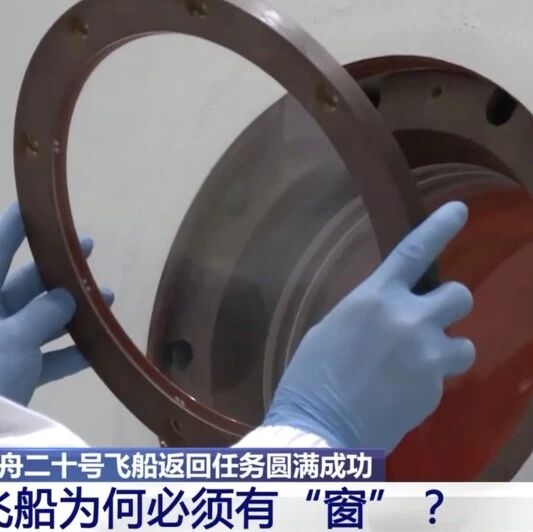
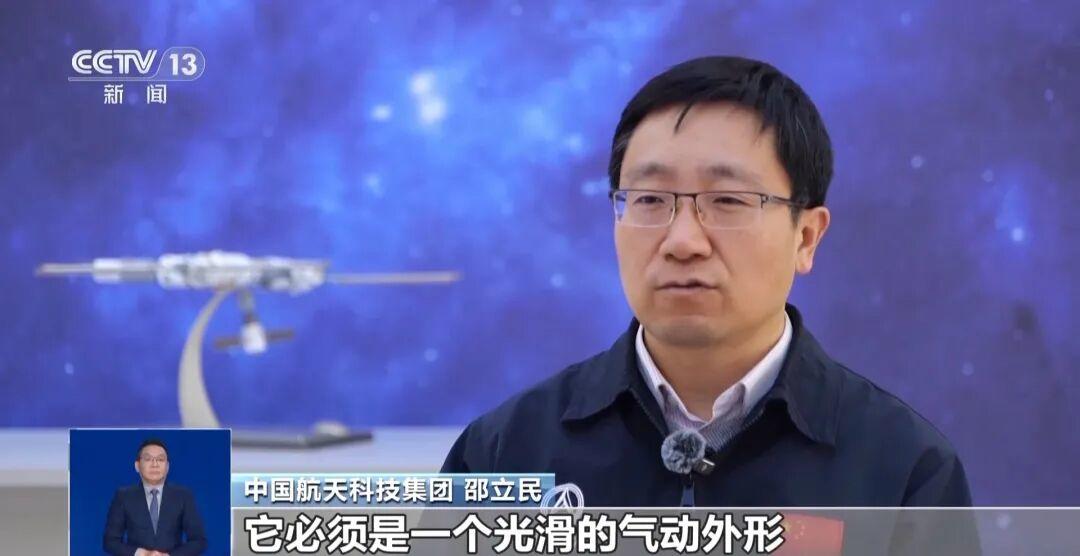
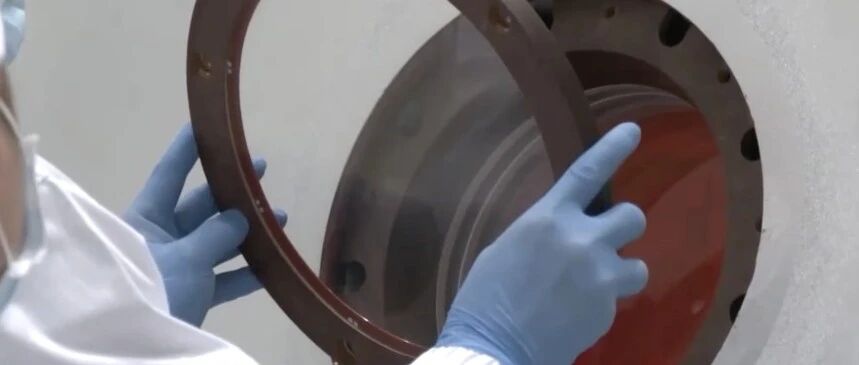
神20舷窗裂纹维修方式披露:从舱内实施加固,后续将加强舷窗结构,能硬扛空间碎片
Yang Shi Xin Wen· 2026-01-20 02:50
Group 1 - The Shenzhou-20 spacecraft successfully landed at the Dongfeng landing site, confirming the overall normal condition of the capsule and the good status of items inside, marking a successful return mission [1] - The main concern during the return mission was the window crack on the Shenzhou-20 spacecraft, which led to the installation of a window crack treatment device by astronauts, providing valuable experience for China's space program in dealing with space debris impacts [2][4] - The window of the Shenzhou spacecraft is made of a three-layer composite glass structure, with the outer layer designed to withstand temperatures exceeding 1000 degrees Celsius during atmospheric re-entry. A penetrating crack was found, prompting the decision for the crew to return via the Shenzhou-21 spacecraft [2][4] Group 2 - Due to the infeasibility of external repairs, the team opted for an internal reinforcement solution, which was successfully installed by astronauts in the Shenzhou-20 capsule, enhancing thermal protection and sealing capabilities during the return process [4] - The window serves critical functions, including allowing astronauts to observe the landing environment and ensuring safety during emergency situations, making it an indispensable part of the spacecraft [11][9] - The window also acts as a backup for attitude determination, enabling astronauts to manually control the spacecraft's stability in case of automatic control system failure [11]
神二十飞船舷窗裂纹维修,细节披露
财联社· 2026-01-20 02:14
Core Viewpoint - The Shenzhou 20 spacecraft experienced a delay in its return due to a crack in the window caused by suspected impact from small space debris, leading to a series of tests in orbit before its eventual return in an unmanned state [1][2]. Group 1: Unmanned Return vs. Manned Return - The Shenzhou 20 spacecraft's return was conducted in an unmanned mode, relying entirely on ground commands, unlike previous manned returns which involved astronaut manual operations [3]. - The Beijing Aerospace Flight Control Center re-evaluated all flight control plans for the unmanned return, ensuring the spacecraft's stability and conducting thorough inspections before the return [3]. Group 2: Window Repair Process - The window of the Shenzhou spacecraft consists of a three-layer composite glass structure, with the outer layer designed to withstand temperatures exceeding 1000 degrees Celsius during re-entry [5]. - After discovering a penetrating crack in the outer layer, the crew switched to Shenzhou 21 for return, and an internal reinforcement plan was implemented to enhance safety [5]. - The Shenzhou 22 spacecraft delivered a specialized device to the space station to improve the thermal and sealing capabilities of the Shenzhou 20 return capsule, which successfully landed with its exterior intact and cargo undamaged [5]. Group 3: Importance of Windows - The windows on the spacecraft serve critical functions beyond observation, including ensuring astronaut safety during emergencies and acting as a backup for attitude determination in case of system failures [6][10]. Group 4: Returned Cargo - The Shenzhou 20 spacecraft returned with a record amount of cargo due to the absence of three astronauts, including an over-aged extravehicular spacesuit and several large items from the space application system [9]. - The extravehicular suit, which has been used by 11 astronauts across 8 missions, is expected to contribute to lunar suit research and may be publicly displayed after fulfilling its scientific mission [9].
A股震荡轮动下 如何抓住机会?
Guo Ji Jin Rong Bao· 2026-01-19 17:04
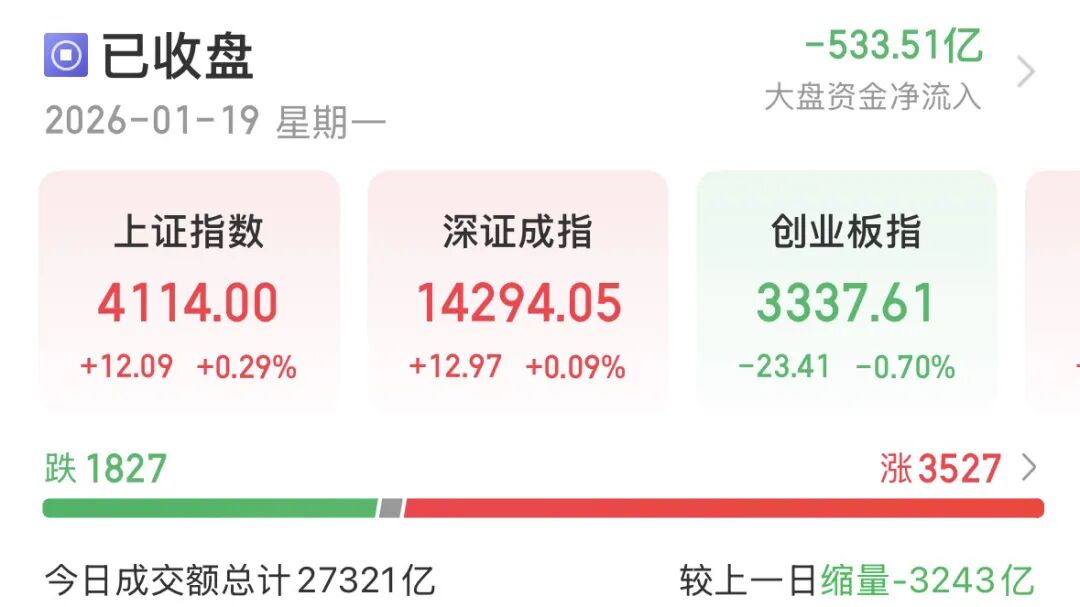
Core Viewpoint - The A-share market is expected to maintain a high-level oscillation pattern in the short term, characterized by a "slow bull" market under policy support, with a focus on sectors with strong industrial trends, clear policy expectations, and robust earnings realization [3][13][14]. Market Performance - The Shanghai Composite Index rose by 0.29% to 4114 points, while the ChiNext Index fell by 0.7% to 3337.61 points, indicating a mixed performance across indices [4]. - The total trading volume decreased to 2.73 trillion yuan, with a margin balance of 2.73 trillion yuan as of January 16 [4]. Sector Performance - The electric power equipment sector saw a surge, with 23 stocks hitting the daily limit, including notable gains from companies like TBEA Co., Ltd. and Goldwind Science & Technology [10][11]. - Traditional industries such as chemicals and oil, as well as emerging sectors like military industry, attracted significant capital, aligning with China's industrial upgrade and economic restructuring [13]. Individual Stock Highlights - TBEA Co., Ltd. (stock code: 600089) experienced a 66.6% increase year-to-date, with a market capitalization of 154.1 billion yuan [5]. - Goldwind Science & Technology (stock code: 002202) saw a year-to-date increase of 244%, with a market capitalization of 117 billion yuan [5]. - The defense and military sector had seven stocks hitting the daily limit, including AVIC Aircraft and AVIC Power [12]. Investment Strategy - Investors are advised to focus on sectors with long-term growth potential, such as new energy, digital economy, and aerospace, while also considering market capital flows and industry trends for portfolio adjustments [16]. - The recommended investment strategy includes a focus on "technology innovation + cyclical growth," with an emphasis on high-dividend stocks as a stable base [16].