
周期成长

Search documents
2026年第40期:晨会纪要-20260317
Guohai Securities· 2026-03-17 01:07
Group 1: Key Insights on China National Heavy Duty Truck Group (CNHTC) - From 2023 to H1 2025, the company's net profit margin is expected to remain around 6%-7%, similar to the previous high prosperity period, but the current profit level is suppressed by several adverse factors [3][6] - The company is transitioning from a traditional cyclical stock to a cross-cycle growth asset, driven by domestic demand cycle reversal, export structure upgrades, and the approaching profitability inflection point for new energy vehicles [3][4] - The domestic replacement cycle and the upgrade to National VII emission standards are expected to drive domestic demand upward, with a potential annual sales peak of 1.52 million units from 2025 to 2029, resulting in a CAGR of approximately 17.8% [4][6] Group 2: International Market Expansion - CNHTC is a leader in the heavy truck export market, with a projected export scale exceeding 500,000 units in the medium term, benefiting from a market share of over 40% [5][6] - The African, Middle Eastern, and Latin American markets are expected to be significant sources of growth, as Chinese heavy trucks continue to replace competitors from developed countries [5] - The Russian market presents opportunities for recovery, with CNHTC's "Shandeka" brand having a good reputation, which could lead to profit elasticity if the economic environment improves [5] Group 3: Financial Performance and Forecast - The company is expected to achieve operating revenues of 110.4 billion, 126 billion, and 135.7 billion yuan from 2025 to 2027, with year-on-year growth rates of 16%, 14%, and 8% respectively [6][7] - The projected net profits for the same period are 6.6 billion, 8.1 billion, and 9.1 billion yuan, with growth rates of +12%, +23%, and +13% [7] - The estimated EPS for 2025, 2026, and 2027 are 2.38, 2.93, and 3.31 yuan, with corresponding PE ratios of 14, 11, and 10 times, indicating a potential for valuation improvement compared to international heavy truck leaders [7] Group 4: Automotive Industry Overview - In the automotive sector, wholesale vehicle sales in January and February 2026 faced pressure, with a year-on-year decline of 9.5% and 8.8% respectively, while commercial vehicles showed positive growth [8][9] - NIO achieved its first quarterly profit in Q4 2025, with a revenue increase of 75.9% year-on-year, while Li Auto's performance faced challenges with a significant decline in net profit [10][11] - The overall automotive industry is expected to face challenges in 2026, but opportunities exist in the high-end upgrade of domestic brands and the acceleration of intelligent technology integration [12]
中国重汽(03808):公司深度研究:从周期到周期成长,中国重汽H的盈利中枢与全球视野下的价值重估
Guohai Securities· 2026-03-16 11:45
Investment Rating - The report assigns an "Accumulate" rating for China National Heavy Duty Truck Group Co., Ltd. (China National Heavy Duty Truck H) [2] Core Insights - The report emphasizes that China National Heavy Duty Truck H is transitioning from a traditional cyclical stock to a growth asset with the ability to elevate its profit center across cycles, driven by domestic demand recovery, export structure upgrades, and the approaching profitability inflection point in new energy vehicles [5][6] - The company is expected to achieve significant revenue growth, with projected revenues of 110.4 billion, 126 billion, and 135.7 billion RMB for 2025, 2026, and 2027 respectively, reflecting year-on-year growth rates of 16%, 14%, and 8% [6][7] - The report highlights the company's strong position in the heavy-duty truck market, with a market share of approximately 27% in 2025, and its leadership in exports, particularly in the African, Middle Eastern, and Latin American markets [20][23] Summary by Sections Company Overview - China National Heavy Duty Truck H is a leading representative in the heavy-duty truck industry in China, with a history of technological advancement and market leadership [17][19] - The company has a complete industrial chain layout, including heavy and light-duty engines, gearboxes, axles, and a full range of truck assemblies [19] Domestic Market Insights - The domestic market is expected to see a recovery in demand, with the replacement cycle and the implementation of the National VI emission standards anticipated to drive sales upward [5][14] - The company's domestic net profit margin is projected to remain between 6% and 7% from 2023 to the first half of 2025, with potential for improvement as market conditions stabilize [5][6] Export Market Insights - China National Heavy Duty Truck H is positioned as a leader in the export market, with expectations for significant growth in exports to Africa, the Middle East, and Latin America, as well as potential recovery in the Russian market [6][23] - The report forecasts that the company's export volume will exceed 500,000 units in the medium term, benefiting from its strong market share and established reputation [6][23] Financial Projections - The report projects the company's earnings per share (EPS) to be 2.38, 2.93, and 3.31 RMB for 2025, 2026, and 2027 respectively, with corresponding price-to-earnings (P/E) ratios of 14, 11, and 10 times [6][7] - The anticipated net profit for the company is expected to reach 6.57 billion, 8.09 billion, and 9.15 billion RMB for the years 2025, 2026, and 2027, reflecting year-on-year growth rates of 12%, 23%, and 13% [6][7]
帮主郑重:A股换挡震荡期,如何布局“确定性”机会?
Sou Hu Cai Jing· 2026-01-20 07:10
Core Viewpoint - The recent market fluctuations are not indicative of a market downturn but rather a transition towards a healthier and more sustainable market phase [1] Market Adjustment - The current market adjustment is a result of regulatory guidance and market self-regulation, aimed at curbing irrational speculation and preventing a "crazy bull" market [3] - The increase in financing margin requirements by regulators is intended to stabilize the market during the earnings forecast disclosure period, leading to a shift from "emotion-driven" to "value and prosperity-driven" market dynamics [3] Market Support - The three main pillars supporting the market in the medium term remain strong: 1. A loose policy environment with targeted interest rate cuts by the central bank [3] 2. Significant potential for incremental capital from various sources, including insurance, household savings, and recovering public fund issuance [3] 3. Clear industrial prosperity lines in sectors like AI computing power, new energy, and non-ferrous metals, which provide a solid foundation for profit growth [3] Investment Strategy - During the current "gear-shifting" period, it is advised to avoid blind chasing of trends and instead focus on "certainty" with balanced investments [3] - Short-term focus should be on performance as earnings forecasts are disclosed, particularly in sectors with positive earnings outlooks and relatively low valuations, such as the insurance sector and certain cyclical industries like non-ferrous metals and chemicals [4] - For medium-term investments, attention should be directed towards high-prosperity industries, specifically: 1. Technology growth, emphasizing AI computing and semiconductors [4] 2. Energy transition, focusing on energy storage and new grid technologies [4] 3. Cyclical growth, including copper and precious metals, benefiting from both emerging industry demand and supply constraints [4] Thematic Opportunities - Thematic opportunities related to significant events, such as the ByteDance industry chain and domestic computing power, as well as sectors benefiting from holidays and policies, should be monitored but not heavily invested in [4] - The market's short-term adjustments are seen as a preparation for smoother long-term performance, emphasizing the importance of focusing on industry trends and company performance rather than short-term index fluctuations [4]


A股震荡轮动下,如何抓住机会?
Guo Ji Jin Rong Bao· 2026-01-19 18:30
Core Viewpoint - The A-share market continues to experience narrow fluctuations, with most stocks closing in the green but showing increased differentiation and accelerated rotation, particularly in the power equipment sector, aerospace, and a continued pullback in AI applications [1][3]. Market Performance - The Shanghai Composite Index rose by 0.29% to 4114 points, while the ChiNext Index fell by 0.7% to 3337.61 points. The Shenzhen Component, CSI 300, and Northbound 50 indices showed slight gains, while the Sci-Tech 50 and SSE 50 indices experienced minor declines [4]. - The trading volume decreased to 324.3 billion yuan, with a total turnover of 2.73 trillion yuan. As of January 16, the margin financing balance in the Shanghai and Shenzhen markets increased to 2.73 trillion yuan [4]. Stock Performance - A total of 3527 stocks closed higher, with 103 hitting the daily limit up, while 1828 stocks closed lower, with 30 hitting the daily limit down. Only 16 stocks had a daily turnover exceeding 10 billion yuan [6]. - Notable performers included TBEA Co., Ltd. (30.50 yuan, +66.6%), Goldwind (27.70 yuan, +2.44%), and China Satellite (104.89 yuan, +2.93%) [7][12]. Sector Analysis - The power equipment sector saw significant gains, with 23 stocks hitting the daily limit up. Key contributors included TBEA Co., Ltd., which rose by 66.6%, and several other companies in the sector showing increases of over 10% [12][13]. - The chemical, oil, automotive, and military sectors also performed well, while sectors such as computers and communications experienced declines [10][15]. Investment Strategy - Investors are advised to focus on sectors with strong industrial trends, clear policy expectations, and robust earnings performance. There is a caution against sectors that have seen significant price increases and high valuations [3][15]. - The market is expected to maintain a "slow bull" trend under policy support, with a focus on structural opportunities in industries like new energy, digital economy, and aerospace [14][18].

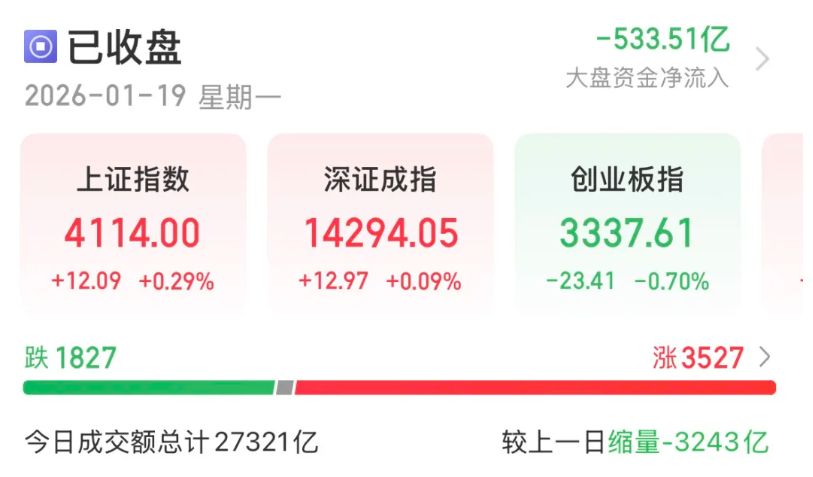
A股震荡轮动下 如何抓住机会?
Guo Ji Jin Rong Bao· 2026-01-19 17:04
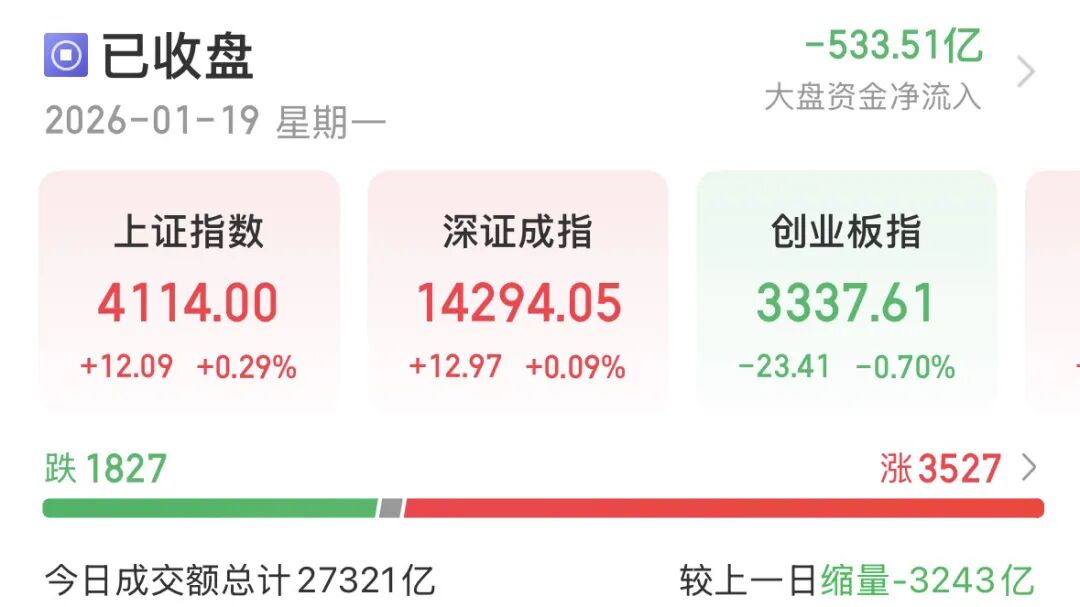
Core Viewpoint - The A-share market is expected to maintain a high-level oscillation pattern in the short term, characterized by a "slow bull" market under policy support, with a focus on sectors with strong industrial trends, clear policy expectations, and robust earnings realization [3][13][14]. Market Performance - The Shanghai Composite Index rose by 0.29% to 4114 points, while the ChiNext Index fell by 0.7% to 3337.61 points, indicating a mixed performance across indices [4]. - The total trading volume decreased to 2.73 trillion yuan, with a margin balance of 2.73 trillion yuan as of January 16 [4]. Sector Performance - The electric power equipment sector saw a surge, with 23 stocks hitting the daily limit, including notable gains from companies like TBEA Co., Ltd. and Goldwind Science & Technology [10][11]. - Traditional industries such as chemicals and oil, as well as emerging sectors like military industry, attracted significant capital, aligning with China's industrial upgrade and economic restructuring [13]. Individual Stock Highlights - TBEA Co., Ltd. (stock code: 600089) experienced a 66.6% increase year-to-date, with a market capitalization of 154.1 billion yuan [5]. - Goldwind Science & Technology (stock code: 002202) saw a year-to-date increase of 244%, with a market capitalization of 117 billion yuan [5]. - The defense and military sector had seven stocks hitting the daily limit, including AVIC Aircraft and AVIC Power [12]. Investment Strategy - Investors are advised to focus on sectors with long-term growth potential, such as new energy, digital economy, and aerospace, while also considering market capital flows and industry trends for portfolio adjustments [16]. - The recommended investment strategy includes a focus on "technology innovation + cyclical growth," with an emphasis on high-dividend stocks as a stable base [16].



春季行情主升时行业如何轮动?
Huajin Securities· 2026-01-10 11:19
Group 1: Market Trends - The spring market's main rising phase may see a rebound in growth sectors, particularly those with low valuation sentiment and significant future financing inflows[1] - Historical data shows that during the main rising phases, the Shanghai Composite Index has increased by approximately 4% to 22%, averaging around 19 trading days[10] - Key sectors that performed well during previous main rising phases include media, electronics, and non-ferrous metals, which experienced substantial financing inflows[1] Group 2: Sector Performance - In the current spring market, technology growth sectors such as media, computing, and pharmaceuticals are expected to rebound due to low valuations and sentiment[2] - Financing inflows since December 17, 2025, have been significant in sectors like electronics, non-ferrous metals, and defense, driven by ongoing industry trends[18] - The main rising phase typically sees theme indices outperforming primary industry indices, with notable gains in sectors like integrated circuits and digital marketing[42] Group 3: Economic Indicators - Short-term economic recovery remains weak, with CPI growth recorded at 0.8% and PPI at -1.9%, indicating a gradual improvement in industrial profitability[23] - The short-term liquidity environment is expected to loosen further, with potential interest rate cuts from the Federal Reserve and domestic central bank actions[31] - Risk appetite is likely to increase due to positive policy implementations and limited overseas risks, such as the anticipated Fed rate cut[38]
年度策略报告姊妹篇:2026年农林牧渔行业风险排雷手册-20251230
ZHESHANG SECURITIES· 2025-12-30 11:17
Group 1 - The core view of the report emphasizes a structural transformation in the capital market, focusing on rebuilding confidence and addressing external demand pessimism [3][4] - The investment logic suggests a shift from cyclical growth to cyclical value, with a resilient cycle expected in 2026, highlighting the value attributes of leading companies [9] - Key assumptions include a gradual decrease in the breeding sow inventory and proactive capacity control by pig companies, which may lead to reduced supply pressure and potential price recovery for pigs in 2026 [8] Group 2 - The report identifies specific companies to focus on, such as leading low-cost and high-certainty firms like Muyuan Foods and Wens Foodstuffs, as well as high-growth smaller pig companies [7] - The report outlines potential risks, including the possibility of breeding sow inventory not decreasing as expected, which could lead to an oversupply of pigs and downward pressure on prices [8] - The report also discusses the beef market, indicating that if the import impact continues, it could lead to downward pressure on beef prices, affecting the profitability of beef companies [16][24] Group 3 - In the poultry sector, the report highlights that the yellow chicken market may see price increases if breeding stocks continue to decline, while the white chicken market is expected to recover as macroeconomic activities improve [25][26] - The report emphasizes the importance of consumer demand in the poultry market, noting that weak demand could lead to price declines and pressure on company performance [27][32] - The report suggests that the animal health sector will benefit from the recovery of livestock profitability, with a focus on companies that have strong R&D capabilities and product pipelines [33][36] Group 4 - The grain sector is expected to see upward price trends due to adverse weather conditions affecting crop yields, with a focus on companies involved in seed production and transgenic varieties [40][41] - The report warns of potential risks in the seed industry, including weak demand for new varieties, which could lead to price declines and increased pressure on seed companies [44][45] - The report highlights the importance of monitoring government policies regarding the commercialization of new seed varieties, as delays could impact market expectations [46][48] Group 5 - The report provides a risk assessment for recommended stocks, such as Muyuan Foods and Wens Foodstuffs, indicating potential risks related to pig output and price declines [50][56] - The report emphasizes the need for continuous monitoring of key indicators, such as breeding sow inventory and market prices, to assess the performance of the companies in the livestock sector [56]


周期开启跨年行情
2025-12-22 01:45
Summary of Key Points from Conference Call Records Industry Overview - **Market Outlook**: The stock market is expected to accelerate in the short term, with a positive outlook for technology and non-bank sectors. Opportunities in cyclical and consumer goods are also worth noting. The impact of institutional profit protection and reduced positions on the market has been largely digested, with the ChiNext showing strong performance, indicating that the technology market is far from over [1][2][3]. Core Insights and Arguments - **Investment Strategy**: The focus remains on technology and non-bank sectors, while also considering transformation opportunities in cyclical and consumer goods. The liquidity aspect suggests that the market's adjustment is more about liquidity than value judgment [3][4]. - **Economic Policy**: The Central Economic Work Conference emphasized stabilizing investment and reducing inventory in real estate, aiming to address the negative growth in investment and foreign direct investment (FDI) [4][5]. - **Market Style Prediction for 2026**: The market is expected to favor quality growth or a return to fundamental strategies, with opportunities in both technology and non-technology sectors, as well as large-cap and small-cap stocks [5][6]. Sector-Specific Insights Aviation Industry - **Investment Logic**: The aviation sector's investment logic for the next two years is based on favorable oil prices, exchange rates, and national policies to boost consumption. High passenger load factors are expected to shift towards price increases, improving supply-demand dynamics and profitability [8][9]. Oil Shipping Industry - **Current Fundamentals**: The oil shipping industry remains robust, with crude oil freight rates maintaining high levels. The fourth quarter and annual profits are expected to reach a ten-year high. The supply-demand relationship in the compliant market continues to improve, with optimistic expectations reflected in rising one-year charter rates [10]. Chemical Industry - **Market Performance**: The chemical market is showing strength, particularly in new energy chemical materials. The spandex sector is expected to see a turning point, with companies like Huafeng Chemical showing potential due to cost advantages [11][12]. Metal Industry - **Future Outlook**: The metal industry is expected to be in a bull market phase, with optimism driven by anticipated interest rate cuts from the Federal Reserve. Industrial metals like copper, aluminum, and tin are expected to perform well, with strong demand driven by AI trends [14][15]. Petrochemical Industry - **Oil Price Predictions**: Oil prices are expected to face pressure in the first half of the year but may recover in the second half due to improving supply-demand dynamics. Companies like CNOOC and PetroChina are highlighted as potential investment opportunities [16][17]. Coal Market - **Short-Term and Long-Term Predictions**: The coal market is currently experiencing a price correction but is expected to stabilize between 650-670 RMB. Long-term, coal prices may enter a new upward cycle, with companies like China Shenhua and Yanzhou Coal Mining recommended for their production capacity [22]. Additional Noteworthy Points - **Investment Recommendations**: Specific companies and sectors are highlighted for potential investment, including technology stocks, financial services, and cyclical consumer goods that can successfully transition [6][7][27]. - **Public Utilities Concerns**: The public utilities sector faces concerns regarding electricity prices, but companies with strong dividend commitments are recommended for investment [26]. This summary encapsulates the key insights and recommendations from the conference call records, providing a comprehensive overview of the current market landscape and future expectations across various sectors.
中字头军工股普跌,国防军工ETF回调逾1%触及半年线,场内溢价再起!资金连续6日净申购!
Xin Lang Ji Jin· 2025-11-18 02:11
Core Viewpoint - The defense and military industry sector is experiencing a significant pullback, with the popular defense ETF (512810) declining over 1% and hitting a six-month low, while major military stocks are also seeing declines [1][2]. Group 1: Market Performance - The defense military ETF (512810) has seen a decline of 1.60%, trading at 0.676, with a drop of 0.011 [2]. - Major military stocks such as AVIC Shenyang Aircraft Corporation and China Shipbuilding Industry Corporation have dropped nearly 3% and over 1% respectively [1]. Group 2: Investment Opportunities - The ETF has attracted over 100 million yuan in net subscriptions over the past six trading days, indicating active interest from investors [1]. - Analysts suggest that the fourth quarter may see the gradual realization of "14th Five-Year Plan" related orders, coupled with military trade catalysts, which could lead to a resurgence in the defense and military market [1]. - The defense industry is expected to benefit from geopolitical risks, technological advancements, and policy support, with potential for high-end weapon exports and a revaluation of core asset values [1]. Group 3: Strategic Insights - CITIC Securities' report indicates a shift in China's defense industry from "cyclical growth" to "comprehensive growth," driven by domestic demand, foreign trade expansion, and civilian contributions [3]. - The defense ETF (512810) is highlighted as an efficient tool for investing in core defense assets, covering various hot themes such as commercial aerospace, low-altitude economy, and military AI [3].
景顺长城基金联合景顺集团举办2025年四季度权益专场策略会
Zheng Quan Ri Bao Wang· 2025-10-24 11:40
Group 1 - The market's focus on AI has increased, with a positive feedback loop observed between computing power, models, and applications, leading to an investment return rate exceeding 1% in code generation scenarios, which supports the valuation of the AI industry and related companies [1] - The performance of the non-ferrous metals sector has surged by 67.32% this year, driven by a combination of global monetary and fiscal policy easing, alongside domestic "anti-involution" policies, suggesting a significant strengthening of cyclical sectors in the coming year [2] - The investment logic for non-ferrous metals has shifted due to three new driving forces: energy transition, increased defense spending, and demand for AI computing power, allowing many non-ferrous products to evolve into a "cyclical growth" industry [2] Group 2 - The domestic innovative drug sector has seen a 20%-50% improvement in R&D efficiency due to advantages in engineering talent, domestic market financing, and clinical resources, positioning Chinese pharmaceutical companies as preferred partners for multinational firms [2] - The current market adjustment phase is viewed as an opportunity to identify companies with genuine innovative capabilities, emphasizing the importance of fundamental stock selection over emotional trading at high valuations [2] - The investment strategy should consider demand, supply, technological advancements, and pricing effects, with specific attention to sectors such as energy storage, power equipment, photovoltaics, coal, innovative drugs, and home appliances [3] Group 3 - The focus on China's manufacturing upgrade story suggests that investment should shift from merely observing GDP growth to evaluating manufacturing output that represents industrial upgrades, with international revenue sources potentially leading to a revaluation of certain companies [3]