南京银行

Search documents
1月20日贷款财政贴息四项政策点评:“一揽子”贷款财政贴息政策影响几何?
EBSCN· 2026-01-21 11:17
Investment Rating - The report maintains a "Buy" rating for the banking industry, indicating an expected investment return exceeding the market benchmark index by more than 15% over the next 6-12 months [29] Core Insights - The "package" loan interest subsidy policies aim to stimulate consumption and investment, focusing on enhancing effective domestic demand through financial and fiscal collaboration [2][7] - The new policies are expected to significantly increase the scale of interest subsidies compared to previous measures, with a projected subsidy scale of approximately 1000 to 2000 billion yuan for 2026 [17][19] Summary by Sections Loan Subsidy Policies - The policies include four main areas: subsidies for small and micro enterprises, equipment updates, service industry operators, and personal consumption loans, with a focus on key industries such as new energy vehicles and medical equipment [4][6] - The subsidy rate for small and micro enterprise loans is set at 1.5 percentage points, with a maximum loan amount of 50 million yuan per entity, potentially providing up to 150,000 yuan in subsidies [4][6] - The equipment update loan subsidy has been increased from 1% to 1.5%, expanding the scope to include technology innovation loans and related fields [4][6] - The personal consumption loan subsidy has removed previous restrictions, allowing for broader eligibility and a maintained subsidy rate of 1% [5][6] Economic Impact - The policies are designed to alleviate financial burdens on small and micro enterprises, encouraging investment and job stability, particularly in high-tech and essential service sectors [7][8] - The expected increase in loan demand from these sectors is anticipated to support the overall credit recovery in the economy, particularly for retail and service industries [7][8] Market Outlook - The report suggests that the coordinated fiscal and monetary policies will positively impact the banking sector's loan volume and pricing, particularly benefiting banks focused on small and micro enterprises and retail finance [23] - The banking sector has seen a decline in stock performance, and the new policies are expected to act as a catalyst for recovery, especially in the context of the "opening red" period for banks [23]
2026年1月宏观利率展望:风险偏好抬升,利率易上难下
Nan Jing Yin Hang· 2026-01-21 10:24
1月以来,债券收益率整体先上后下,上行主要受年初以来股市持续上涨、 风险偏好上升的影响。从经济基本面来看,内需仍然处于回落的趋势中,外需 保持韧性,但对债市影响有限。通胀逐步回升,1月工业品价格也多数上涨,使 得市场通胀预期逐步上行,对债市偏利空。货币政策方面,在央行进行结构性 降息后,短期内进一步降准降息的概率有所下降,但会维持资金面稳定。目前 债市的主要矛盾仍然集中在逐步好转的基本面预期、股市和商品市场的持续上 涨以及风险偏好的整体抬升,利率呈现易上难下的特征。2月处于数据真空期, 预计短期内上述预期持续,对债市较为不利。建议短期内交易盘保持谨慎,配 置盘有年初早配置的需求,可在利率受冲击上行至区间上沿时择机介入。 1 南京银行 2026 年 1 月宏观利率展望 风险偏好抬升,利率易上难下 阿 内容摘要: 宏观经济方面,12月经济显示内需继续放缓,需求端固定资产投资降幅扩 大,其中房地产、制造业、基建投资增速均继续下行。消费增速回落,显示内 需仍然在走弱的过程中。供给端生产略有回升,主要受高技术产业生产加速拉 动。12月CPI和PPI同步回升,显示通胀逐步进入温和上行的趋势中。 1 月以来,资金面月初偏宽 ...

南京银行2026年1月宏观利率展望:风险偏好抬升,利率易上难下
Nan Jing Yin Hang· 2026-01-21 09:05
Economic Overview - Domestic demand continues to weaken, with fixed asset investment declining by 3.8% year-on-year, a decrease of 1.2 percentage points from the previous value[8] - Real estate investment dropped by 17.2%, down 1.3 percentage points, indicating ongoing weakness in the sector[9] - Consumer spending growth fell to 0.9% in December, a decline of 0.4 percentage points from the previous month, reflecting weak consumer sentiment[12] Inflation and Production - CPI rose by 0.8% year-on-year in December, up 0.1 percentage points, indicating a mild upward trend in inflation[41] - PPI increased by 0.2% month-on-month, with a year-on-year decline of 1.9%, but the decline is narrowing by 0.3 percentage points compared to the previous month[49] - High-tech industries showed growth, with industrial value-added increasing by 5.9% year-on-year, although overall industrial production growth was slightly down[37] Monetary Policy and Liquidity - The central bank implemented an unexpected structural interest rate cut, indicating a continued commitment to liquidity support[56] - Short-term funding rates remained stable, with DR001 operating within 15 basis points below the policy rate[58] - The central bank's measures include increasing the quota for targeted loans to small and medium-sized enterprises by 1 trillion yuan, reflecting a focus on supporting the real economy[82] Market Trends - Bond yields initially rose but later fell, influenced by rising risk appetite and stock market performance[2] - The overall market sentiment remains cautious, with expectations of continued pressure on bond prices due to improving economic fundamentals and inflation concerns[2] - The trade surplus expanded to $114.14 billion in December, driven by a rebound in exports, particularly in automotive and electronic products[22]
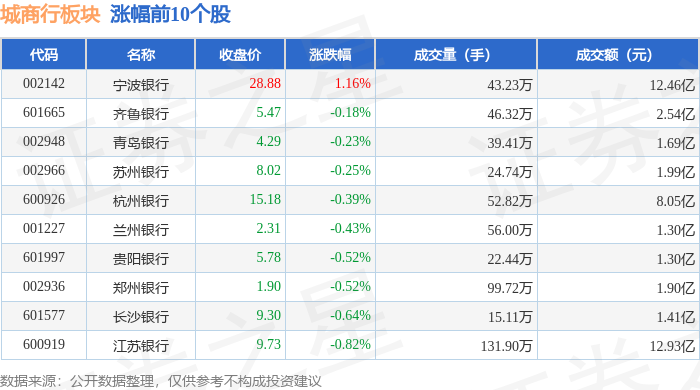
城商行板块1月21日跌0.55%,重庆银行领跌,主力资金净流入5.08亿元
Zheng Xing Xing Ye Ri Bao· 2026-01-21 08:54
Market Overview - The city commercial bank sector experienced a decline of 0.55% on January 21, with Chongqing Bank leading the drop [1] - The Shanghai Composite Index closed at 4116.94, up 0.08%, while the Shenzhen Component Index closed at 14255.12, up 0.7% [1] Individual Stock Performance - Ningbo Bank closed at 28.88, with an increase of 1.16% and a trading volume of 432,300 shares, amounting to a transaction value of 1.246 billion [1] - Chongqing Bank closed at 10.25, down 1.82%, with a trading volume of 106,800 shares and a transaction value of 110 million [2] - Other notable performers include Xiamen Bank, which closed at 7.13, down 1.66%, and Chengdu Bank, which closed at 15.72, down 1.38% [2] Capital Flow Analysis - The city commercial bank sector saw a net inflow of 508 million from institutional investors, while retail investors experienced a net outflow of 566 million [2] - The capital flow for individual stocks indicates that Hangzhou Bank had a net inflow of 158 million from institutional investors, while it faced a net outflow of 86.5 million from retail investors [3] - Shanghai Bank also saw a net inflow of 107 million from institutional investors, with a net outflow of 121 million from retail investors [3]





一周银行速览(1.10—1.16)
Cai Jing Wang· 2026-01-21 06:05
财经网×企业预警通App ◆监管之声 2025年金融数据出炉:社融、M2高增长 直接融资占比显著上升 2025年全年金融数据出炉。中国人民银行1月15日发布的数据显示:据初步统计,截至2025年末,社会融资规模存量 为442.12万亿元,同比增长8.3%;人民币贷款余额271.91万亿元,同比增长6.4%;广义货币(M2)余额340.29万亿 元,同比增长8.5%。业内专家表示,2025年,我国货币信贷总量稳步增长,结构持续优化。直接融资在整个社融中的 占比提升,彰显金融供给侧结构性改革成效。同时,社会综合融资成本进一步下行,较好满足了企业和居民部门的资 金需求,为经济回升向好创造了适宜的货币金融环境。 中国人民银行推出八项举措 加大结构性货币政策工具支持力度 多家上市银行大股东或高管增持落地 开年以来,多家银行披露了获大股东、高管增持的相关消息。例如,渝农商行6位核心高管集体增持,齐鲁银行高管 超额兑现增持承诺,南京银行大股东持续加码增持。整体来看,银行主要股东及高管实施增持,展现了其对银行业发 展的信心。 ◆企业动态 中国人民银行副行长邹澜1月15日在国新办举行的新闻发布会上介绍,根据当前经济金融形势需要 ...
“数字生活伙伴”——南京银行发布手机银行App8.0
Jing Ji Guan Cha Wang· 2026-01-21 04:20
近日,南京银行(601009)手机银行App8.0版本正式发布。在金融科技与零售业务深度融合的背景下, 这款全新升级的App,以"智能管钱、专业投资、便捷花钱、精致省钱、安全守护"为定位,通过数字化 统一渠道建设,展现南京银行在零售经营能力建设、前沿科技应用及数字化转型领域的实力。 战略升级:数字化经营能力的体系化突破 数字生态:用户价值导向的数字化转型标杆 南京银行App8.0的升级,是数字化能力向用户价值转化的生动实践。从宏观视角的资产负债全景管理, 到微观场景的每日记账与消费分析;从专业级的投资决策支持,到一键式的跨行资产管理;从场景化贷 款服务的智能匹配,到覆盖日常消费、餐饮、助农等多元领域的"鑫福生活"省钱专区——每一个功能模 块的迭代,都彰显着南京银行对"用户需求在哪里,服务就延伸到哪里"的数字化思维。 作为"精致省钱"板块的核心载体,全新升级的鑫福生活专区整合了鑫选福利、限时特惠、精选商户等多 个模块,覆盖日常消费、餐饮、娱乐、助农等多元生活场景。通过丰富的优惠活动、灵活的分期购、实 用的积分兑换等多种形式,为用户提供高品质、高性价比的生活消费选择,让省钱成为提升生活品质的 有效方式。 南京银行 ...
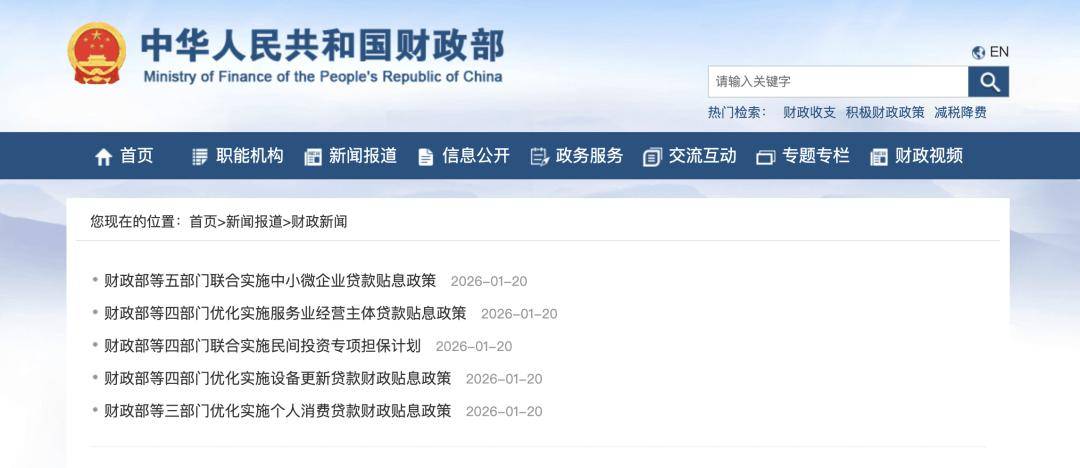
中小微企业贷款贴息、民间投资专项担保……财政部连发五项重要政策
Sou Hu Cai Jing· 2026-01-21 03:12
Group 1 - The Ministry of Finance and other departments have released five policy documents aimed at optimizing financial support for personal consumption loans, equipment updates, private investment guarantees, service industry loans, and small and micro enterprise loans [1][9][29] - The personal consumption loan subsidy policy has been extended until December 31, 2026, with adjustments to the subsidy standards and an expanded range of supported financial institutions [4][5][6] - The equipment update loan subsidy policy includes a 1.5% subsidy on fixed asset loans for equipment updates, applicable for up to two years, and has been expanded to include various sectors such as construction, aviation, and digital technology [10][11][12] Group 2 - The private investment guarantee plan has a total quota of 500 billion yuan, to be implemented over two years, focusing on supporting small and micro enterprises in various sectors including technology upgrades and service industry enhancements [17][18] - The plan includes a risk-sharing mechanism where banks will bear at least 20% of the loan risk, while the government guarantee fund will cover up to 80% [19] - The government will also reduce guarantee fees and increase the compensation limit for the guarantee fund to enhance support for private investments [20] Group 3 - The service industry loan subsidy policy has been extended to December 31, 2026, with an increased subsidy cap of 10 million yuan per loan and a 1% annual subsidy rate [23][24] - The policy now includes additional sectors such as digital, green, and retail industries, expanding the scope of financial support [24][25] - The implementation of these policies will involve streamlined processes for fund allocation and enhanced collaboration among financial institutions and regulatory bodies [26][28]







信用卡分期纳入贴息支持范围,年贴息比例1%
2 1 Shi Ji Jing Ji Bao Dao· 2026-01-20 12:00
Core Viewpoint - The recent upgrades to multiple loan interest subsidy policies signal a shift in government strategy from relying solely on large-scale infrastructure investment to a more balanced approach that encourages consumer spending and reduces financing costs for micro and small enterprises [1][4]. Group 1: Policy Upgrades - The Ministry of Finance has optimized existing interest subsidy policies for personal consumption loans, service industry loans, and equipment upgrade loans, extending their terms to the end of 2026 [1]. - The personal consumption loan subsidy now includes credit card installment payments, with an annual subsidy rate of 1% [3]. - The subsidy cap for new service industry loans has increased from 1 million to 10 million yuan per borrower [6]. Group 2: Support for Micro and Small Enterprises - A new interest subsidy policy for micro and small enterprises has been introduced, targeting key industry chains and their upstream and downstream sectors [11]. - The subsidy for eligible fixed asset loans for micro and small enterprises will be 1.5% annually, with a maximum loan amount of 50 million yuan per borrower [12]. Group 3: Expanded Coverage and Financial Institutions - The range of financial institutions eligible to provide these subsidies has been expanded to include city commercial banks, rural cooperative financial institutions, foreign banks, and consumer finance companies [4][7]. - The policy aims to enhance the accessibility of financial services in rural and grassroots markets, thereby stimulating consumption [4]. Group 4: Specific Sector Support - The updated policies now include support for digital, green, and retail sectors, alongside the previously established eight categories [6][7]. - The equipment upgrade loan subsidy has been raised to 1.5%, covering a wider range of sectors including high-end, intelligent, and green technologies [8].



设备更新贷款贴息范围扩容
Di Yi Cai Jing· 2026-01-20 09:25
不久前,中国人民银行决定增加科技创新和技术改造再贷款额度4000亿元。增加后,科技创新和技术改 造再贷款总额度为1.2万亿元。另外央行适当拓展政策支持领域,自2026年起,将研发投入水平较高的 民营中小企业纳入科技创新和技术改造再贷款政策支持领域。 另外,此次设备更新贷款财政贴息领域扩围。 贴息政策实施至2026年12月31日,后续可视情况延长 为了支持经营主体开展设备更新和技术改造,降低经营主体融资成本,推动形成有效投资,中国加大财 政贴息政策支持力度。 1月20日,财政部等四部门公布《关于优化实施设备更新贷款财政贴息政策的通知》(下称《通 知》),明确经营主体实施设备更新行动且银行向其发放贷款的,中央财政对经营主体的设备更新项目 相关固定资产贷款本金贴息1.5个百分点,按照相关固定资产贷款发放之日起予以贴息,贴息期限不超 过2年。 这一政策与此前不同的是,扩大了设备更新贷款财政贴息支持范围,将科技创新和技术改造再贷款政策 支持的、银行2026年起新发放的科技创新类贷款纳入上述中央财政贴息支持范围。 《通知》称,上述设备更新财政贴息政策实施至2026年12月31日,后续可视情延长实施期限。 此外,设备更新财 ...
财政部连发多份重要文件,事关贷款贴息、民间投资贷款担保等 一揽子政策全文公布
Sou Hu Cai Jing· 2026-01-20 09:03
Group 1 - The core viewpoint of the news is the implementation of a financial subsidy policy for equipment renewal loans to support businesses in reducing financing costs and promoting effective investment [3][4][5] - The policy includes a 1.5% interest subsidy on fixed asset loans for equipment renewal projects, applicable for a maximum of two years, and is effective until December 31, 2026 [3][4] - The scope of support has been expanded to include various sectors such as construction, aviation, digital technology, and green energy, emphasizing high-end, intelligent, and digital equipment updates [4][6] Group 2 - A total of 26 banks are designated as eligible for processing the interest subsidy loans, including major national banks and several regional banks [4][5] - The subsidy process has been optimized to include a "pre-allocation + settlement" method, streamlining the application and approval process for banks and provincial financial departments [5][6] - The policy aims to enhance the experience of businesses by ensuring timely communication regarding subsidy payments through modern technology [6][7] Group 3 - The policy for small and micro enterprises includes a 1.5% interest subsidy on fixed asset loans, with a maximum loan amount of 50 million yuan, effective from January 1, 2026 [8][9] - The targeted sectors for this subsidy include new energy vehicles, medical equipment, and various service industries, aiming to stimulate investment and production [9][10] - The operational mechanism involves a "total-to-total" model for coordination between financial institutions and fiscal departments to ensure efficient processing of subsidy funds [11][12] Group 4 - The service industry loan subsidy policy has been extended until December 31, 2026, with an increased maximum loan amount of 10 million yuan and a 1% interest subsidy for one year [16][17] - New sectors such as digital, green, and retail have been added to the support scope, enhancing the policy's relevance to current economic trends [17][18] - The funding allocation process has been refined to improve efficiency and reduce redundancy in the approval process [18][19] Group 5 - A special guarantee plan for private investment has been introduced with a total quota of 500 billion yuan over two years, aimed at supporting small and micro enterprises [22][24] - The plan includes risk-sharing mechanisms where banks bear at least 20% of the loan risk, while the government guarantee fund covers up to 80% [24][25] - The initiative encourages innovative financing models and aims to enhance the capital strength of the government guarantee fund to support private investments effectively [26][27]