
华硕

Search documents
鸿蒙PC近况更新
2025-07-16 06:13
Summary of Conference Call Company and Industry - The conference call primarily discusses **Huawei** and its new product **Hongmeng PC** within the **PC industry** and **operating systems** market Key Points and Arguments - **Introduction of Hongmeng PC**: Huawei's Hongmeng PC was anticipated and aligns with previous statements made by the company regarding its development timeline, particularly referencing a mention in March about a May launch [1][2] - **Market Context**: The global PC shipment volume is projected to be **245 million units** in 2024, reflecting a **1.3% increase** from previous years. Historical data shows fluctuations in shipments, with a notable drop to **299.8 million units** in 2020, followed by a recovery during the pandemic [4][5] - **China's PC Market**: In 2024, China's PC shipments are expected to be **39.7 million units**, down **4%** year-over-year. Lenovo leads the market with a **35% share**, followed by Huawei [5][6] - **Competitive Landscape**: The competitive dynamics in the PC market are highlighted, with Huawei positioned as a significant player alongside Lenovo and HP. The call notes that Huawei's market share is growing despite challenges [5][6] - **Operating System Landscape**: The discussion includes the competitive positioning of operating systems, noting that **93%** of industrial software relies on Windows, indicating a significant barrier for alternatives like Hongmeng [8] - **Technological Ambitions**: Huawei's ambition to create a microkernel-based operating system, initiated in **2012**, aims to compete with established players like Google and Apple. The company seeks to integrate various devices (PCs, servers, smartphones) under a unified operating system [11][16] - **Ecosystem Development**: The call emphasizes the importance of building an ecosystem around Hongmeng, with opportunities for hardware manufacturers and software developers to collaborate and innovate [14][15][19] - **Future Prospects**: The potential for Hongmeng to disrupt the PC market is discussed, with expectations for significant advancements and market changes leading up to the official launch on **May 19** [24] Other Important Content - **Technological Features**: The Hongmeng PC is designed to facilitate seamless connectivity and interoperability between devices, showcasing features like multi-window capabilities and cross-device functionality [12][22][23] - **Investment Opportunities**: The call identifies potential investment opportunities in companies that will support the Hongmeng ecosystem, particularly in hardware and software sectors [14][15] - **Collaborative Efforts**: Various partners and companies are mentioned as part of the ecosystem, indicating a broad network of collaboration to enhance the Hongmeng platform [18][19] This summary encapsulates the key discussions and insights from the conference call, focusing on Huawei's strategic initiatives and the broader implications for the PC industry and operating systems market.
美对等关税引爆消费电子涨价潮!iPhone、笔电涨幅至少10% 台厂备战库存消耗战
Jing Ji Ri Bao· 2025-07-13 22:54
Group 1 - The new wave of tariffs announced by President Trump has set an average tax rate of 20% for products imported from various countries, leading to a projected price increase of at least 10% for consumer electronics in the US market, including iPhones and laptops, to reflect the added tariff costs [1] - Companies such as Asus, Acer, MSI, Gigabyte, and HTC are expected to be affected by the impending price hikes, as they prepare to respond by either raising prices or cutting supply chain costs to avoid scaring off consumers [1][2] - Currently, there is no immediate price increase for consumer electronics in the US, as major brands like Apple, HP, Dell, Asus, and Lenovo have already stocked up inventory in the first half of the year, relying on previously accumulated stock for sales [1] Group 2 - Asus has been proactive in response to the tariffs, having started strategic inventory preparations in the US market since Q4 of last year, with stock levels sufficient for three to six months depending on the product category [2] - In contrast, Acer has not engaged in preemptive stocking in the US, maintaining an inventory level of about six to eight weeks, which is considered normal [2] - As brand inventories in the US continue to decrease and the final tariff rates are confirmed, it is anticipated that noticeable price increases for consumer electronics will begin in the second half of the year, particularly for newly launched models [2]
AI双Buff加持,戴尔将再迎“春天”?
海豚投研· 2025-07-11 11:39
Core Viewpoint - The article discusses Dell's transition from traditional PC to AI PC, exploring its potential and investment value in the context of AI servers and AI PCs driving growth [1][17]. Group 1: Traditional Business Opportunities - Dell's client business includes laptops, desktops, workstations, monitors, peripherals, and software solutions, with laptops and desktops being the main revenue drivers [1]. - Unlike competitors like Lenovo and HP, Dell's largest customer base is enterprises, with commercial clients accounting for 88% of its client business revenue [2][4]. - Dell holds approximately 15% of the global PC market share, ranking third, and has maintained a stable market position due to its focus on enterprise clients [4][6]. - In the U.S. market, Dell and HP together account for nearly half of the PC market share, with Dell's PC revenue significantly influenced by its higher average selling price [6][10]. Group 2: Market Competitiveness - Dell's PC products are competitive, with high performance configurations and relatively higher prices compared to competitors [8][9]. - The XPS series targets executives and creative professionals, while the Alienware series caters to hardcore gamers [9][10]. - Despite lower shipment volumes compared to Lenovo, Dell's revenue in the client business is comparable due to its higher average selling price [10]. Group 3: AI PC Development - AI PCs are defined as desktops and laptops equipped with specialized chips for AI workloads, and Dell is actively entering this market alongside competitors [11]. - Dell has restructured its product lineup into three categories: Dell, Dell Pro, and Dell Pro Max, focusing on different performance levels and AI capabilities [11][12]. - The growth of AI PCs is primarily driven by supply-side factors, with expectations for significant market penetration by 2029 [14][15]. Group 4: Dual Growth from AI Servers and PCs - Dell's revenue from AI servers is projected to surpass traditional servers by 2025, with significant growth expected in the AI server market [21][23]. - The overall revenue from Dell's AI servers is anticipated to reach $425 billion by 2029, with a compound annual growth rate (CAGR) of 11.4% [23]. - For the PC segment, Dell's shipment volume is expected to grow to approximately 45 million units by 2029, with a revenue target of $590 billion [27][28]. Group 5: Investment Value Assessment - Dell's projected core operating profit for fiscal year 2026 is estimated at $7.15 billion, with a growth rate of over 30% [33]. - The company's current price-to-earnings (PE) ratio is below its historical average, indicating potential for upward valuation [34]. - Discounted cash flow (DCF) analysis suggests a significant upside potential for Dell's stock price compared to its current valuation [35][36].


【太平洋科技-每日观点&资讯】(2025-07-11)
远峰电子· 2025-07-10 12:01
Market Overview - The main board saw significant gains with Huamai Holdings up by 10.09%, Huanrui Century by 10.06%, and Jingyida by 10.02% [1] - The ChiNext board led the gains with Pulian Software increasing by 20.00% and Changxin Bochuang by 15.07% [1] - The Sci-Tech Innovation board also saw increases, with Lexin Technology up by 5.77% [1] - Active sub-industries included SW Panel with a rise of 1.04% and SW Portal Websites by 0.77% [1] Domestic News - TSMC reported a June sales figure of NT$263.71 billion, a decrease of 17.7% month-on-month but an increase of 26.9% year-on-year, with a cumulative sales figure of NT$1,773.046 billion for the first half of the year, up 40.0% year-on-year [1] - United Microelectronics Corporation's advanced packaging interposer has been validated by Qualcomm and is expected to enter mass production in Q1 2026 [1] - Upwind New Materials announced a control acquisition of at least 63.62% of shares in Zhiyuan Robotics for approximately RMB 2.1 billion, making it the first intelligent listed company in A-shares [1] - STMicroelectronics launched a new 3MP automotive-grade CMOS image sensor, SC326AT, featuring significant optimizations in sensitivity, noise suppression, and power control [1] Company Announcements - Dinglong Co. expects a net profit of RMB 290 million to 320 million for H1 2025, representing a year-on-year increase of 33.12% to 46.9% [3] - Shenzhen Textile A anticipates a net profit of RMB 28 million to 42 million for H1 2025, a decrease of 4.31% to 36.20% year-on-year [3] - Heertai forecasts a net profit of RMB 326.67 million to 366.27 million for H1 2025, a growth of 65% to 85% year-on-year [3] - Quectel expects revenue of RMB 11.45 billion for H1 2025, a year-on-year increase of 38.81%, with a net profit of RMB 463 million, up 121.13% year-on-year [3] International News - Murata Manufacturing is ramping up production of its first high-frequency filter using XBAR technology, crucial for 5G and emerging wireless technologies [2] - India's first semiconductor chip manufacturing plant has commenced operations in Gujarat, with production expected to start by December 2026 [2] - NEXTIN, a South Korean testing equipment company, is expanding into the next-generation display sector with orders for OLEDoS testing equipment from major Chinese firms [2] - IDC reported a 6.5% year-on-year increase in global PC shipments in Q2, reaching 68.4 million units, with Apple and Asus showing the largest growth [2]

Canalys:2025Q2台式机、笔记本电脑和工作站的总出货量同比增长7.4%
智通财经网· 2025-07-10 06:58
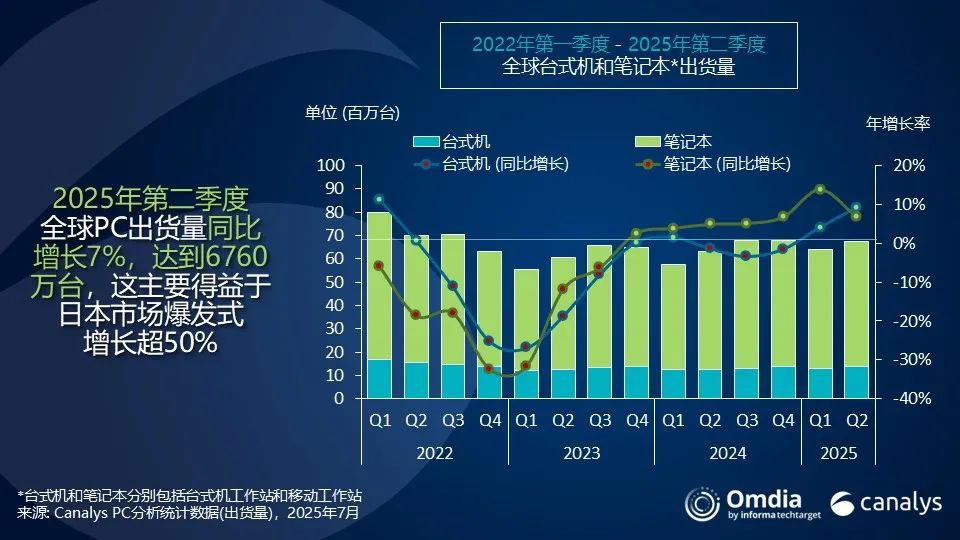
Core Insights - The global PC market is projected to see a year-on-year shipment increase of 7.4% in Q2 2025, reaching 67.6 million units, driven primarily by commercial PC deployments ahead of the Windows 10 service termination [1][3] Market Overview - Total shipments for Q2 2025 include 53.9 million notebooks (up 7%) and 13.7 million desktops (up 9%) [1] - The growth is attributed to large-scale commercial deployments as businesses prepare for the end of Windows 10 support, despite weak consumer demand due to macroeconomic uncertainties [1][3] Supply Chain Dynamics - The evolving tariff policies under the Trump administration are reshaping the global PC supply chain, leading to a significant shift in PC imports from China to Vietnam [3] - Uncertainties remain regarding potential tariffs on products manufactured in Vietnam using Chinese components, complicating the supply chain landscape [3] Market Leaders - Lenovo maintains its position as the global PC market leader with shipments of 17 million units, a year-on-year increase of 15.2% [3][4] - HP follows in second place with 14.1 million units shipped, reflecting a growth rate of 3.2% [4] - Dell ranks third with 9.8 million units, showing a decline of 3.0% [4] - Apple and Asus rank fourth and fifth, with Apple achieving a significant growth rate of 21.3% and Asus at 18.4% [3][4] Future Outlook - A survey indicates that over half of the channel partners expect their PC business to grow year-on-year in the second half of 2025, with 29% anticipating growth exceeding 10% [3] - The consumer PC market is expected to see growth in 2026 as delayed purchasing decisions from consumers are anticipated to align with natural replacement cycles of devices bought during the pandemic [3]



2025年第二季度,全球PC出货量同比增长7%,联想稳居榜首,苹果华硕表现亮眼!
Canalys· 2025-07-10 06:27
Core Insights - The global PC market is experiencing a 7.4% year-on-year growth in Q2 2025, with total shipments reaching 67.6 million units, driven primarily by commercial PC deployments ahead of the Windows 10 service termination [1][4] - Consumer demand remains weak due to macroeconomic uncertainties, influenced by the evolving tariff policies of the Trump administration, which have created significant uncertainty in the market [1][2] Market Performance - In Q2 2025, notebook shipments (including mobile workstations) reached 53.9 million units, growing by 7%, while desktop shipments increased by 9% to 13.7 million units [1] - Lenovo maintained its leadership in the global PC market with shipments of 17 million units, a year-on-year increase of 15.2% [4][5] - HP followed with 14.1 million units shipped, reflecting a growth rate of 3.2%, while Dell's shipments decreased by 3% to 9.8 million units [4][5] - Apple saw a significant growth of 21.3%, with shipments reaching 6.4 million units, capturing a market share of 9.4% [4][5] - ASUS ranked fifth with shipments of 5 million units, marking an 18.4% increase [4][5] Supply Chain Dynamics - The evolving tariff policies are reshaping the global PC supply chain, with a notable shift in US PC imports from China to Vietnam to avoid potential tariffs [2] - Recent trade agreements between the US and Vietnam impose a 20% tariff on Vietnamese goods and up to 40% on "transshipped" products, complicating the supply chain further [2] - The ambiguity surrounding the enforcement standards raises concerns about cost stability for market participants, as products made in Vietnam using Chinese components may be subject to higher tariffs [2] Consumer Behavior - The impending termination of Windows 10 services is expected to stabilize the market, particularly benefiting commercial device upgrades, while consumer purchasing decisions are likely to be delayed due to economic uncertainties [4] - A survey indicated that over half of channel partners expect their PC business to grow year-on-year in the second half of 2025, with 29% anticipating growth exceeding 10% [4]

全球PC出货量逆势增长,联想苹果等抢跑关税窗口期
Guan Cha Zhe Wang· 2025-07-10 00:57
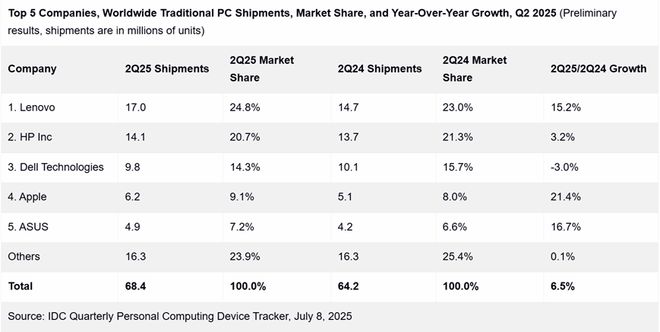
Core Insights - The global PC shipments are projected to grow by 6.5% year-on-year in Q2 2025, reaching 68.4 million units [1][2] - Lenovo maintains its leading position with a shipment of 17 million units and a market share of 24.8%, showing a year-on-year growth of 15.2% [1][2] - The U.S. PC market is experiencing a slowdown due to the impact of import tariffs, while other regions show strong demand driven by device upgrades and the transition to Windows 11 [1][2][5] Company Summaries - **Lenovo**: - Q2 2025 shipments: 17 million units - Market share: 24.8% - Year-on-year growth: 15.2% [2] - **HP Inc**: - Q2 2025 shipments: 14.1 million units - Market share: 20.7% - Year-on-year growth: 3.2% [2] - **Dell Technologies**: - Q2 2025 shipments: 9.8 million units - Market share: 14.3% - Year-on-year decline: -3.0% [2] - **Apple**: - Q2 2025 shipments: 6.2 million units - Market share: 9.1% - Year-on-year growth: 21.4% [2] - **ASUS**: - Q2 2025 shipments: 4.9 million units - Market share: 7.2% - Year-on-year growth: 16.7% [2] Industry Trends - The overall PC market is facing challenges due to high inventory levels and uncertain demand outlook for Q3 and beyond [5] - The anticipated end of support for Windows 10 in October 2025 may drive further demand for PC upgrades [3] - Strong demand in regions outside the U.S. is primarily driven by aging devices and the transition to newer operating systems [1][5]
7月9日电,华硕6月销售额685.7亿元台币,同比增长17.3%。
news flash· 2025-07-09 07:28
智通财经7月9日电,华硕6月销售额685.7亿元台币,同比增长17.3%。 ...
不惧关税风险!联想二季度PC出货量同比增长15.2% 市占率再创历史新高
智通财经网· 2025-07-09 05:22
Core Insights - The global personal computer (PC) shipments continued to grow in Q2 2025, reaching 68.4 million units, a year-over-year increase of 6.5% [1][2] - Lenovo maintained its position as the market leader with a 24.8% market share, achieving a shipment volume of 17 million units, which is a 15.2% increase compared to the same period last year [1][2][3] Company Performance - Lenovo's shipment growth rate of 15.2% significantly outpaced the overall market growth, showcasing its strong competitive position and brand influence [3] - In contrast, HP and Dell experienced modest growth and declines, with HP's shipments increasing by only 3.2% and Dell's shipments decreasing by 3.0% [2][3] Market Dynamics - The demand for PCs remains robust globally, supported by the upgrade of old devices and the transition to Windows 11, despite challenges in the U.S. market due to tariff policies [2][3] - Lenovo's effective product innovation, marketing strategies, and supply chain management have contributed to its leading position in the global PC market [3][4] Supply Chain and Global Strategy - Lenovo has established a flexible global supply chain that allows for timely market responses and product delivery, ranking 8th in the Gartner Top 25 global supply chain list [4] - The company's global strategy focuses on an end-to-end business model and a "China + N" manufacturing layout, enabling it to mitigate tariff impacts while serving over 180 countries [6] Commitment to Market Leadership - Lenovo's commitment to maintaining its market share and profitability is evident in its performance in the first half of 2025, aligning with CEO Yang Yuanqing's promise made in May [6]
亚马逊(AMZN.US)Prime日有望点燃238亿美元消费浪潮,移动端占比将创历史新高
智通财经网· 2025-07-08 02:47
Group 1 - Amazon's Prime Day is expected to generate record online sales of $23.8 billion from July 8 to 11, representing a 28.4% increase compared to last year [1] - Mobile shopping is projected to reach an all-time high, contributing $12.5 billion in sales, which accounts for 52.5% of total online sales [1] - Over 200 million Prime members participated in the event, with independent sellers selling over 200 million items, primarily from small and medium-sized enterprises [1] Group 2 - Amazon will offer millions of exclusive deals across more than 35 categories, including electronics, apparel, beauty, and home goods [2] - Historical data indicates that Amazon's stock price averages a 2% increase in the week following Prime Day, with a cumulative rise of over 4% in the six weeks after the event [2]
