
大成基金

Search documents
联动科技股价跌5.02%,大成基金旗下1只基金重仓,持有21.88万股浮亏损失100.43万元
Xin Lang Cai Jing· 2025-11-11 02:12
Group 1 - The core point of the news is that LianDong Technology's stock price has dropped by 5.02%, currently trading at 86.86 CNY per share, with a total market capitalization of 6.13 billion CNY [1] - LianDong Technology, established on December 7, 1998, specializes in the research, production, and sales of equipment for the semiconductor industry's backend packaging and testing [1] - The company's main revenue sources include 86.15% from semiconductor automated testing systems, 10.24% from semiconductor laser marking equipment and other electromechanical integration equipment, and 3.61% from parts, maintenance, and other technical services [1] Group 2 - According to data, Dachen Fund has a significant holding in LianDong Technology, with the Dachen CSI 360 Internet+ Index A fund holding 218,800 shares, representing 1.11% of the fund's net value [2] - The Dachen CSI 360 Internet+ Index A fund has a total scale of 788 million CNY and has achieved a return of 39.8% this year, ranking 1170 out of 4216 in its category [2] - The fund manager, Xia Gao, has been in position for 10 years and 344 days, with the best fund return during this period being 227.83% [3]
明星基金经理被指“躲牛,大成基金权益业务牛市“水土不服”
凤凰网财经· 2025-11-10 13:40
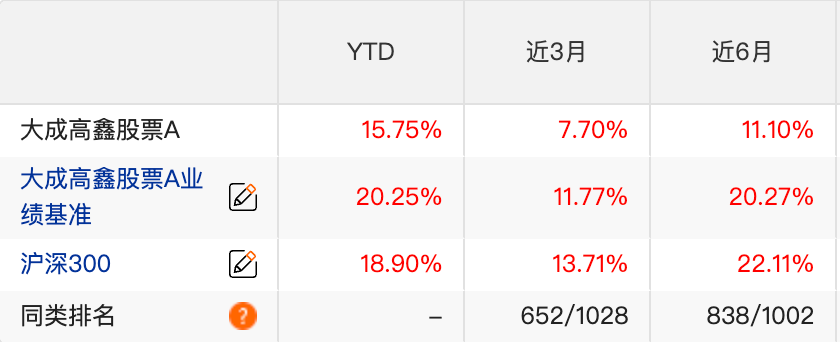
Core Viewpoint - Dachen Fund has struggled to adapt to the current bull market, resulting in underperformance of its equity products compared to the market average, highlighting issues in its investment strategy and execution [3][4][8]. Group 1: Performance Analysis - Dachen Fund's flagship product, Dachen Gaoxin Stock, has shown a decline in performance, with year-to-date returns of 15.75%, trailing behind its benchmark and the CSI 300 index [5][6]. - The fund's management scale decreased from 123.64 billion to 114.53 billion yuan, indicating a loss of investor confidence [6]. - Other Dachen equity products, such as Dachen Rui Xiang Mixed A and Dachen Strategy Return Mixed A, also underperformed relative to the CSI 300 index [6][7]. Group 2: Investment Strategy Issues - Dachen Fund's conservative investment approach, which worked well during bear markets, has led to missed opportunities in the current growth-driven market [8][9]. - The fund's portfolio has been heavily weighted towards value stocks and large-cap stocks, limiting its ability to capitalize on the tech and growth sectors that are currently leading the market [8][9]. - The fund's products have been criticized for style drift, where funds marketed as "growth" or "new" are actually concentrated in traditional value stocks, potentially misleading investors [9]. Group 3: Management and Operational Challenges - Dachen Fund's slow response to market changes has been evident in its delayed investment decisions, with significant cash holdings in newly launched funds [10][11]. - The Dachen Xingyuan Qihang Mixed Fund had an 84% cash position shortly after its launch, missing critical market gains during the early months [10][11]. - High turnover rates in the fund's portfolio have increased trading costs without resulting in improved performance, indicating a reactive rather than proactive management style [14][15]. Group 4: Future Outlook - Dachen Fund's current challenges may serve as a case study for traditional public fund institutions facing transformation difficulties in a changing market environment [16].

明星基金经理被指“躲牛”,大成基金权益业务牛市“水土不服”
Feng Huang Wang Cai Jing· 2025-11-10 13:01
Core Viewpoint - Dachen Fund, once a leader in defensive strategies during the bear market of 2023-2024, has struggled to adapt to the current structural bull market, resulting in poor performance and significant criticism from investors [1][3][8]. Performance Analysis - Dachen Fund achieved a 7.99% absolute return in active equity during the bear market, ranking first among 24 large and medium-sized public funds [3]. - As of September 2025, Dachen Fund's active equity returns have dropped to second-to-last among peers, with several flagship products showing negative performance [3][4]. - The Dachen Gao Xin Stock Fund, the largest equity fund under Dachen, has seen a cumulative return of 423.11% since its inception in 2015, but has underperformed the market since Q3 2024 [3][4]. Fund Management Issues - Dachen Fund's conservative investment style, which focused on value stocks, has led to missed opportunities in the growth sectors that dominated the market in 2025 [8][9]. - Fund managers have been criticized for their slow response to market changes, with significant cash holdings delaying stock purchases [11]. - The Dachen Xingyuan Qihang Mixed Fund, launched in March 2025, had an 84% cash position three months post-launch, resulting in poor performance compared to benchmarks [11][12]. Trading Activity - Dachen Fund has experienced a dramatic increase in turnover rates, indicating a reactive rather than proactive approach to market conditions [14]. - The turnover rate for Dachen Industry Pioneer Mixed Fund surged from 520% to 1847%, significantly higher than the market average [14]. - Despite high turnover, performance has not improved, with the Dachen Industry Pioneer showing negative returns over the past year [15]. Strategic Recommendations - To address its current challenges, Dachen Fund needs to rethink its investment strategies and adapt to changing market conditions, moving away from rigid investment styles [15][16]. - A focus on restructuring its research and investment decision-making processes may be essential for long-term recovery and competitiveness in the public fund industry [15][16].
创业板50指数ETF今日合计成交额26.13亿元,环比增加43.11%
Zheng Quan Shi Bao Wang· 2025-11-10 08:28
Core Insights - The total trading volume of the ChiNext 50 Index ETF reached 2.613 billion yuan today, an increase of 787 million yuan from the previous trading day, representing a growth rate of 43.11% [1] Trading Volume Summary - The Huazhang ChiNext 50 ETF (159949) had a trading volume of 1.942 billion yuan today, up 651 million yuan from the previous day, with a growth rate of 50.40% [1] - The Chuang 50 ETF (159681) recorded a trading volume of 253 million yuan, an increase of 73.19 million yuan, with a growth rate of 40.66% [1] - The Invesco Great Wall ChiNext 50 ETF (159682) saw a trading volume of 311 million yuan, up 42.13 million yuan, with a growth rate of 15.65% [1] - The Wanji ChiNext 50 ETF (159372) and the Huatai-PB ChiNext 50 ETF (159383) had significant increases in trading volume, with growth rates of 192.76% and 102.12% respectively [1] Market Performance Summary - As of market close, the ChiNext 50 Index (399673) fell by 1.30%, while the average decline for related ETFs was 1.34% [1] - The Chuang 50 ETF ICBC (159370) and the Huazhang ChiNext 50 ETF (159949) experienced the largest declines, with drops of 1.55% and 1.51% respectively [1]

基金量化观察:港股通 ETF 持续申报,金融地产主题基金业绩占优
SINOLINK SECURITIES· 2025-11-10 02:58
- The report mentions the construction of enhanced strategy ETFs, which are based on indices such as CSI 300, CSI 500, CSI 1000, SSE STAR 50, and others. These ETFs aim to outperform their respective benchmarks through quantitative strategies and factor-based enhancements [23][24][35] - The construction process involves selecting stocks from the underlying index and applying quantitative models to optimize the portfolio. The models may include factor analysis, risk control, and return enhancement techniques. Specific formulas or methodologies are not detailed in the report [23][24][35] - Evaluation of enhanced strategy ETFs indicates that 18 out of 51 ETFs outperformed their benchmarks last week. Over the past year, 30 out of 33 ETFs achieved positive excess returns, showcasing the effectiveness of the strategy [23][24][35] - Testing results for enhanced strategy ETFs show varying excess returns. For example, the CSI 300 Enhanced ETF achieved a weekly excess return of 0.64%, while the CSI 500 Enhanced ETF achieved 1.42%. Over the past year, the CSI 1000 Enhanced ETF delivered an excess return of 28.67%, and the Guozheng 2000 Enhanced ETF achieved 33.35% [24][35][36]
两市ETF两融余额减少26.7亿元丨ETF融资融券日报
2 1 Shi Ji Jing Ji Bao Dao· 2025-11-10 02:22
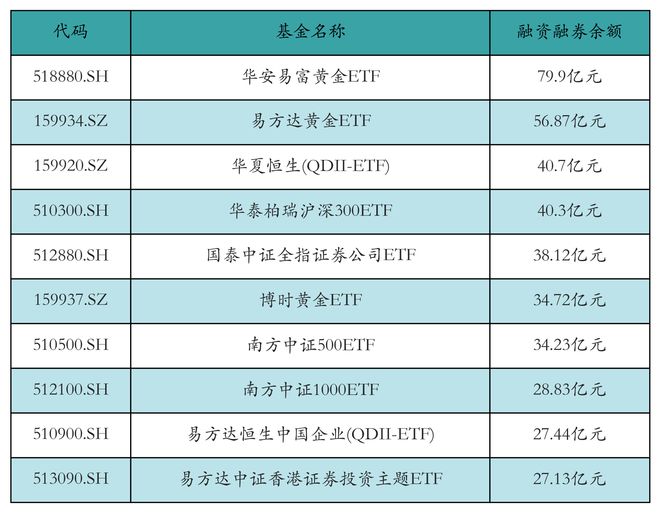
Market Overview - As of November 7, the total ETF margin balance in the two markets is 118.109 billion, a decrease of 2.67 billion from the previous trading day [1] - The financing balance is 109.725 billion, down by 2.626 billion, while the securities lending balance is 8.384 billion, a decrease of 43.779 million [1] - In the Shanghai market, the ETF margin balance is 82.395 billion, down by 2.291 billion, with a financing balance of 74.998 billion, decreasing by 2.25 billion [1] - In the Shenzhen market, the ETF margin balance is 35.714 billion, down by 379 million, with a financing balance of 34.727 billion, decreasing by 376 million [1] ETF Margin Balance - The top three ETFs by margin balance on November 7 are: - Huaan Yifu Gold ETF (7.99 billion) - E Fund Gold ETF (5.687 billion) - Huaxia Hang Seng (QDII-ETF) (4.07 billion) [2] - The detailed top 10 ETFs by margin balance include various funds, with the Huaan Yifu Gold ETF leading [2] ETF Financing Buy Amount - The top three ETFs by financing buy amount on November 7 are: - Haifutong CSI Short Bond ETF (1.147 billion) - Bosera CSI Convertible Bonds and Exchangeable Bonds ETF (920 million) - Huatai-PineBridge Southbound Hang Seng Technology Index (QDII-ETF) (875 million) [3][4] ETF Financing Net Buy Amount - The top three ETFs by financing net buy amount on November 7 are: - Huaxia Hang Seng Internet Technology Industry (QDII-ETF) (87.3478 million) - Penghua CSI Subdivided Chemical Industry Theme ETF (72.7372 million) - Dacheng Hang Seng Technology (QDII-ETF) (60.0607 million) [5][6] ETF Securities Lending Sell Amount - The top three ETFs by securities lending sell amount on November 7 are: - Huatai-PineBridge CSI 300 ETF (30.8381 million) - Southern CSI 1000 ETF (16.3727 million) - Southern CSI 500 ETF (12.1994 million) [7][8]
久盛电气股价跌5.01%,大成基金旗下1只基金位居十大流通股东,持有90.59万股浮亏损失96.93万元
Xin Lang Cai Jing· 2025-11-10 02:21
Group 1 - The core point of the news is that Jiusheng Electric experienced a decline of 5.01% in its stock price, reaching 20.28 CNY per share, with a trading volume of 263 million CNY and a turnover rate of 6.14%, resulting in a total market capitalization of 4.59 billion CNY [1] - Jiusheng Electric, established on May 19, 2004, and listed on October 27, 2021, is located in Huzhou, Zhejiang Province, and specializes in the research, production, sales, and service of fire-resistant special cables and power cables [1] - The revenue composition of Jiusheng Electric includes: plastic insulated cables (44.51%), inorganic mineral insulated metal sheath cables (19.56%), power cables (18.88%), mineral insulated cables (12.48%), and others (4.57%) [1] Group 2 - Among the top ten circulating shareholders of Jiusheng Electric, a fund under Dacheng Fund has entered the list, specifically the Dacheng CSI 360 Internet + Index A (002236), which holds 905,900 shares, accounting for 0.43% of the circulating shares [2] - The Dacheng CSI 360 Internet + Index A fund was established on February 3, 2016, with a latest scale of 788 million CNY, and has achieved a return of 39% this year, ranking 1249 out of 4216 in its category [2] - The fund has a one-year return of 40.96%, ranking 612 out of 3917, and a cumulative return since inception of 227.83% [2]
216只ETF获融资净买入 华夏恒生互联网科技业ETF居首
Zheng Quan Shi Bao Wang· 2025-11-10 01:47
Core Viewpoint - As of November 7, the total margin balance for ETFs in the Shanghai and Shenzhen markets is 118.109 billion yuan, showing a decrease of 2.67 billion yuan from the previous trading day [1] Summary by Category ETF Margin Balance - The ETF financing balance is 109.725 billion yuan, down by 2.626 billion yuan from the previous trading day [1] - The ETF margin short balance is 8.384 billion yuan, decreasing by 0.044 billion yuan compared to the previous trading day [1] Net Inflows - On November 7, 216 ETFs experienced net financing inflows, with the top inflow being the Huaxia Hang Seng Internet Technology ETF, which saw a net inflow of 87.3479 million yuan [1] - Other ETFs with significant net inflows include the Penghua CSI Subdivision Chemical Industry Theme ETF, the Da Cheng Hang Seng Technology ETF, the E Fund CSI Overseas Internet ETF, the Huatai-PineBridge CSI Photovoltaic Industry ETF, and the Fortune CSI Hong Kong Stock Connect Internet ETF [1]
金融产品每周见:消费行业基金:从投资能力分析到基金经理画像-20251107
Shenwan Hongyuan Securities· 2025-11-07 15:30
1. Report Industry Investment Rating No relevant content provided. 2. Core Views of the Report - Based on fund holdings, consumption - related funds can be classified into five types, with most fund managers adopting the "segmented track (mainly liquor)" strategy [3]. - Consumption - related funds can generate relatively stable excess returns in the long - term compared to the sector index, are relatively good at stock - picking in certain industries, and it's difficult to identify their stock - picking ability for consumer stocks compared to all - industry funds [3]. - When comparing consumption - related funds with different style characteristics from seven dimensions, high turnover may lead to high returns recently, high - ROE style funds usually have high dividend attributes, etc. [3]. - To screen the observation list of consumption - related funds, quantitative indicators such as excess performance momentum, performance in favorable and unfavorable environments, stock - picking ability, etc. can be referred to [3]. 3. Summary According to the Directory 3.1 Classification of Consumption - Related Funds - The classification method is based on the fund's full - position data and heavy - position stock data in a certain sector. For consumption funds, some Hong Kong stocks are additionally included. Most of the top 10 consumption - related funds in terms of scale have some commonalities in allocation [6]. - Consumption - related funds are classified into five types: consumption + satellite, sector rotation, segmented track, consumption rotation, and consumption equilibrium, with "segmented track (mainly liquor)" being the most commonly adopted strategy [3]. 3.2 Holding Characteristics: Can Consumption - Related Funds Create Positive Excess Returns? - As a whole, consumption - related funds have similar performance to the consumption sector index before 2025, and have achieved certain excess returns compared to the index since this year [22]. - Consumption - related funds are relatively good at stock - picking in industries such as household appliances, textile and apparel, agriculture, forestry, animal husbandry and fishery, etc., and have prominent excess returns in some industries during certain periods [23][26]. - It's difficult to determine whether consumption - related fund managers have stronger stock - picking ability for consumer stocks compared to all - industry funds [28]. - Consumption - related funds prefer to allocate liquor in food and beverage, and their individual - stock allocation is relatively stable. They had positions in new - consumption stocks earlier [36]. - Through cluster analysis, different types of consumption - related funds can be identified, such as those focusing on agriculture, forestry, animal husbandry and fishery, those focusing on liquor investment, etc. [39] 3.3 Comparison of Consumption - Related Funds with Different Style Characteristics - In terms of turnover trading, high - turnover consumption - related funds have better short - term performance recently, and some liquor - themed funds with low turnover have return drag. In the long - term, both high - and low - turnover funds have excellent performers [42][44]. - In terms of holding style, funds with high ROE generally have high dividend attributes. Different segmented tracks have significant differences in market - value styles [48][52]. - In terms of holding popularity, the structure of market - preferred stocks in the consumption sector has changed significantly, and there are excellent performers in various types of products [53]. - In terms of left - and right - side investment, consumption - related funds are generally on the right side of the market median, and there are excellent performers on both sides [59]. - In terms of stock - picking ability, by calculating the skewness, kurtosis, and mean/standard deviation of stock - picking returns, funds with strong stock - picking ability can be found [60][62]. - In terms of adaptability to different market environments, different types of products show different adaptability results, and there are products with strong performance in favorable or unfavorable environments [63][65]. - In terms of segmented - track rotation, there are both products with good and poor rotation effects among consumption - related funds [71]. 3.4 Observation List of Consumption - Related Funds - The screening of the observation list refers to quantitative indicators such as excess performance momentum, performance in favorable and unfavorable environments, stock - picking ability, left - and right - side investment ability, and segmented - track rotation effect. Other factors such as the fund manager's tenure and fund scale are also considered [75]. - The observation list includes funds like E Fund Long - Term Value, Cathay Pacific Consumption Optimization, Changxin Multi - Benefit, etc. [3][76]
天府证券ETF日报-20251107
天府证券· 2025-11-07 09:05
Report Summary 1. Report Industry Investment Rating No relevant content provided. 2. Core View of the Report On November 7, 2025, the A - share market generally declined, with the Shanghai Composite Index down 0.25%, the Shenzhen Component Index down 0.36%, and the ChiNext Index down 0.51%. Different sectors and ETFs showed varying performance [2][6]. 3. Summary by Related Catalogs Market Overview - The Shanghai Composite Index closed at 3997.56 points, down 0.25%; the Shenzhen Component Index closed at 13404.06 points, down 0.36%; the ChiNext Index closed at 3208.21 points, down 0.51%. The trading volume of A - shares in the two markets was 20205 billion yuan [2][6]. - The top - performing industries were basic chemicals (up 2.39%), comprehensive (up 1.45%), and petroleum and petrochemicals (up 1.38%); the worst - performing industries were computer (down 1.83%), electronics (down 1.34%), and household appliances (down 1.17%) [2][6]. Stock ETF - The top - trading - volume stock ETFs included Huaxia CSI A500 ETF (down 0.08%, discount rate - 0.14%), Guotai CSI A500 ETF (down 0.17%, discount rate - 0.18%), and Huatai - Ber瑞 CSI A500 ETF (unchanged, discount rate - 0.05%) [3][7]. - The report also listed the details of the top ten stock ETFs in terms of trading volume, including price, change rate, tracking index change rate, discount rate, trading volume, and latest share reference [8]. Bond ETF - The top - trading - volume bond ETFs were Haifutong CSI Short - Term Financing ETF (unchanged, discount rate 0.00%), Boshi CSI Convertible and Exchangeable Bond ETF (up 0.15%, discount rate - 0.12%), and Huaxia Shanghai Stock Exchange Benchmark Market - Making Treasury Bond ETF (down 0.06%, discount rate 0.01%) [4][9]. - The details of the top five bond ETFs in terms of trading volume were provided, including price, change rate, discount rate, and trading volume [10]. Gold ETF - Gold AU9999 was unchanged, and Shanghai Gold was up 0.31%. The top - trading - volume gold ETFs were Huaan Gold ETF (up 0.43%, discount rate 0.15%), Boshi Gold ETF (up 0.42%, discount rate 0.10%), and E Fund Gold ETF (up 0.42%, discount rate 0.12%) [12]. - The details of several gold ETFs were presented, including price, change rate, trading volume, IOPV, and discount rate [13]. Commodity Futures ETF - Huaxia Feed Soybean Meal Futures ETF was down 0.10%, discount rate 0.07%; Dacheng Non - Ferrous Metals Futures ETF was down 0.28%, discount rate - 0.13%; Jianxin Yisheng Zhengzhou Commodity Exchange Energy and Chemical Futures ETF was down 0.57%, discount rate 0.39% [13][14]. - The details of these commodity futures ETFs were provided, including price, change rate, trading volume, IOPV, discount rate, tracking index, and tracking index change rate [14]. Cross - Border ETF - The previous trading day, the Dow Jones Industrial Average was down 0.84%, the Nasdaq was down 1.90%, the S&P 500 was down 1.12%, and the German DAX was down 1.31%. On this day, the Hang Seng Index was down 0.92%, and the Hang Seng China Enterprises Index was down 0.94% [15]. - The top - trading - volume cross - border ETFs were E Fund CSI Hong Kong Securities Investment Theme ETF (down 1.17%, discount rate - 1.21%), GF CSI Hong Kong Innovative Drug ETF (down 2.22%, discount rate - 1.85%), and Huatai - Ber瑞 Hang Seng Technology ETF (down 1.27%, discount rate - 1.30%) [15]. - The details of the top five cross - border ETFs in terms of trading volume were given, including trading volume, change rate, and discount rate [16]. Currency ETF - The top - trading - volume currency ETFs were Yin Hua Day - to - Day Profit ETF, Hua Bao Tian Yi ETF, and Currency ETF Jian Xin Tian Yi [17][19]. - The trading volumes of the top three currency ETFs were provided [19].