
晋控煤业

Search documents
煤炭开采板块11月18日跌2.38%,郑州煤电领跌,主力资金净流出16.16亿元
Zheng Xing Xing Ye Ri Bao· 2025-11-18 08:11
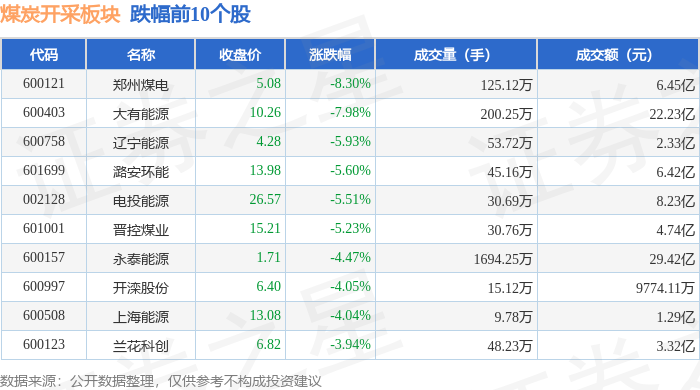
Market Overview - The coal mining sector experienced a decline of 2.38% on November 18, with Zhengzhou Coal Power leading the drop [1] - The Shanghai Composite Index closed at 3939.81, down 0.81%, while the Shenzhen Component Index closed at 13080.49, down 0.92% [1] Individual Stock Performance - Zhengzhou Coal Power (600121) closed at 5.08, down 8.30% with a trading volume of 1.25 million shares and a transaction value of 645 million yuan [1] - Dayou Energy (600403) closed at 10.26, down 7.98% with a trading volume of 2.00 million shares and a transaction value of 2.22 billion yuan [1] - Liaoning Energy (600758) closed at 4.28, down 5.93% with a trading volume of 537,200 shares and a transaction value of 233 million yuan [1] - Other notable declines include Lu'an Environmental Energy (669109) down 5.60%, and Electric Power Investment Energy (002128) down 5.51% [1] Capital Flow Analysis - The coal mining sector saw a net outflow of 1.616 billion yuan from institutional investors, while retail investors contributed a net inflow of 1.356 billion yuan [1] - The table of capital flow indicates that Electric Power Investment Energy (002128) had a net inflow of 27.82 million yuan from institutional investors, despite a net outflow from retail investors [2] - Other companies like Huai Bei Mining (600985) and Gansu Energy Chemical (000552) also showed mixed capital flows, with varying degrees of net inflows and outflows from different investor types [2]


晋控煤业股价跌5.17%,国联基金旗下1只基金重仓,持有115.11万股浮亏损失95.54万元
Xin Lang Cai Jing· 2025-11-18 05:48
Group 1 - The core point of the news is the decline in the stock price of Jinkong Coal Industry, which fell by 5.17% to 15.22 CNY per share, with a trading volume of 302 million CNY and a turnover rate of 1.16%, resulting in a total market capitalization of 25.474 billion CNY [1] - Jinkong Coal Industry, established on July 25, 2001, and listed on June 23, 2006, is primarily engaged in coal mining, washing, processing, and sales, with coal accounting for 94.00% of its main business revenue [1] - The company also generates revenue from coal by-products (3.26%), transportation services (1.63%), and other sources (1.11%) [1] Group 2 - From the perspective of fund holdings, Guolian Fund has one fund heavily invested in Jinkong Coal Industry, specifically Guolian Coal A (168204), which reduced its holdings by 82,100 shares in the third quarter, now holding 1.1511 million shares, representing 3.82% of the fund's net value [2] - The estimated floating loss for Guolian Coal A today is approximately 955,400 CNY [2] - Guolian Coal A was established on January 1, 2021, with a current scale of 291 million CNY, achieving a year-to-date return of 10.19% and a one-year return of 7.6% [2] Group 3 - The fund managers of Guolian Coal A are Chen Xinyu and Du Chao, with Chen having a tenure of 6 years and 112 days, managing assets totaling 1.211 billion CNY, and achieving a best return of 68.84% during his tenure [3] - Du Chao has a tenure of 2 years and 31 days, managing assets of 1.967 billion CNY, with a best return of 55.81% during his management period [3]
晋控煤业股价跌5.17%,博时基金旗下1只基金重仓,持有4.61万股浮亏损失3.83万元
Xin Lang Cai Jing· 2025-11-18 05:48
Group 1 - The core point of the news is the decline in the stock price of Jinko Coal Industry, which fell by 5.17% to 15.22 CNY per share, with a trading volume of 302 million CNY and a turnover rate of 1.16%, resulting in a total market capitalization of 25.474 billion CNY [1] - Jinko Coal Industry, officially known as Shanxi Coal Industry Co., Ltd., was established on July 25, 2001, and listed on June 23, 2006. The company is primarily engaged in coal mining, washing, processing, and sales, with coal accounting for 94.00% of its main business revenue [1] - The revenue composition of Jinko Coal Industry includes 94.00% from coal, 3.26% from coal by-products, 1.63% from transportation services, and 1.11% from other sources [1] Group 2 - From the perspective of fund holdings, one fund under Bosera Fund has a significant position in Jinko Coal Industry. Bosera Xintai Mixed A (004175) held 46,100 shares in the second quarter, representing 1.31% of the fund's net value, making it the largest holding [2] - The estimated floating loss for Bosera Xintai Mixed A (004175) today is approximately 38,300 CNY. The fund was established on December 29, 2016, with a latest scale of 3.2026 million CNY [2] - Year-to-date, Bosera Xintai Mixed A (004175) has reported a loss of 0.35%, ranking 8105 out of 8193 in its category, while its one-year return is 3.27%, ranking 7699 out of 7977. Since its inception, the fund has achieved a return of 100.61% [2]
煤炭月度供需数据点评:10月:火电增速逆势向上,煤价上涨超预期-20251118
Shanxi Securities· 2025-11-18 05:42
Investment Rating - The report maintains an investment rating of "Leading the Market" for the coal industry, indicating an expected price increase exceeding the benchmark index by more than 10% [6][39]. Core Insights - In October, thermal power demand increased against the trend, leading to an unexpected rise in coal prices. The supply of raw coal showed a marginal decrease, with cumulative production from January to October reaching 3.973 billion tons, a year-on-year increase of 1.5%, but with a declining growth rate [5][6]. - The report highlights that while fixed asset investment decreased by 1.7% year-on-year in the first ten months of 2025, thermal power demand saw a notable increase of 7.3% in October, contrasting with declines in other sectors such as real estate [5][6]. - Coal imports showed a downward trend, with cumulative imports from January to October at 388 million tons, a year-on-year decrease of 11%. In October alone, imports were 41.74 million tons, down 9.76% year-on-year [5][6]. - The report emphasizes that coal prices in October rose unexpectedly, driven by increased demand from downstream power plants and a reduction in inventory at ports. The report suggests that if coal prices continue to rise significantly, it may attract policy attention [6][7]. Summary by Sections Supply - From January to October 2025, raw coal supply showed a marginal decrease, with October production at 407 million tons, down 2.3% year-on-year and 1.16% month-on-month [5][6]. Demand - The demand for thermal power increased by 7.3% in October, while cumulative demand for fixed asset investment showed a decline of 1.7% year-on-year. Other sectors like real estate and cement experienced significant declines [5][6]. Imports - Coal imports decreased, with a cumulative total of 388 million tons from January to October, reflecting an 11% year-on-year drop. October imports were 41.74 million tons, down 9.76% year-on-year [5][6]. Prices - Coal prices saw an unexpected rise in October, with various types of coal showing different price trends. The report notes that the price increase is supported by strong demand and reduced supply expectations [6][7]. Investment Recommendations - The report suggests a positive outlook for the coal sector in the fourth quarter, with specific stocks recommended for investment based on their performance and market conditions [6][7].
——煤炭行业周报(2025.11.8-2025.11.14):安监、环保检查下,产量预期偏紧,取暖季煤价预计上涨-20251117
Shenwan Hongyuan Securities· 2025-11-17 12:02
Investment Rating - The report maintains a positive outlook on the coal industry, suggesting a "Buy" rating for specific stocks based on their performance relative to the market [3][29]. Core Insights - The report highlights that the coal prices are expected to rise due to supply constraints and seasonal demand, particularly in the context of winter heating needs [3][4]. - It emphasizes the impact of environmental regulations and safety inspections on coal production, which are likely to tighten supply further [3][7]. - The report identifies several companies as potential investment opportunities, including Jin控煤业, 华阳股份, and 山煤国际, based on their price elasticity and valuation [3][4]. Summary by Sections 1. Recent Industry Policies and Dynamics - The report discusses the initiation of the third round of central ecological environment protection inspections, which will affect major coal-producing regions and companies [7]. - It mentions the State Energy Administration's guidance on integrating coal with renewable energy, focusing on low-carbon transitions and new energy developments in mining areas [7]. 2. Price Trends of Coal - The report notes fluctuations in domestic coal prices, with specific increases in certain regions, such as a rise of 10 CNY/ton in Dazhou and Ordos [8]. - The overall coal price index in the Bohai Rim region has increased by 4 CNY/ton, indicating a general upward trend in coal prices [8]. 3. International Oil Prices - Brent crude oil prices have risen by 1.19% to 64.39 USD/barrel, which may influence coal prices due to the relationship between oil and coal markets [14]. 4. Port Inventory Trends - The report indicates an increase in coal inventory at the Bohai Rim ports, with a total of 24.3 million tons, reflecting a 2.56% rise week-on-week [18]. 5. Domestic and International Freight Rates - Domestic coastal shipping rates have increased slightly, with an average of 51.52 CNY/ton, while international shipping rates from Australia to China have also seen a rise [23]. 6. Key Company Valuation Table - The report provides a detailed valuation table for key companies in the coal sector, highlighting their stock prices, market capitalization, and earnings projections [28].




2026年煤炭行业投资策略:资源民族主义觉醒,高估的煤炭供给
Shenwan Hongyuan Securities· 2025-11-17 09:41
Investment Strategy Overview - The report highlights the resurgence of resource nationalism driven by de-globalization, emphasizing coal's strategic importance for national energy security. Major coal-producing countries like Indonesia, Mongolia, and the USA are tightening control over coal resources, integrating them into national strategies to bolster energy independence and support domestic industrial and power needs [3][4][5]. Supply Side Analysis - The coal industry is undergoing a significant restructuring, with safety and environmental regulations leading to a more rational supply order. The release of production capacity is expected to be steady but cautious, promoting high-quality development in the coal sector [3][4]. - Domestic supply costs are rising, and coal imports are tightening marginally due to increased scrutiny and regulations [4][32]. Demand Side Analysis - The report anticipates a stable and slight increase in overall coal demand, driven by the rigid growth in electricity consumption and the irreplaceable role of coal in peak regulation and energy security. The expected price range for thermal coal in 2026 is projected to be between 750-800 RMB per ton [3][4][29]. - The resilience of coal power generation is highlighted, particularly in the context of fluctuating renewable energy output, indicating that coal will continue to play a crucial role in the energy mix [3][4]. Investment Recommendations - The report recommends investing in stable, high-dividend companies such as China Shenhua, Shaanxi Coal and Chemical Industry, and China Coal Energy. It also suggests paying attention to companies with price elasticity like Jinkong Coal Industry, Huayang Co., Tebian Electric Apparatus, and Shanxi Coal International [3][4]. - Growth-oriented companies in coal-electricity joint ventures, such as Xinji Energy, are also recommended for consideration [3][4]. Regional Insights - Indonesia's coal production is expected to decline in 2025 due to new resource tax regulations, which will increase export costs and support domestic coal prices [11][12]. - Mongolia's coal production and sales are affected by ongoing political instability, impacting the stability of coal imports [17][18]. - The USA is implementing favorable policies to revitalize its coal industry, including reducing royalty rates and increasing federal land available for coal exploration [21][22]. Future Capacity and Production Trends - Future coal production capacity is expected to be limited, with only about 67 million tons of new capacity projected over the next three years. The focus is shifting towards regions like Xinjiang, which has significant coal reserves and favorable mining conditions [61][67]. - The report notes that the overall coal production in China is unlikely to see significant growth in 2026 due to ongoing safety inspections and regulatory measures [51][53].




开源证券:动力煤正在经历价格上穿过程 煤价逻辑逐一兑现
Zhi Tong Cai Jing· 2025-11-17 07:13
Core Viewpoint - The report from Kaiyuan Securities indicates that the price of thermal coal has been rising, driven by supply constraints and increased demand due to seasonal factors, marking a potential turning point for the coal sector [1][2]. Thermal Coal Market - As of November 14, the Qinhuangdao Q5500 thermal coal price is 834 CNY/ton, showing a slight increase, while the Guangzhou port price has reached 880 CNY, surpassing the target of 750 CNY for coal-electricity profit sharing [1][2]. - The recent price increase is attributed to supply reductions from strict production checks post-National Day and a surge in demand due to cold weather in northern regions [1][2]. Coking Coal Market - The price of coking coal at Jingtang Port is 1860 CNY/ton, rebounding from a low of 1230 CNY in July, with coking coal futures rising from 719 CNY to 1192 CNY, a cumulative increase of 65.79% [2][3]. - The price of coking coal is closely linked to thermal coal prices, with a significant price ratio of 2.4 times, indicating a predictable price movement based on thermal coal trends [3]. Investment Recommendations - The coal sector is characterized by dual logic: cyclical elasticity and stable dividends. Current prices for thermal and coking coal are at historical lows, providing room for rebound [4]. - The supply-side policies aimed at curbing overproduction and the seasonal demand for heating are expected to improve the coal supply-demand fundamentals [4]. - Several coal companies are maintaining high dividend payouts, with six listed coal companies announcing interim dividend plans [4]. Selected Coal Stocks - Key stocks benefiting from the cyclical logic include Jinko Coal Industry (601001.SH) and Yanzhou Coal Mining (600188.SH) for thermal coal, and Pingmei Shenma (601699.SH) and Huabei Mining (600985.SH) for metallurgical coal [5]. - Dividend-focused stocks include China Shenhua (601088.SH) and Zhongmei Energy (601898.SH), while diversified and growth-oriented stocks include Shenhuo Co. (000933.SZ) and Xinji Energy (601918.SH) [5].
华源证券:煤炭Q3政策支撑下企稳回升 冬季煤价有望保持强势
智通财经网· 2025-11-17 03:29
Core Viewpoint - The coal sector is expected to stabilize and rebound in prices due to the "check overproduction" policy, benefiting thermal coal companies through improved long-term contract performance and coal-electricity integration, while coking coal companies face pressure due to lagging contract pricing [1][7]. Group 1: Financial Performance - In Q3 2025, the coal sector saw a positive revenue growth, with thermal coal companies experiencing a better net profit growth compared to coking coal companies [1]. - The price of Qinhuangdao 5500 kcal thermal coal increased from 621 CNY/ton on June 30, 2025, to 699 CNY/ton on September 30, 2025, marking a cumulative increase of 12.6% in Q3 [1]. - The overall performance of the coal industry is expected to continue improving due to increased heating demand and tight supply-side policies in Q4 [1][6]. Group 2: Production and Sales - The "check overproduction" policy in Q3 2025 led to stable production among leading thermal coal companies, while coking coal production saw a noticeable decline [2]. - Most listed coal companies did not significantly reduce their output in Q3, with some midstream companies experiencing high sales growth and accelerated inventory reduction due to improved supply-demand dynamics [2]. Group 3: Pricing Dynamics - In Q3 2025, the self-produced coal prices decreased year-on-year by 10% to 20%, while the sales prices of coal companies showed narrow fluctuations or slight increases, with most increases being less than 10% [3]. - The lag in price transmission from market coal prices to listed companies' sales prices is attributed to long-term contract pricing mechanisms and order delivery cycles [3]. Group 4: Cost Management - In H1 2025, coal companies shifted their strategies from volume-based to cost control, which became crucial in facing low coal prices and high inventory levels [4]. - Leading thermal coal companies maintained cost control in Q3 2025, achieving a decrease in unit costs, while some coking coal companies experienced an increase in unit sales costs, negatively impacting their performance [4]. Group 5: Future Outlook - The combination of stable production, rising prices, and cost reductions for thermal coal companies is expected to lead to improved profitability, while coking coal companies may see significant price rebounds in Q4 as long-term contracts adjust to higher market prices [5]. - The coal market is currently in a phase of tightening supply and increasing demand, with winter coal prices expected to remain strong due to seasonal heating needs and ongoing supply-side policies [7]. Group 6: Investment Recommendations - The report suggests actively monitoring robust thermal coal companies such as China Shenhua, China Coal Energy, and Shaanxi Coal and Chemical Industry, as well as high-elasticity coal companies like Yanzhou Coal Mining, Jincheng Anthracite Mining, and Shanxi Coal International [8].
晋控煤业涨2.01%,成交额1.35亿元,主力资金净流入110.95万元
Xin Lang Zheng Quan· 2025-11-17 02:33
Core Viewpoint - Jin Energy Holdings Co., Ltd. has experienced fluctuations in stock performance, with a year-to-date increase of 25.51% but a recent decline in the last five trading days by 2.11% [1][2] Financial Performance - For the period from January to September 2025, Jin Energy reported a revenue of 9.325 billion yuan, a year-on-year decrease of 16.99%, and a net profit attributable to shareholders of 1.277 billion yuan, down 40.65% year-on-year [2] - The company has distributed a total of 6.083 billion yuan in dividends since its A-share listing, with 3.640 billion yuan distributed over the past three years [2] Stock Market Activity - As of November 17, the stock price of Jin Energy was 16.21 yuan per share, with a market capitalization of 27.131 billion yuan [1] - The stock has seen a trading volume of 135 million yuan and a turnover rate of 0.50% on the same day [1] - The net inflow of main funds was 1.1095 million yuan, with significant buying and selling activity from large orders [1] Shareholder Structure - As of October 20, the number of shareholders increased to 58,000, with an average of 28,856 circulating shares per person, a decrease of 4.40% [2] - The second-largest circulating shareholder is the Guotai CSI Coal ETF, holding 33.2232 million shares, an increase of 2.024 million shares from the previous period [2]
10月煤炭行业数据解读
2025-11-16 15:36
10 月煤炭行业数据解读 20251116 摘要 近期煤价调整旨在修复坑口与港口倒挂现象,并非全面下跌,而是部分 煤矿生产经营节奏变化,前期上涨后的消化过程,整体趋势未变。 海外动力煤价格上涨,但 10 月进口量未明显上升,因 9 月订货时无明 显倒挂且正与海外企业商谈长协,短期内大量进口概率不大。 港口及中间环节低库存延续,沿海电厂库存偏低,若天气显著变冷日耗 上升,沿海电厂边际压力可能增加,需关注其采购回升情况。 10 月原煤产量同比和环比均明显下降,四季度难以在去年高基础上实现 增长,多数矿井年底希望平稳收官,不会冒险超产。 10 月火电需求同比大幅增长 7%,预计全年火电消费可维持零或小幅正 增长,水电淡季后火电支柱作用将更明显。 煤炭供需矛盾未缓解,供应端持续收缩,需求端逐渐恢复旺季态势,短 期价格调整是上涨节奏放缓,需求边际回升与供应减量状态未变。 预计 2025 年四季度煤炭价格将表现强劲,市场需求旺盛,价格有望在 需求回升后进一步上涨,年底供应收缩因素较多,短期内煤价上涨概率 较大。 Q&A 国内动力煤库存情况如何? 本周秦皇岛港库存进一步下行,北方九港库存略有恢复但同比仍下降超 10%。 整 ...