
腾景科技

Search documents
腾景科技:目前半导体设备领域的订单充裕。
Xin Lang Cai Jing· 2025-10-28 08:25
Core Viewpoint - The company, Tengjing Technology, is currently experiencing a robust order backlog in the semiconductor equipment sector [1] Group 1: Company Insights - Tengjing Technology is positioned well within the semiconductor equipment industry due to a significant influx of orders [1]

腾景科技:目前半导体设备领域的订单充裕
Mei Ri Jing Ji Xin Wen· 2025-10-28 08:25
Group 1 - The company, Tengjing Technology, has announced its capabilities in complex membrane structure design and high-precision coating processes [1] - The company provides high-performance optical film solutions for clients in the semiconductor equipment sector, contributing to the domestic production process in the industry [1] - Currently, there is a strong order backlog in the semiconductor equipment field, and the company is focused on enhancing its product delivery capabilities [1]
腾景科技股价涨5.75%,财通证券资管旗下1只基金重仓,持有2.09万股浮盈赚取14.24万元
Xin Lang Cai Jing· 2025-10-28 02:05
Core Viewpoint - Tengjing Technology has experienced a significant stock price increase, with a 24.57% rise over the past week, indicating strong market interest and potential investor confidence in the company [1]. Company Overview - Tengjing Technology Co., Ltd. is located in Fuzhou, Fujian Province, and was established on October 12, 2013. The company went public on March 26, 2021. Its main business involves the research, production, and sales of various precision optical components and fiber optic devices [1]. - The revenue composition of Tengjing Technology is as follows: precision optical components account for 78.87%, fiber optic devices for 16.65%, optical testing instruments for 4.43%, and other sources for 0.05% [1]. Fund Holdings - According to data, one fund under Caitong Securities Asset Management has a significant holding in Tengjing Technology. The Caitong Asset Management Stable Prosperity Six-Month Holding Period Mixed A Fund (014625) held 20,900 shares in the second quarter, representing 0.6% of the fund's net value, making it the ninth-largest holding [2]. - The fund has realized a floating profit of approximately 142,400 yuan today, with a total floating profit of 488,900 yuan during the seven-day price increase [2]. Fund Manager Performance - The fund managers of Caitong Asset Management Stable Prosperity Six-Month Holding Period Mixed A Fund are Gong Zhifang and Li Jing. Gong has a cumulative tenure of 8 years and 74 days, managing assets totaling 25.93 billion yuan, with the best fund return during his tenure being 39.79% and the worst being -9.12% [3]. - Li Jing has a cumulative tenure of 3 years and 362 days, managing assets of 230 million yuan, with the best fund return during his tenure being 101.08% and the worst being 9.8% [3].

腾景科技股价涨5.75%,天治基金旗下1只基金重仓,持有3100股浮盈赚取2.12万元
Xin Lang Cai Jing· 2025-10-28 02:03
Group 1 - The core viewpoint of the news is that Tengjing Technology has experienced a significant stock price increase, rising 5.75% on October 28, with a total market capitalization of 16.258 billion yuan and a cumulative increase of 24.57% over the past seven days [1] - Tengjing Technology specializes in the research, production, and sales of precision optical components and fiber optic devices, with its main business revenue composition being 78.87% from precision optical components, 16.65% from fiber optic devices, and 4.43% from optical testing instruments [1] - The stock has seen a trading volume of 3.77 billion yuan and a turnover rate of 2.39% on the reporting date [1] Group 2 - Tianzhi Fund has a significant holding in Tengjing Technology, with the Tianzhi China Manufacturing 2025 Mixed Fund (350005) holding 3,100 shares, representing 2.36% of the fund's net value, ranking as the ninth largest holding [2] - The fund has generated a floating profit of approximately 21,200 yuan today and a total of 72,700 yuan during the seven-day increase [2] - The Tianzhi China Manufacturing 2025 Mixed Fund has a total scale of 15.5074 million yuan and has achieved a year-to-date return of 22.16% [2]
通信行业周报:光模块需求上修,Anthropic与谷歌云达成百亿美元合作协议-20251027
Haitong Securities International· 2025-10-27 09:04
Investment Rating - The report maintains a positive outlook on AI growth and highlights key companies to focus on: ZhongJi InnoLight, Eoptolink Technology, Yuanjie Technology, ZTE, Hui Lyu Ecological Technology Groups Co., Ltd., Shenzhen JPT Opto-Electronics, Ruijie Networks, Aojie Technology, and Unisplendour [1][31]. Core Insights - The demand for optical modules is expected to increase significantly, with a forecast of 20 million units for 1.6T optical modules by 2026 [15][39]. - The communication industry is seen as the foundation of the digital economy, encompassing various sectors such as AI ecosystems, satellite internet, data elements, AIoT, internet of vehicles, and industrial internet [31][39]. - OpenAI's release of the AI browser ChatGPT Atlas is viewed as a significant development in redefining internet usage [6][38]. - Anthropic's agreement with Google Cloud for up to one million TPUs, valued at several billion dollars, indicates strong growth potential in AI infrastructure [10][39]. - The acquisition of a 94% stake in Wuhan Ruijing by Dugen Core is expected to enhance technical synergy in the optoelectronics field [12][39]. Summary by Sections Optical Module Demand - The report revises the demand forecast for 1.6T optical modules upwards, predicting a demand of over 20 million units by 2026, with a significant supply gap anticipated for high-speed optical modules [15][39]. AI and Communication - The report emphasizes the acceleration of AI-related investments and innovations, particularly in GPU capabilities and communication networks, which are crucial for enhancing AI efficiency [31][32]. Company Performance - The report includes a simulated investment portfolio for the communication sector, showing a strong performance with an average increase of 14.95% for selected stocks during the specified period [22][23].



谷歌OCS和产业链详解
2025-10-27 00:31
Summary of Key Points from Google OCS and Industry Chain Analysis Industry Overview - The analysis focuses on the AI and cloud services industry, particularly highlighting Google's advancements in AI technology and its implications for the optical communication market [1][2][3]. Core Insights and Arguments - Google's Gemini series C-end products have exceeded penetration expectations, with enterprise applications such as meeting transcription and code assistance accelerating paid adoption. This has led to sustained high growth in inference demand on a daily, weekly, and monthly basis [1][2]. - Major cloud service providers, including Google, Oracle, Microsoft, and AWS, express confidence in long-term AI growth, increasing investments in GPU, TPU, smart network cards, switches, and high-speed optical interconnects. This indicates a shift towards a stable iterative investment cycle in AI [1][3]. - The demand for optical modules is expected to surge, with projections indicating that the demand for 800G optical modules could reach 45 to 50 million units by 2026, and the demand for 1.6T optical modules has been revised upwards to at least 20 million units, potentially reaching 30 million units under ideal conditions [3][16]. Implications for Optical Communication - AI applications are evolving towards multi-modal integration, necessitating multiple network communications during each intelligent agent upgrade, which enhances the value of optical interconnects. The inference demand requires long connections, high concurrency, and low latency, placing higher demands on optical interconnects within and outside data centers [5][7]. - Google has adopted the OCS solution and Ironwood architecture to reduce link loss and meet performance requirements for large-scale training. The Ironwood architecture allows for interconnection of 9,216 cards, optimizing AI network performance through 3D Torus topology and OCS all-optical interconnects [6][10]. Hardware Requirements - The inference phase emphasizes high-frequency interactions with both C-end and B-end, necessitating higher bandwidth networks compared to the training phase, which focuses more on internal server computations [7][8]. - The performance of Google's TPU V4 architecture is significantly influenced by the number of optical modules used, with each TPU corresponding to approximately 1.5 high-speed optical modules [9][10]. Market Dynamics - The optical module market is experiencing a supply-demand imbalance, which is expected to extend to upstream material segments, including EML chips, silicon photonic chips, and CW light sources. This imbalance is likely to drive growth in upstream industries as demand for optical modules increases [17]. - Key beneficiaries of the demand surge driven by Google include leading manufacturers such as Xuchuang, Newye, and Tianfu, which possess optimal customer structures and strong capacity ramp-up capabilities. Additionally, upstream companies like Yuanjie and Seagull Photon are likely to enhance their production capabilities to meet the growing demand [18]. Additional Important Insights - The OCS solution's cost structure includes significant components such as 2D MEMS arrays valued at approximately $6,000 to $7,000 each, with additional costs for other components like lens arrays and optical fiber arrays [11]. - The liquid crystal solution, while having a higher unit value, is simpler in structure compared to the MEMS solution, which is more mature and cost-effective but may have lower efficiency in practical applications [13][15]. This comprehensive analysis highlights the critical developments in Google's AI initiatives and their broader implications for the optical communication industry, emphasizing the expected growth in demand for optical modules and the strategic responses from key players in the market.

光模块板块重申推荐
2025-10-27 00:31
Summary of Conference Call on Optical Module Sector Industry Overview - The optical module sector is experiencing significant growth, particularly in the North American market, which is outperforming expectations. Domestic leading companies are still undervalued despite their strong performance [1][2] - The AI era is enhancing the technological attributes of optical module companies, leading to faster iteration cycles and a more stable market structure [1][2] Key Companies and Performance - Leading companies such as Xuchuang and NewEase have shown excellent performance, with notable increases in net profit margins and revenue growth [2][3] - The optical module market is expected to see a substantial increase in demand, with predictions of 50 million units needed by 2025 and 100 million by 2027, particularly for 800G and 1.6T modules [1][6] Market Dynamics - The development of CPUs is directly impacting the performance of optical module companies, with varying progress across different regions [4][7] - Traditional electrical switches are being gradually replaced by OCS (Open Compute Switch) switches, which have begun to receive bulk orders [4][9] Demand Drivers - The demand for 1.6T and 800G optical modules is driven by AI inference and training needs, with major tech companies increasing their order requirements [5][6] - The construction of large-scale GPU clusters is enhancing the demand for related hardware, including optical modules and switches [5][10] Valuation and Investment Outlook - Despite significant price increases for leading optical module companies, their valuations remain relatively low, suggesting continued investment potential [10][11] - Recommendations include leading companies in the optical module sector, such as Zhongji Xuchuang and NewEase, as well as upstream companies benefiting from CPU development [11][12] Technological Developments - OCS technology is gaining traction due to its low cost and low power consumption, which is expected to increase its penetration in data center switches [9] - Companies like Google are firmly advancing OCS, and recent orders for related technologies indicate a growing market [9] Conclusion - The optical module sector is poised for growth driven by AI and technological advancements, with leading companies maintaining strong performance and favorable valuations, making them attractive investment opportunities [1][11]
我国芯片领域,取得新突破
2 1 Shi Ji Jing Ji Bao Dao· 2025-10-25 23:35
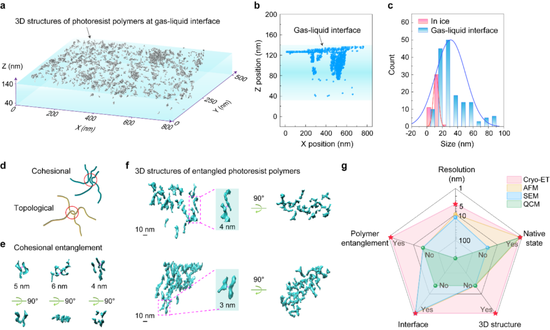
Group 1 - The research team from Peking University has successfully utilized cryo-electron tomography to analyze the micro-3D structure, interfacial distribution, and entanglement behavior of photoresist molecules in a liquid environment, leading to a significant reduction in lithography defects [1][3] - The study addresses three major pain points in the lithography process, particularly the development step, which is crucial for accurately transferring circuit patterns onto silicon wafers [3][4] - The new method allows for in-situ, three-dimensional, high-resolution observation of photoresist behavior, overcoming limitations of traditional techniques [3][4] Group 2 - The implications of this research extend beyond the lithography field, providing a powerful tool for in-situ studies of various chemical reactions occurring in liquid environments, which could enhance defect control and yield improvement in semiconductor manufacturing [4] - The photoresist market in China is projected to grow from approximately 10.92 billion yuan in 2023 to over 11.4 billion yuan in 2024, with expectations to reach 12.3 billion yuan by 2025 [5] - The domestic photolithography machine industry is advancing, but still faces technical limitations compared to international standards, particularly in high-end photolithography technology [6] Group 3 - The domestic supply chain for photolithography machines includes upstream equipment and materials, midstream system integration and production, and downstream applications [6] - Various companies are making strides in specific technology areas related to photolithography, such as laser sources and optical lenses, indicating a growing capability within the industry [7]

我国芯片领域,取得新突破
21世纪经济报道· 2025-10-25 23:31
Core Viewpoint - The research team from Peking University has successfully utilized cryo-electron tomography to analyze the micro-3D structure, interfacial distribution, and entanglement behavior of photoresist molecules in a liquid environment, leading to a significant reduction in lithography defects [1][4]. Group 1: Research Significance - The introduction of cryo-electron tomography in the semiconductor field allows for real-time, high-resolution observation of photoresist behavior in developing solutions, addressing the limitations of traditional methods [4][5]. - This advancement is expected to enhance defect control and yield improvement across various critical manufacturing processes in the chip industry, paving the way for the next generation of more powerful and reliable chips [5]. Group 2: Market Insights - The photoresist market in China is projected to grow from approximately 10.92 billion yuan in 2023 to over 11.4 billion yuan in 2024, with expectations to reach 12.3 billion yuan by 2025, driven by the acceleration of domestic substitution for mid-to-high-end products like KrF photoresists [5]. - Lithography is identified as the most time-consuming and challenging process in integrated circuit manufacturing, accounting for about 50% of the manufacturing time and approximately one-third of production costs [5]. Group 3: Domestic Equipment Development - The domestic lithography machine industry is progressing, although it still faces technological limitations compared to international standards, particularly in high-end lithography machines [7]. - The domestic supply chain for lithography machines includes upstream equipment and materials, midstream system integration and production, and downstream applications [7].

腾景科技:聘任公司证券事务代表
Zheng Quan Ri Bao Wang· 2025-10-24 15:16
Group 1 - The company announced the unanimous decision of its board to appoint Mr. Huang Liancheng as the representative for securities affairs [1]