OPPO

Search documents
拆解粤产八大爆款手机 看顶流机型背后的“四新”力量
2 1 Shi Ji Jing Ji Bao Dao· 2026-01-19 22:39
Core Insights - Guangdong produces one out of every three smartphones sold globally, with major brands like Huawei, vivo, OPPO, Honor, and Transsion leading the market [1] - The evolution of smartphones in Guangdong reflects a microcosm of technological advancement, driven by new technologies, processes, materials, and equipment [1] - The Guangdong smartphone industry benefits from a collaborative ecosystem that supports innovation and maintains its leading position in the market [1] Group 1 - The rapid iteration of smartphones is fueled by advancements in AI, new materials, and manufacturing processes [1] - OPPO's fast-charging technology can fully charge a smartphone battery in just 30 minutes, showcasing innovation in battery technology [1] - Huawei's "Tian Gong hinge" achieves micron-level precision, allowing foldable screens to minimize crease anxiety with a thickness of only 3.6 mm when unfolded [1] Group 2 - Guangdong smartphones are expanding beyond traditional boundaries, creating impressive new use cases [2] - The vivo X300 Pro captures half of the concert rental market with its 200 million pixel telephoto capabilities, demonstrating its professional quality [2] - The Honor YOYO smart assistant enhances user interaction by allowing voice commands to manage subscriptions, representing a shift towards intelligent personal assistants [2] Group 3 - The transformation of the Guangdong smartphone industry reflects a shift from scale advantages to systemic innovation capabilities [2] - The integration of AI enables smartphones to possess sensing, thinking, and responding capabilities, positioning them as intelligent mediators between humans and the digital world [2] - The narrative surrounding these devices transcends mere communication tools, focusing on how technological innovation reshapes human lifestyles [2]
全球每三台手机就有一台广东造 广货“粤来粤强”驶入快车道
Nan Fang Du Shi Bao· 2026-01-19 13:52
Core Viewpoint - The Guangdong smartphone industry is experiencing significant growth and transformation, establishing itself as a global leader in smartphone manufacturing and innovation, with local brands gaining substantial market share both domestically and internationally [1][2][11]. Group 1: Industry Overview - Guangdong is the most important cluster for the smartphone industry in China, leading in scale, production, and export, with a projected revenue of 1.9618 trillion yuan in 2024, accounting for 38.7% of the province's new generation electronic information industry revenue [2]. - In 2024, Guangdong's smartphone production reached 683 million units, representing 40.9% of the national total, while exports amounted to 205 million units, also leading the country [2]. - The smartphone industry in Guangdong has evolved from a manufacturing hub to a global innovation leader, with local brands capturing 38% of the global market share by 2025 [2][12]. Group 2: Brand Performance - Major Guangdong brands like Huawei, OPPO, and vivo dominate both domestic and international markets, with Huawei's global shipment reaching 48.4 million units in 2024, capturing one-third of the high-end market [3]. - OPPO's global shipments reached 104.8 million units in 2024, with its Reno series leading in the $400-$600 price segment [3]. - By 2025, six Guangdong brands are expected to be among the top ten in the global smartphone market, with market shares of 9% for vivo, 8% for Transsion, and 7% for OPPO [2]. Group 3: Global Expansion Strategies - Guangdong smartphone brands are increasingly focusing on international markets, particularly in Southeast Asia and Latin America, leveraging cultural similarities and existing market experiences for efficient penetration [4][5]. - OPPO's gradual global expansion strategy began in Thailand and has since included Indonesia and Vietnam, with plans to enter European markets [5]. - vivo's strategy emphasizes deep localization, establishing a significant retail network in Indonesia and expanding into various regions since 2014 [5]. Group 4: Technological Innovation - Guangdong smartphone companies are at the forefront of technological innovation, with significant investments in R&D, particularly in chip technology and fast charging [11]. - Huawei's self-developed Kirin 9000S chip achieved a 65% self-sufficiency rate in 2024, while OPPO's 125W fast charging technology leads globally in patent numbers [11]. - The rise of AI smartphones, with brands like Huawei and vivo integrating advanced AI capabilities, marks a new era in the industry [12]. Group 5: Manufacturing and Supply Chain - Guangdong's smartphone manufacturing ecosystem is robust, with a high concentration of electronic component manufacturers, accounting for 28% of China's total [7]. - The region's strong supply chain allows for rapid assembly and production, with average production cycles as short as 48 hours in Dongguan [9]. - Major manufacturers like Foxconn and local firms have adopted advanced manufacturing techniques, enhancing efficiency and production capabilities [8][9].

32家企业销售额提升110%!“广货行天下”实现开门红
2 1 Shi Ji Jing Ji Bao Dao· 2026-01-19 13:23
Core Insights - The "Guangdong Goods Going Global" spring campaign has significantly boosted sales in the home appliance sector, with some products experiencing sales increases of over 200% compared to the previous day [1][3][5] Group 1: Sales Performance - The sales of live-streamed products on January 15 saw a year-on-year increase of 202% compared to January 14 [1] - The sales of a multi-functional electric cooker increased by 254% on January 15 compared to January 14 [5] - A total of 32 companies participating in the live-streaming event reported a 110% increase in sales compared to the previous day [5][7] Group 2: Participating Companies - Notable companies such as Midea, Galanz, Hisense, and Bear Electric participated in the campaign, showcasing their latest products and innovations [5][7] - The event featured a diverse range of products, focusing on smart home appliances and health-oriented devices [5] Group 3: Marketing Strategy - The campaign utilized multiple e-commerce platforms, including Douyin, JD.com, and Pinduoduo, to maximize reach and engagement, resulting in over 10 million views on the "Guangdong Goods Going Global" topic [5][9] - Companies reported that consumer preferences are shifting towards product practicality, brand trust, and content experience, making comprehensive competitiveness essential [7] Group 4: Future Plans - Guangdong plans to continue promoting its products through a series of online events, with a focus on various categories such as mobile phones, clothing, and food leading up to the Spring Festival [9][11] - The agricultural sector will also see promotional activities aimed at enhancing the visibility of local products, with plans for multiple seasonal campaigns throughout the year [11][13] Group 5: Cultural Integration - The campaign aims to integrate cultural elements into the marketing of Guangdong products, promoting local tourism and culinary experiences alongside product sales [13][15] - Upcoming events will include themed live-streaming sessions and immersive cultural experiences to enhance consumer engagement [13][15]

中国手机市场,活活打成一场“消耗战”
3 6 Ke· 2026-01-19 11:20
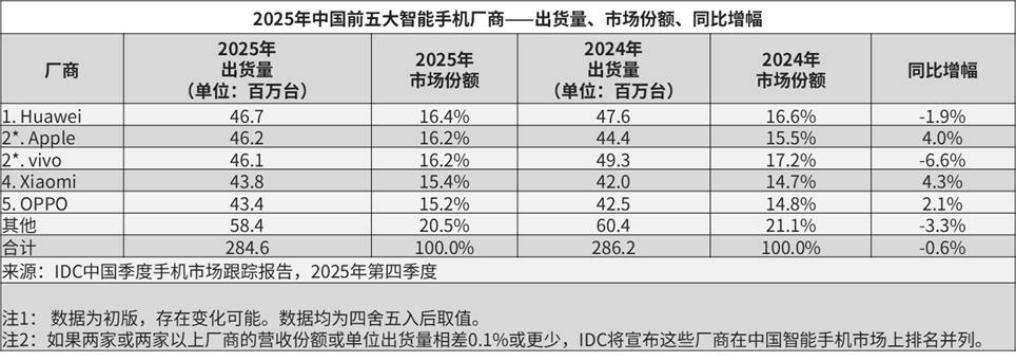
Core Insights - The Chinese smartphone market experienced a slight decline in 2025, with total shipments around 285 million units, a year-on-year decrease of 0.6% compared to a 5.6% growth in 2024 [1] - Key trends include a solidified high-end market, intense competition in the mid-range segment, and the entry of external players, prompting traditional manufacturers to innovate and expand their business boundaries [1] Market Dynamics - Huawei regained the top position in the Chinese smartphone market in 2025, with a shipment of 46.7 million units, a 1.9% decrease from 2024 [6][5] - Apple followed closely with 46.2 million units shipped, marking a 4% increase year-on-year, and capturing a market share of 16.2% [6][5] - The top five manufacturers—Huawei, Apple, vivo, Xiaomi, and OPPO—showed minimal differences in market share, all exceeding 15%, with only a 330,000 unit gap between the first and fifth [4][3] Competitive Landscape - The competition among the top five manufacturers has intensified, with no significant gaps in market share, indicating a shift towards a more competitive environment [2][4] - Xiaomi is focusing on high-end markets and aims to increase its average selling price (ASP) while exploring new growth avenues through its automotive business [8][22] - OPPO and vivo are facing challenges in their traditional offline channels due to the rise of e-commerce and aggressive competition from peers [9] Market Segmentation - The mid-range market (2000-4000 yuan) is characterized by fierce competition, with brands pushing flagship technologies into this segment, leading to a homogenization of products [11] - The high-end market remains stable, with no significant shifts in market dynamics, as brands struggle to introduce disruptive technologies that could challenge established players like Apple and Huawei [12] Technological Evolution - The smartphone industry is transitioning into an era of "joint definition," where both hardware and AI capabilities are being integrated to enhance user experience [15][21] - Two main technological paths are emerging: one led by internet companies focusing on AI-driven hardware, and another by traditional manufacturers integrating AI into their existing hardware [17][20] Industry Expansion - Traditional smartphone manufacturers are diversifying their business models, exploring new growth avenues such as electric vehicles and AI products [22] - New entrants, particularly from the internet and AI sectors, are reshaping the competitive landscape, with companies like ByteDance seeking partnerships to leverage their AI capabilities in the smartphone market [25][26]


功率半导体行业规模高增,长晶科技重启IPO,年营收近20亿
Jin Rong Jie· 2026-01-19 10:20
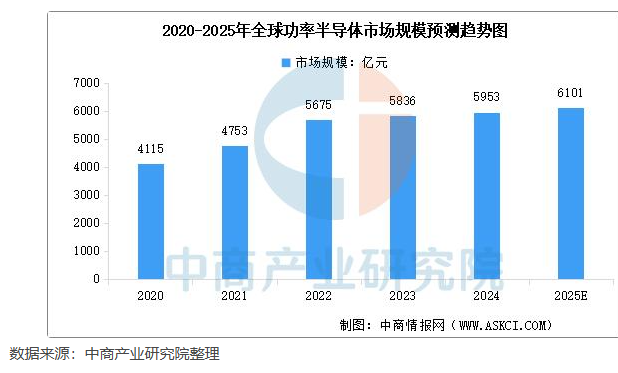
Core Viewpoint - The power semiconductor industry is entering a golden period driven by the boom in new energy vehicles and AI, with the Chinese market expected to exceed 180 billion yuan by 2025 [1]. Group 1: Company Overview - Changjing Technology, a leading power semiconductor company, has restarted its IPO process after more than two years, with the China Securities Regulatory Commission confirming its filing on January 15 [1]. - Established in 2018, Changjing Technology specializes in the R&D, production, and sales of semiconductor products, and has been recognized as one of China's top ten power semiconductor companies for six consecutive years [2]. - The company has built a complete industrial chain through acquisitions, including the purchase of Haide Semiconductor and the establishment of Changjing Pulian, enhancing its capabilities in wafer manufacturing [2]. Group 2: Financial Performance - According to its 2022 prospectus, Changjing Technology's revenue from 2020 to 2022 was 1.339 billion yuan, 1.902 billion yuan, and 1.884 billion yuan, respectively, with net profits of 66 million yuan, 244 million yuan, and 127 million yuan [3]. - Despite the acquisition of New Shunwei contributing to wafer revenue growth, the company's total revenue remained stable compared to 2021, while net profit saw a significant decline due to weak demand in the consumer electronics market and cyclical factors [3]. Group 3: Market Trends and Future Prospects - The power semiconductor industry is showing signs of recovery, with revenue growth entering an upward cycle since Q4 2022, creating a favorable external environment for companies [4]. - The global power semiconductor market is projected to grow from 411.5 billion yuan in 2020 to 610.1 billion yuan by 2025, with China's market expected to exceed 180 billion yuan [4]. - Changjing Technology is actively expanding into new application markets, particularly in automotive electronics, with over 3,500 AEC-Q certified automotive-grade products [5]. Group 4: Strategic Initiatives - The company plans to use the funds raised from its IPO to expand production capacity, including projects for an annual output of 8 billion new components and 600,000 6-inch power semiconductor chips [5]. - This expansion aims to enhance self-sufficiency in packaging and testing, reduce reliance on external foundries, and improve cost control and delivery capabilities [5]. Group 5: Shareholder Structure - The controlling shareholder of Changjing Technology is Shanghai Jianghao Enterprise Management Consulting Co., Ltd., which holds 6.9% of the shares and controls 31.62% of the voting rights [6]. - Notably, the company's shareholder list includes industry giants like Xiaomi and OPPO, highlighting its significant position in the consumer electronics supply chain [6].
Counterpoint:2025年中国智能手机市场华为排名第一,苹果第二
Xin Lang Cai Jing· 2026-01-19 10:15
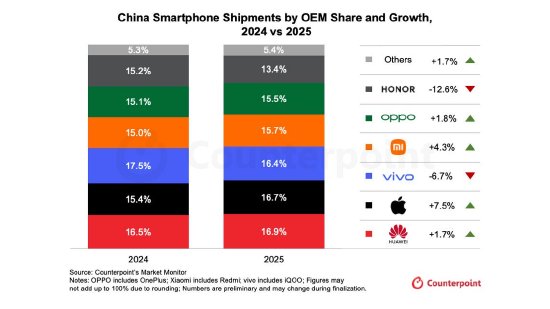
Core Insights - The report from Counterpoint indicates a 1.6% year-on-year decline in smartphone shipments in China for Q4 2025, with an overall annual decline of 0.6% [1][3] Company Performance - Huawei's shipments increased by 1.7% year-on-year, securing the top position in the Chinese market with a 16.9% market share, bolstered by strong performance of mid-to-high-end models following price discounts [1][3] - Apple saw a 7.5% year-on-year increase in shipments, achieving a 16.7% market share, attributed to the successful market performance of the iPhone 17 series and accelerated supply growth [1][3] - Vivo experienced a 6.7% decline in shipments, holding a 16.4% market share, ranking third in the market [1][3] - Xiaomi's shipments grew by 4.3%, capturing a 15.7% market share, placing it fourth [1][3] - OPPO's shipments rose by 1.8%, with a market share of 15.5%, ranking fifth [1][3] - Honor faced a significant decline of 12.6% in shipments, resulting in a 13.4% market share and a sixth-place ranking [1][3]
媒体+融合展销体验!“广货行天下”手机专场1月20日在东莞开启
Nan Fang Nong Cun Bao· 2026-01-19 10:02
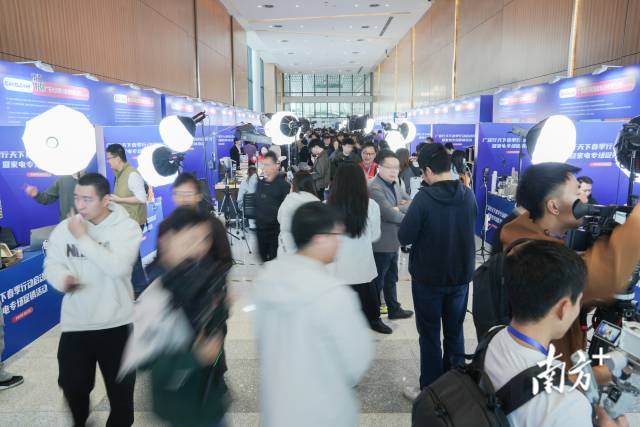
Core Viewpoint - The "Guangdong Goods Going Global" mobile special promotion event will officially launch in Dongguan on January 20, showcasing the strength and charm of Guangdong's smart mobile terminal industry while promoting local brands and products [2][3][4]. Group 1: Event Overview - The event is organized by the Guangdong Provincial Department of Industry and Information Technology and the Dongguan Municipal People's Government, marking an annual promotional feast [2][3]. - It aims to present a wide variety of high-quality mobile products from local brands such as Huawei, OPPO, vivo, and Honor, emphasizing the theme of "selecting the best products and government-enterprise collaboration" [6][14]. - The event will feature both online and offline activities, integrating major e-commerce platforms and media for a comprehensive consumer experience [17][18]. Group 2: Industry Significance - Guangdong is recognized as a crucial hub for the smartphone industry, with a production volume of 683 million units in 2024, accounting for 40.9% of the national total [29][30]. - Dongguan specifically contributes 28.6% of Guangdong's smartphone production, hosting major manufacturers and achieving over 90% industry matching rate [32][33]. - The event will highlight the complete industry chain from chips to finished products, showcasing the technological innovations and cultural narratives of leading brands [31][36]. Group 3: Consumer Engagement - The promotion will include a "Quality Traceability Live Broadcast," allowing consumers to engage with the production process and understand the quality of Guangdong's mobile products [19][20]. - Offline promotions will take place in various administrative service centers and key communities in Dongguan, facilitating easy access to technology for consumers [21][22]. - The event aims to create a vibrant consumer atmosphere, encouraging participation through a blend of online and offline experiences [9][26].



全球每卖出3台就有1台广东造,“手机天团”1月20日齐聚东莞
2 1 Shi Ji Jing Ji Bao Dao· 2026-01-19 09:35
作为"广货行天下"系列活动中备受关注的手机主题专场,本次活动以"优中选品、政企联动"为核心,线上联动主流电商平台与 媒体直播,线下走进社区与政务中心,华为、OPPO、vivo、荣耀等本土品牌共同参与,旨在打造一场全民可逛、可买、可信赖 的广货消费盛宴,为新一年"广货出圈"注入扎实动能。 南方财经记者程浩 东莞报道 1月20日,由广东省工业和信息化厅、东莞市人民政府共同举办的"广货行天下"春季行动广东工业品促销活动(手机专场)将在 东莞正式启动。本次"广货行天下"春季行动手机专场活动将全面呈现广货手机"品牌多、种类广、质量优"的鲜明特色。华为、 OPPO、vivo、荣耀、中兴、TCL等本土龙头企业将携最新旗舰产品与创新科技齐聚亮相,天珑、龙旗等手机产业链核心供应商 也将同步展示关键技术解决方案。通过线上线下联动,进一步扩大广东全年促消费、拓展"广货"影响力。 广东是我国最重要的智能手机产业集聚区,也是全球主要的智能手机生产制造基地和创新高地,智能手机产业规模、产量和出 口量均位居全国首位,世界每卖出三台手机就有一台是广东企业制造。目前,广东手机领域主要有华为终端、OPPO、vivo、荣 耀、传音、中兴、TCL等 ...

苹果手机单季在华销量大增28%,份额突破20%
Guan Cha Zhe Wang· 2026-01-19 08:34
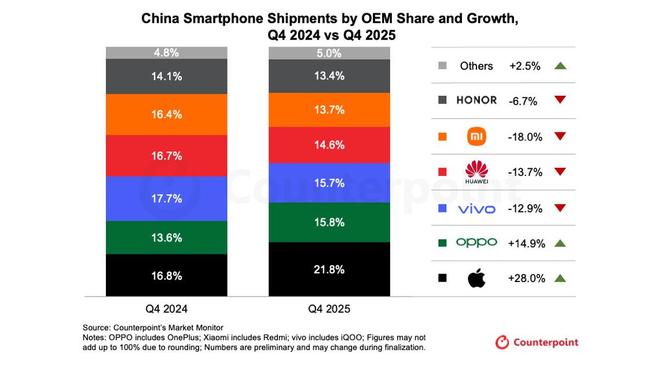
Core Insights - Counterpoint Research reports a 1.6% year-on-year decline in China's smartphone shipments for Q4 2025, with an overall annual decrease of 0.6% [1] - Apple leads the domestic market with a 21.8% market share in Q4, followed by OPPO at 15.8% and vivo at 15.7% [1] - Huawei maintains the top position for the entire year with a 16.9% market share, closely followed by Apple (16.7%) and vivo (16.4%) [1] Group 1: Market Performance - Apple's Q4 shipments surged by 28% year-on-year, driven by strong demand for the iPhone 17 series and increased supply [4] - OPPO achieved a 15% year-on-year growth in Q4, supported by strong demand for the Reno series and contributions from the newly launched Find X9 and OnePlus 15 series [5] - Huawei's mid-to-high-end models performed well after price promotions, despite a decline in the second half of the year [5] Group 2: Product Insights - The iPhone Air's late launch and design compromises have led to a slow start, but it is expected to have a long-term impact on the eSIM smartphone market [5] - Vivo's iQOO 15 offers strong value among devices with Qualcomm's latest flagship chip, while Xiaomi's 17 series has gained attention for its Pro model's unique back screen [6] - Honor's X70 and 400 series maintained steady demand, with the new WIN series noted for its cooling performance [6] Group 3: Industry Outlook - Counterpoint Research anticipates a 40%-50% increase in storage prices in Q1 2026, followed by an additional 20% rise in Q2 [6] - The low-end market (under $200) has been significantly impacted, with a 20%-30% increase in Bill of Materials (BoM) costs since the beginning of the year [7] - Global smartphone shipments are projected to decline by 2.1% in 2026, with an expected average selling price increase of 6.9% due to cost adjustments [7]
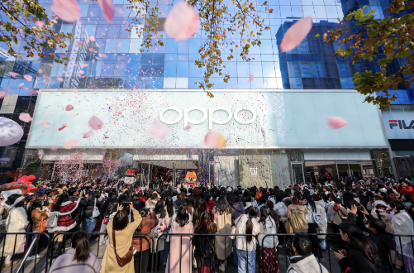
OPPO西北首家旗舰店落户西安,打造“科技国潮”新体验
Jing Ji Wang· 2026-01-19 07:28
Core Insights - OPPO has opened its first flagship store in Northwest China, located in Xi'an, designed as a "city park for young people" that integrates historical culture with modern design [1][3] - The store aims to create a cultural landmark that promotes Xi'an's rich history while providing a social space for youth, emphasizing the connection between traditional culture and contemporary experiences [1][3] Group 1: Store Design and Concept - The flagship store incorporates elements of ancient Chang'an's culture, using textures from Qin bricks and modern interpretations of Tang dynasty motifs in its design [3] - The store features a blend of traditional craftsmanship and modern aesthetics, including the use of water imagery to evoke historical landscapes [3] - A new character, "Bing Ma Yong Xiao Ou," is introduced, merging traditional and contemporary styles to create a dialogue between history and the present [3] Group 2: Cultural and Social Engagement - The store is positioned as a cultural hub, integrating elements of popular culture, including anime and gaming, to attract young consumers [4][6] - OPPO plans to host various themed events and activities, ensuring a dynamic and engaging environment that caters to diverse interests [4][6] Group 3: Technological Innovation and User Experience - The flagship store is designed to be more than just a retail space, featuring interactive areas for gaming and technology experiences that enhance customer engagement [6][8] - OPPO's innovative technologies, such as the Reno15 series and AI features, are showcased to provide users with immersive experiences that blend technology with cultural exploration [8] - The store aims to serve as a platform for young creators, hosting events that encourage creative expression through photography and storytelling [6][8]