南京银行

Search documents
南京银行举办“芯动能 融未来”金融赋能芯片产业交流会
Jiang Nan Shi Bao· 2026-02-25 05:03
近日,由南京银行(601009)江北新区分行主办的"芯动能 融未来"金融赋能芯片产业交流会在南京江 北新区科学城成功举办。本次活动汇聚了行业专家、券商代表、20家集成电路企业负责人近40人参加, 共同探讨金融与芯片产业深度融合路径,为区域集成电路发展注入新动能。 本次交流会的成功举办,得到了南京国家集成电路芯火平台及南京市集成电路行业协会的大力支持,标 志着南京银行服务芯片产业进入了更体系化、更专业化的新阶段。下一步,南京银行将持续迭代优化金 融服务,立足自身资源优势,组建专门力量、配置专业资源,制定专属方案、完善专项机制,秉持"与 地方经济同频共振"的理念,将政策与资金精准滴灌至产业最需处,以更强的使命感、更专业的服务、 更创新的金融工具,全力支持集成电路等战略性新兴产业高质量发展,为现代化产业体系建设贡献坚实 的金融力量。 南京江北新区科学城作为集成电路产业核心区域,目前已成为产业链最完备、创新资源最密集、人才活 力最充沛、资本市场最活跃的集成电路集聚区之一。活动现场,知名行业专家、知名券商代表,紧密围 绕企业需求分享芯片产业发展概况与机遇。南京银行公司金融部介绍了南京银行针对芯片产业的金融服 务体系,从 ...

险资还会增配银行股吗?
2026-02-25 04:13
分析师 1: 投资者大家好,我是浙商证券大金融组组长,银行和政策首席分析师杜晴川。今天我们就 我们刚刚发布的这个深度报告。减资还会增配银行股吗?我们进行一些那个观点汇报。接 下来,我先就我们这篇报告的核心观点做一个阐述。然后具体的相关的问题,由我们的这 个选你老师来汇报。我们的核心观点是,我们认为,就是险资增持银行股还是符合一个长 期趋势的。测算下来,预计 2026 年、2027 年,合计约有 4000 亿的这个险资资金会增 值银行股。时点上,我们预计 2026 年的二季度开始,这个配置动力可能会进一步增强。 在投资的观点上,我们认为,未来险资增持银行股还是可期的,所以继续看好银行股的这 个绝对收益的机会。当前这个时间,我们重点推荐的新动能组合。包括南京银行,这是我 们的年度金股,还有那个浦发银行、上海银行、玉龙商行和这个工商银行。接下来,我们 把时间交给我们的宣妮老师,她来详细的汇报我们那个关心的研究的几个问题。 徐安妮 浙商证券分析师: 那从期限匹配来看,配置高股息的一个资产是可以缓解寿险的一个期限错配的一个压力。 那可以看到,近年来,不少保险公司是将红利策略、高股息股票视为新的一个有机资产。 那把它放入 ...
贴息折扣双重福利 银行加码信用卡分期优惠
Bei Jing Shang Bao· 2026-02-24 16:56
除了银行端对信用卡分期费率的优惠外,财政贴息政策更让消费者享受到双重福利。1月20日,财政 部、中国人民银行、金融监管总局三部门联合印发通知,明确优化实施个人消费贷款财政贴息政策。新 政发布后,多家银行迅速响应,密集发布实操细则与答疑指引,部分机构同步开启信用卡分期贴息补申 请通道,确保政策红利快速落地。 北京商报讯(记者 孟凡霞 周义力)年味渐淡,而超长春节假期消费后的账单压力正悄然袭来。2月24 日,马年复工首日,北京商报记者梳理发现,在财政贴息政策支持下,多家银行正密集加码信用卡分期 优惠,以折扣、优惠券、抽奖等"真金白银"的补贴方式降低居民信贷压力,助力消费市场开门红。 复工首日,北京商报记者注意到,在社交平台上不少消费者晒出自己的信用卡分期账单。一位辽宁地区 的消费者分享,其近4万元账单分24期偿还,首期利息为56.38元,叠加财政贴息后单期分期利息再减免 17.19元。"银行给了2.1折的分期优惠券,折后年化利率约3.26%,出账时又叠加了1%的财政贴息,实际 年化利率降至2.26%,确实很划算。"另有北京地区的消费者表示,自己2万余元的分期账单分12期后, 在银行分期优惠折扣与1%的财政补贴双重 ...
再添一员,我国系统重要性银行增至21家
Mei Ri Jing Ji Xin Wen· 2026-02-24 12:32
Core Viewpoint - The People's Bank of China and the National Financial Regulatory Administration have assessed the systemically important banks for 2025, identifying 21 banks, with notable changes in the rankings and classifications of certain banks [1][2]. Group 1: Systemically Important Banks - A total of 21 domestic systemically important banks have been recognized, including 6 state-owned commercial banks, 10 joint-stock commercial banks, and 5 city commercial banks [1]. - The latest list shows that Zhejiang Commercial Bank has been newly included, while Industrial Bank has been reclassified from the third group to the second group [1][2]. - The banks are categorized into five groups based on their systemic importance scores, with the first group containing 11 banks, the second group 4 banks, the third group 2 banks, the fourth group 4 banks, and no banks in the fifth group [1]. Group 2: Zhejiang Commercial Bank - As of September 2025, Zhejiang Commercial Bank has an asset scale of approximately 3.4 trillion yuan, with capital adequacy ratios of 12.15%, 9.61%, and 8.40% for total capital, tier 1 capital, and core tier 1 capital respectively, all maintaining reasonable levels [2]. - The bank reported an operating income of approximately 48.9 billion yuan and a net profit attributable to shareholders of approximately 11.7 billion yuan for the first three quarters of the previous year [2]. - In the 2025 Global Bank 1000 ranking published by The Banker magazine, Zhejiang Commercial Bank ranked 82nd by tier 1 capital and 75th by total assets, both improving by 2 positions from the previous year [2]. Group 3: Regulatory Framework - Systemically important banks are defined as large, complex institutions with significant interconnections to other financial entities, necessitating stricter regulatory measures to ensure financial stability [2]. - The regulatory framework established in October 2021 mandates additional capital requirements for these banks, ranging from 0.25% to 1.5% based on their group classification [2]. - The authorities plan to enhance macro-prudential management and micro-prudential supervision to ensure the safe and sound operation of systemically important banks, thereby supporting high-quality development of the real economy [3].


银行股马年开局遇冷
Di Yi Cai Jing Zi Xun· 2026-02-24 12:31
Core Viewpoint - The A-share market experienced a positive start to the year, but bank stocks continued to be underperformers, reflecting ongoing concerns about credit quality and lending dynamics in the context of stable LPR rates and lower-than-expected credit growth [2][3][4]. Market Performance - On the first trading day of the year, the Shanghai Composite Index rose by 0.87% to 4117.41 points, while the Shenzhen Component increased by 1.36% and the ChiNext Index by 0.99% [3]. - The banking sector saw a decline of 0.24%, with more stocks falling than rising, indicating a divergence in performance compared to other sectors [3]. - The China Securities Banking Index has retreated nearly 16% from its peak in July 2022, contrasting with an 18% rise in the broader market during the same period [3]. Credit and Lending Dynamics - The latest financial data revealed that new RMB loans in January amounted to 4.71 trillion yuan, lower than the 5.13 trillion yuan recorded in January 2022, indicating a year-on-year decrease in credit growth [3][4]. - The social financing scale increased by 7.22 trillion yuan in January, with a notable decline in loans to the real economy, which increased by 4.9 trillion yuan, down by 317.8 billion yuan year-on-year [3][4]. Institutional Research Focus - Institutional interest in bank research has decreased compared to previous years, with 16 banks undergoing 63 institutional surveys in 2023, involving 467 institutions, compared to 20 banks and 92 surveys in the same period last year [6]. - Key areas of focus during these surveys included credit quality, liability management under margin pressure, capital replenishment plans, and asset quality outlook [6][7]. Future Outlook and Strategies - Analysts predict that the trend of prioritizing credit quality over quantity will become more pronounced in 2023, with significant attention on post-Spring Festival operational rhythms and consumer spending [4][5]. - Banks are expected to enhance their non-interest income sources, with strategies including the promotion of wealth management products and diversified capital replenishment channels to address ongoing profitability pressures [8][9].


银行经营周期如何定价各类资产?
GF SECURITIES· 2026-02-24 12:04
Investment Rating - The report assigns a "Buy" rating for the banking sector, indicating an expectation of stock performance exceeding the market by more than 10% over the next 12 months [58]. Core Insights - In 2025, the banking sector's asset growth is projected to be 8.01%, an increase from 6.52% in 2024, driven by factors such as fiscal stimulus, cross-border capital inflows, and the activation of maturing deposits [5][13]. - The report identifies two key cycles affecting asset pricing in banking: the bank expansion cycle and the interest margin cycle, suggesting a comprehensive analysis of these cycles [5][13]. - The debt cycle is characterized as a fundamental aspect of the bank expansion cycle, with a model proposed by Dalio outlining seven stages of a typical debt cycle, which can be influenced by external debt reliance [16][19]. - The report anticipates limited upward space for the debt cycle in 2026, with government leverage expected to increase by 5.89%, lower than the 7.6% projected for 2025 [35][36]. - The banking interest margin cycle is expected to stabilize in 2025, following two complete cycles since 2010, with a correlation observed between bank interest margins and the 30Y-10Y government bond spread [41][45]. Summary by Sections Bank Expansion Cycle - The asset growth rates for different types of banks in 2025 are projected as follows: state-owned banks at 11%, joint-stock banks at 4.74%, city commercial banks at 9.68%, and rural commercial banks at 5.17%, all exceeding the average growth rate [5][13]. - The report emphasizes the importance of understanding the relationship between bank assets and liabilities, highlighting that credit and debt expansion are cyclical and self-reinforcing [15][16]. Debt Cycle Analysis - The report outlines that the current debt cycle, which began in 2022, has lasted 16 quarters, surpassing previous cycles, and indicates a shift in leverage dynamics among enterprises, government, and households [35][36]. - The analysis includes a comparison of deflationary and inflationary debt cycles, noting that the U.S. faces greater inflationary pressures due to higher external debt reliance compared to China [21][19]. Interest Margin Cycle - The report notes that the banking interest margin has experienced significant fluctuations since 2010, with a stabilization phase expected to begin in 2025 [41][45]. - It highlights the impact of loan repricing cycles on interest margins, with a notable decline in loan rates observed in recent years [49][50].



银行股马年开局遇冷,机构调研透露几大隐忧
Di Yi Cai Jing· 2026-02-24 12:01
Core Viewpoint - The enthusiasm for institutional research on banks has declined compared to previous years, with a focus on credit quality and the impact of interest rate spreads on profitability [1][6]. Group 1: Market Performance - On the first trading day of the Year of the Horse, the A-share market saw a rise, with the Shanghai Composite Index up 0.87% and the Shenzhen Component Index up 1.36%, while the banking sector fell by 0.24% [2]. - The banking sector has experienced a divergence in performance, with state-owned banks declining while some regional banks have shown improvement [2]. - The China Securities Banking Index has retreated nearly 16% from its peak in July 2022, while the broader market has increased by nearly 18% during the same period [2]. Group 2: Credit and Monetary Policy - The latest LPR remained unchanged for both the 1-year and 5-year terms, marking a period of stability in interest rates [3]. - In January, new RMB loans totaled 4.71 trillion yuan, lower than the 5.13 trillion yuan in January 2022, indicating a slowdown in credit growth [2][3]. - The People's Bank of China (PBOC) is expected to maintain liquidity support through MLF operations, with a net injection of 300 billion yuan in February [3][4]. Group 3: Institutional Research Focus - Institutional research has shown a preference for banks in economically promising regions, with a significant number of surveys conducted on smaller banks in the Yangtze River Delta [6]. - Key areas of focus during institutional surveys include credit demand, interest margin pressures, capital adequacy, and asset quality outlook [6][7]. - The trend of "deposit migration" towards equity markets is noted, with banks expected to enhance their wealth management and middle-income sources [4][7]. Group 4: Profitability and Capital Management - Banks are under pressure regarding profitability, with institutions increasingly inquiring about capital adequacy and internal capital replenishment strategies [8]. - Several banks plan to explore diverse capital replenishment channels, including issuing capital-boosting bonds and optimizing business structures to enhance capital efficiency [8].




贴息、折扣双重优惠!你的信用卡分期又能省一笔
Bei Jing Shang Bao· 2026-02-24 11:42
年味渐淡,而超长春节假期消费后的账单压力正悄然袭来。2月24日,马年复工首日,北京商报记者梳理发现,在财 政贴息政策支持下,多家银行正密集加码信用卡分期优惠,以折扣、优惠券、抽奖等"真金白银"的补贴方式降低居 民信贷压力,助力消费市场开门红。 信用卡分期双重福利齐上阵 复工首日,北京商报记者注意到,在社交平台上不少消费者晒出自己的信用卡分期账单。一位辽宁地区的消费者分 享,其近4万元账单分24期偿还,首期利息为56.38元,叠加财政贴息后单期分期利息再减免17.19元。"银行给了2.1 折的分期优惠券,折后年化利率约3.26%,出账时又叠加了1%的财政贴息,实际年化利率降至2.26%,确实很划 算。"另有北京地区的消费者表示,自己2万余元的分期账单分12期后,在银行分期优惠折扣与1%的财政补贴双重优 惠下,年化利率由3.06%降至2.06%。 尽管财政贴息与银行折扣让利消费者,但在实际体验中,不少用户仍感困惑:不同银行优惠规则不一、不同用户分 期费率定价存在差异,再加上贴息与折扣的叠加计算,让不少消费者陷入"看得懂优惠,算不清成本"的困境,对实 际省多少钱、真实资金成本缺乏清晰判断。 而从各家银行公布的信用卡 ...

三年定存利率最高1.9%,春节揽储国有大行按兵不动,中小银行激战正酣
Xin Lang Cai Jing· 2026-02-24 09:23
新年伊始,正值年终奖发放及资金回笼高峰期,忙碌了一年的人们正在计划如何进行投资并筹划新一年 的资产配置方案。对于银行来说,"揽储"就成了当前的重要任务。 春节期间,时代周报记者实地探访五大行及部分股份行、城商行营业网点,发现银行揽储存在明显分 化:五大行"按兵不动",存款利率未作调整,没有特殊的揽储活动;而股份行及城商行在利率上拥有一 贯优势,定期存款利率普遍高于五大行,并且在春节期间推出各类揽储活动。 此外,时代周报记者还发现,银行正经历从"揽储为王"转向"资产配置"的转型。针对不同风险偏好、不 同资金实力、不同职业背景、不同回报预期的投资者,理财经理需精准匹配投资产品,不同银行的业务 侧重点也各不相同。 五大行专攻资管规模,股份行、城商行"揽储正酣" 春节期间,五大行保持存款利率不动,战略性放弃高息揽储,收缩存贷利差空间,同时转向资产提升送 积分或立减金活动,客户存款+理财+基金等综合资产达标即可领奖。 据时代周报记者春节期间实地探访,工商银行、农业银行、中国银行、建设银行的存款利率未作改变, 定期存款一年期、两年期、三年期利率分别为1.1%、1.2%、1.55%。而交通银行的定期存款利率要高于 上述四家 ...
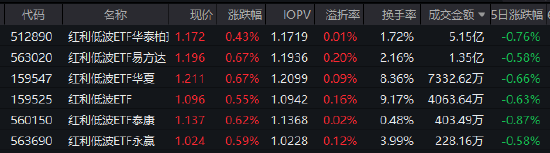
红利低波ETF华泰柏瑞(512890)近60天狂吸金48.6亿!机构:2026年科技与非科技都有机会,质量策略正当时
Xin Lang Cai Jing· 2026-02-24 09:02
2月24日,市场冲高回落,创业板指盘中一度涨超2%,沪指放量收涨0.87%。在此背景下,红利低波 ETF华泰柏瑞(512890)全天上涨0.43%,报收1.172元,换手率1.72%,成交额5.15亿元,居同类ETF首 位。 | 代码 | 名称 现价 涨跌幅 IOPV 溢折率 换手率 成交金额 = 5日涨跌幅 ( | | --- | --- | | 512890 | 红利低波ETF华泰柏 1.172 0.43% 1.1719 0.01% 1.72% 5.15亿 -0.76% | | 563020 | 红利低波ETF易方达 1.196 0.67% 1.1936 0.20% 2.16% 1.35亿 -0.58% | | 159547 | 红利低波ETF华夏 1.211 0.67% 1.2099 0.09% 8.36% 7332.62万 -0.66% | | 159525 红利低波ETF | 1.096 0.55% 1.0942 0.16% 9.17% 4063.64万 -0.63% | | 560150 | 红利低波ETF泰康 1.137 0.62% 1.1368 0.02% 0.48% 403.49万 -0.8 ...