
锦波生物

Search documents
今日看盘 | 2月9日:A股三大指数集体上涨 山西板块上涨0.61%
Xin Lang Cai Jing· 2026-02-09 08:04
Market Performance - The A-share market saw a collective increase in the three major indices, with the Shanghai Composite Index rising by 1.41%, the Shenzhen Component Index by 2.17%, and the ChiNext Index by 2.98% [1] - The North China 50 Index increased by 1.36% [1] - The total trading volume in the Shanghai and Shenzhen markets was approximately 22,494.73 billion yuan, an increase of about 1,037.54 billion yuan compared to the previous trading day [1] Shanxi Sector Analysis - The Shanxi sector performed steadily, with an overall increase of 0.61% and a trading volume of 120.25 billion yuan, indicating a positive market sentiment [1] - Among the 41 stocks in the Shanxi sector, 28 stocks rose, 12 fell, and 1 remained flat [1] Individual Stock Performance - Notable gainers included Jinlihua Electric and Huaxiang Co., both rising over 3%, while Dongjie Intelligent, Luhua Technology, and Huayang New Materials increased by over 2% [1] - Other stocks such as Beifang Copper Industry, Kexin Development, and Shitou Co. saw increases of over 1% [1] - Decliners included Jinkong Power and Lanyan Holdings, both dropping over 2%, while Shanxi Coking Coal and Qianyuan Pharmaceutical fell by more than 1% [1] - Several stocks, including Jinkong Coal Industry, Lu'an Environmental Energy, and Jinbo Biological, experienced milder declines, with losses contained within 1% [1]


时报观察丨新三板已成多层次资本市场重要“苗圃”
Xin Lang Cai Jing· 2026-02-09 05:11
Core Insights - The total number of companies listed on the New Third Board has decreased to 5,973 from a peak of over 10,000, indicating a shift towards the concentration of quality enterprises [1] - By 2025, over 50% of the companies listed are expected to be national-level specialized and innovative "little giant" enterprises, reflecting a transformation in the attractiveness and selection function of the New Third Board [1] - Since 2020, the New Third Board has supplied over 670 companies to the A-share market, becoming a crucial reserve for A-share listed companies [1] Group 1 - The New Third Board is evolving into an important "nursery" and "incubator" for high-quality enterprises, facilitating their preparation for higher-level capital markets [1] - The board has become a pre-class for innovative and growth-oriented SMEs, with many companies aiming for higher regulatory standards from the outset [1] - The ultimate goal of this "seedling" process is to "transplant" and "grow into a forest," indicating a long-term vision for enterprise development [1] Group 2 - Since the opening of the Beijing Stock Exchange in November 2021, it has accepted 292 companies from the New Third Board, becoming the primary platform for nurturing high-quality firms [2] - Notable companies like Pop Mart, which started on the New Third Board, exemplify the successful transition to larger markets, achieving significant brand exposure and financing [2] - The New Third Board is focusing on quality over quantity, aiming to cultivate high-quality enterprises and establish a complete growth pathway through efficient connections with major exchanges [2]
时报观察丨新三板已成多层次资本市场重要“苗圃”
证券时报· 2026-02-09 00:41
其中,自2021年11月开板以来,北交所已接纳292家源自新三板的公司,成为最主要的承接平 台,培育了贝特瑞、锦波生物、星图测控、曙光数创等市值过百亿元的优质公司;沪深交易所作 为成熟的主阵地,持续吸纳来自新三板的成长型企业,例如今年A股首只新股陕西旅游,以及 2025年上市的天溯计量、信通电子、禾元生物、华新精科等;港股、美股则为新三板企业展现多 元路径,泡泡玛特、西普尼、健康160、经纬天地等在港股上市后大放异彩。 数据显示,2025年挂牌的公司中,国家级专精特新"小巨人"企业占比超过50%。这标志着新三板 的吸引力与筛选功能正在发生转变,越来越多的创新型、成长型中小企业将其作为规范发展、对 接更高层次资本市场的"预科班"。众多具备专精特新特质的企业明确将新三板挂牌视为迈向公开 资本市场的重要一步。这些企业从挂牌伊始便倾向于以更高的规范性要求进行自我准备,从而整 体提升质量基底。 "育苗"的最终目的是"移栽"与"成林"。数据显示,自2020年以来,新三板已累计向A股市场(含 沪深北交易所)输送670多家企业,成为A股上市公司最重要的后备军之一。这一输送通道的持续 畅通,体现了我国多层次资本市场层层递进、有 ...


北交所新消费产业研究系列(六):从“悦人”到“悦己”,解码美丽消费赛道的
Sou Hu Cai Jing· 2026-02-08 11:14
Group 1: Medical Aesthetics Industry - The Chinese medical aesthetics market is expected to reach nearly 370 billion yuan by 2025, with a compound annual growth rate (CAGR) of approximately 10% projected until 2030, potentially reaching 600 billion yuan [2][8][36] - The trend of "self-pleasure consumption" is prominent, with about 50% of users indicating that the reason for choosing medical aesthetics is that "becoming beautiful makes them happier" [8][11][15] - The consumer demographic is shifting towards younger individuals, with the proportion of users under 25 years old increasing from 26% in 2022 to 35% by 2025 [20][22][36] - Light medical aesthetics are becoming mainstream, accounting for 52% of the market in 2022, with a growing preference for non-invasive procedures [16][17][36] - The market for recombinant collagen is expected to grow significantly, with a projected CAGR of 41.4% from 2023 to 2027, potentially reaching 114.5 billion yuan [8][45] Group 2: Beauty Industry - The retail sales of cosmetics in China are projected to grow at a CAGR of approximately 9% from 2016 to 2024, with a moderate recovery expected in 2025 [3][9] - The trend of "self-gifting" is becoming the primary scenario for beauty consumption, reflecting the strengthening of "self-pleasure consumption" [3][8] - The cosmetics raw materials market is expected to grow from 1147.8 billion yuan in 2019 to 1603.9 billion yuan by 2024, with a CAGR of 6.9% [3][9] - The ODM (Original Design Manufacturer) industry for cosmetics is projected to reach 62.29 billion yuan by 2025, with domestic brands gaining market share [3][9] Group 3: Related Companies on the Beijing Stock Exchange - Companies such as Jinbo Biological, which leads in recombinant collagen medical devices and is entering the functional skincare market, are expected to benefit from the ongoing growth in the beauty consumption sector [3][8] - Bawei Co., which provides ODM services for domestic and international cosmetic brands, is also positioned to gain from the industry's expansion [3][8] - Leading companies in cosmetic raw materials, such as Weiqi Technology and Jiakai Biological, are well-placed to capitalize on the industry's growth [3][8]



整个社会都在喊没钱了,为什么这些公司反而年赚百亿?
创业家· 2026-02-08 10:00
Core Viewpoint - The article emphasizes that despite the prevailing narrative of economic hardship, certain industries are thriving and generating substantial profits, particularly in the context of Japan's "lost 30 years" and the evolving consumer behavior in China [3][4]. Group 1: Economic Shifts and Opportunities - The concept of a "low-desire society" does not equate to a lack of opportunities, as consumer demand is shifting towards different sectors [4]. - The article identifies eight key industries that are capitalizing on changing consumer preferences, highlighting that demand migration presents significant business opportunities [5]. Group 2: Key Industries - **Second-Hand Economy**: The second-hand luxury market in Japan, exemplified by companies like Daikokuya, has seen a dramatic revenue increase. In China, platforms like Hongbulin and Panghu are experiencing similar growth [6][7][8]. - **Pet Economy**: With declining birth rates, spending on pets is rising. Companies like Inaba in Japan and Guobao in China are benefiting from this trend, with various pet brands seeing continuous sales growth [12][13][14][15][16]. - **Adult Care**: The adult diaper market in Japan has surpassed $10 billion, indicating that aging populations can create substantial economic opportunities rather than being a burden [17][18][19]. - **Health Food and Beverages**: Changes in population structure and rising health awareness have led to the growth of sugar-free beverages and functional foods in both Japan and China [21][22]. - **Beauty Economy**: The demand for beauty products, such as collagen supplements and at-home beauty devices, remains strong, indicating that consumers prioritize personal care even in economic downturns [23][24][25][26]. - **Outdoor Recreation**: Companies in the outdoor equipment sector, like Snow Peak in Japan, are thriving as consumers seek leisure activities despite economic constraints [29][30][31]. - **Convenience Economy**: The rise of frozen foods and smart home appliances reflects a shift towards convenience, with brands like Anjijia and Kewotai seeing steady growth [39][40][42]. - **Lazy Economy**: The trend of reduced cooking time among younger generations has led to increased demand for time-saving products, suggesting that time-saving solutions may hold more commercial value than cost-saving ones in a low-desire economy [39][42]. Group 3: Market Sentiment - The article argues against the notion that the current market is in a "cold winter," suggesting that the true winners in a low-desire era are those who can identify and invest in counter-cyclical opportunities [44].

2026年中国藻酸盐敷料行业发展历程、产业链、发展现状、竞争格局及趋势研判:慢性病护理需求日益增加,推动藻酸盐敷料市场规模迅速扩大[图]
Chan Ye Xin Xi Wang· 2026-02-08 01:28
Core Insights - The core viewpoint of the article highlights the rapid growth and increasing adoption of alginate dressings in the medical field due to their superior properties such as high absorbency, breathability, and antibacterial effects, making them a preferred choice for wound care, especially for complex wounds like burns and ulcers [1][12]. Industry Overview - The alginate dressing industry in China has seen its market size grow from 335 million yuan in 2017 to an estimated 3.421 billion yuan by 2024, with a compound annual growth rate (CAGR) of 39.37% [1][12]. - By 2025, the market size is projected to reach approximately 3.783 billion yuan [1][12]. - Key growth drivers include an aging population, increased health awareness, advancements in medical technology, and a growing preference for biodegradable materials [1][12]. Industry Development History - The alginate dressing industry in China began in the late 1980s, initially dominated by traditional gauze and cotton pads [7]. - The introduction of alginate dressings was facilitated by foreign companies in the early 1990s, but market penetration remained low due to high costs and limited clinical awareness [7]. - Domestic companies have since made significant technological advancements, overcoming key production challenges [7]. Industry Supply Chain - The supply chain for alginate dressings includes upstream raw materials such as alginate, silver ions, calcium chloride, and collagen [9]. - The midstream involves the production and manufacturing of alginate dressings, while the downstream encompasses sales channels including pharmaceutical companies, hospitals, pharmacies, and e-commerce platforms [9]. Competitive Landscape - The competitive landscape features both domestic and foreign companies, with foreign firms like ConvaTec and Smith & Nephew holding significant market shares in high-end products [12]. - Domestic companies such as Ma Ying Long, Weigao Group, and Steady Medical are actively pursuing technological innovation and market expansion [12]. Industry Trends - The industry is expected to see a shift towards smart and functional products, integrating technologies like pH monitoring and drug release systems to enhance treatment precision [16]. - Demand is anticipated to grow in chronic wound management and high-end care scenarios, driven by rising chronic disease rates and the expanding medical aesthetics market [17]. - Future products will focus on low allergenicity, biocompatibility, and ease of use to cater to sensitive skin and complex wound needs [19].



经济越来越差,这八大行业越赚爆!
创业家· 2026-02-07 10:24
Core Insights - The article discusses how certain industries are thriving despite a general perception of economic downturn, highlighting eight key sectors that present significant business opportunities in a low-desire society [3][4]. Group 1: Key Industries - **Second-Hand Economy**: The second-hand luxury market in Japan, represented by companies like Daikokuya, has seen a surge in revenue. In China, platforms like Hongbulin and Panghu are experiencing similar growth, indicating a shift in consumer spending towards second-hand goods [6][7][8][9]. - **Pet Economy**: With declining birth rates, young people are spending more on pets, leading to significant growth in pet food and healthcare products. Companies like Inaba in Japan and Guobao in China are capitalizing on this trend [11][12][14][15]. - **Adult Care Products**: The adult diaper market in Japan has surpassed $10 billion, indicating a growing demand for adult care products in China, with companies like Kexin showing potential for growth [16][17][18]. - **Health Food and Beverages**: The rise in health consciousness has led to increased demand for sugar-free beverages and functional drinks. Brands like Dongfang Shuye and Jianchun are gaining traction in this sector [21][22]. - **Beauty Economy**: The demand for beauty products, including collagen supplements and at-home beauty devices, is on the rise. Companies like Jinbo Biological are seeing significant market value growth [23][25]. - **Outdoor and Leisure Products**: The outdoor equipment market is thriving, with brands like Kailas and Camel experiencing rapid sales growth, as consumers seek leisure activities despite economic constraints [25][26][27]. - **Emotional Economy**: Brands like Labubu and Rio are tapping into the emotional needs of consumers, providing products that offer comfort and joy, even in a tight economic climate [28][29][30]. - **Convenience Economy**: The demand for convenience products, such as frozen foods and smart home appliances, is increasing as younger generations spend less time cooking. Companies like Anjijia and Kewot are benefiting from this trend [33][35][36]. Group 2: Market Trends - The article emphasizes that the current economic climate, often viewed as a "winter," presents opportunities for those willing to invest in counter-cyclical sectors. The key to success lies in recognizing and seizing these opportunities [39].



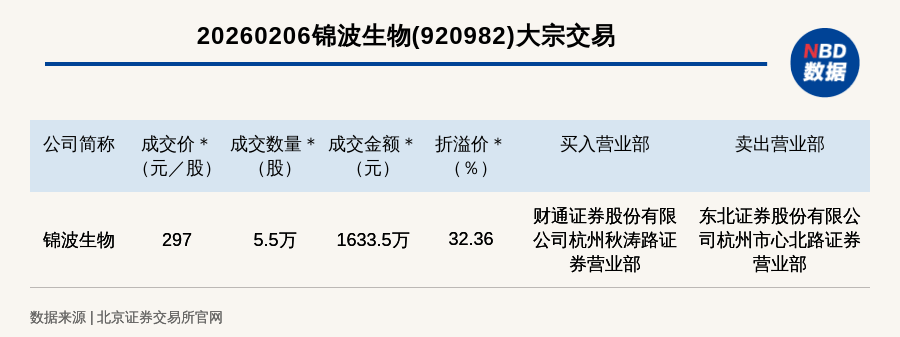
北交所上市公司锦波生物大宗交易溢价32.36%,成交金额1633.5万元
Sou Hu Cai Jing· 2026-02-06 12:28
Group 1 - The core event involves a block trade of Jinbo Biological (stock code: 920982) on the Beijing Stock Exchange, with a closing price of 224.39 CNY per share [1] - The block trade occurred on February 6, 2026, with a transaction price of 297 CNY per share, representing a premium of 32.36% [1] - The total volume of the transaction was 55,000 shares, amounting to 16.335 million CNY [1] Group 2 - The buying brokerage was Caitong Securities Co., Ltd., specifically the Hangzhou Qiutao Road Securities Business Department [1] - The selling brokerage was Dongbei Securities Co., Ltd., from the Hangzhou Xinbei Road Securities Business Department [1]
北交所新消费产业研究系列(六):从悦人到悦己,解码美丽消费赛道的增长逻辑
Hua Yuan Zheng Quan· 2026-02-06 09:11
Group 1: Medical Aesthetics Industry - The Chinese medical aesthetics market is expected to reach nearly 370 billion by 2025, with a high growth outlook for the recombinant collagen segment [2][35] - The trend of younger consumers in medical aesthetics is evident, with light medical aesthetics gradually becoming mainstream, accounting for 52% of the market in 2022 [7][12] - Approximately 50.90% of users choose medical aesthetics because "becoming beautiful can make oneself happier," indicating a strong emotional value associated with beauty [4][8] Group 2: Beauty Industry - The retail sales of cosmetics in China are projected to grow at a CAGR of about 9% from 2016 to 2024, with domestic brands expected to maintain growth momentum [2][3] - The Chinese cosmetics market is entering a phase of high-quality development, with trends leaning towards scientific beauty and Eastern philosophies [3][19] - The market for cosmetic raw materials is expected to grow from 1147.80 billion in 2019 to 1603.90 billion by 2024, with a CAGR of 6.9% [2][3] Group 3: Related Companies on the Beijing Stock Exchange - Companies such as Jinbo Biological, which leads in recombinant human collagen medical devices, and Bawei Co., which provides ODM services for domestic and international cosmetic brands, are expected to benefit from the ongoing beauty consumption boom [2][3] - The market for functional skincare products is also seeing new entrants, with companies like Jinbo Biological expanding into this segment [2][3] - The beauty industry is experiencing a transformation driven by technological innovations, including synthetic biology and the application of new materials [2][3]
今日看盘 | 2月6日:山西板块整体涨0.54% 振东制药涨达13.24%
Xin Lang Cai Jing· 2026-02-06 07:49
文 | 张阳阳 下跌个股中,锦波生物、北方铜业、美锦能源等7只个股跌幅均在1%以上;山煤国际、山西焦化、山西 焦煤等13只个股跌幅收窄在1%以内。 山西板块今日整体表现稳健,指数上涨0.54%,成交额为138.66亿元,反映出市场情绪积极且资金参与 度较高。 涨跌情况方面,山西板块41只个股,19只上涨,20只下跌,2只平盘。 上涨个股中,领涨股振东制药显著上涨,涨幅达到13.24%;晋控电力同样上涨明显,涨幅为9.97%。 此外,仟源医药上涨4.43%;蓝焰控股、科新发展涨逾2%;潞化科技、永东股份、东杰智能涨超1%; 国新能源、金利华电、华阳股份等11只个股涨幅均在1%以下。 2月6日,A股三大指数集体下跌,截至收盘,上证指数跌0.25%,深证成指跌0.33%,创业板指跌 0.73%;北证50涨0.9%。沪深两市成交额约21457.19亿元,较前一个交易日缩量约305亿元。 ...
