Perplexity

Search documents
AI来了,搜索怎么办
Di Yi Cai Jing· 2026-01-11 12:46
AI时代的搜索是"搜索辅助的AI",而不是"有AI能力的搜索"。 人要做决策,必须首先获得信息,然后理解信息、产生认知。 在互联网时代,信息的获取主要是通过搜索。搜索从本质上讲跟图书馆的检索系统非常相似,不同之处 在于其更庞大、更智能。搜索系统的建立分两步:首先得找到尽可能多的信息(网页爬取),其次要把 这些信息整理得易于查找(索引)。做好这些基础准备工作,用户输入了搜索需求,就可以提取关键词 (查询解析)去和索引好的数据库做匹配(检索),最后进行关键的一步:对初步匹配的结果进行打分 (根据相关度、质量、权威性、用户反馈等进行相关性计算),排序输出,呈现给用户。 正是由于有了搜索,互联网上的海量信息才能为人所用。可以说,没有搜索,互联网的使用价值就会大 打折扣。 说到搜索,人们一般想到谷歌、必应、百度等搜索引擎,但实际几乎所有的重要互联网公司的业务都离 不开搜索,用户在淘宝、京东购物,在海量的商品中找到想买的东西需要搜索;在抖音和小红书上,用 户除了"刷"视频和帖子,也会去搜索"怎么做红烧肉";用美团或饿了么搜吃喝玩乐;在微信中则通过搜 索聊天记录、公众号、视频号、小程序,找到相关的信息。 像谷歌、百度这样的 ...
8个月干到1亿美金,盘点全球最赚钱9家AI应用,AI 商业逻辑彻底变了
3 6 Ke· 2026-01-08 13:07
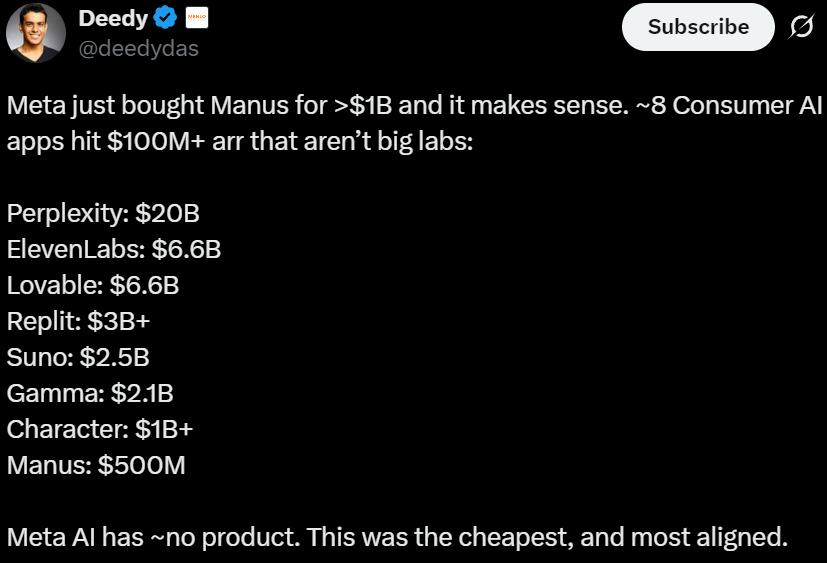
Group 1 - The core point of the article is the rapid growth of AI companies achieving over $100 million in Annual Recurring Revenue (ARR), highlighting a shift in business models from selling capabilities to selling results [1][2][30] - Manus was acquired by Meta for $2 billion, and its ARR reached $125 million shortly before the acquisition, marking it as one of the fastest companies to reach this milestone [1][25] - Nine AI application companies have joined the "1 billion ARR club" this year, including notable names like Cursor, Lovable, and Perplexity, showcasing a trend of rapid commercialization in the AI sector [1][2] Group 2 - The speed of growth among these companies is striking, with Lovable achieving $100 million ARR in just 8 months, Cursor in 12 months, and Perplexity in 14 months [2][28] - The shift in commercial value is evident as companies focus on delivering credible results rather than just capabilities, indicating a fundamental change in how success is measured in the AI industry [2][30] - Investors are increasingly prioritizing single customer revenue over traditional profit margins as a key metric for evaluating AI companies, suggesting a new standard for what constitutes a successful AI business [2][28][37] Group 3 - Perplexity, valued at $20 billion, operates a subscription-based model with various tiers, and its ARR has shown significant growth, reaching $120 million by May 2025 [5][9] - ElevenLabs, valued at $6.6 billion, has a diverse client base and achieved $100 million ARR within 22 months, with plans to reach $300 million by the end of 2025 [7][9] - Lovable, also valued at $6.6 billion, reached $100 million ARR in 8 months and aims to double that figure within a year [10][11] Group 4 - Replit, valued at over $3 billion, transitioned from traditional code completion to a more integrated platform, achieving $150 million ARR in 18 months [12][13] - Suno, an AI music generation tool, reached over $100 million in annual revenue within three years, indicating strong market demand [15][16] - Gamma, an AI presentation tool, achieved $100 million ARR in a relatively short time, demonstrating effective monetization strategies [18][19] Group 5 - The article emphasizes that the fastest-growing companies are those that effectively transition from consumer to enterprise markets, enhancing their average revenue per user (ARPU) [29][30] - The trend indicates that AI companies are increasingly starting from consumer markets, which allows them to scale more rapidly [30][31] - The article also raises concerns about the sustainability of growth, as some companies face significant losses despite high ARR figures, highlighting the need for a deeper understanding of what constitutes a successful AI business [33][34][36]


股疯、寡头与血包,印度“赢麻了”?
虎嗅APP· 2026-01-07 00:56
Core Viewpoint - The Indian stock market, once seen as a shining example among emerging markets, is now facing significant challenges and potential downturns as structural issues and external pressures come to light [4][8]. Group 1: Market Performance and Trends - The Indian stock market has shown a remarkable upward trend over the past decade, characterized by quick recoveries and a clear long-term slope, even amidst global challenges like the pandemic and interest rate hikes [2]. - However, starting in 2024, the market has begun to decline, revealing underlying problems that resemble those seen in the Chinese market [4]. - Foreign investors have significantly pulled out, with a net sell-off of $18.4 billion (1.6 trillion rupees) in 2024, marking a historical high in capital outflows [8]. Group 2: Structural Issues - The Indian stock market is heavily concentrated in financial services, which account for approximately 36% of the index, making it vulnerable to sector-specific downturns [15]. - The Nifty 50 index's performance is highly dependent on a few major banks and IT giants, exposing it to systemic risks if these sectors face challenges [15]. - The market has seen a dramatic increase in retail trading, with retail investors accounting for 50% of derivatives trading volume, yet 90% of active retail investors have incurred losses equivalent to 63% of India's per capita GDP [22]. Group 3: Economic Challenges - India's GDP growth rate is projected to decline from 9.2% to 6.5% in 2025, reflecting difficulties across all three major sectors: services, manufacturing, and agriculture [44]. - The manufacturing sector's contribution to GDP has fallen to a record low of 12.5%, indicating a lack of growth in this critical area [47]. - The service sector, which has been a growth pillar, is now facing pressures as companies reduce spending on technology, particularly in IT services [46]. Group 4: Investment Landscape - Despite the challenges, there is cautious optimism among foreign investors, with expectations of a recovery in profit growth for Indian companies [65]. - The Nifty index's forward P/E ratio is around 23, close to its historical average, suggesting potential for recovery if earnings improve [66]. - Domestic institutional investors have increased their holdings, surpassing foreign institutional investors for the first time, indicating a shift in market dynamics [25]. Group 5: Future Outlook - The ability of the Indian market to attract foreign investment will depend on geopolitical shifts and the reassessment of risk and return by foreign investors [42]. - The Indian economy is likely to remain a mix of high potential and significant internal structural challenges, making it a complex environment for investors [58][59].

PayPal Leverages Massive Data Trove to Challenge Advertising Giants
PYMNTS.com· 2026-01-06 14:00
Core Insights - PayPal has launched its Transaction Graph Insights & Measurement program to provide merchants with a comprehensive view of consumer spending habits across the internet [1] - The program aims to position PayPal as a more accurate alternative to traditional tech giants by tracking verified purchases rather than just clicks or impressions [2][6] Program Features - The program utilizes a "transaction graph" that connects signals from 430 million consumer accounts and tens of millions of merchants, allowing advertisers to see the complete purchase journey [3] - It includes an interactive analytics dashboard for brands to visualize shopper journeys and a measurement suite for reporting on campaign attribution and sales lift [4] Industry Impact - Mark Grether, senior vice president and general manager of PayPal Ads, emphasized the importance of data-driven precision in advertising solutions, stating that real commerce data is essential for meeting the needs of empowered shoppers [5] - Early results indicate success, with Ulta Beauty reporting a 20% increase in transaction spend via PayPal during a campaign utilizing these insights [6] Validation and Expansion - To ensure data objectivity, PayPal has launched a partnership program with third-party firms like Experian, TransUnion, and Kantar to independently validate campaign results, initially available for U.S.-based advertisers [7] - The program is expected to expand to the United Kingdom and Germany [7] Related Developments - This initiative follows a partnership with generative AI search engine Perplexity, which integrated PayPal to provide personalized results based on user history [8]

微信发布AI小程序成长计划;腾讯ima上线PPT生成功能,基于知识库打造专属AI工作台丨AIGC日报
创业邦· 2026-01-06 00:07
Group 1 - WeChat Mini Programs launched an AI application and online tools growth plan, providing comprehensive support including cloud development resources, AI computing power, data analysis, commercial monetization, and traffic incentives, with the incentive period lasting throughout 2026 [2] - Leading AI companies are intensifying efforts to challenge Google's dominance in the browser market, with OpenAI and Perplexity launching their own web browsers, and Microsoft integrating Copilot AI tools into its Edge browser, marking significant changes in the global browser market [2] - Tencent's AI workspace, ima.copilot, has introduced a "generate PPT" feature, allowing users to create well-structured and beautifully designed slides using their personal knowledge base, representing a breakthrough in multi-modal output capabilities [2] Group 2 - Beijing has a total of 15,000 AI scholars, accounting for 30% of the national total, and ranks second globally in terms of innovation in artificial intelligence, with significant resources including two national laboratories and four new R&D institutions [2]

Intel (NasdaqGS:INTC) Update / Briefing Transcript
2026-01-06 00:02
Summary of Intel's CES 2026 Conference Call Company Overview - **Company**: Intel Corporation (NasdaqGS: INTC) - **Event**: CES 2026 Conference Call - **Date**: January 5, 2026 Key Industry Insights - **AI Integration**: AI is transforming workflows across industries, and Intel aims to make AI intelligence accessible and efficient [1][2] - **Strategic Inflection Point**: The industry is at a critical juncture, with Intel delivering leadership products that integrate compute, graphics, and AI [5] Core Product Developments - **Core Ultra Series 3**: - First processor built with 18A technology, offering significant improvements in performance and efficiency [9][10] - Delivers 60% more performance than the previous Lunar Lake Series 2, with a focus on power efficiency [13] - Features new E-cores, P-cores, and a GPU with built-in ray tracing capabilities [9][10] - Achieves up to 15% better performance per watt and over 30% better chip density due to advanced technologies like RibbonFET and PowerVia [6] Graphics Advancements - **Intel Arc B390 Graphics**: - Next-generation integrated GPU with 50% more graphics cores and 70% more gaming performance compared to previous models [17] - Capable of delivering 120 GPU TOPS and significantly improved frame rates compared to competitors [17][19] - Introduces AI-based multi-frame generation, enhancing gaming experiences [19] AI and Software Ecosystem - **AI PC Footprint**: Intel has established the largest AI PC footprint in the industry, driving software innovation [33] - **Local AI Execution**: Emphasizes the importance of local AI processing for performance, privacy, and cost efficiency [40][44] - **Collaboration with Software Partners**: Intel supports hundreds of ISVs to optimize AI applications for its hardware [36][37] Market Position and Future Outlook - **Edge Computing**: Intel is accelerating the launch of 18A products for edge markets, aligning with the PC launch to meet growing demand [61] - **Broad Adoption**: Series 3 is expected to be the most widely adopted AI PC platform, with over 200 designs planned [63] - **Strategic Goals**: Intel aims to redefine the intelligence PC stack, combining hardware, software, and infrastructure for enhanced client devices [38] Additional Noteworthy Points - **Investment in R&D**: Over the last five years, Intel has heavily invested in capital, R&D, and new manufacturing capabilities [6] - **Performance Metrics**: Series 3 processors are designed to support a wide range of applications, with significant improvements in battery life and power efficiency [12][13] - **Future Gaming Platforms**: Intel plans to launch a handheld gaming platform based on Panther Lake technology [32] This summary encapsulates the critical points discussed during Intel's CES 2026 conference call, highlighting the company's advancements in AI, graphics, and overall market strategy.

氪星晚报|人工智能公司加大力度挑战谷歌在浏览器市场的主导地位;字节“豆包”AI眼镜即将进入出货阶段,将分版本推出;2025年国家铁路运输总收入首次突破万亿
3 6 Ke· 2026-01-05 11:01
Group 1 - Samsung plans to deploy Google's Gemini AI on 800 million mobile devices by 2026, up from approximately 400 million devices last year [1] - Bilibili has launched its first AI-themed creation competition with a total prize pool exceeding 3 million yuan, featuring two categories: "Open Track" and "Three-Body Adaptation Track" [1] Group 2 - Kandi Technologies and Zhejiang University have established a joint research center focused on intelligent robotics, targeting the North American market for smart security inspection needs [2] Group 3 - Leading AI companies are intensifying efforts to challenge Google's dominance in the browser market, with OpenAI and Perplexity launching their own web browsers and Microsoft integrating AI tools into its Edge browser [3] - ZhiYuan Robotics has partnered with MiniMax to enhance voice interaction experiences for its robots, utilizing custom AI technology for personalized voice synthesis [3] Group 4 - Jindi Co. has signed a strategic cooperation framework agreement with Bosch Lai New Materials Technology to integrate their technological advantages in hydrogen energy components and electrode manufacturing [4] Group 5 - Bosch has secured a high-end cockpit project order from a global luxury brand, with expected sales in China nearing 10 billion yuan, set to begin production in 2027 [5] Group 6 - Dongfang Zirconium has announced a 300 million yuan investment to establish a production line for 10,000 tons of high-purity composite zirconia for new energy batteries [6][7] - Fulin Precision plans to invest 6 billion yuan in a project to produce 500,000 tons of high-end lithium iron phosphate for energy storage [8] Group 7 - Hawaiian Airlines has announced a $600 million investment plan over the next five years for airport facility upgrades and cabin renovations for its Airbus A330 fleet [9] - AI hardware company Looki has completed over $20 million in Series A financing, with plans to enhance talent development and product research [9] Group 8 - ByteDance's "Doubao" AI glasses are set to enter the shipping phase, developed in collaboration with Longqi Technology [10] Group 9 - Hainan has successfully exported fresh coconuts to Belarus, marking a significant step in agricultural trade with Belt and Road countries [11] Group 10 - Sichuan Province is accelerating the construction of large and super-large data centers as part of its digital economy innovation development plan [12]
人工智能公司加大力度挑战谷歌在浏览器市场的主导地位
Xin Lang Cai Jing· 2026-01-05 05:42
据英国金融时报,顶尖人工智能公司正加大力度挑战谷歌在浏览器市场的主导地位,公司押注这一前沿 技术将改变人们上网的方式。OpenAI和 Perplexity最近几个月都推出了自己的网页浏览器,而微软也在 其Edge浏览器中推出了Copilot AI工具,使用户可以在浏览内容的同时向聊天机器人提问。这些发展标 志着过去二十年来全球浏览器市场的最大变化,同时也是科技公司在人工智能领域争夺竞争优势的最新 战场。 ...


中美 AI 创投的真实差异|42章经
42章经· 2026-01-04 13:33
Core Insights - The article discusses the differences between AI investment landscapes in China and the United States, highlighting the focus on large models in both markets and the evolving perceptions of application value [3][4]. - It emphasizes the shift from AI agents to more practical enterprise applications, indicating a growing demand for stability and reliability in AI solutions [5][6]. - The article also addresses the cultural and market differences that influence investment strategies and product development in the two regions [10][11]. Group 1: Investment Trends - In 2023, there was a clear consensus in both China and the U.S. to invest in large models, with companies like OpenAI and Anthropic capturing significant market profits [3]. - By 2024 and 2025, application companies began to establish unique features and competitive advantages, moving beyond superficial applications [4]. - The article notes that the AI agent trend has faced challenges in real-world applications due to stability issues, prompting a shift towards more pragmatic entrepreneurial approaches [5][6]. Group 2: Market Dynamics - The U.S. market is characterized by a strong willingness to pay for software solutions, while Chinese companies tend to prefer service-based models, affecting pricing strategies [11][12]. - The article highlights that U.S. investors often favor B2B and B2G models, contrasting with China's focus on B2C, due to the unified market nature in China versus the diverse U.S. market [10][11]. - The concept of "Prosumer" is viewed differently in both regions, with U.S. products often transitioning from individual users to business applications [12][13]. Group 3: Company Evaluation and Valuation - Investors look for unique industry insights and the ability to adapt quickly to market changes when evaluating startups [24][25]. - The article discusses the common practice of having a few major clients contributing a significant portion of revenue, which can indicate a lack of product-market fit [18][19]. - Valuation practices differ, with early-stage companies in Silicon Valley often seeing valuations ranging from $10 million to $40 million, depending on their background and market traction [41][42]. Group 4: Future Outlook - The article predicts a significant adjustment in the AI market, with concerns about potential bubbles and the impact of major players like NVIDIA and OpenAI on valuations [66][67]. - It suggests that while scaling laws may have reached their limits, there are still opportunities for optimization in application layers [78][79]. - The discussion includes the potential for AI to enhance productivity, with contrasting views on its impact on employment and business efficiency [80][81].

这里还有8个“Manus”:1亿美元ARR,都是ToC
量子位· 2026-01-03 10:00
Core Insights - The article discusses the emergence of the "1 Billion ARR Club" in the AI sector, highlighting companies that have achieved significant annual recurring revenue (ARR) and their implications for the industry [1][3][4]. Group 1: Definition and Importance of ARR - ARR stands for Annual Recurring Revenue, representing stable, repeatable income generated by a product within a year [5]. - It reflects a critical question for AI companies: whether users are willing to pay for AI services long-term [6]. Group 2: Notable Companies in the 1 Billion ARR Club - Companies achieving over $1 billion ARR include: - Perplexity: $20 billion - ElevenLabs: $6.6 billion - Lovable: $6.6 billion - Replit: over $3 billion - Suno: $2.5 billion - Gamma: $2.1 billion - Character: over $1 billion - Manus: $500 million - HeyGen: over $500 million [7][8]. Group 3: Categories of Business Models - The companies can be categorized into five main business paths: 1. AI Search/Information Services (e.g., Perplexity) [12][13]. 2. Audio/Voice Infrastructure Products (e.g., ElevenLabs) [15][16]. 3. Vibe Coding/Development Tools (e.g., Replit and Lovable) [17][18]. 4. Content/Office Efficiency Tools (e.g., Gamma) [20][21]. 5. Generative Entertainment Content (e.g., Suno and HeyGen) [23][24]. Group 4: Trends and Market Dynamics - The shift from foundational models to consumer products is a significant trend, with the consumer (ToC) sector emerging as a new goldmine [9][30]. - The AI 2.0 era is characterized by high user tolerance for product iterations, allowing companies to receive rapid feedback and adjust quickly [32][37]. Group 5: Challenges and Considerations - Despite the growth, user stickiness is low, leading to potential churn as users switch to better products [34]. - AI-Native applications face unique cost structures, where each interaction incurs computational costs, necessitating a focus on sustainable revenue models [40][46]. - Companies must balance user growth with the costs of AI processing to ensure long-term viability [47][49]. Group 6: Strategic Acquisitions - Meta's acquisition of Manus illustrates the value of established AI products with proven user bases, as it allows Meta to leverage existing capabilities rather than developing new products from scratch [58][62]. - The acquisition not only brings a product but also a talented team capable of enhancing Meta's AI offerings across its platforms [66].