iFood

Search documents
美团“空袭”,滴滴反攻:巴西外卖大战再起
Hu Xiu· 2025-08-07 10:27
Core Viewpoint - The competition in the Brazilian food delivery market is intensifying as Meituan and Didi both aim to capture market share from the dominant local player, iFood, with Meituan planning a significant investment of $1 billion to establish its service, Keeta, in Brazil [4][16][22]. Market Opportunity - The Brazilian food delivery market is valued at $12 billion and is the fifth largest globally, growing at a rate of 20% annually [6]. - A survey indicated that 40% of Brazilians have used food delivery services, with the percentage rising to 51% among the 15 to 28 age group [6]. - The emergence of "ghost kitchens," which operate solely for delivery, is becoming a trend, with 30% of businesses adopting this model [6]. Competitive Landscape - iFood, established in 2011, is the only major player in the Brazilian market, having previously outperformed Didi's 99 Food, which struggled to gain market share [7][9]. - Didi's 99 Food had to exit the market due to operational challenges and regulatory issues but is now re-entering with a stronger foundation [10][12]. Regulatory Environment - New regulations in Brazil prohibit exclusive agreements between delivery platforms and merchants, creating a more favorable environment for new entrants like Meituan and Didi [10][12]. Strategic Moves - Meituan's CEO in Brazil, Qiao Guangyu, has a background in Didi's Latin American operations, indicating a strategic advantage in understanding the local market [11]. - Meituan has been preparing for its entry into Brazil since 2020, including trademark registration and market research [16]. Technological Edge - Meituan plans to leverage its advanced data algorithms and delivery management systems, which have been tested in other markets, to optimize operations in Brazil [17]. - The company has experience with drone delivery, which it intends to introduce in Brazil, potentially enhancing delivery efficiency [18]. Recruitment and Market Penetration - Keeta plans to hire over 1,000 employees in Brazil and will focus on food delivery, with potential future expansions into other sectors [21]. - The competition for delivery personnel will be fierce, as both Keeta and 99 Food will need to attract riders from the existing pool [19]. Future Outlook - Both Meituan and Didi aim to create "super apps" in Brazil, similar to their operations in China, with the initial focus on food delivery as a gateway to broader service offerings [22]. - The battle for market share against iFood will be critical for both companies, as they seek to establish a foothold in a lucrative and growing market [22].

美团成鸡肋?剖析Prosus减持原因
Sou Hu Cai Jing· 2025-06-25 07:10
Core Viewpoint - Prosus, the major shareholder of Tencent, is considering reducing or completely selling its stake in Meituan to invest in other businesses that better align with its ecosystem strategy [2][3][13]. Group 1: Reasons for Reducing Stake in Meituan - Prosus CEO Fabricio Bloisi expressed disappointment in Meituan's international expansion efforts, believing the company faces significant competition and risks [3][9]. - The decision to divest is driven by the need to invest in areas that can strengthen Prosus's ecosystem, particularly in Latin America, where opportunities may be more promising than Meituan's current trajectory [3][12][13]. - Meituan's international expansion strategy has raised concerns, especially with its attempts to enter markets like Brazil, where it competes directly with Prosus's iFood [3][13]. Group 2: Performance Comparison between iFood and Meituan - iFood, a key investment for Prosus, has shown strong performance with a 29% increase in order volume and a 30% increase in revenue, alongside a significant rise in adjusted EBITDA [7][8]. - In contrast, Meituan reported a 20.41% revenue growth, but its profitability metrics, while improving, do not match the high margins seen in iFood [8][9]. - Prosus's overall food delivery segment has a higher adjusted EBITDA margin of 18.59%, compared to Meituan's 15.21%, indicating stronger profitability in Prosus's investments [8][9]. Group 3: Financial Implications of the Stake Reduction - Prosus holds approximately 257.5 million shares of Meituan, valued at around $4.3 billion, making it the second-largest listed holding after Tencent [10][12]. - The value of Prosus's stake in its unlisted food delivery business, primarily iFood, is estimated at $6.4 billion, suggesting a strategic shift towards more profitable ventures [12][13]. - The potential divestment from Meituan could provide capital to support expansion in more lucrative markets, aligning with Prosus's long-term strategic goals [12][13].



股东变对手!腾讯大股东Naspers考虑减持美团,全力支持旗下明星资产iFood
Hua Er Jie Jian Wen· 2025-06-24 12:44
Group 1 - Meituan plans to expand into the South American market, specifically Brazil, with an investment of $1 billion over the next five years to launch its food delivery platform "Keeta" [2][4] - This expansion creates direct competition with Naspers' iFood, which is already a leading food delivery platform in Latin America [2][4] - Naspers, holding a 4% stake in Meituan valued at $4 billion, expressed disappointment in Meituan's international expansion strategy and indicated a potential reduction in its Meituan holdings to reinvest in iFood [1][3] Group 2 - iFood has shown strong performance, with a significant increase in order volume, reaching over 120 million orders per month as of March this year, and a projected total gross merchandise value growth of 32% year-on-year [4][5] - Naspers emphasizes that iFood's future growth will come from new business ventures such as fintech and online travel, which are seen as key competitive advantages [5] - The adjusted EBITDA for iFood has surged by 178% year-on-year, reaching $226 million, with a profit margin of 27% [4]
巴西外卖市场增长潜力大
Ren Min Ri Bao· 2025-06-17 21:51
Core Insights - The Brazilian food delivery market is rapidly expanding, with iFood being a leading player valued at over $5.4 billion in 2022 and holding an 80% market share [1][2] - The number of food delivery users in Brazil has increased from 41.4 million in 2020 to 84.8 million currently, with projections to reach 90.5 million by 2028 [2] - The entry of Chinese companies like Meituan and Didi into the Brazilian market is expected to invigorate the industry, providing more options for consumers and enhancing the business environment [3][4] Company Overview - iFood, founded in 2011, has over 60 million users and processes approximately 120 million orders monthly, collaborating with over 360,000 delivery personnel and 400,000 restaurants [1] - The company has become a significant player in Brazil's food delivery sector, reflecting the growing trend of convenience in urban lifestyles [2] Market Trends - The Brazilian food delivery market is projected to reach a size of $21.18 billion by 2025, with a compound annual growth rate (CAGR) of 7.04% from 2025 to 2029 [2] - The rise of "dark kitchens," which focus solely on delivery without dine-in options, is becoming prevalent, with nearly 30% of delivery businesses in certain cities adopting this model [2] Competitive Landscape - The introduction of platforms like Keeta and 99Food by Chinese companies is anticipated to enhance competition and service offerings in the Brazilian market [3][4] - Partnerships, such as the one between Uber and iFood, aim to integrate services, allowing users to access both ride-hailing and food delivery without switching applications [3]

商业贸易行业研究:外卖出海空间广阔,Keeta出海掘金进行时
SINOLINK SECURITIES· 2025-06-09 04:25
Investment Rating - The report maintains a "Buy" rating for the industry [2] Core Insights - The Middle East and Brazil exhibit significant population dividends, with the food delivery market size continuing to grow [2][3] - The penetration rate and ARPU (Average Revenue Per User) are driving steady growth in the food delivery market in these regions [2][3] - Keeta's entry into the Middle East and Brazil is supported by favorable policies and a strong local market presence [2][3][4] Summary by Sections 1. Market Growth in the Middle East and Brazil - The food delivery market in Saudi Arabia is projected to reach 10.78 billion USD in 2024, growing by 17.8% year-on-year, with user numbers reaching 21.2 million, a 15.2% increase [2][31] - The GCC's food delivery market is expected to exceed 16.5 billion USD in 2024, with a year-on-year growth of 14.3% [2][31] - Brazil's online food delivery market is anticipated to reach 18.6 billion USD in 2024, with a growth rate of 16.9% [2][39] 2. Competitive Landscape in the Middle East and Brazil - In the Middle East, Jahez and HungerStation dominate the Saudi market, holding approximately 70% market share [3][46] - Keeta, a subsidiary of Meituan, entered the Saudi market in 2024 and aims to capture market share through aggressive subsidies and a low commission model [3][4] - In Brazil, iFood leads the market with an 80% share, while Aaiqfome focuses on smaller cities to avoid direct competition [4][56] 3. Keeta's Strategy and Potential for Replication - Keeta's success in Hong Kong is attributed to its localized strategies and technological innovations, which may be replicable in overseas markets [5][6] - The company has implemented a "one billion rewards" subsidy plan to attract price-sensitive users and has optimized its delivery efficiency [5][6] 4. Profitability Potential in Overseas Markets - The report estimates that the overseas profit potential for Keeta in the Middle East and Brazil could exceed 10 billion USD [6][7] - Current profit margins for local platforms in the Middle East suggest a favorable environment for Keeta's expansion [6][7] 5. Policy Support for Market Expansion - Saudi Arabia's Vision 2030 emphasizes economic diversification and digital transformation, providing a conducive environment for foreign investment in food delivery services [2][44] - The government is actively promoting digital services through tax incentives and infrastructure investments, which benefit companies like Keeta [2][44]
Sensor Tower:2024年全球餐饮应用下载量接近20亿次 同比增长11%
智通财经网· 2025-05-29 02:51
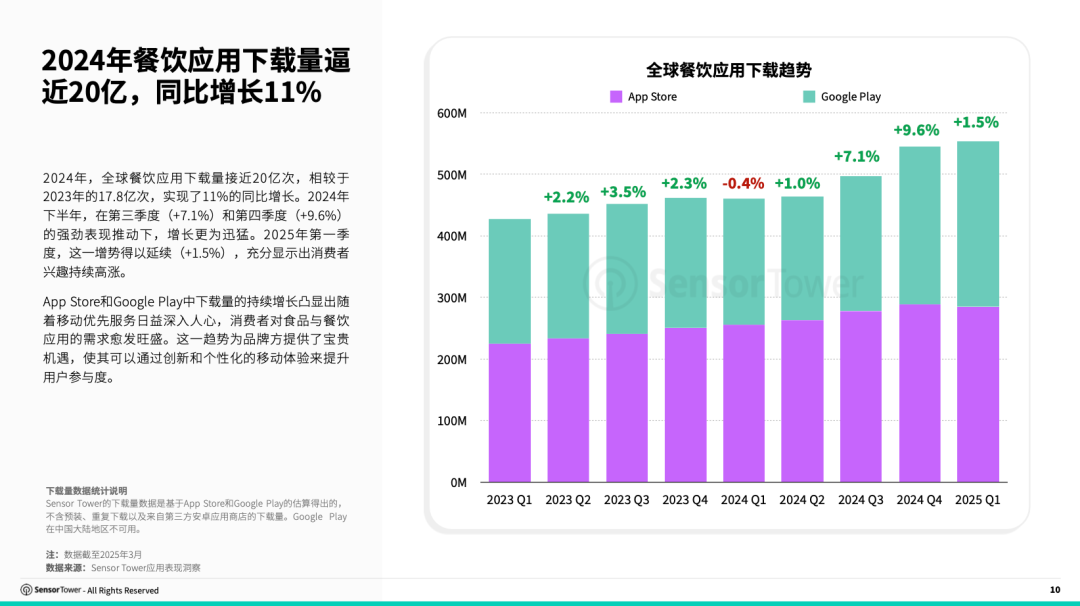
Core Insights - In 2024, global downloads of food and beverage applications are expected to reach nearly 2 billion, representing an 11% year-over-year increase from 1.78 billion in 2023 [1][2] - The Asia-Pacific region is identified as the primary growth engine for the food and beverage app market, with India showing remarkable growth due to rapid digitalization and smartphone penetration [1][4] Download Growth - The download growth is particularly strong in the second half of 2024, with Q3 and Q4 showing increases of 7.1% and 9.6% respectively, continuing into Q1 2025 with a 1.5% increase [2] - The sustained growth in downloads on App Store and Google Play highlights the increasing consumer demand for food and beverage applications [2] Regional Performance - India experienced explosive growth in app downloads, with a year-over-year increase of 143%, surpassing 113 million downloads by Q1 2025 [4] - Southeast Asia saw an 18% growth, while South Korea's growth was 4%. In contrast, China's iOS market saw a slight decline of 1.6% due to market saturation and competition [4] - The U.S. and Japan maintained steady growth at approximately 3% [4] Subcategory Growth - Grocery delivery applications led the growth in 2024 with a 36% increase, driven by consumer demand for convenience [6] - Restaurant and dining applications grew by 29%, while dine-in restaurant apps increased by 16% [6] - Fast food applications saw a modest growth of 3.3%, while restaurant ordering and delivery apps grew by 7% [6] Leading Applications - In Q1 2025, Zepto led the downloads in the grocery delivery category, alongside major fast-food brands like McDonald's and KFC [8] - Instamart and BigBasket also showed significant growth, with Blinkit achieving an 80% increase and BigBasket a 148% increase [8] Regional Preferences - The ranking of food and beverage applications reflects diverse regional consumer preferences, with McDonald's leading in Europe and Japan, and DoorDash dominating in the U.S. [11] - Local platforms like Coupang Eats in South Korea and Yakiniku King in Japan are particularly favored by consumers [11] Role of Digital Advertising - Digital advertising remains a key driver of growth in the food and beverage sector, with U.S. brands spending over $600 million monthly, achieving over 60 billion impressions [14] - Major brands like Yum Brands and McDonald's maintain influence through strategic advertising investments [18] Localization Strategies - Brands are increasingly localizing their marketing efforts to resonate with regional audiences, incorporating culturally relevant promotions and partnerships [21] - Examples include KFC's collaboration with the popular game Genshin Impact in Japan and Baedal Minjok's value-focused promotions in South Korea [21] Future Outlook - The landscape for food and beverage applications is expected to continue evolving, with grocery delivery and specialty dining apps gaining more attention [22] - As competition intensifies, brands will need to refine their digital advertising strategies, emphasizing personalized marketing and seamless user experiences [22]
中国大厂,争夺巴西「互联网下半场」
创业邦· 2025-05-24 10:33
Core Viewpoint - Brazil is emerging as a significant destination for Chinese companies seeking to expand globally, driven by its large market size, digital habits, and relatively lower competition compared to other Latin American countries [3][5][6]. Group 1: Investment and Expansion - Chinese companies are making substantial investments in Brazil, with Meituan planning to invest $1 billion in its food delivery service Keeta over the next five years [3]. - Didi has relaunched its food delivery service "99 Food" in Brazil, indicating a strategic move to integrate various services [3][4]. - Mixue Ice Cream plans to open its first store in Brazil and establish a supply chain factory, with an investment of no less than 4 billion RMB in local agricultural products over the next 3-5 years [4]. Group 2: Market Potential - Brazil is viewed as the "last blue ocean" for many Chinese companies, with a population of 210 million and a projected GDP per capita of approximately $11,178 in 2024 [5][6]. - The average consumer spending in Brazil is around $6,800, which is higher than in China, indicating a strong consumer willingness to spend [6]. - The internet penetration rate in Brazil is high, with approximately 86.2% of the population being internet users, and 99.1% of respondents owning smartphones [8]. Group 3: E-commerce and Competition - Brazil's e-commerce sales surged from approximately 126 billion BRL in 2020 to 169.6 billion BRL in 2022, attracting various Chinese e-commerce platforms [10]. - Local giants like Mercado Livre dominate the e-commerce market, contributing 51.7% of the new GMV in 2023-2024, making it challenging for new entrants [24][25]. - The food delivery market in Brazil is highly competitive, with local platform iFood holding over 80% market share, making it difficult for Didi's 99 Food to gain traction [23][24]. Group 4: Challenges and Risks - Brazil's complex tax system poses significant challenges for foreign companies, with compliance costs exceeding 1% of revenue [12][13]. - The logistics and payment infrastructure in Brazil is underdeveloped, with a significant portion of the population relying on cash transactions [16]. - Recent tax reforms have increased the burden on cross-border e-commerce, complicating the operational landscape for companies like SHEIN and Shopee [13][15].





36氪出海·关注|另一场外卖“大战”,在巴西
3 6 Ke· 2025-05-16 07:24
Core Viewpoint - The competition in Brazil's food delivery market is intensifying as major players like Meituan and Didi enter the scene, prompting existing platforms like iFood to adapt through strategic partnerships and user integration with Uber [4][5]. Group 1: Market Dynamics - Brazil's food delivery market is the largest in Latin America, experiencing a 50.8% growth from 2019 to 2023, reaching a value of 139 billion reais (approximately 177.3 billion yuan) [5]. - iFood holds over 80% market share, with 55 million active users and 360,000 couriers, processing over 120 million orders monthly across approximately 1,500 cities [4]. - The market is expected to grow at a rate of 6.9% until 2028, indicating potential for increased user engagement and penetration in lower-tier cities [5]. Group 2: Competitive Landscape - iFood has successfully outperformed competitors like Uber Eats and 99Food, which exited the Brazilian market due to competitive pressures [5][7]. - The company employs aggressive subsidy strategies to enhance user frequency and has exclusive agreements with restaurants, limiting competitors' access to key supply sources [7]. - Didi, despite 99Food's exit, has a substantial user base in Brazil, with 50 million active users and 700,000 active riders, providing a strong foundation for its re-entry into the food delivery market [7]. Group 3: Strategic Partnerships and Investments - iFood has formed a strategic partnership with Uber, allowing mutual user access between the two platforms, set to launch in the second half of the year [4]. - Meituan plans to invest $1 billion in Brazil over the next five years to support its new service, Keeta, while Didi is also investing 1 billion reais (approximately 1.279 billion yuan) to restart its food delivery operations [4][5]. - iFood's profitability has significantly improved, with a reported operating profit of $96 million for the fiscal year ending March 2024, marking a 249% year-on-year increase [6].
美团外卖进巴西 将与滴滴短兵相接
Zhong Guo Jing Ying Bao· 2025-05-13 11:41
Core Insights - Meituan's CEO Wang Xing made a rare public appearance to promote the entry of its food delivery service Keeta into Brazil, signing an investment agreement to invest $1 billion over the next five years [2][3] - The Brazilian food delivery market is competitive, with Meituan's old rival Didi also planning to re-enter the market with its "99 Food" brand [6][7] Group 1: Meituan's International Expansion - Keeta, launched in Hong Kong in May 2023, has quickly become the leading food delivery platform there, utilizing promotional strategies like "half-price first order" and "free delivery" [2] - Meituan's international strategy involves a gradual expansion from Hong Kong to Saudi Arabia and now Brazil, validating and replicating its business model [4] - The investment in Brazil aims to build a nationwide instant delivery network, enhancing local consumer experience and supporting restaurant partners with various digital tools [3][5] Group 2: Market Dynamics and Competition - The Brazilian food delivery market is dominated by iFood, which holds an 80% market share, presenting a significant challenge for new entrants like Meituan and Didi [5][6] - Meituan's planned $1 billion investment represents 20% of its projected net profit for 2024, indicating a strong commitment to the Brazilian market [5] - Didi's re-entry into Brazil with its existing resources, including 70,000 active riders, positions it to compete effectively against Meituan, focusing on user subsidies and operational efficiency [7]

中国大厂扎堆去巴西送外卖,为什么?
第一财经· 2025-05-13 09:44
Core Viewpoint - Chinese internet companies are increasingly targeting Brazil as a key market for expansion, with significant investments planned in the food delivery sector [3][4]. Group 1: Company Initiatives - Meituan plans to introduce its food delivery service Keeta in Brazil, investing $1 billion over the next five years to develop a nationwide instant delivery network [5]. - Didi is also expanding its services in Brazil, planning to build 10,000 electric vehicle charging stations and re-launching its food delivery service under the "99 Food" brand [2][6]. - Didi has approximately 700,000 active riders and 50 million active users in Brazil, covering over 3,300 towns and cities [6]. Group 2: Market Potential - Brazil is the largest market in Latin America, with a projected online food delivery market size of $18.8 billion by 2024, making it one of the top ten markets globally [9][10]. - The entry of Chinese companies into Brazil is driven by the country's large population, its regional influence, and favorable geopolitical relations between China and Brazil [9]. Group 3: Competitive Landscape - The Brazilian food delivery market is currently dominated by the local platform iFood, which has a market share of 89% and over 60 million customers [13][14]. - iFood's success is attributed to its aggressive advertising strategies and exclusive partnerships with restaurants, which have raised concerns about competition [14]. - The return of Didi and the entry of Meituan are seen as positive developments by local restaurant associations, aiming to increase competition and diversify service offerings [12]. Group 4: Strategic Advantages - Chinese companies are perceived to be more flexible and technologically advanced, leveraging successful strategies from other markets to adapt to local conditions in Brazil [14][15]. - Didi's experience in Mexico and Colombia, where it has successfully integrated ride-hailing, food delivery, and financial services, is expected to enhance its operations in Brazil [15].