
海康威视

Search documents
研判2025!中国视频交换系统行业概述、市场规模、企业及行业趋势分析:5G-A/6G与超高清驱动,视频交换系统迈向基础设施新阶段[图]
Chan Ye Xin Xi Wang· 2026-01-04 01:17
Core Insights - The Chinese video exchange system industry is entering a new phase of development driven by technology, with a market size projected to reach approximately 12.865 billion yuan in 2024, reflecting a year-on-year growth of 5.27% [1][8]. Industry Overview - Video exchange systems (MTP) are integrated hardware and software systems that ensure secure video transmission across networks through device authentication, signal filtering, and one-way transmission mechanisms, supporting high reliability in public safety and emergency command scenarios [4][1]. Industry Chain - The upstream of the video exchange system industry consists of video user authentication servers (TMS), video access authentication servers (UMS), and security isolation gateways (GAP) [4]. - The midstream includes system integration and equipment manufacturing, while the downstream applications span video surveillance, intelligent transportation, emergency command, public safety, remote conferencing, data sharing, and smart services [4]. Market Size - The market for video exchange systems in China is expected to grow significantly, driven by the explosion of 5G-A/6G, ultra-high-definition, and immersive video applications, evolving from a simple audio-video connection tool to a key infrastructure for digital transformation [1][8]. Key Companies' Performance - The industry is characterized by a competitive landscape where major players like Huawei lead with end-to-end solutions and 5G/AI integration, while specialized companies like Qiming Star focus on video IoT security [9][10]. - Guangha Communication has reported a revenue of 332 million yuan in the first three quarters of 2025, marking a year-on-year increase of 41.90% [10]. - Xingtong New Science and Technology has achieved a revenue of 91 million yuan in the same period, reflecting a growth of 31.99% [11]. Industry Development Trends 1. The transition to IP-based technology and cloud-network integration is reducing system wiring complexity and costs, with standards like NDI and SMPTE ST 2110 becoming mainstream [13]. 2. AI integration is transforming video exchange systems from mere transmission channels to intelligent hubs capable of real-time analysis and insights [14]. 3. The national strategy for information technology innovation is driving the restructuring of the industry towards self-sufficiency and ecological reconstruction, leading to a more diversified competitive landscape [15][16].





2025中国大数据产业白皮书
Sou Hu Cai Jing· 2026-01-04 00:31
Core Insights - The "2025 China Big Data Industry White Paper" emphasizes that big data has become a core driving force for transformation in the digital age, characterized by its scale, diversity, speed, and value [1][9][38] - The global big data market is expected to grow steadily, with IDC predicting a total IT investment of approximately $413.4 billion by 2025, with the Asia-Pacific region leading at a 22% growth rate [1][11] - China's big data industry is projected to exceed 3 trillion yuan by 2025, accounting for 65% of the Asia-Pacific market [1][11] Industry Growth and Trends - By 2025, global data traffic is expected to reach hundreds of exabytes (EB), with a tenfold increase in storage capacity over the next decade [1][11] - The integration of technologies such as 5G, IoT, cloud computing, and AI is enhancing the efficiency of data collection, storage, and processing [1][11][20] - The Chinese big data industry has formed 38 sub-sectors with 49,248 companies, including leading firms like Alibaba Cloud, Huawei, and Hikvision, indicating a rising market concentration [1][11] Applications Across Sectors - Big data applications are penetrating various industries, including finance, healthcare, agriculture, manufacturing, and transportation, addressing core pain points [1][11][19] - In finance, big data enables precise risk control and inclusive finance, while in healthcare, it supports accurate diagnosis and health management [1][11][19] - The retail sector benefits from big data through enhanced marketing strategies, inventory management, and supply chain optimization [1][29][30] Future Outlook - The future of big data will see deeper integration with AI, driving transformations across production paradigms, social structures, and cultural prosperity [1][11][38] - Ethical norms and governance systems will be essential to address challenges associated with big data, supporting high-quality development of the digital economy [1][11][38]

软体机器人新进展!这款高空缆绳攀爬机器人,仅110克却能扛10倍自重
机器人大讲堂· 2026-01-03 09:14
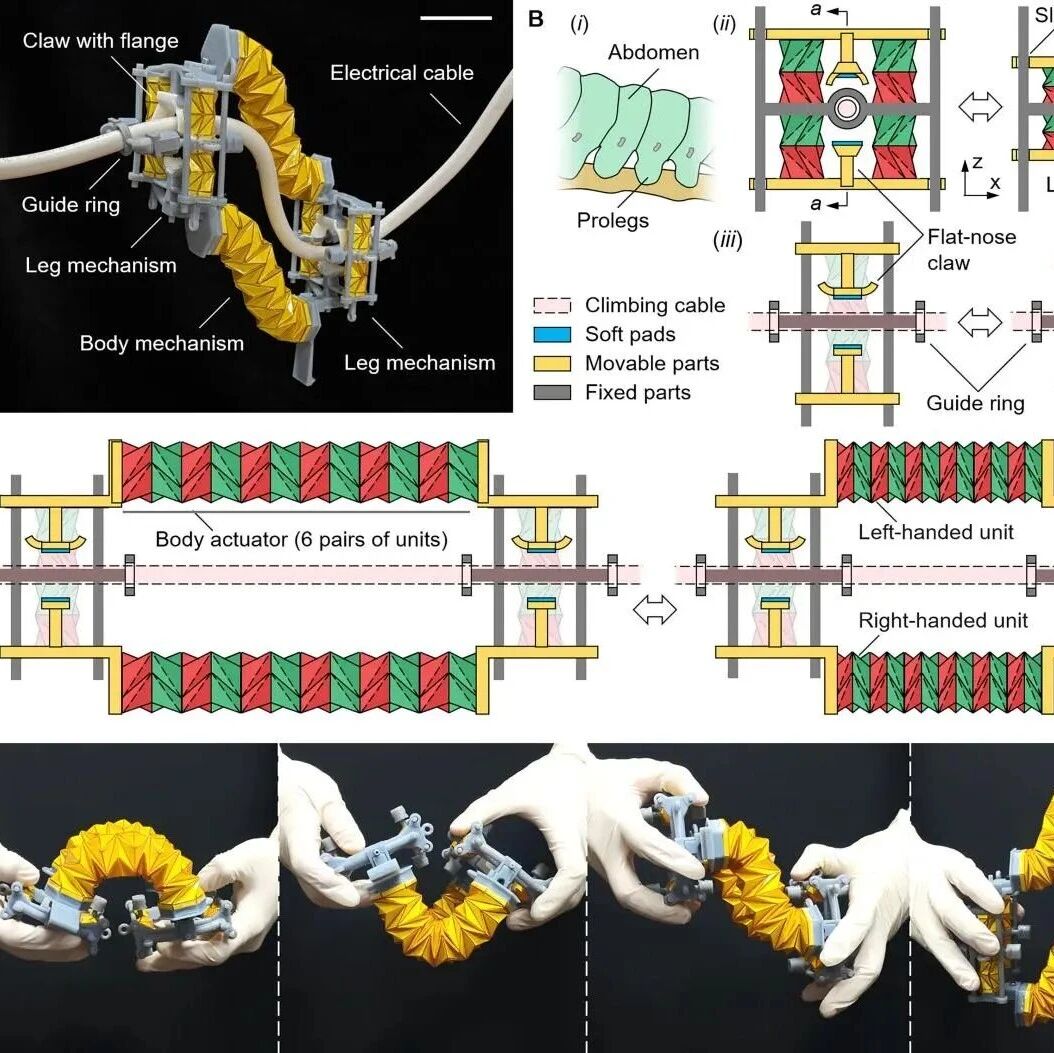
Core Concept - The article discusses a new climbing robot inspired by biomimicry and origami, designed to inspect and maintain high-voltage cables and other infrastructure safely and efficiently [1][2]. Design Inspiration and Core Concept - The robot's design combines biomimicry and origami, mimicking the "anchoring-crawling" gait of caterpillars for movement [2]. - The actuation mechanism utilizes a Kresling origami pattern, allowing significant axial deformation when driven by air pressure [2][4]. Climbing Robot Design and Working Principle - The robot weighs approximately 110 grams and consists of a body mechanism and two leg mechanisms, featuring two parallel stable origami actuators for smooth movement [5]. - The design allows for different mechanical characteristics by adjusting the geometric parameters of the origami units, enabling stable and energy-efficient operation [4]. Performance Characteristics and Testing Results - The robot can adapt to a wide range of cable diameters, from less than 1 millimeter to 32 millimeters, and can carry loads over ten times its weight, demonstrating a load capacity of 1.2 kilograms on a 30-millimeter diameter cable [16][18]. - It has shown excellent adaptability in various conditions, including dirty, oily, and icy cables, maintaining a crawling speed of 10.8 millimeters per second even on the smoothest surfaces [16]. - The robot's dual-stable self-locking feature enhances safety, allowing it to remain securely attached to cables even in the event of power loss [18]. Future Potential and Applications - The robot currently requires an external air source and control system, limiting its operational range, but future improvements aim to integrate these systems for autonomous climbing [20]. - Plans include adding pressure sensors for automatic grip detection and conducting tests in real outdoor environments to enhance its adaptability and reliability [20].
美国半导体技术霸权的底层支撑与中国突围
是说芯语· 2026-01-03 00:52
Core Viewpoint - The article discusses the absolute monopoly of the United States in the semiconductor industry, highlighting the dominance in core technologies such as design tools, high-end IP cores, advanced architectures, key manufacturing equipment, and testing instruments. This monopoly creates significant barriers to entry and establishes a comprehensive technological hegemony that is difficult to challenge globally, while also leaving room for diversification and breakthroughs in specific fields, particularly in China's domestic semiconductor industry [1]. Group 1: Chip Design Tools (EDA) - The monopoly is held by Synopsys, Cadence, and Siemens EDA, which together account for over 95% of the global market share, providing a comprehensive toolchain for chip design [3]. - These tools are essential for advanced process nodes of 7nm and below, featuring capabilities such as lithography simulation and yield optimization, making them critical infrastructure for chip development [3]. - The high density of patent barriers and deep collaboration with leading foundries like TSMC and Samsung create strong user ecosystem stickiness, making it difficult for latecomers to replace these tools [3]. Group 2: High-Performance IP Cores and Architectures - The monopoly is dominated by X86 architecture (Intel, AMD), GPU architecture (NVIDIA, AMD), and AI acceleration IP (NVIDIA, Xilinx), with ARM's technology also heavily influenced by U.S. regulations [6]. - The X86 architecture leads in high-performance computing, while NVIDIA's CUDA architecture defines global AI computing standards, creating dual barriers of performance and ecosystem [6]. - Global chip design companies are highly dependent on U.S. IP, and the U.S. can restrict access to these IPs through licensing, directly impacting the design capabilities of other nations [6]. Group 3: Key Manufacturing Equipment - The monopoly is held by U.S. companies like Applied Materials, Lam Research, and KLA, which lead in critical equipment for etching, film deposition, and process inspection [9]. - These companies provide essential technologies for advanced processes, with high barriers to entry due to long R&D cycles and significant capital investment [9]. - The dependency of global foundries like TSMC and Samsung on U.S. equipment means that U.S. export controls can directly affect the expansion and technological upgrades of advanced manufacturing capacities [9]. Group 4: High-End Chip Design and Architecture Innovation - U.S. companies like NVIDIA, Qualcomm, AMD, and Apple dominate the global technology direction in AI chips, mobile terminal chips, and high-performance computing chips [12]. - Continuous high R&D investment (approximately 17.7% of semiconductor industry revenue) and strong ecosystem integration capabilities allow these companies to maintain significant advantages [12]. - The U.S. leads in defining the demand and technological evolution of high-end chips, influencing the global semiconductor supply chain [12]. Group 5: Semiconductor Testing and Packaging Technologies - The monopoly is held by U.S. companies like Teradyne and Cohu, which dominate the high-end chip testing equipment market [15]. - These companies provide comprehensive testing solutions that meet the high precision requirements of advanced process nodes [15]. - The global chip production's yield control and quality assurance are highly reliant on U.S. testing equipment, and export restrictions can impact production efficiency and quality stability [15]. Group 6: Core Materials Technology - U.S. companies like Dow Chemical, DuPont, and GlobalFoundries dominate the market for critical semiconductor materials such as photoresists and electronic specialty gases [18]. - The high purity and stability requirements for semiconductor materials create significant barriers for new entrants [18]. - Advanced process chip manufacturing relies over 80% on U.S. core materials, and U.S. export controls can directly affect global production capacities [18]. Group 7: Semiconductor Software and Ecosystem - U.S. companies like Microsoft, Google, and NVIDIA dominate the software ecosystem that supports chip applications [21]. - The NVIDIA CUDA ecosystem monopolizes AI training and inference software, with over 90% of AI developers using the CUDA platform [21]. - The strong network effects of these ecosystems create significant barriers for new entrants, making it difficult for other countries to commercialize breakthroughs in high-performance chip development [21]. Group 8: Industry Standard Setting Authority - The U.S. leads international standard organizations like IEEE and JEDEC, controlling the core industry standards for chip interfaces and performance specifications [24]. - The binding of industry standards with technology patents creates dual barriers that are difficult for non-U.S. companies to overcome [24]. - The U.S. can guide global semiconductor technology development through standard-setting, impacting the innovation paths of non-U.S. enterprises [24]. Group 9: High-End Semiconductor Products and Solutions - U.S. companies like NVIDIA, Intel, Qualcomm, and Micron hold a dominant share in the global high-end semiconductor product market [27]. - These companies have established significant performance advantages through long-term technological accumulation and deep integration with downstream manufacturers [27]. - The global technology industry is highly dependent on U.S. semiconductor products, and U.S. export controls can directly influence the development of global technology sectors [27].


Momenta和华为智驾谁能胜出?
自动驾驶之心· 2026-01-02 08:08
作者 | 历不白@知乎 编辑 | 自动驾驶之心 原文链接: https://www.zhihu.com/question/1899822735284244767/answer/1989321465271706827 点击下方 卡片 ,关注" 自动驾驶之心 "公众号 戳我-> 领取 自动驾驶近30个 方向 学习 路线 >>自动驾驶前沿信息获取 → 自动驾驶之心知识星球 本文只做学术分享,如有侵权,联系删文 中国市场太卷了, 智驾没有芯片根本没有议价权。 我们回顾历史来说明一下。历史虽然不能说明一切,但是历史却是现实的一面镜子。 在 2004 年至 2010 年间。全球视频监控市场正经历从模拟信号向数字和网络监控。 当时的行业话语权掌握在德州仪器(Texas Instruments, TI)和安霸(Ambarella)等老牌半导体巨头手中 。 TI 作为通用 DSP(数字信号处理)领域的霸主,其方案如经典的 DM365、DM368 系列芯片,本质上是通用的计算引擎。 这意味着下游的安防器材厂商不仅要购买昂贵的芯片,还需要配备庞大的软件团队,在底层的 DSP 上进行极具挑战性的视 频编解码开发和图像算法调优。 对于 ...

2025年贵州省煤炭工业协会、贵州省煤炭学会年度大会暨贵州省煤炭行业高质量发展大会在贵阳举行
Zhong Guo Neng Yuan Wang· 2025-12-31 15:32
Core Insights - The conference held on December 29, 2025, in Guiyang focused on the high-quality development of the coal industry in Guizhou, emphasizing the integration of artificial intelligence and coal mining [1][3] - The event gathered over 200 leaders, experts, and industry representatives to discuss achievements, recognize outstanding contributions, and plan future developments in the coal sector [2][9] Group 1: Industry Development and Strategies - The conference highlighted the importance of the coal industry as a pillar of Guizhou's economy and its role in promoting high-quality industrial development [4] - Recommendations for industry transformation included leading with "intelligentization," adhering to "green" practices, and exploring "integration" paths to extend the industrial chain [3][4] - The establishment of the Guizhou Coal Industry Association's Artificial Intelligence Professional Committee marks a significant step towards intelligent transformation in the coal sector [7] Group 2: Achievements and Future Plans - The Guizhou Coal Industry Association reported positive progress in production efficiency, structural optimization, and technological innovation during 2025, while also acknowledging challenges such as safety and environmental constraints [4][5] - Plans for 2026 include advancing a provincial coal trading platform, establishing safety standards, and promoting intelligent coal washing facilities [5] - The conference featured academic reports on innovative technologies addressing challenges in coal mining, such as gas control and resource recovery [6] Group 3: Recognition and Collaboration - Awards were presented to outstanding individuals in the coal sector, including the "Most Beautiful Coal Science Workers" and recipients of the Guizhou Coal Youth Science Award [8] - The conference facilitated strategic partnerships among various organizations to enhance technological development and talent cultivation in the coal industry [7] - Participants expressed a commitment to leveraging the conference as a platform for collaboration and to further the "rich mine and precise mining" strategy [9]
年内1494家A股公司回购1392亿元,美的集团115亿元居首
Bei Ke Cai Jing· 2025-12-31 14:23
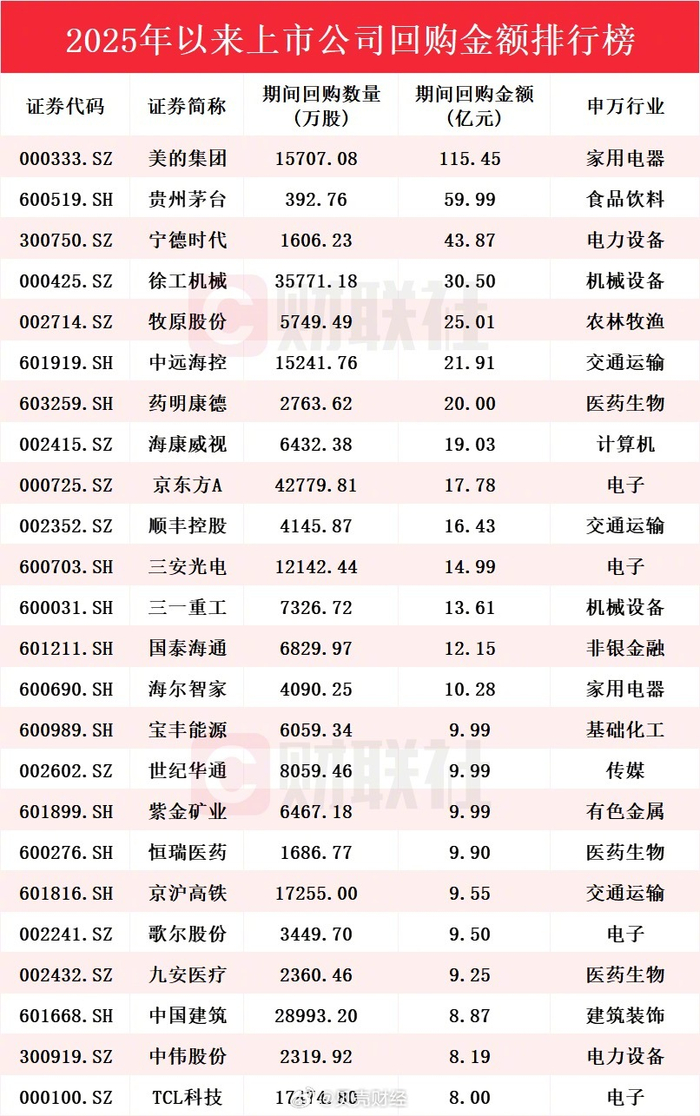
Group 1 - As of the report date, 1494 A-share companies have implemented share buybacks in 2025, with a total amount exceeding 1392.84 billion yuan [1] - Among these, 14 companies have repurchased more than 1 billion yuan, with Midea Group leading at 115.45 billion yuan [1] - Other notable companies include Kweichow Moutai with 59.99 billion yuan and CATL with 43.87 billion yuan in buybacks [1] Group 2 - The top companies by buyback amount include: - Midea Group: 15,707.08 thousand shares, 115.45 billion yuan [1] - Kweichow Moutai: 392.76 thousand shares, 59.99 billion yuan [1] - CATL: 1,606.23 thousand shares, 43.87 billion yuan [1] - XCMG Machinery: 35,771.18 thousand shares, 30.50 billion yuan [1] - Muyuan Foods: 5,749.49 thousand shares, 25.01 billion yuan [1]






2025浙股收官:731家A股公司稳居全国第二,科创引领高质量发展新征程
Xin Lang Cai Jing· 2025-12-31 11:33
Group 1 - As of December 31, 2025, Zhejiang has 731 A-share listed companies, an increase of 16 from the beginning of the year, ranking second nationally [1][4] - The stock performance in Zhejiang remains strong, with 612 companies rising and 116 falling; the top five stocks by growth are Tianpu Co., Hengbo Co., Pinming Technology, Zhejiang Rongtai, and Zhejiang Dongri, with growth rates of 1,645.35%, 527.03%, 428.78%, 419.00%, and 357.82% respectively [1][5] - There are currently 10 companies in Zhejiang with a market capitalization exceeding 100 billion, including Hikvision and Sanhua Intelligent Control, which increased in value by 273.4 billion and 222.8 billion respectively [5] Group 2 - In 2025, 17 companies from Zhejiang successfully went public, with 5 on the Shanghai main board, 2 on the Sci-Tech Innovation Board, 3 on the Shenzhen main board, 4 on the Growth Enterprise Market, and 3 on the Beijing Stock Exchange [2][6] - The geographical distribution of new listings shows that Hangzhou and Taizhou are the main hubs, with 4 new listings each, contributing to a more balanced regional layout [2][6] - The capital market ecosystem in Zhejiang has improved, with three companies migrating in and three companies delisting, indicating an effective market exit mechanism [2][6] Group 3 - New companies listed in 2025 include Han Shuo Technology, a leading provider of digital solutions for retail stores, and Zhejiang Huaye, which has maintained a leading market share in screw and barrel products [3][7] - Key industries in Zhejiang include new energy, batteries, chemicals, photovoltaics, and semiconductors, with strategic emerging industries driving high-quality transformation in the capital market [3][7]
A股2025市值增长九强省盘点:浙江TOP5企业的增量贡献不到两成 公牛集团为市值缩水最严重企业
Xin Lang Cai Jing· 2025-12-31 09:49
Group 1 - The core viewpoint of the articles is that the market capitalization of A-share listed companies in Zhejiang Province increased by 23,386 billion yuan in 2025, representing a growth of 34.01% compared to the beginning of the year [1][2] - Leading companies contributed significantly to the market capitalization increase, with Sanhua Intelligent Controls, Century Huatong, Huayou Cobalt, Wolong Electric Drive, and Top Group contributing 1,450 billion yuan, 874 billion yuan, 798 billion yuan, 543 billion yuan, and 515 billion yuan respectively, accounting for a total of 17.88% of the overall increase [1][2] - The companies with the most significant market capitalization reduction in Zhejiang Province were Bull Group, Samsung Medical, Hikvision, Zhejiang Energy Power, and Flat Glass, with each experiencing a decline of no more than 20 billion yuan [1][2]

国产算力水平有望不断提升,AI人工智能ETF(512930)交投活跃
Xin Lang Cai Jing· 2025-12-31 05:23
Group 1 - The core viewpoint of the news highlights the rapid growth and innovation in the demand for AI-related computing power chips in China, supported by the government's "Artificial Intelligence +" initiative [1] - The domestic chip products are accelerating their adaptation in various application scenarios, with significant improvements in performance, particularly through technologies like "super nodes" [1] - The collaboration across the industrial chain is expected to enhance domestic computing power levels, providing robust support for the development of the AI industry [1] Group 2 - The AI-driven demand for high-performance storage products such as DDR5 RDIMM and eSSD is rapidly increasing, indicating a new upward cycle in the global storage industry, with price increases expected to continue into 2026 [1] - The transition of DRAM and NAND to 3D structures is significantly boosting the demand for etching and thin-film deposition equipment, with the investment per wafer reaching 1.7 to 1.8 times previous levels, indicating clear growth momentum for the semiconductor equipment sector [1] - The CSI Artificial Intelligence Theme Index (930713) includes 50 listed companies involved in providing resources, technology, and application support for AI, reflecting the overall performance of AI-related securities [2]