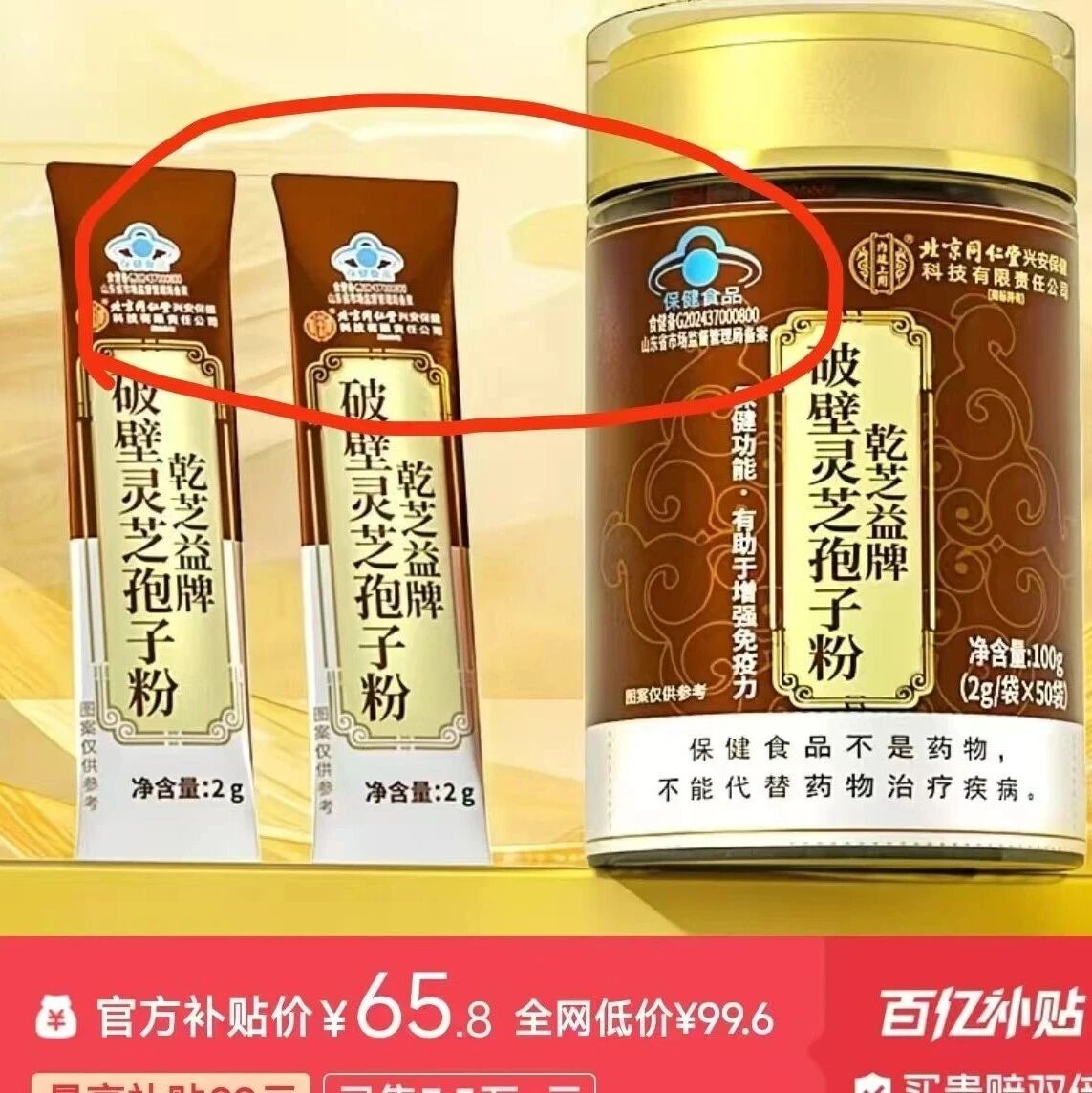
同仁堂

Search documents
同仁堂卷入磷虾油造假风波陷信任危机
Chang Jiang Shang Bao· 2025-12-17 02:54
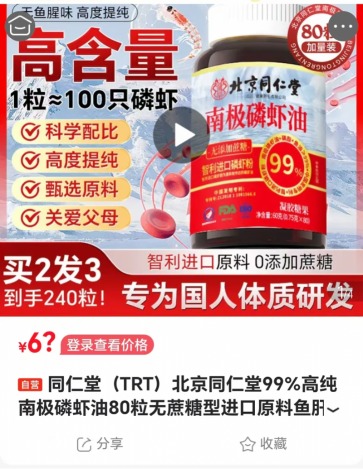
Core Viewpoint - The company Tong Ren Tang is embroiled in a scandal regarding the authenticity of its Antarctic krill oil product, which has been found to contain no phospholipids despite claims of high purity [1][2][3] Group 1: Product Quality Issues - A product labeled "Beijing Tong Ren Tang 99% High Purity Antarctic Krill Oil" was found to have a phospholipid content of 0%, raising suspicions of fraud [1][2] - The Shanghai Consumer Protection Committee is investigating the product and has summoned the involved companies for explanations [2] - The product was sold at prices ranging from 35 to 100 yuan on various e-commerce platforms, with misleading marketing claims [2] Group 2: Company Response - On December 15, the company ordered the cessation of sales of the implicated product and initiated a full traceability check [3] - The company stated that the product was sold without authorization and plans to take legal action against the responsible parties [3] Group 3: Historical Context of Quality Issues - The company has faced multiple product quality scandals over the years, including issues with honey, mercury levels in products, and contamination in foot bath products [4][5][6] - These recurring issues have led to a significant erosion of consumer trust in the brand [6][7] Group 4: Financial Performance - The company's revenue and net profit have been declining, with a reported revenue of 133.08 billion yuan and a net profit of 11.78 billion yuan in the first three quarters of 2025, representing declines of 3.70% and 12.78% respectively [8] - The company's stock price has dropped significantly, from a peak of 64.28 yuan per share to around 33 yuan, resulting in a market capitalization of approximately 450 billion yuan, which is less than half that of competitors like Yunnan Baiyao and Pian Zai Huang [8]

青年早新闻 | 日本民众排长队告别大熊猫,每批只能看1分钟
Zhong Guo Qing Nian Bao· 2025-12-17 01:44
Group 1 - The last two giant pandas in Japan, "Xiaoxiao" and "Leilei," are scheduled to return to China in early 2026, prompting a significant public farewell event at Ueno Zoo in Tokyo [1][3] - From December 16, Ueno Zoo implemented visitor restrictions for the panda viewing area, allowing each group of visitors only one minute to observe the pandas [1][5] - Long queues were reported, with visitors typically waiting over 40 minutes on weekdays and more than an hour on weekends to see the pandas [1][7] Group 2 - The Australian government has enacted a law prohibiting social media access for individuals under 16, with penalties for non-compliance reaching up to 49.5 million AUD (approximately 230 million RMB) [11] - This legislation has garnered international attention, with countries like the UK, France, Denmark, and Norway expressing support, and others like Indonesia and Malaysia exploring similar regulations [11] Group 3 - The Shanghai Consumer Protection Commission has raised concerns regarding a product labeled as "99% high-purity Antarctic krill oil" from Beijing Tongrentang, which was found to contain no actual krill oil [19][20] - The commission has urged the involved companies to conduct self-inspections, apologize to consumers, and recall the defective products [20]


风口财评|几百年商誉也禁不起“贴牌”消耗
Da Zhong Ri Bao· 2025-12-17 01:24
Group 1 - The incident involving a product claiming "99% high purity" Antarctic krill oil, which was found to have a phospholipid content of 0, has led to a trust crisis for Tong Ren Tang, a brand with a 355-year history [1] - The involved product was produced under a private label, highlighting a lack of quality control due to uncontrolled brand authorization, which has damaged consumer trust and the brand's long-standing reputation [1] - The core asset of a time-honored brand is not the trademark but the trust built over generations through quality, as emphasized by Tong Ren Tang's principle of meticulous production and quality assurance [1] Group 2 - Many time-honored brands view trademark authorization as a quick profit method, but short-term gains do not equate to long-term brand value [2] - The Ministry of Commerce reports that among 1,455 "Chinese time-honored brands," nearly 1,000 are involved in intangible cultural heritage projects, indicating that these brands carry both commercial value and cultural significance [2] - Tong Ren Tang Group should not merely issue statements to evade responsibility but must establish a comprehensive quality control system and clarify the responsibilities associated with trademark authorization [2]
同仁堂卷入磷虾油造假风波陷信任危机 老字号失色市值450亿不及云南白药一半
Chang Jiang Shang Bao· 2025-12-17 00:19
Core Viewpoint - The long-established brand Tong Ren Tang (600085.SH) is embroiled in a scandal regarding the authenticity of its Antarctic krill oil product, which has been found to contain no phospholipids despite claims of a 43% content [1][2]. Group 1: Product Scandal - The Shanghai Consumer Protection Commission released test results showing that a product labeled "Beijing Tong Ren Tang 99% High Purity Antarctic Krill Oil" had a phospholipid content of 0, raising suspicions of fraud [1][2]. - The product was sold at prices ranging from 35 to 100 yuan on various e-commerce platforms, with misleading claims about its quality and content [2]. - Tong Ren Tang has ordered the involved company, Anhui Habao Pharmaceutical Co., to cease distribution of the product and has initiated legal action against them for unauthorized use of its brand [3]. Group 2: Historical Issues - Tong Ren Tang has faced multiple product quality issues over the years, including incidents involving excessive nitrite levels, illegal additives, and contamination [5][6]. - The company has been involved in various scandals, such as the "honey incident" in 2018 and the mercury contamination in its Ren Dan product in 2024 [4][5]. Group 3: Financial Performance - The company's revenue and net profit have been declining, with a reported revenue of 133.08 billion yuan and a net profit of 11.78 billion yuan in the first three quarters of 2025, representing year-on-year declines of 3.70% and 12.78%, respectively [8]. - In 2024, the company experienced a slowdown in growth, with revenue of 185.97 billion yuan, a mere 4.12% increase, and a net profit decline of 8.54% [7][8]. - The market performance has also been poor, with the stock price dropping from 64.28 yuan per share in May 2023 to around 33 yuan by December 2025, resulting in a market capitalization of approximately 450 billion yuan, significantly lower than competitors like Yunnan Baiyao and Pian Zai Huang [8].
国家中医药管理局原局长于文明被起诉;江西发文支持连锁药店发展
2 1 Shi Ji Jing Ji Bao Dao· 2025-12-17 00:10
Policy Developments - Jiangxi Province has introduced 13 measures to promote the high-quality development of the pharmaceutical retail chain industry, including support for enterprise integration, simplified approval processes, and encouragement of innovative business models [1] - The new policies aim to address industry pain points, such as supporting mergers and acquisitions, and promoting health service extensions like chronic disease management [1] Medical Device Approvals - The National Medical Products Administration has approved two innovative medical devices: a proton therapy system for treating malignant tumors and a deep brain stimulation system for opioid addiction treatment [2] Clinical Trials - Haikang announced that its subsidiary received clinical trial approval for four innovative drugs targeting inflammatory bowel disease, respiratory diseases, acute pain, and muscular dystrophy [3] Capital Market Developments - Changchun High-tech signed an exclusive licensing agreement for the GenSci098 injection project, potentially earning up to $1.365 billion in milestone payments [4][5] Industry Collaborations - Sunshine Nuohuo has partnered with Peking University to establish a joint laboratory focused on innovative drug development, particularly in cell and gene therapy [7] Regulatory Actions - The Shanghai Consumer Protection Committee has addressed issues related to Antarctic krill oil products from Beijing Tongrentang, highlighting quality control failures and potential misrepresentation [10][11]



主要成分含量为0!推脱责任、涉嫌故意造假,同仁堂被约谈
Zhong Guo Ji Jin Bao· 2025-12-16 22:43
Core Viewpoint - The Shanghai Consumer Protection Committee has raised concerns regarding the authenticity of Antarctic krill oil products marketed by Beijing Tongrentang (Sichuan) Health Pharmaceutical Co., Ltd, leading to an investigation and potential legal actions against the involved parties [4][5][9]. Group 1: Product Issues - A product labeled as "99% high-purity Antarctic krill oil" was found to have a phospholipid content of 0%, despite claims of 43% on its packaging [4][5]. - The product's marketing included misleading statements such as "high content," "imported from Chile," and "highly purified," which were proven to be false [5]. Group 2: Company Accountability - Anhui Hab Pharmaceutical Co., Ltd, the manufacturer, admitted that the product did not contain the claimed Antarctic krill oil during production [4][5]. - Beijing Tongrentang (Sichuan) Health Pharmaceutical Co., Ltd, the distributor, denied knowledge of the alleged fraudulent activities and attempted to deflect responsibility [4][5]. Group 3: Regulatory Actions - The Shanghai Consumer Protection Committee has urged the distributor to conduct a self-examination, inform consumers of the situation, issue an apology, and recall the problematic products [5]. - The committee has also notified relevant regulatory authorities in Sichuan to monitor the situation [5]. Group 4: Company Background - Beijing Tongrentang (Sichuan) Health Pharmaceutical Co., Ltd was established in June 2000 and is a member of the Beijing Tongrentang Group, with a 51% stake held by Beijing Tongrentang Health Pharmaceutical Co., Ltd [7][8]. - The company has faced scrutiny in the past for similar issues, including false advertising related to fish oil products [10].
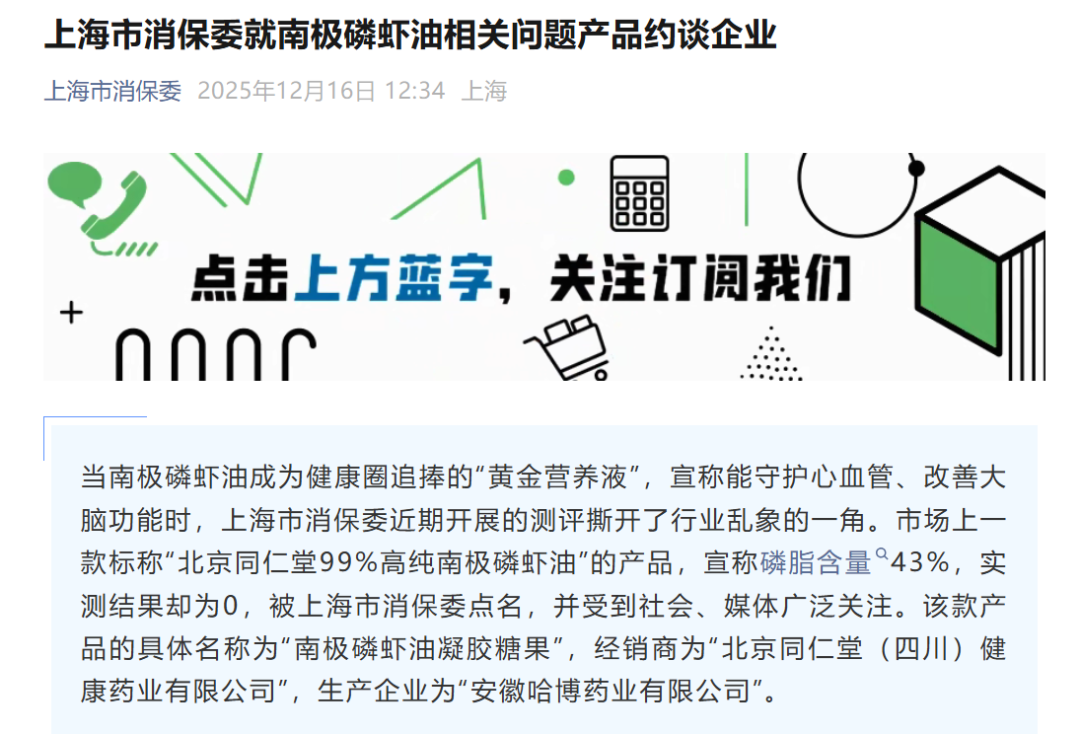
上海消保委就同仁堂南极磷虾油乱象再发文:采购价仅需三四元
Nan Fang Du Shi Bao· 2025-12-16 15:36
Core Viewpoint - The Shanghai Consumer Protection Committee has exposed the "Tongrentang Antarctic Krill Oil" product for having a phospholipid content of 0, raising questions about the integrity of the brand and the supply chain involved in this alleged counterfeit case [1][3]. Group 1: Company Accountability - Beijing Tongrentang (Sichuan) Health Industry Co., Ltd. is questioned for purchasing the product at a price significantly lower than the normal cost of Antarctic krill oil, raising concerns about their quality control measures during product acceptance [3][4]. - The company has been criticized for not conducting thorough checks on the phospholipid content during the procurement process, which is essential for ensuring product quality [3]. - The company claims to be responsible for the products sold, stating that they are currently awaiting responses from relevant authorities regarding the testing of the product [4]. Group 2: Consumer Impact - Consumers are purchasing the product at a retail price of 50-60 yuan per bottle, while the procurement cost is only 3-4 yuan, highlighting a significant markup and questioning the ethical practices of the involved parties [3]. - The presence of such problematic products in the health functional food market not only harms consumer rights but also negatively impacts consumer confidence [3]. Group 3: Legal Actions - The controlling shareholder of Beijing Tongrentang Health Industry Co., Ltd. has announced that the involved product was used without authorization of the "Beijing Tongrentang" name, indicating potential legal violations, and has initiated legal proceedings against the involved companies [5].
远看是同仁堂,近看是“擦边球”!三问“同仁堂”磷虾油事件
Xin Hua She· 2025-12-16 15:12
Core Viewpoint - A product claiming to be "99% pure Antarctic krill oil" from "Beijing Tongrentang" was found to contain "0" krill oil, raising concerns about misleading marketing practices and consumer protection [1][3][12]. Group 1: Product Misrepresentation - The Shanghai Consumer Protection Commission tested 15 popular Antarctic krill oil products and discovered that the product in question had no actual krill oil content, despite claims of 43% phospholipid content [1][3]. - The manufacturer, Anhui Habao Pharmaceutical Co., admitted that the product was customized by the distributor, Beijing Tongrentang (Sichuan) Health Pharmaceutical Co., and did not contain the claimed krill oil [4][8]. - The product was sold at a price of 60 yuan per bottle, while the manufacturer's cost was only 3 to 3.7 yuan, raising questions about the legitimacy of the pricing and the quality of the ingredients [4][11]. Group 2: Misleading Branding - The packaging prominently featured "Beijing Tongrentang," which misled consumers into believing it was a product directly from the well-known brand, while it was actually from a different company [4][7]. - The product's branding utilized a design that closely resembled the core trademark of Beijing Tongrentang, creating a deceptive impression of authenticity [7][19]. - The distributor claimed that misleading packaging decisions were made by the manufacturer, while the manufacturer stated that the packaging was designed according to the distributor's specifications, indicating a shared responsibility for the misleading marketing [8][11]. Group 3: Broader Industry Implications - The incident is not isolated; there is a larger trend of "borderline" products using the Tongrentang name to mislead consumers, with similar products also found on e-commerce platforms [12][18]. - The Shanghai Consumer Protection Commission urged the distributor to conduct a self-examination, apologize to consumers, and recall the problematic products [19][20]. - Beijing Tongrentang Health Pharmaceutical Co. announced that it would stop the distribution of the implicated product and initiate legal action against the responsible parties for unauthorized use of its name [19][20].
机构预计楼市下行趋势将在2026年见底
21世纪经济报道· 2025-12-16 14:40
Group 1 - The core viewpoint of the article is that China's GDP growth rate is expected to reach 4.7% in 2026, with a shift in the economic growth structure towards increased domestic demand and a reduced role of exports compared to 2025 [1][2] - The People's Bank of China is anticipated to implement two rate cuts of 10 basis points each in 2026 to support domestic demand, likely occurring in the first and second quarters [1] - Infrastructure investment is expected to rebound in the first quarter of 2026, despite previous constraints due to local government liquidity issues, with a long-term focus shifting from traditional transportation to new infrastructure such as energy, 5G, and data centers [1] Group 2 - China's export performance has exceeded expectations this year, primarily driven by a global recovery in electronic products and strong export growth to regions outside the U.S. [2] - The retail sales growth rate of social consumer goods in China has been around 4% since 2025, supported by government subsidy programs for major items, although recent months have seen a slowdown due to high base effects from the previous year [2] - The real estate market is expected to bottom out in 2026, with first-tier cities likely to see a recovery in housing prices first, which will gradually extend to second and third-tier cities [2]

同仁堂与磷虾油涉事孙公司割席,品牌授权人员:控制字号就没事
凤凰网财经· 2025-12-16 13:19
Core Viewpoint - The article discusses the controversy surrounding the Beijing Tongrentang brand, particularly regarding the quality of its products and the implications of its private label business model, which allows for low-cost, flexible branding of health products [2][4][12]. Group 1: Brand and Product Quality Issues - A product labeled as "Beijing Tongrentang High Purity Antarctic Krill Oil" was found to contain zero phospholipid content, raising public concerns about the quality of Tongrentang products [5][12]. - The Shanghai Consumer Protection Committee is investigating the production company, Anhui Habao Pharmaceutical Co., and the distributor, Beijing Tongrentang (Sichuan) Health Pharmaceutical Co., for misleading claims [5][6]. - The packaging of the krill oil product prominently features the "Beijing Tongrentang" name, but it actually uses a different trademark owned by the distributor, which could mislead consumers [11][20]. Group 2: Business Model and Market Practices - The private label business model allows for low minimum order quantities, with initial orders starting at 10,000 boxes, enabling various products to be marketed under the Tongrentang brand [2][15]. - The article highlights that the core operation of the private label business involves brand authorization and contract manufacturing, with actual production outsourced to companies like Habao Pharmaceutical [13][28]. - The pricing strategy for these products can lead to significant markups on e-commerce platforms, with retail prices reaching 60 to over 90 yuan for products that cost much less to produce [17]. Group 3: Legal and Regulatory Responses - In response to the controversy, Tongrentang announced plans to sue the distributor for unauthorized use of its brand name, aiming to protect consumer rights and the company's reputation [4][12]. - The article notes a history of quality issues and regulatory penalties faced by Tongrentang and its subsidiaries, indicating a pattern of quality control failures [29][31]. - Legal experts suggest that Tongrentang has the right to take action against unauthorized use of its trademarks, emphasizing the importance of maintaining brand integrity and consumer trust [32].