
小马智行

Search documents
中泰国际每日晨讯-20260126
ZHONGTAI INTERNATIONAL SECURITIES· 2026-01-26 02:15
Market Overview - On January 23, Hong Kong stocks opened higher and fluctuated upwards, with the Hang Seng Index rising by 119 points (0.5%) to close at 26,749 points[1] - The Hang Seng Tech Index increased by 35 points (0.6%), closing at 5,798 points, with total market turnover reaching HKD 240.9 billion[1] - Southbound capital experienced a net outflow of HKD 1.6 billion[1] Regulatory Concerns - Chinese regulators are considering tightening the standards for mainland companies issuing shares in Hong Kong due to concerns over the quality of listed companies[1] - Potential measures may include setting a minimum market capitalization requirement for companies applying to list H-shares in Hong Kong[1] Sector Performance - The technology sector showed signs of recovery, with Alibaba (9988 HK) rising by 2.2%, Xiaomi (1810 HK) by 2.8%, and Kuaishou (1024 HK) by 2.7%[1] - The photovoltaic sector surged, with Xinyi Solar (968 HK) increasing by 11.1% and Fuyao Glass (6865 HK) by 10.4% following Tesla CEO Elon Musk's support for space photovoltaics[1] U.S. Market Dynamics - In the U.S., geopolitical tensions and conservative earnings guidance from Intel (INTC US) led to a decline in the Dow Jones Index by 285 points (0.6%) to 49,098 points[2] - The Nasdaq Index rose by 65 points (0.3%) to 23,501 points, while the S&P 500 Index increased by 2 points to 6,915 points[2] - Intel's stock fell by 17% due to supply constraints, while Nvidia (NVDA US) rose by 1.5% on news of Chinese approval for large tech firms to purchase H200 chips[2] Automotive Sector Highlights - The smart driving sector performed well, with Tesla's FSD system set to launch in China next month[3] - GAC Aion and Didi's Robotaxi R2 officially began mass production, and Cao Cao Mobility (2643 HK) plans to deploy 100,000 custom Robotaxis by 2030, with its stock rising by 10.2%[3] Healthcare Sector Insights - The Hang Seng Healthcare Index fell by 2.8% last week but rose by 1.1% on Friday[4] - Insilico Medicine (3696 HK) saw a rise after receiving FDA approval for its oral NLRP3 inhibitor for Parkinson's disease treatment[4] - Crystal Technology (2228 HK) reported significant advancements in CAR-T therapy, achieving a 100% complete response rate in lupus patients[4]
综合行业周报:RoboX进展顺利,家用机器人新品密集亮相
KAIYUAN SECURITIES· 2026-01-26 01:24
Investment Rating - The industry investment rating is "Positive" (maintained) [1] Core Views - The automotive sector is awaiting a turning point in passenger vehicle sales, with RoboX company making steady progress [5][7] - The tools sector is seeing significant developments, including the establishment of the QuanFeng Vietnam park and exciting new products showcased at CES [6][27] Automotive Sector Summary - The Hang Seng Automotive Theme Index increased by 2.2%, outperforming the Hang Seng Index (-0.4%) and the Hang Seng Technology Index (-0.4%) [5][13] - In December 2025, the passenger vehicle market reached a new high with retail sales of 2,374.5 million units, including 1,280.9 million units of new energy vehicles, marking a 17.6% year-on-year growth [14] - January 2026 passenger vehicle sales are expected to see a slight year-on-year increase, with an estimated total market retail of around 1.8 million units [15] - New vehicle launches have been relatively quiet, with the Geely Galaxy V900 being the only notable release [19][20] - RoboX plans to deploy 100,000 fully customized Robotaxis globally by 2030, enhancing commercial operations [22] Tools Sector Summary - The establishment of the QuanFeng (Vietnam) New Energy Intelligent Manufacturing Base marks a significant step in global strategic layout [39] - At CES 2026, several innovative home robot products were showcased, including the G-Rover by Stone Technology, which features a dual-wheel leg architecture [40] - Milwaukee Tools opened a flagship experience center in the UK, enhancing strategic value and user engagement [53]
敲钟、烧钱、出局:智能驾驶2025“狂飙”实录
智通财经网· 2026-01-25 02:40
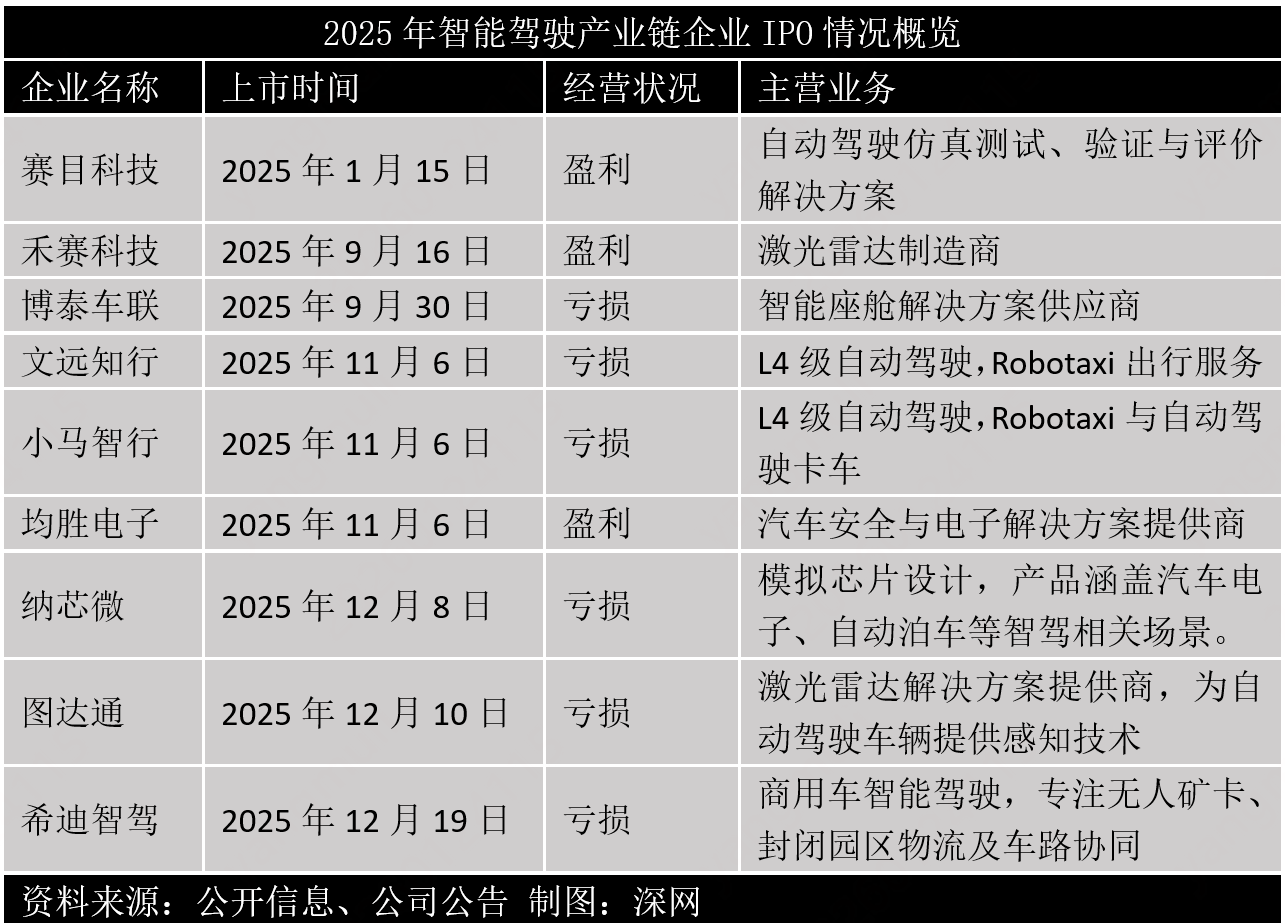
Group 1 - The core point of the article highlights the end of a significant IPO wave in the smart driving industry, with the last company, Xidi Zhijia, ringing the bell on the Hong Kong Stock Exchange in December 2025, marking the ninth company to go public that year [1][6] - The focus of the capital market is shifting from "listing stories" to questioning "post-listing performance," with funds becoming more selective towards companies that have demonstrated initial commercialization capabilities [2][20] - The industry is expected to undergo a significant reshuffle, moving from a phase of "hundreds of flowers blooming" to one of "integration and elimination," as the market becomes more rational [3][17] Group 2 - In 2025, the smart driving industry saw a collective explosion in the capital market, with companies from various segments, including solution providers and core sensor manufacturers, rushing to list or file for IPOs [6][7] - Notable companies that went public include Saimo Technology, which became the first smart driving company to list in 2025, and others like Pony.ai and WeRide, which achieved dual listings in both the US and Hong Kong [6][8] - The successful IPOs predominantly feature leading companies in their respective niches, such as Hesai Technology, which holds a 33% market share in the ADAS lidar market [9] Group 3 - Despite the IPO successes, many companies face significant challenges, including ongoing losses and high R&D expenditures, with only three out of the nine listed companies achieving profitability [12][10] - The high R&D spending is a major factor contributing to the widespread losses, with some companies reporting R&D expenses exceeding 300% of their revenue [12][10] - The commercialization process is slow, with many companies struggling to achieve profitability due to the lengthy validation cycles of smart driving technologies [13][14] Group 4 - The industry is experiencing a rapid and ruthless reshuffle, with a significant reduction in financing, dropping from 932 billion yuan in 2021 to 350 billion yuan in 2025, accelerating the elimination of weaker players [18][19] - The shift in capital judgment criteria indicates that investors are now more focused on verifiable operational capabilities and clear paths to profitability, moving away from merely technical narratives [20][19] - The market concentration is expected to increase, with only those companies that can achieve large-scale production, cost control, and strong ecosystem partnerships likely to survive in the long run [20][19]

Robotaxi驶入“千辆时代”,广东智驾提速规模商业化
2 1 Shi Ji Jing Ji Bao Dao· 2026-01-24 13:17
Core Insights - The autonomous driving industry in China has reached a significant milestone with the Robotaxi fleets of WeRide and Pony.ai surpassing 1,000 vehicles, marking the entry into the "thousand-vehicle era" [1][4][8] Industry Overview - Guangdong province has emerged as a key player in the autonomous driving sector, with 3.618 million new energy vehicles produced in 2022, accounting for 25% of the national total [2] - The province aims to produce 1.1829 million new energy vehicles by 2025, laying a solid foundation for the development of the intelligent driving industry [2] Company Developments - WeRide's Robotaxi has commenced commercial operations in over 10 major cities globally, including Guangzhou, Beijing, and Abu Dhabi, with a focus on fully autonomous operations [2][6] - WeRide reported a revenue of 171 million yuan in Q3 2025, a year-on-year increase of 144.3%, with a gross profit of 56.3 million yuan, reflecting a gross margin of 32.9% [4][5] - The company has achieved a significant reduction in net losses, narrowing by 70.5% year-on-year, indicating a transition towards scale expansion and profitability improvement [4] Technological Advancements - WeRide launched the HPC 3.0 high-performance computing platform, which provides 2,000 TOPS of AI computing power, reducing the cost of its autonomous driving suite by 50% [5] - The WeRide One platform enables efficient mass deployment of autonomous driving across various urban scenarios, enhancing operational capabilities [5][6] Market Expansion - WeRide has accelerated its international expansion, partnering with Uber to establish the largest commercial Robotaxi fleet in Abu Dhabi, with plans to expand to 15 additional international cities over the next five years [6][8] - The company is positioned to benefit from favorable policies, including the recent approval for L4 autonomous vehicles to operate commercially in several cities [7][8] Competitive Landscape - Guangdong's robust industrial foundation, including a well-developed supply chain for chips and electronic components, supports the growth of the autonomous driving sector [7] - The province's supportive government policies and funding initiatives have created a conducive environment for the development of autonomous driving technologies [7][8]
“木头姐”年度重磅:ARK 2026 Big Idea
华尔街见闻· 2026-01-24 12:15
Core Insights - The article discusses Cathie Wood and ARK Invest's focus on long-term technological transformations, emphasizing the report "ARK Big Ideas 2026" which highlights the concept of "The Great Acceleration" driven by AI and other technologies [2][3][6]. Group 1: Major Innovations and Economic Impact - The report identifies 13 significant innovation areas, asserting that five key platforms centered around AI are accelerating and will lead to a substantial increase in global economic growth, with a projected GDP growth rate of 7.3% by 2030, significantly higher than the IMF's forecast of 3.1% [8][12]. - ARK predicts that the market share of innovative assets will rise from approximately 20% in 2025 to about 50% by 2030, with a market value expansion from around $5 trillion to approximately $28 trillion [13]. - Investment in data center systems is expected to grow from about $500 billion in 2025 to approximately $1.4 trillion by 2030, reflecting a compound annual growth rate of 30% [14][26]. Group 2: AI and Technological Convergence - The report emphasizes that AI acts as a "Central Dynamo," driving multiple technological curves simultaneously, leading to a convergence of technologies that enhances their interdependencies [8][10]. - The "Convergence Network Strength" metric is projected to increase by 35% by 2025, indicating a significant acceleration in the mutual catalysis of different technologies [10]. - AI's demand is driving a surge in investment, with the annualized growth rate of data center investments increasing from 5% to 29% since the launch of ChatGPT [24][29]. Group 3: Market Opportunities and Consumer Behavior - AI agents are expected to transform online consumer spending, with ARK forecasting that their contribution to global online sales will grow from about 2% in 2025 to approximately 25% by 2030, potentially exceeding $8 trillion [35]. - The share of AI-related search traffic is anticipated to rise from 10% in 2025 to 65% by 2030, with search advertising spending growing at an annual rate of about 50% [38]. - By 2030, AI agents could generate around $900 billion in business and advertising revenue, primarily driven by lead generation and advertising [40]. Group 4: Robotics and Automation - Robotics is highlighted as a critical GDP engine, with the global robotics market opportunity estimated at $26 trillion, split between manufacturing and household services [42][44]. - The report suggests that the adoption of humanoid robots could significantly convert non-market activities into market activities, potentially increasing GDP growth rates from 2-3% to 5-6% if 80% of U.S. households adopt such technology [49]. - Autonomous driving is projected to create approximately $34 trillion in enterprise value by 2030, with significant implications for the ride-hailing market [53]. Group 5: Biotechnology and Healthcare - The integration of multiomics and AI is expected to revolutionize biology, with the cost of whole genome sequencing projected to drop to $10 by 2030, driving demand for molecular diagnostics [59][61]. - AI-driven drug development could reduce the time to market by 40% and lower total drug costs from $2.4 billion to $700 million, indicating a substantial shift in the pharmaceutical landscape [64]. - The potential market opportunity for extending healthy lifespan is estimated at $1.2 quadrillion, highlighting the vast economic implications of advancements in biotechnology [65]. Group 6: Space Economy and Energy Efficiency - SpaceX's reusable rocket technology is set to propel the economy into the space age, with launch costs decreasing significantly, potentially below $100 per kilogram [68][70]. - The report indicates that energy efficiency is improving, with a projected doubling of capital expenditure in the global power sector to meet rising electricity demands by 2030 [75]. - The anticipated growth in energy storage and distributed energy systems is crucial for the next generation of cloud infrastructure [12].
These 2 ‘Perfect 10’ Stocks Are Winning Wall Street’s Confidence
Yahoo Finance· 2026-01-24 10:57
Company Overview - Pony AI operates in the Chinese market, focusing on autonomous vehicles and robotaxis, with headquarters in Fremont, California, and Guangzhou, China [3] - The company has been a leader in the autonomous vehicle sector since its inception in 2016, developing self-driving vehicles and robotaxis [3] Product and Technology - Pony's robotaxi service, PonyPilot, is available in major cities including Beijing, Shanghai, Guangzhou, and Shenzhen, accessible via a mobile app [1] - The company has launched its sixth-generation automated robotaxi vehicles and recently introduced Gen-7 robotaxis, aiming to operate 3,000 robotaxis by the end of the year [1] - Pony's technology includes high-end sensors for perception, AI for prediction and planning, and a robust infrastructure with over 20 safety features integrated into its vehicles [2] Financial Performance - In Q3 2025, revenue from robotaxis increased by 89.5% year-over-year, contributing to total quarterly revenues of US$25.4 million, a 72% year-over-year gain [7] - The company reported a net operating loss of 14 cents per share in Q3, based on non-GAAP measures [7] Analyst Insights - Citi analyst Jeff Chung has a positive outlook on Pony AI, citing several upcoming catalysts, including potential gains from Q4 results and a favorable re-rating of Pony's valuation [8] - Chung rates Pony AI as a Buy with a price target of $24.50, indicating a potential upside of 48% from the current price of $16.58 [8] - The consensus rating for Pony AI is Strong Buy, based on 4 reviews, with a majority favoring Buy over Hold [8]

“木头姐”年度重磅:ARK 2026 Big Idea
Hua Er Jie Jian Wen· 2026-01-24 07:09
Core Insights - The central theme of the report is "The Great Acceleration," highlighting the rapid convergence of five major innovation platforms centered around artificial intelligence (AI) that are expected to drive significant global economic growth by the end of the decade [1][4]. Group 1: Economic Growth Projections - The report predicts that the global GDP growth rate could reach 7.3% by 2030, significantly higher than the International Monetary Fund's forecast of 3.1% [4]. - Capital investment in innovation assets is expected to increase from approximately $5 trillion in 2025 to around $28 trillion by 2030, with the market share of innovation assets rising from about 20% to 50% [9][14]. Group 2: Technological Convergence - ARK identifies a 35% increase in the "Convergence Network Strength" by 2025, indicating a significant acceleration in the inter-catalysis of different technologies [7]. - AI is described as a "Central Dynamo" that drives multiple technology curves simultaneously, leading to a shift from linear to highly coupled technological relationships [4][12]. Group 3: Investment in Data Centers - Investment in data center systems is projected to grow from approximately $500 billion in 2025 to about $1.4 trillion by 2030, with a compound annual growth rate of 30% [20][17]. - The demand for AI is driving this investment surge, with the cost of inference dropping over 99% in the past year, leading to exponential growth in AI usage [22]. Group 4: AI and Consumer Behavior - AI is reshaping consumer interaction with digital platforms, with AI chatbots achieving a 25% penetration rate among smartphone users within seven years, faster than the internet's adoption rate [23]. - The share of AI-related search traffic is expected to increase from 10% in 2025 to 65% by 2030, with a projected annual growth rate of 50% in AI-related search advertising spending [26]. Group 5: Robotics and Automation - The global robotics market is estimated to present a revenue opportunity of approximately $26 trillion, with significant potential in both manufacturing and household services [32]. - The report emphasizes the transformative potential of humanoid robots, which could convert significant amounts of unpaid household labor into measurable GDP contributions [34]. Group 6: Autonomous Vehicles - The market for autonomous taxis is projected to create about $34 trillion in enterprise value by 2030, with autonomous technology providers capturing approximately 98% of the EBIT [37]. - The cost of autonomous taxi services is expected to drop significantly, with projections suggesting a price of $0.25 per mile by 2035 [35]. Group 7: Multiomics and AI in Healthcare - The integration of multiomics with AI is expected to revolutionize biology, with the cost of whole genome sequencing potentially dropping to $10 by 2030 [41]. - AI-driven drug development could reduce time to market by 40%, from 13 years to 8 years, while significantly lowering overall drug costs [45]. Group 8: Space Economy - The use of reusable rockets is anticipated to propel the economy into the space age, with SpaceX leading the market and significantly reducing launch costs [50][52]. - The market opportunity for satellite connectivity is projected to exceed $160 billion annually by 2030, driven by cost reductions and performance improvements [55]. Group 9: Energy and Infrastructure - The report highlights the need for a substantial increase in capital investment in the energy sector, estimating a requirement of about $10 trillion by 2030 to meet global electricity demand [60]. - Distributed energy systems are becoming crucial for supporting the energy needs of AI data centers, with ongoing declines in energy intensity across major economies [57].

3 Self-Driving Car Stocks That Cathie Wood Can’t Get Enough Of
Yahoo Finance· 2026-01-23 17:44
Core Insights - Pony.ai is expanding its partnership with BAIC BJEV to co-develop next-generation robotaxi models, integrating its autonomous technology with BAIC's electric vehicle platforms [1] - The global robotaxi market is projected to grow from under $1 billion in 2025 to the mid-$100 billion range by 2033, indicating significant future potential for autonomous services [5] - Cathie Wood is increasing her investments in autonomous driving companies, signaling confidence in the sector's growth beyond established players like Tesla [4] Company Overview - Pony.ai, based in Guangzhou and Fremont, is focused on developing Level 4 robotaxi systems for commercial self-driving services [3] - The company's stock is currently priced at $16.47, with a year-to-date gain of 14% and a 52-week increase of 24% [3] Financial Performance - For the quarter ending September 30, 2025, Pony.ai reported sales of $25.4 million, a 72% year-over-year increase, but also a net loss of $61.6 million [7] - The company is expected to narrow its full-year loss for fiscal 2025, with an average EPS estimate of -$0.08 compared to -$2.45 in the previous year, indicating a forecasted 97% year-over-year improvement [7] - Analysts have a consensus "Strong Buy" rating for Pony.ai, with an average price target of $23.56, suggesting a potential upside of approximately 42% from the current price [8] Market Context - The autonomous driving industry is transitioning from proof-of-concept to revenue generation, with significant investments being made in the sector [6] - The financial outlook for other autonomous driving companies, such as WeRide and Kodiak AI, shows similar trends of increasing sales and narrowing losses, reinforcing the growth narrative in the autonomous mobility space [11][12][18]

小马智行-W(02026)授出合共200万份受限制股份单位
智通财经网· 2026-01-23 11:01
于2026年1月23日,公司已根据2026年股份计划向彭军博士(董事会主席、执行董事、首席执行官以及公 司不同投票权受益人之一)及楼天城博士(执行董事、首席技术官以及公司不同投票权受益人之一)有条件 授出合共200万份受限制股份单位。 智通财经APP讯,小马智行-W(02026)公布,于2026年1月23日,董事会已决议建议采纳2026年股份计 划。 ...
小马智行-W授出合共200万份受限制股份单位
Zhi Tong Cai Jing· 2026-01-23 11:01
于2026年1月23日,公司已根据2026年股份计划向彭军博士(董事会主席、执行董事、首席执行官以及公 司不同投票权受益人之一)及楼天城博士(执行董事、首席技术官以及公司不同投票权受益人之一)有条件 授出合共200万份受限制股份单位。 小马智行-W(02026)公布,于2026年1月23日,董事会已决议建议采纳2026年股份计划。 ...