东风汽车

Search documents
影响市场重大事件:外交部:中方将对53个非洲建交国实施100%税目产品零关税
Mei Ri Jing Ji Xin Wen· 2025-06-11 22:41
每经记者|杨建 每经编辑|彭水萍 |2025年6月12日 星期四| NO.1 外交部:中方将对53个非洲建交国实施100%税目产品零关税 外交部发言人林剑6月11日主持例行记者会表示,中非合作论坛成果落实协调人会议在湖南长沙举行。 中方宣布,将落实对53个非洲建交国实施100%税目产品零关税举措,为非洲最不发达国家对华出口提 供更多便利,愿同非方深入落实"十大伙伴行动",为中非携手推进现代化、建设新时代全天候中非命运 共同体提供了重要指引。去年北京峰会以来,中方新增对非投资超133亿元人民币,对非资金支持总额 超1500亿元人民币。今年前5个月,中国对非进出口达9630亿元,同比增长12.4%,创历史同期新高。 NO.2 超10家车企纷纷宣布将供应商支付账期统一至60天内 近日,超10家汽车企业接连宣布将供应商支付账期统一至60天内,以切实行动提高产业链资金周转效 率,推动汽车产业健康、可持续发展。截至目前,比亚迪汽车、中国一汽、东风汽车、吉利汽车集团、 广汽集团、赛力斯集团、长安汽车、奇瑞集团、长城汽车、小鹏汽车、小米汽车等近日纷纷发声,宣布 将供应商支付账期统一至60天内。相关举措有利于保障产业链供应链稳 ...
友谊之桥,双向奔赴(边城见闻)
Ren Min Ri Bao· 2025-06-11 22:11
Core Viewpoint - The article highlights the increasing trade and cultural exchanges between China and Nepal through key border ports, particularly focusing on the significance of the Zhangmu and Jilong ports in facilitating these interactions. Group 1: Trade and Economic Activities - Zhangmu port has become a vital trade hub, handling over 80% of the trade volume between China and Nepal at its peak, with significant exports of Chinese products like electric vehicles and solar products to Nepal [11][12]. - As of May 2024, the export of electric vehicles through the Zhangmu and Jilong ports is projected to reach 11,000 units, indicating a strong demand for Chinese products in the South Asian market [12]. - The first export of Nepali fodder to China occurred in July 2023 via the Jilong port, marking a new chapter in agricultural trade between the two countries [14]. Group 2: Cultural Exchange and Tourism - The article describes the cultural integration and exchanges occurring at the border, with local businesses in Nepal benefiting from the influx of Chinese tourists and traders [15]. - The Jilong area is noted for its historical significance and natural beauty, attracting tourists and promoting cross-border tourism, with local businesses adapting to cater to this growing market [14][15]. - The establishment of a travel agency by a local entrepreneur reflects the increasing interest in promoting cross-border tourism, with plans to attract more international visitors to the region [15]. Group 3: Infrastructure and Development - The opening of the new Lizhi-Naiqiong port in November 2023 enhances the connectivity between China and South Asia, facilitating smoother trade routes [16]. - Ongoing infrastructure improvements and the establishment of border economic cooperation zones are part of the strategic plans to boost trade and economic activities in the region [16]. - The article mentions the implementation of advanced customs procedures, such as facial recognition for border crossings, which streamline the process and enhance the efficiency of trade [17]. Group 4: Economic Performance - In the first quarter of 2023, the total import and export value of Shigatse reached 907 million yuan, a year-on-year increase of 22.2%, with significant trade with South Asian countries [17]. - The article emphasizes the growing economic significance of Shigatse as a center for trade with South Asia, with plans for further development outlined in the 2025 government work report [16][18].


剑指“价格战”!车企相继承诺“60天付款”
Qi Lu Wan Bao· 2025-06-11 21:06
Core Viewpoint - The automotive industry is responding to the government's call to address "involution" competition by collectively committing to a payment term of no more than 60 days for suppliers, aiming to stabilize the supply chain and improve financial conditions for upstream partners [2][3][4]. Group 1: Industry Actions - Major automotive companies, including China FAW, Dongfeng Motor, GAC Group, and Seres, announced on June 10 that they would limit supplier payment terms to within 60 days, promoting a more efficient capital circulation mechanism [3][4]. - Following this, companies like BYD, Chery, and Xpeng joined the initiative, with a total of 17 key automotive manufacturers committing to the 60-day payment term by June 11 [4]. - The commitment aligns with the upcoming implementation of the "Regulations on Ensuring Payment to Small and Medium Enterprises," which emphasizes a 60-day payment deadline and aims to improve the business environment [4]. Group 2: Industry Challenges - The automotive sector is facing intense price wars, leading to a significant decline in profitability, with industry profits dropping to 462.3 billion yuan in 2024, down 8% year-on-year, resulting in a profit margin of only 4.3% [5]. - Despite record production and sales exceeding 31 million vehicles in 2023, the profit margin has decreased from 7.8% in 2017 to 4.3% in 2024, indicating a troubling trend of increasing sales but declining profitability [6][5]. - The average accounts receivable collection period for major automotive companies has increased, with the automotive industry facing severe cash flow challenges [6]. Group 3: Supplier Relations - The commitment to a 60-day payment term is expected to alleviate financial pressure on suppliers, enhancing their ability to invest in production and development, thereby stabilizing their operations [9]. - This initiative is anticipated to strengthen the cooperative relationship between suppliers and automotive companies, fostering a more supportive environment for quality products and services [9]. - The move is seen as a significant shift in supply chain management philosophy, promoting a healthier industry ecosystem and limiting the ability of companies to maintain low prices through delayed payments [10][11].
主流车企承诺账期不超过60天 保障汽车产业链供应链稳定
Shang Hai Zheng Quan Bao· 2025-06-11 18:40
Core Viewpoint - Major Chinese automotive companies have collectively committed to standardizing supplier payment terms to a maximum of 60 days, aiming to enhance cash flow efficiency and stabilize the supply chain, in response to the newly implemented regulations for small and medium enterprises [1][2][3][4]. Group 1: Industry Response - Nearly 20 leading automotive companies, including China FAW, Dongfeng Motor, and GAC Group, have publicly announced their commitment to a 60-day payment term for suppliers [1][2][3]. - The new regulation, effective from June 1, mandates that large enterprises must pay small and medium enterprises within 60 days of delivery, addressing long-standing issues of delayed payments in the automotive supply chain [4][5]. - The collective commitment from these companies has led to a notable increase in the A-share automotive parts sector, reflecting positive market sentiment [5][6]. Group 2: Financial Implications - Historically, payment terms for suppliers in the automotive industry have exceeded 120 days, with some companies reporting terms over 200 days, which has strained the financial health of upstream suppliers [5][6]. - The average accounts payable turnover days for major companies like BYD and Geely are reported to be around 127 days, while Great Wall and SAIC exceed 160 days [3][5]. - Experts suggest that the reduction in payment terms could improve cash flow for suppliers, potentially alleviating financial pressures across the entire supply chain [5][6]. Group 3: Future Outlook - The successful implementation of the 60-day payment term will depend on the willingness of dominant automotive companies to foster mutually beneficial relationships with suppliers [7]. - Industry experts believe that if the commitment is genuinely upheld, it could lead to a revitalization of the automotive supply chain, enhancing overall industry confidence [7].
中美贸易原则上达成框架,腾讯音乐收购喜马拉雅 | 财经日日评
吴晓波频道· 2025-06-11 18:12
Group 1: US-China Trade Negotiations - The US and China have reached a preliminary framework for trade negotiations, indicating a mutual desire for a stable foreign trade environment to support domestic economic growth [1][2] - The US is considering lifting recent restrictions on various sectors, contingent on China easing its export restrictions on rare earths [1] - Both countries have demonstrated that a cooperative relationship benefits them, while conflict leads to mutual harm [1] Group 2: Gaming Industry Support - Zhejiang province has introduced measures to support the international expansion of the gaming industry, focusing on nurturing market players and promoting high-quality 3A game projects [3] - Local governments are increasingly implementing policies to enhance the global influence of gaming brands, reflecting a growing emphasis on the international market [3] - The success of games like "Black Myth: Wukong" has prompted a stronger focus on developing high-quality games for global audiences [3] Group 3: Automotive Industry Payment Terms - Multiple automotive companies, including BYD and Xiaomi, have committed to keeping payment terms within 60 days in response to new regulations aimed at improving the payment environment for small and medium enterprises [5][6] - The new regulation is designed to address the issue of delayed payments, which has been a common practice in the industry [5] - The effectiveness of this regulation remains to be seen, especially in a competitive market where price wars are prevalent [6] Group 4: Smartphone Market Trends - A UBS survey indicates that the expected replacement cycle for smartphones has extended to 2.6 years, reflecting a mature market with limited hardware innovations [7][8] - Consumer intent to purchase new smartphones has decreased, particularly in the US, where interest dropped significantly [7] - The lack of compelling new features has led consumers to retain their devices longer, impacting sales for manufacturers [7][8] Group 5: Cloud Services Market - ByteDance's Volcano Engine has captured 46.4% of the Chinese public cloud large model service market, surpassing competitors like Baidu and Alibaba [9][10] - The company has adopted aggressive pricing strategies to attract clients from established cloud service providers [9] - The demand for AI large models has leveled the playing field among cloud service providers, allowing newer entrants to compete effectively [10] Group 6: Tencent Music Acquisition - Tencent Music has announced a $1.26 billion cash acquisition of Ximalaya, aiming to expand its presence in the long audio content market [11][12] - This acquisition is seen as a strategic move to enhance user experience and creator revenue amid increasing competition in the audio content space [11] - The integration of resources from both companies is expected to strengthen their market position, although user base differences may pose challenges [12] Group 7: Tesla's Autonomous Driving Developments - Tesla plans to deliver its first fully autonomous vehicle in Texas, marking a significant step in its self-driving technology rollout [13][14] - The vehicle will utilize Tesla's Full Self-Driving software, although it currently operates at Level 2 autonomy [13] - Safety remains a critical concern as the company navigates the challenges of achieving full autonomy [14]



车圈60天账期革命,压力最大的是新势力
吴晓波频道· 2025-06-11 18:12
点击上图▲立即收听 " 如果对所有车企都是 ' 一刀切 ' ,那么对那些持续亏损、现金流不足、融资能力又一般的新势力们,恐怕将是一场灾难。 " 文 / 巴九灵(微信公众号:吴晓波频道) 气温在升高,车圈的火药味也没降温。六月,一场由账期引发的"反内卷热浪"正在席卷汽车江湖。 周二 晚上,广汽、一汽、东风三家国企及赛力斯率先发声,承诺供应商账期不超过60 天。紧随其后,吉利、长安接力响应。 昨日凌晨一点,中国第一大车企比亚迪发文称,将供应商支付账期统一至60天内。 图源:比亚迪官微 随后,北汽、上汽、长城、奇瑞等传统车企以及小米、小鹏、零跑等造车新势力纷纷跟进。 就这样,一场由头部车企发起的"账期革命"迅速蔓延,在产业链上空缓缓荡起涟漪,一点点渗入旧有的游戏规则。 口水战 本质而言,此番密集表态,时机微妙,似乎是对近期车企内卷加剧的回应。 五月底,比亚迪宣布了年内第三次大规模价格调整,王朝网、海洋网共计22款智驾版车型最高降幅达5.3万元,创下其智驾车型价格新低。 随后,奇瑞、上汽通用等约10个车企跟进,混战拉开帷幕,引发新一轮车企价格战恐慌。 对此,工信部、汽车工业协会等纷纷发文批评此番降价,车企之间也不再保 ...


守契约、反内卷 车企集体压缩账期,共塑行业信用
Zheng Quan Shi Bao· 2025-06-11 17:24
证券时报记者韩忠楠王小伟 从6月10日到11日,车企将供应商支付账期压缩至60天内的承诺刷屏。先是6月10日晚间,中国一汽、东 风汽车、广汽集团、赛力斯4家车企打响第一枪;次日凌晨,新能源车企"一哥"比亚迪跟进;11日,吉 利、奇瑞、长城、零跑、北汽、小鹏等更多车企加入,汽车圈达成"集体对账"的共识。 这次车圈集体事件拨动了资本市场的神经。6月11日,汽车零部件供应商股价大涨。同心传动、美晨科 技等股价当日涨幅均超过20%;天际股份、新宙邦等电池公司股价也封于涨停。 在中国新能源汽车产业高速发展的过程中,并非产业链条所有主体都能即时共享蛋糕。 压账期、延回款、账款流转链条不断被拉长,是汽车供应链的长期痛点。车企集体承诺"60天账期",多 数受访者认为这是汽车行业"反内卷"的标志性事件,是一种产业共识与信用重建。 一方面,产业链有望实现从"拖账期"到"守契约"的转变;另一方面,集体承诺如何落地,会否出现变相 降价或延期问题,将是账期拖欠难题能否真正解决的关键。 车企积极响应新规 "60天账期"承诺的车企名单不断扩容。截至证券时报记者发稿,广汽、一汽、东风、赛力斯、吉利、长 安、比亚迪、奇瑞、小鹏、阿维塔、北汽、 ...
汽车业“反内卷”第一刀落下
Bei Jing Shang Bao· 2025-06-11 16:40
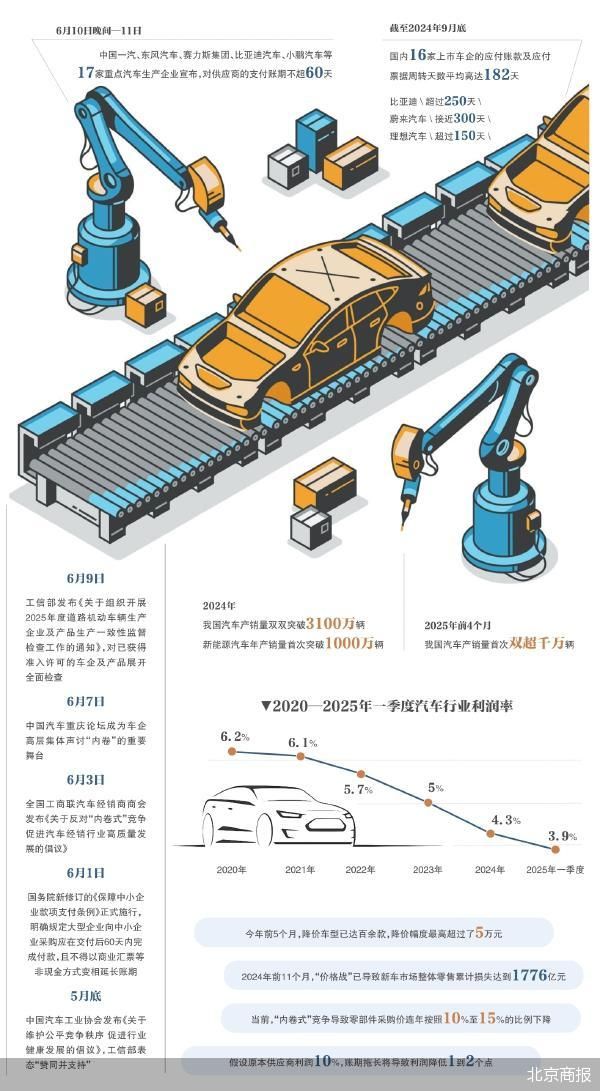
Core Viewpoint - Multiple Chinese automotive companies have committed to reducing payment terms to suppliers to no more than 60 days, aiming to alleviate financial pressure on suppliers and promote healthier industry practices amid government scrutiny of "involution" in the automotive sector [1][4][6]. Group 1: Industry Response - As of June 10, major automotive companies including China FAW, Dongfeng Motor, and BYD have announced their commitment to a maximum payment term of 60 days for suppliers, with 17 key automotive manufacturers participating in this initiative [4][5]. - The commitment is seen as a proactive measure to maintain a stable market economy and improve the efficiency of the supply chain [4][5]. - Companies like BAIC Group and SAIC Group have gone further by eliminating unreasonable settlement methods, such as commercial acceptance bills, to ease cash flow pressures on smaller suppliers [5][6]. Group 2: Financial Context - The automotive industry is facing declining profit margins, with the profit rate dropping from 7.8% in 2017 to 4.3% in 2024, and further declining to 3.9% in the first quarter of 2025 [6][8]. - Despite record production and sales figures, the industry is experiencing a significant drop in profitability, exacerbated by aggressive pricing strategies and a high average accounts receivable period of 70.3 days [6][9]. - The average payment period for 16 listed automotive companies is reported to be as high as 182 days, with some companies like BYD and NIO exceeding 250 and 300 days respectively [10][11]. Group 3: Market Dynamics - The ongoing "price war" among automotive companies has led to a detrimental cycle affecting the entire supply chain, with suppliers facing increased pressure to lower prices [9][10]. - Industry experts emphasize the need for a shift from price competition to value-based competition, highlighting the risks associated with prioritizing low prices over quality [8][12]. - The government's recent regulatory measures, including the new payment regulations for large enterprises, aim to curb the negative impacts of "involution" and promote a healthier competitive environment [6][12][13]. Group 4: Future Outlook - The automotive industry is encouraged to focus on technological innovation and quality improvement rather than engaging in destructive price competition, as highlighted by industry leaders [14][15]. - The commitment to a 60-day payment term is viewed as a significant step towards restructuring relationships within the supply chain and fostering a more sustainable industry environment [8][12].






落实“60天账期”,供应商活得好车企才有未来
Nan Fang Du Shi Bao· 2025-06-11 16:17
Core Viewpoint - The automotive industry is making significant progress in addressing the issue of extended payment terms, with major companies committing to a payment period of no more than 60 days, driven by new regulations aimed at supporting small and medium-sized enterprises [1][2]. Group 1: Industry Developments - Several major automotive companies, including Dongfeng Motor, GAC Group, FAW Group, and BYD, have publicly committed to a payment term of 60 days, following the implementation of the revised "Regulations on Payment for Small and Medium-sized Enterprises" [1]. - The automotive industry has been experiencing intense price competition, leading to a mismatch between profits and industry growth, with a reported 5.1% decline in total industry profits despite a 12.9% increase in production and a 10.8% increase in sales from January to April this year [1]. Group 2: Supplier Challenges - Many small and medium-sized automotive parts suppliers have been struggling with extended payment terms, which can occupy operational funds and lead to difficulties in meeting daily expenses, potentially forcing them to accept high-interest loans [2]. - The relationship between automakers and parts suppliers should be one of mutual benefit rather than exploitation, as emphasized by Dongfeng Motor's commitment to building a more resilient and innovative automotive ecosystem [2]. Group 3: Payment Methods and Regulations - Concerns have been raised regarding the use of commercial acceptance bills as a means for companies to circumvent cash payments, which are less flexible than cash and do not effectively address the payment term issue [3]. - The revised regulations prohibit the mandatory acceptance of commercial acceptance bills and other non-cash payment methods, with companies like SAIC Group and BAIC Group committing to eliminate such practices to strengthen trust within the supply chain [3].

17家车企承诺应付账款不超过60天,或将助力改善产业链资金周转效率
Guang Zhou Ri Bao· 2025-06-11 15:43
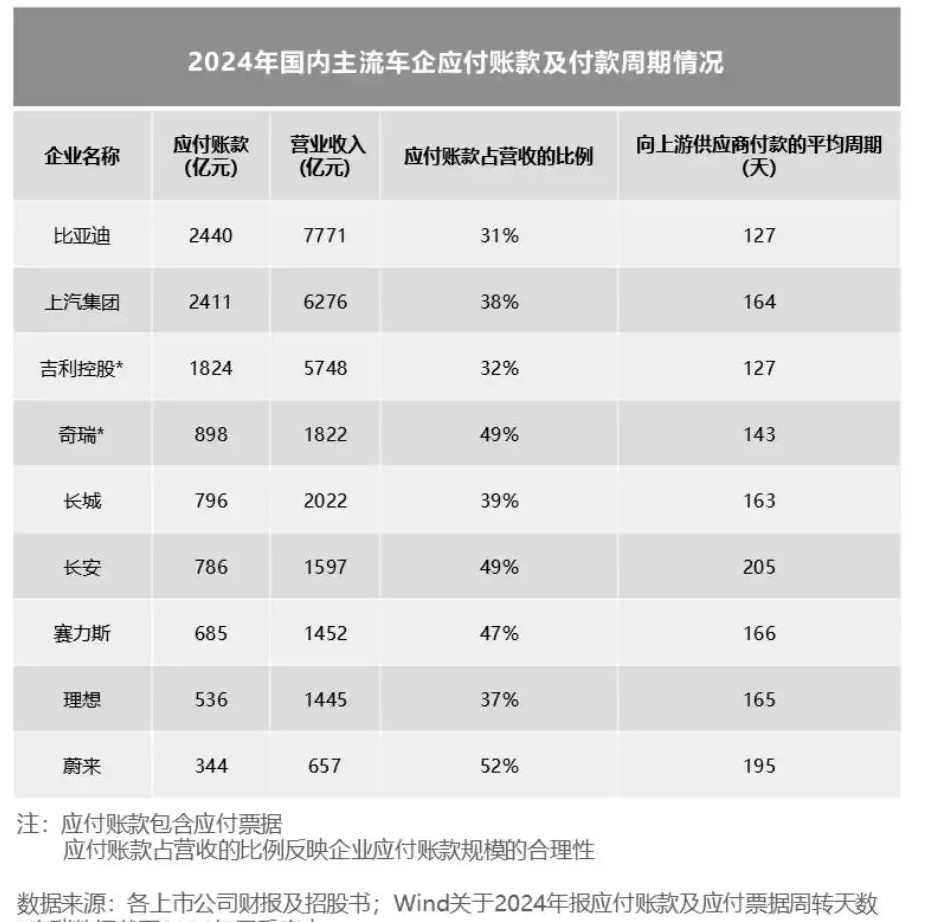
Core Viewpoint - Major Chinese automotive companies have committed to a maximum supplier payment term of 60 days, effective from June 1, 2025, as part of a new regulation aimed at improving cash flow for small and medium-sized enterprises [1][7]. Group 1: Supplier Payment Terms - 17 key automotive manufacturers have pledged to adhere to a 60-day payment term for suppliers, which is a response to the new regulation from the State Council [1]. - The average payment cycle for major companies is significantly longer, with BYD at 127 days, Chery at 143 days, Great Wall at 163 days, NIO at 195 days, and Changan exceeding 200 days [3][5]. Group 2: Financial Impact on Suppliers - Extended payment terms lead to increased financial costs for upstream suppliers, resulting in reduced profits [3]. - The ratio of accounts payable to revenue is a critical indicator of a company's operational health, with NIO at 52%, Changan at 49%, Great Wall at 39%, SAIC at 38%, and BYD at 31% [3][5]. Group 3: Industry Competition and Profitability - Intense competition has caused component procurement prices to decline by 10%-15% annually, putting additional pressure on profitability and supply chains [6]. - The automotive industry's profit margin was reported at 4.3% in 2024, decreasing to 3.9% in the first quarter of 2025 [6]. Group 4: Future Considerations - The commitment to a 60-day payment term is seen as a positive step towards reducing risks in the automotive supply chain and promoting sustainable development [7]. - There are still many operational details that need clarification, such as the calculation methods for payment terms and the types of payment instruments used [7][8].