全自动驾驶

Search documents
【Tesla每日快訊】 南韓車主延FSD轉移,美國人只有炸黃瓜解氣?🔥Model Y L六座神車南韓過關/亞馬遜阻撓SpaceX(2026/3/8-2)
大鱼聊电动· 2026-03-08 11:04
大家好我是大鱼 南韩Tesla 车主狂喜! 北美FSD转移 卡在3月底死线 很多人订了 却交付不了 直接没戏 但南韩却 突然大放送 延长到六月底 多出整整 三个月的 喘息空间 这背后到底 藏什么玄机? Tesla为何 对两个市场 玩差别待遇? 今天就来拆解 这场区域 大乱斗的真相 大家不要错过 今天的精彩内容 OK let's go 第一部分 南韩FSD 转移大放送 Tesla在南韩 延长FSD转移交付 期限到六月底 北美那边却是 三月底死线 搞得一堆人气炸 Tesla为什么 对两个地区 差别对待呢? 我们就来看看 这背后的门道 FSD的转移计划 本来就是给 忠实粉丝的 一个福利 让你把旧车上的 全自动驾驶软体 转到新车上 不用再花大钱重买 南韩这边 Tesla Korea 在官方部落格公告 原本三月底 的交付截止 现在推到 六月三十号 只要你在 3月31号前下订 新车六月底前到手 就能转移FSD (Supervised) 或强化自动驾驶 这等于直接多给了 南韩车主三个月 喘息的空间 特别适合那些 等生产排程 或调度延迟的买家 这政策一出 马上被 南韩网友赞爆 有人说这才是 真正照顾 忠实客户 对南韩市场来说 ...


何小鹏定调 2026:今年将量产机器人与飞行汽车
Xin Lang Cai Jing· 2026-02-24 11:11
Core Insights - The CEO of XPeng Motors, He Xiaopeng, announced a strategic plan titled "Steady Progress and Breaking the Game, 2026 Towards a New Decade of Physical AI," marking 2026 as a pivotal year for the company's transition from "capable" to "mass production" in embodied intelligence [1][4] - The company plans to launch three cutting-edge AI businesses this year: humanoid robots, flying cars, and Robotaxi services, with a focus on large-scale production and delivery [1][4] Flying Cars - The flying car, referred to as "land aircraft carrier," has completed its trial production line and has undergone extreme cold testing at -35 degrees Celsius [5] - XPeng has received over 7,000 global orders for the flying car, with 600 orders from the Middle East, and its manufacturing facility in Guangzhou has an annual production capacity of "tens of thousands" [6] - The company aims to initiate commercial exploration of personal low-altitude travel this year [7] Humanoid Robots - The next-generation IRON robot is set to begin mass production by the end of 2026, targeting the title of "the world's first mass-produced advanced humanoid robot" [8] - This robot will meet automotive-grade standards and will initially be used in guiding and shopping scenarios, with an open SDK available for global developers to build an ecosystem [8] Robotaxi Services - The Robotaxi initiative will accelerate this year, with pilot operations for ride-hailing services starting, utilizing models built on the GX platform equipped with four self-developed Turing AI chips, providing 3000 TOPS of computing power for a pure vision solution [8] - He Xiaopeng predicts that the Robotaxi segment will enter a rapid growth phase between 2027 and 2028, significantly boosting revenue and market value for the company [2][8] Global Strategy and Product Expansion - 2026 is projected to be an unprecedented product year for XPeng, with three super-range products launching in Q1 and at least four new vehicles entering overseas markets throughout the year, aiming to double overseas sales [10] - By 2030, XPeng plans to achieve overseas sales of 1 million vehicles, contributing over 70% of profits, focusing on key markets such as Germany and Thailand [3][10] Talent Acquisition - To support its ambitious plans, XPeng intends to hire 8,000 people globally in 2026, including 5,000 campus recruits, to strengthen its talent pool [11] - He Xiaopeng emphasized that 2026 will be a critical turning point for fully autonomous driving, as the company aims to transition from an automotive manufacturer to a comprehensive player in the physical AI sector [11]


何小鹏发开工信:清晰看到全自动驾驶的拐点已经到来
Nan Fang Du Shi Bao· 2026-02-24 08:00
Core Insights - Xiaopeng Motors is poised for significant growth in 2026, with a focus on autonomous driving and product expansion, aiming to leverage the "DeepSeek moment" in the autonomous driving sector [1][2] - The company achieved a remarkable 126% year-on-year increase in vehicle deliveries in 2025, totaling 429,445 units, exceeding its annual sales target [1] - The second-generation VLA (Vehicle Learning Architecture) will be launched in the first quarter of 2026, with Volkswagen as the first customer, indicating Xiaopeng's competitive edge in both product and core technology [2] Product Development - 2026 is expected to be an unprecedented year for product launches, with multiple new models planned to cover various core market segments [3] - The company will introduce three super-range products in the first quarter, aiming to rapidly increase market share through a "dual-energy" strategy [3] - Xiaopeng plans to launch at least four new vehicles in overseas markets in 2026, with the P7+ already undergoing trial production in Austria for delivery across 25 European countries [3] AI and Technology - Xiaopeng's three major AI initiatives—robotics, flying cars, and Robotaxi—are set to enter mass production in 2026, with Robotaxi trials starting this year [4] - The company aims to produce the next-generation IRON robot by the end of 2026, targeting to be the first to achieve large-scale production of advanced humanoid robots [4] - The flying car, referred to as the "land aircraft carrier," is also expected to achieve mass production and delivery within the year [4] Global Strategy - Xiaopeng aims to double its overseas sales in 2026, with a target of selling 1 million units abroad by 2030, contributing over 70% of profits [4] - The company plans to focus on five key markets—Israel, Germany, Norway, Thailand, and France—launching six globally competitive models priced between 100,000 to 200,000 [5] - The number of sales channels is expected to double to 680, enhancing lead generation [5] Workforce and Organizational Development - Xiaopeng plans to increase its global workforce by 8,000 in 2026, with a focus on recruiting 5,000 campus talents [6] - The company emphasizes internal talent development to cultivate future leaders, aiming for efficiency through AI integration across various processes [6] - Quality improvement is a priority, with a focus on enhancing product quality and customer service across all touchpoints [6] Global Operations - Xiaopeng is committed to building a robust global supply and production system, ensuring quality and reputation are maintained as the company expands internationally [7] - The strategy includes upgrading supply chain management, production scalability, logistics support, and investment control [7]
小鹏汽车何小鹏:全自动驾驶拐点已到
Bei Jing Shang Bao· 2026-02-24 07:52
Core Viewpoint - Xiaopeng Motors is at a historical turning point, aiming to lead in the autonomous driving sector with its "DeepSeek" initiative by 2026, which is defined as the tipping point for fully autonomous driving [1] Group 1: Company Strategy - CEO He Xiaopeng emphasized the importance of 2026 for the company, marking it as the year when physical AI and globalization must be fully integrated [1] - The second-generation VLA (Vehicle Learning Architecture) is positioned as the first version aimed at the L4 fully autonomous driving era, transitioning high-level intelligent driving from niche to mainstream [1] Group 2: Partnerships and Business Development - Volkswagen will be the first customer for Xiaopeng's second-generation VLA model, indicating a significant partnership that could enhance the company's market presence [1] - The exploration in the field of physical AI is driving a qualitative change in the company's business structure, suggesting a shift towards becoming a globally-oriented embodied intelligence company [1]
何小鹏开工信:2026年海外销量要翻番,全球员工总数将再增8000人
Xin Lang Cai Jing· 2026-02-24 06:20
Core Insights - The CEO of XPeng Motors, He Xiaopeng, emphasized the theme "Steady Progress and Breaking Through, Together Entering the New Decade of Physical AI in 2026" in a letter to employees, highlighting the company's achievements in 2025 and setting ambitious goals for 2026 [1][14][17] 2025 Achievements - XPeng delivered 429,445 vehicles in 2025, marking a 126% year-on-year increase and setting a historical record [1][14][17] - The strategic partnership with Volkswagen was deepened, enhancing technology experiences for more users [1][14][17] - The Turing AI chip was integrated into vehicles, and several new products were launched, including the "dual-energy" vehicle [1][14][17] 2026 Goals - The company aims to seize the "DeepSeek" moment for autonomous driving in China, with the second-generation VLA set to be launched in the current quarter, and Volkswagen as the first customer for this model [1][14][15] - XPeng plans to introduce multiple new models to cover various core market segments [2][15][21] - The company targets mass production of three frontier AI businesses—robots, flying cars, and Robotaxi—within the same year [2][15][22] - The Robotaxi service will begin pilot operations this year, while the new generation IRON robot is expected to start mass production by the end of 2026 [2][15][22] Global Expansion - XPeng aims to double its overseas sales by 2026 and sell 1 million units overseas by 2030, contributing over 70% of profits [2][15][23] - The company plans to expand its global employee base by 8,000, with 5,000 positions targeted for campus talent [2][15][10] Product Strategy - 2026 is designated as a "Product Year," with plans to launch at least four new models in overseas markets, including the XPeng P7+ [2][15][21] - The company intends to leverage a product matrix to capture every core market segment, focusing on both product and market strategies [2][15][21] Technological Advancements - The second-generation VLA is positioned as a significant step towards L4 autonomous driving, with improvements in operational fluidity and predictive capabilities [4][18][20] - XPeng has merged its autonomous driving and intelligent cockpit centers to form a "General Intelligence Center," enhancing the integration of driving decisions and human-vehicle interaction [4][18][19] Quality and Efficiency - The company is committed to enhancing quality across all aspects, including design, craftsmanship, technology, and user service [10][24] - XPeng aims to build a robust global supply chain and production capability to support its international expansion [10][24]
对话特斯拉陶琳:FSD入华稳步推进,今年将加大AI软硬件和能源领域
Xin Lang Cai Jing· 2026-02-09 10:49
Core Insights - Tesla plans to exceed $20 billion in capital expenditures (CapEx) in 2026, focusing on AI computing power, robotics factories, Cybercab production, energy storage and manufacturing, charging networks, and battery factories, with increased investment in AI hardware and software in the Chinese market [1][22][30] Group 1: Strategic Shift - Tesla is undergoing a significant transformation, evolving from an electric vehicle company to a technology enterprise centered on AI, robotics, and energy [3][24] - The company aims to shift market perception from focusing on vehicle delivery numbers to evaluating technological potential [6][27] Group 2: AI and Robotics Investment - The 2026 CapEx budget will prioritize AI computing investments, robotics factories, Cybercab production, energy storage, and global charging network expansion [10][31] - A local training center has been established in China for the localization of Tesla's smart driving technology [11][32] Group 3: Delivery and Production Insights - In 2025, Tesla's global delivery volume exceeded 1.636 million units, reflecting an 8% year-over-year decline, attributed to production line transitions rather than reduced demand [6][27] - The Shanghai Gigafactory delivered over 850,000 new vehicles despite production line changes for the Model Y [6][27] Group 4: Full Self-Driving (FSD) Development - Tesla's FSD is progressing rapidly, with global mileage surpassing 7.5 billion miles (approximately 12 billion kilometers) [13][34] - The company is confident that its FSD model, trained in North America, can adapt to China's complex road conditions with minor adjustments [5][26] Group 5: Energy Sector Growth - Tesla's energy sector is expected to become a new growth area, particularly with the establishment of a Megapack production facility in Shanghai, which has already secured over 1 GWh of orders [11][32] - The company is focused on enhancing energy storage systems as a critical component for grid stability and energy quality improvement [11][32] Group 6: Robotics and Supply Chain - Tesla plans to achieve mass production of humanoid robots by the end of 2026, with significant improvements in dexterity compared to previous models [15][36] - The robotics supply chain is still in the early development stage, with many components needing to be self-developed by Tesla [17][37] Group 7: Internal Efficiency and AI Utilization - Tesla utilizes its proprietary AI tools across various internal operations, enhancing efficiency and reducing the need for a large workforce [21][41] - The company has conducted 58 over-the-air (OTA) updates in the past four years, adding 105 significant practical features to its vehicles [18][38]

特斯拉,可能得看SpaceX的脸色了
虎嗅APP· 2026-02-03 00:41
Core Viewpoint - There is speculation that SpaceX will go public in 2026, with potential merger discussions with Tesla or AI company xAI, but the IPO will occur after the merger [5][6]. Group 1: Tesla's Market Performance - Tesla's delivery volume has seen a significant decline, with a projected delivery of 1.636 million vehicles in 2025, down 8.6% from 2024 [8]. - The high-end product sales are particularly concerning, with Model S/X deliveries dropping by 40.3% in 2025 [10]. - Tesla has lost its position as the top seller of pure electric vehicles globally, with BYD achieving 2.26 million units sold in 2025, surpassing Tesla by 37.9% [12]. - The decline in sales and market position is expected to have a profound impact on Tesla's valuation, as automotive sales are fundamental to its business [14]. Group 2: Financial Metrics - Tesla's gross profit from vehicle sales has decreased significantly, with a 45.7% drop in gross profit compared to 2022, despite a 32,200 vehicle increase in deliveries [23]. - The net profit for Tesla is projected to fall to $3.86 billion in 2025, only 25.7% of the 2023 figure [25][27]. - Revenue from carbon credit sales is a significant contributor to net profit, accounting for 51.7% of the 2025 net profit, which is expected to decline further due to new regulations [27][28]. Group 3: FSD Revenue and Future Prospects - The Full Self-Driving (FSD) revenue is minimal, constituting only 1.5% of vehicle sales revenue in 2025, raising concerns about its viability as a revenue stream [36]. - The contribution per vehicle from FSD has peaked, with projections showing a decline in revenue per vehicle sold [39]. - Tesla plans to shift entirely to a subscription model for FSD, which may lower barriers to entry but could also impact revenue stability [41][43]. Group 4: Strategic Considerations - The potential merger of SpaceX with Tesla is seen as a strategy to enhance Tesla's valuation amidst declining core business performance [44][48]. - The current financial struggles and the need for innovative revenue streams highlight the urgency for Tesla to adapt its business model to maintain investor confidence [48].
汽车业务承压,特斯拉(TSLA.US)高估值将由“AI与能源”叙事撑起?
Zhi Tong Cai Jing· 2026-01-26 08:35
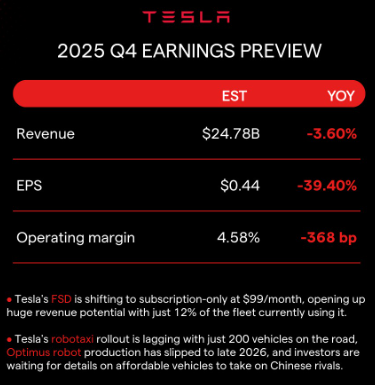
Core Viewpoint - Tesla continues to be a highly controversial and closely watched stock, with polarized investor opinions regarding its future performance and valuation [1] Group 1: Financial Performance - In Q3, Tesla achieved record revenue of $28.1 billion, a 12% year-over-year increase, with deliveries reaching 497,099 vehicles [2] - Operating expenses surged by 50% year-over-year to $3.4 billion, leading to a contraction in operating margin to 5.8% [2] - Earnings per share (EPS) fell by 31% year-over-year to $0.50, below market expectations [2] Group 2: Future Projections - Q4 delivery volume is projected to decline by 15.6% year-over-year to 418,227 vehicles, indicating a slowdown in growth [3] - Analysts predict a 3.6% year-over-year revenue decline for Q4 2025, with total revenue for the fiscal year expected to decrease by 2.8% [5] - The automotive sales revenue is forecasted to reach $17.97 billion, reflecting a 3.7% year-over-year decline [5] Group 3: Business Segments - Tesla's energy storage segment showed significant growth, with a record deployment of 14.2 GWh in Q4 and a total of 46.7 GWh for the year, a 49% increase [3] - The energy business is becoming an increasingly important profit driver, with expected revenue of $3.66 billion, a 19.7% year-over-year increase [3] Group 4: Strategic Initiatives - Full Self-Driving (FSD) technology is transitioning to a subscription model, with a target of 10 million active subscribers, although current adoption is only at 12% [7] - The Optimus humanoid robot is a key part of Tesla's future strategy, with production timelines pushed to late 2026 [9] Group 5: Market Challenges - Tesla faces significant competition, particularly in Europe and China, where it is losing market share to local manufacturers [5] - The company's stock is currently valued at a high P/E ratio of 201, with analysts expressing caution regarding its valuation [12]
未知机构:招商电新马总信息快递123马斯克在2026世界经济论坛发言-20260123
未知机构· 2026-01-23 02:25
Summary of Key Points from the Conference Call Industry and Company Involved - The discussion primarily revolves around the renewable energy sector, specifically solar energy, robotics, and autonomous driving technologies, with a focus on companies like SpaceX and Tesla, as well as various related firms in the solar and robotics industries [1]. Core Insights and Arguments 1. **Mass Production of Robots**: - By 2026, robots will be capable of performing more complex tasks, with large-scale production expected to begin, potentially leading to significant sales by the end of 2027 [1]. - Related companies include: JunDa Co., Dike Co., and Chunhui Zhikong [1]. 2. **Solar Energy as the Optimal Solution**: - Solar energy is highlighted as the best energy solution, with plans for SpaceX to launch solar-powered AI satellites and collaborate with Tesla to establish 100GW of solar capacity in the U.S. [1]. - Future plans include the construction of a space-based solar power station to support data centers [1]. - Companies to watch in this sector include: Dongfang Risheng, Shanghai Port, and Haiyou New Materials [1]. 3. **Advancements in Autonomous Driving**: - The transition towards fully autonomous driving is underway, with Tesla's insurance becoming more affordable and the imminent proliferation of autonomous taxis in the U.S. [1]. 4. **AI Development Projections**: - By 2030, AI is projected to surpass human intelligence collectively [1]. 5. **Electricity Supply as a Bottleneck**: - The supply of electricity remains a critical bottleneck for AI development, with a note on the strength of China's electricity system and its solar energy capabilities [1]. Other Important but Potentially Overlooked Content - The mention of various companies involved in the solar equipment and robotics sectors, such as Maiwei Co., Aotwei, Kaidi Co., Zhenyu Technology, Xinjie Electric, Meihu Co., and Fusa Technology, indicates a broad ecosystem of players that could benefit from these advancements [1]. - The reference to North American power equipment companies like Siyuan Electric, Igor, Jinpan Technology, and Shima Power suggests potential investment opportunities in the power supply chain related to these technologies [1].
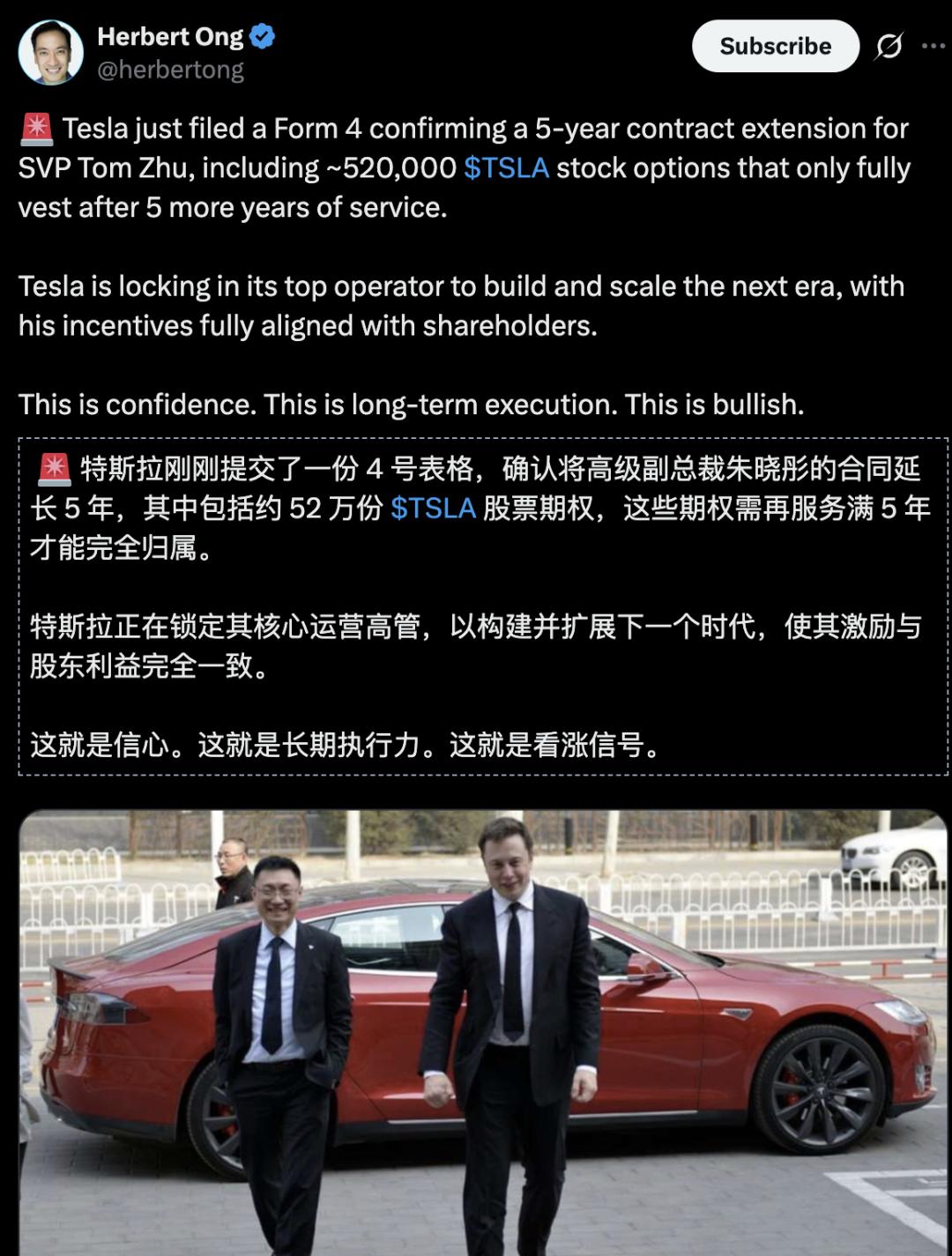
马斯克狂砸16亿“买”他5年,揭秘特斯拉2号人物,那个睡工厂的狠人
3 6 Ke· 2026-01-19 07:29
Core Insights - Tesla has granted over 520,000 stock options to Tom Zhu, valued at approximately $233 million, contingent on meeting specific KPIs over five years [1][7][10] - This stock option grant signifies Tesla's commitment to long-term execution and strategic leadership, highlighting Zhu's critical role in the company's operations [3][5][10] Group 1: Stock Options and Strategic Importance - Tom Zhu's stock options have an exercise price of $435.80 per share, and he must remain with Tesla until March 5, 2031, to fully realize this incentive [7][8] - The current stock price of Tesla is around $445 to $450, making the options appear to be a break-even situation, yet it reflects a deeper strategic bet on the company's long-term value [10][12] - Zhu's leadership is seen as essential for Tesla's ambitions to achieve unprecedented production targets and market leadership [10][20] Group 2: Tom Zhu's Background and Achievements - Tom Zhu, born in Shenyang, China, has a background in engineering and project management, having worked on significant infrastructure projects in Africa before joining Tesla in 2014 [12][14] - Zhu was pivotal in establishing Tesla's Supercharger network in China, overcoming significant challenges to enhance the company's market presence [14][15] - His leadership during the construction of the Shanghai Gigafactory was transformative, completing the project in just nine months, which was previously deemed impossible [15][18] Group 3: Future Goals and Challenges - Zhu's current objectives include achieving the ambitious KPIs set for 2031, which involve delivering 20 million vehicles, reaching 10 million FSD subscriptions, producing 1 million humanoid robots, and generating $50 billion in profit [26][29] - The success of the Optimus robot production is crucial, with plans to produce 100,000 units annually by 2026, potentially generating over $20 billion in revenue [25][26] - Zhu's understanding of the Chinese manufacturing landscape is expected to play a vital role in scaling Tesla's operations globally [25][29]