方大特钢

Search documents
方大特钢:战略深耕破局行业挑战 以质量与人才筑牢发展根基
Zhong Guo Jin Rong Xin Xi Wang· 2025-09-17 02:35
Core Insights - The company is enhancing its innovation-driven strategy by integrating newly recruited high-educated talents into key operational roles, which aligns with its ongoing "Quality Month" initiative to strengthen its development foundation based on quality and talent [1][4]. Group 1: Strategic Developments - In the first half of 2025, the domestic steel industry faced challenges due to "strong supply and weak demand," but the company achieved impressive results by adhering to a "low-cost, differentiated, and specialized" development path and implementing its "two upgrades" strategy [1]. - The company focuses on a "combination of common and special products" as its core product strategy, exploring new growth areas while consolidating its advantages [1]. - The commercial vehicle market's gradual recovery has increased demand for spring flat steel, allowing the company to respond quickly and deliver over 100 specifications of spring flat steel products [1]. Group 2: Quality Management Initiatives - The "Quality Month" activity emphasizes quality control across the entire production chain, promoting a culture of quality awareness among all employees through various communication channels [2]. - The technical center will conduct specialized training on the QEOEn management system to strengthen employees' understanding of quality management [2]. - Daily inspections and real-time feedback mechanisms are implemented to ensure adherence to quality standards throughout the production process [3]. Group 3: Talent Development and Market Confidence - Newly recruited master's and doctoral talents are provided with mentors and hands-on training to enhance their understanding of production processes and contribute to quality improvement and technological innovation [4]. - The capital market's recognition of the company's strategy is evident, with significant share purchases by major stakeholders, reflecting confidence in the company's quality management capabilities and growth potential [4]. - The company aims to continue deepening its "two upgrades" strategy, reinforcing its commitment to quality and talent-driven innovation in the steel industry [5].

中国企业500强公布:辽宁方大集团跃升至第126位!
Zheng Quan Shi Bao· 2025-09-16 18:09
Group 1 - The core viewpoint of the news is that Liaoning Fangda Group has shown resilience and growth across its various sectors, ranking 126th in the 2025 China Top 500 Enterprises and 40th in the Top 100 Leading Enterprises in Strategic Emerging Industries [1] - The company focuses on five major sectors: carbon products, steel, pharmaceuticals, commerce, and aviation, aiming to develop new productive forces and achieve stable growth [1] - In the first eight months of 2025, the company emphasized its commitment to national strategies and innovation, adapting to market pressures from raw material price fluctuations and steel demand [1] Group 2 - Fangda Steel Group achieved a sales revenue of 46.317 billion yuan and a profit of 1.699 billion yuan in the first half of the year, with its subsidiaries ranking high in profitability within the industry [2] - The pharmaceutical sector, particularly Northeast Pharmaceutical, is advancing in cell therapy for various cancers, with over ten products in development and a strong research pipeline [2] - The commercial sector, represented by Zhongxing Commercial, reported a 25.08% increase in net profit year-on-year, while Tianjin Yishang's revenue exceeded 7.1 billion yuan with a 63% profit increase [3] Group 3 - HNA Group, part of the aviation sector, launched the "HNA PLUS Membership Card" to enhance service offerings and received multiple awards for its airlines, achieving record passenger numbers during the summer travel season [3] - The company is committed to aligning its development with national strategies and regulations, focusing on technological innovation to contribute to high-quality economic growth in China [4]

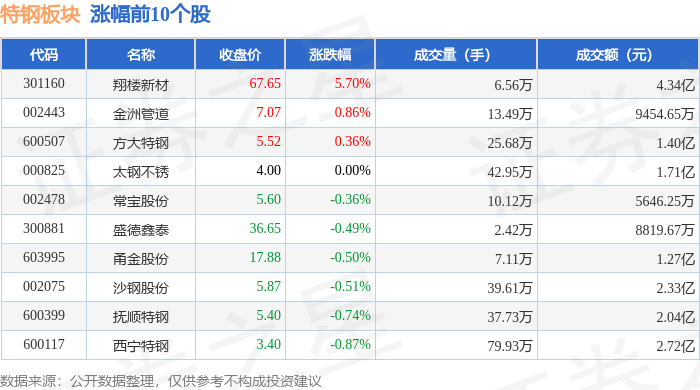
特钢板块9月16日跌0.57%,久立特材领跌,主力资金净流出6995.81万元
Zheng Xing Xing Ye Ri Bao· 2025-09-16 08:39
Market Overview - The special steel sector experienced a decline of 0.57% on September 16, with Jiuli Special Materials leading the drop [1] - The Shanghai Composite Index closed at 3861.87, up 0.04%, while the Shenzhen Component Index closed at 13063.97, up 0.45% [1] Stock Performance - Notable stock performances included: - Xianglou New Materials: closed at 67.65, up 5.70% with a trading volume of 65,600 and a turnover of 434 million [1] - Jiu Li Special Materials: closed at 22.17, down 1.95% with a trading volume of 146,600 and a turnover of 326 million [2] - Other stocks like Fushun Special Steel and Xining Special Steel also saw declines of 0.74% and 0.87% respectively [1][2] Capital Flow - The special steel sector saw a net outflow of 69.96 million from institutional investors, while retail investors contributed a net inflow of 59.04 million [2] - The capital flow for specific stocks showed: - Jiuli Special Materials had a net outflow of 25.39 million from retail investors [3] - Xining Special Steel experienced a net inflow of 1.22 million from institutional investors [3] Summary of Key Stocks - Key stocks in the special steel sector and their performance included: - Jiuli Special Materials: net outflow of 36.50 million from institutional investors [3] - Xining Special Steel: net inflow of 1.22 million from institutional investors [3] - Fushun Special Steel: net outflow of 17.23 million from institutional investors [3]


大额买入与资金流向跟踪(20250908-20250912)
GUOTAI HAITONG SECURITIES· 2025-09-16 06:00
Quantitative Factors and Construction Methods - **Factor Name**: Large Buy Order Transaction Amount Ratio **Factor Construction Idea**: This factor captures the buying behavior of large funds by analyzing the proportion of large buy orders in the total transaction amount for a given day [7] **Factor Construction Process**: 1. Utilize tick-by-tick transaction data to reconstruct buy and sell order data based on the bid and ask sequence numbers [7] 2. Filter transactions based on order size to identify large orders [7] 3. Calculate the proportion of large buy order transaction amounts to the total transaction amount for the day [7] **Formula**: $ \text{Large Buy Order Transaction Amount Ratio} = \frac{\text{Large Buy Order Amount}}{\text{Total Transaction Amount}} $ **Factor Evaluation**: This factor effectively reflects the buying behavior of large funds [7] - **Factor Name**: Net Active Buy Transaction Amount Ratio **Factor Construction Idea**: This factor measures the active buying behavior of investors by analyzing the net active buy transaction amount as a proportion of the total transaction amount for a given day [7] **Factor Construction Process**: 1. Use tick-by-tick transaction data to classify each transaction as either active buy or active sell based on the buy/sell indicator [7] 2. Calculate the net active buy transaction amount by subtracting the active sell amount from the active buy amount [7] 3. Compute the proportion of the net active buy transaction amount to the total transaction amount for the day [7] **Formula**: $ \text{Net Active Buy Transaction Amount Ratio} = \frac{\text{Active Buy Amount} - \text{Active Sell Amount}}{\text{Total Transaction Amount}} $ **Factor Evaluation**: This factor provides insights into the active buying tendencies of investors [7] Factor Backtesting Results - **Large Buy Order Transaction Amount Ratio**: - Top 10 stocks with the highest 5-day average values: 1. Guofa Co., Ltd. (600538.SH): 86.5%, 97.9% time-series percentile [9] 2. Jilin Expressway (601518.SH): 86.3%, 82.3% time-series percentile [9] 3. Chongqing Iron & Steel (601005.SH): 85.8%, 83.1% time-series percentile [9] 4. Zijin Bank (601860.SH): 85.6%, 62.6% time-series percentile [9] 5. Jianyuan Trust (600816.SH): 85.5%, 90.5% time-series percentile [9] - **Net Active Buy Transaction Amount Ratio**: - Top 10 stocks with the highest 5-day average values: 1. Fangda Special Steel (600507.SH): 24.8%, 100.0% time-series percentile [10] 2. Liaogang Co., Ltd. (601880.SH): 18.3%, 95.1% time-series percentile [10] 3. Overseas Chinese Town A (000069.SZ): 17.6%, 99.6% time-series percentile [10] 4. Qixia Construction (600533.SH): 14.6%, 99.2% time-series percentile [10] 5. Wanwei High-Tech (600063.SH): 14.3%, 99.6% time-series percentile [10] Additional Results for Indices, Industries, and ETFs - **Indices**: - Large Buy Order Transaction Amount Ratio (5-day average): - Shanghai Composite Index: 74.2%, 25.1% time-series percentile [12] - CSI 300: 73.1%, 10.7% time-series percentile [12] - Net Active Buy Transaction Amount Ratio (5-day average): - Shanghai Composite Index: -4.3%, 95.5% time-series percentile [12] - CSI 300: -4.5%, 100.0% time-series percentile [12] - **Industries**: - Large Buy Order Transaction Amount Ratio (5-day average): - Steel: 80.6%, 46.9% time-series percentile [13] - Construction: 79.5%, 62.6% time-series percentile [13] - Net Active Buy Transaction Amount Ratio (5-day average): - Steel: 4.0%, 40.7% time-series percentile [13] - Construction: 2.4%, 70.8% time-series percentile [13] - **ETFs**: - Large Buy Order Transaction Amount Ratio (5-day average): - ChinaAMC SSE 50 ETF (510050.SH): 89.3%, 74.1% time-series percentile [15] - GF CSI All-Index IT ETF (159939.SZ): 89.2%, 54.3% time-series percentile [15] - Net Active Buy Transaction Amount Ratio (5-day average): - Huaan SSE STAR Chip ETF (588290.SH): 17.3%, 99.6% time-series percentile [16] - Harvest CSI Battery Theme ETF (562880.SH): 13.9%, 92.2% time-series percentile [16]




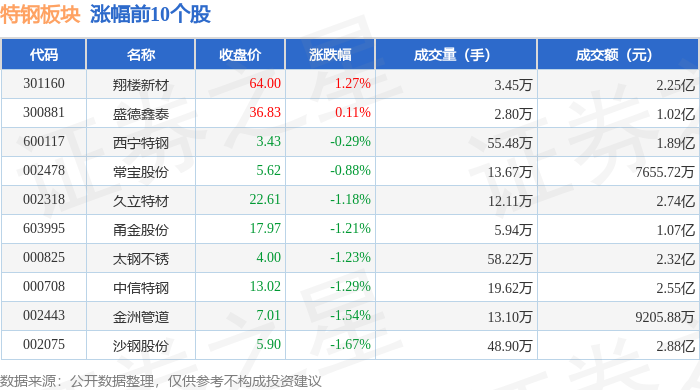
特钢板块9月15日跌1.51%,方大特钢领跌,主力资金净流出2.68亿元
Zheng Xing Xing Ye Ri Bao· 2025-09-15 08:43
Market Overview - On September 15, the special steel sector declined by 1.51%, with Fangda Special Steel leading the drop [1] - The Shanghai Composite Index closed at 3860.5, down 0.26%, while the Shenzhen Component Index closed at 13005.77, up 0.63% [1] Stock Performance - Key stocks in the special steel sector showed varied performance, with notable declines in Fangda Special Steel, which fell by 5.50% to a closing price of 5.50 [2] - Other significant declines included Sha Steel Co., down 1.67% to 5.90, and Jiu Li Special Materials, down 1.18% to 22.61 [2] Trading Volume and Capital Flow - The special steel sector experienced a net outflow of 268 million yuan from main funds, while retail funds saw a net inflow of 85.74 million yuan [2] - The trading volume for Fangda Special Steel was 575,800 shares, with a transaction value of 320 million yuan [2] Individual Stock Capital Flow - Major stocks like Tai Steel and CITIC Special Steel saw significant net outflows from main funds, with Tai Steel experiencing a net outflow of 53.12 million yuan [3] - Conversely, retail investors showed a net inflow into stocks like Sha Steel, with a net inflow of 891.85 million yuan [3]


周期论剑|重申资源品牛市
2025-09-15 01:49
Summary of Key Points from Conference Call Records Industry Overview - The conference call discusses the **Chinese stock market** and its transition towards a comprehensive bull market driven by three main factors: accelerated transformation, declining risk-free returns, and institutional reforms [1][2][15]. Core Insights and Arguments - **Bull Market Prediction**: A comprehensive bull market is anticipated rather than a structural one, with emerging technology and cyclical finance sectors showing potential [1][2][15]. - **2026 as a Key Year**: The year 2026 is expected to be significant for the resource bull market, driven by a surge in asset management demand due to the maturity of three-year and five-year deposits, estimated at **10 trillion RMB** [1][4][15]. - **Economic Stability**: The Chinese economy is transitioning from an L-shaped recovery to a more stable growth phase, with listed companies' revenues and inventories stabilizing over two consecutive quarters [1][6][15]. - **Stock Valuation Improvement**: The stabilization of traditional industries is expected to improve stock valuations, with predictions of the Chinese stock market stabilizing above **4,000 points** in 2025 and higher in 2026 [1][8][15]. - **Policy Impact**: The "anti-involution" policy is seen as a shift in economic governance, positively impacting sectors like non-ferrous metals, chemicals, real estate, and new energy vehicles [1][13][15]. Important but Overlooked Content - **Electric Power Sector Changes**: New policies in the electric power sector require energy storage devices to pay capacity fees for grid access, enhancing the competitive advantage of thermal power companies [1][17][15]. - **Steel Industry Dynamics**: The steel industry is transitioning from off-peak to peak season, but the pace is slow, with high production levels putting pressure on pricing [1][26][15]. - **Consumer Sector Outlook**: The consumer sector is expected to face challenges in Q3 due to regulatory impacts, but this may represent a bottoming out phase, with potential recovery anticipated in 2026 [1][12][15]. - **Investment Recommendations**: Specific stocks are highlighted for their potential, including **Xinfengming**, **Hengli Rongsheng**, and **Sinopec** in the petrochemical sector, and **Western Mining** in the non-ferrous metals sector [1][20][16]. Conclusion - The overall sentiment is optimistic regarding the Chinese market's future, with a focus on the cyclical recovery of various sectors and the potential for significant investment opportunities as economic conditions improve and policies evolve [1][15][10].
中央督察组反馈钢铁产能乱象,反内卷背景下行业供给管理或加强 | 投研报告
Zhong Guo Neng Yuan Wang· 2025-09-15 01:05
Core Viewpoint - The steel industry is experiencing a divergence driven by scale effects and high-end demand, leading to improved profitability despite overall supply-demand challenges [1][7]. Sales Performance - In Q2 2025, total wholesale passenger car sales reached 7.111 million units, up 13.0% year-on-year and 11.8% month-on-month; new energy passenger car sales were 3.629 million units, up 33.9% year-on-year and 26.3% month-on-month; exports totaled 1.401 million units, up 13.9% year-on-year and 25.1% month-on-month [1]. Revenue Performance - Sample companies in the steel sector reported revenues of 673.96 billion yuan, an increase of 13.8% year-on-year and 20.2% month-on-month, benefiting from increased market share and high-end product demand [1]. Market Performance - The steel sector rose by 3.70% this week, outperforming the broader market; sub-sectors included special steel up 2.06%, long products up 3.55%, and flat products up 3.90% [2]. Supply Situation - As of September 12, the capacity utilization rate for blast furnaces among sample steel companies was 90.2%, up 4.39 percentage points week-on-week; electric furnace utilization was 55.3%, down 0.48 percentage points week-on-week [2]. Production and Consumption - The production of five major steel products was 7.448 million tons, down 5.18 million tons week-on-week; consumption increased to 8.433 million tons, up 15.50 million tons week-on-week [2][6]. Inventory Situation - Social inventory of five major steel products reached 10.951 million tons, up 17.41 million tons week-on-week; factory inventory was 4.195 million tons, down 3.50 million tons week-on-week [3]. Price and Profitability - As of September 12, the comprehensive index for ordinary steel was 3,489.7 yuan/ton, up 0.71 yuan/ton week-on-week; profits for rebar were -14 yuan/ton, down 8.0 yuan/ton week-on-week [3]. Raw Material Situation - The spot price index for Australian iron ore (62% Fe) was 796 yuan/ton, up 11.0 yuan/ton week-on-week; the price for coking coal remained stable at 1,550 yuan/ton [4][5]. Regulatory Environment - Recent inspections highlighted issues in steel production capacity management, particularly in Shanxi, Shandong, and Shaanxi provinces, indicating a potential tightening of capacity management in the steel industry [6]. Investment Outlook - Despite challenges, the steel industry is expected to maintain stable demand supported by real estate and infrastructure investments; high-end steel products are likely to benefit from macro trends towards high-quality development [7].
险资加快入市,如何展望钢铁的红利价值?
Changjiang Securities· 2025-09-14 23:31
Investment Rating - The investment rating for the steel industry is Neutral, maintained [8] Core Views - The pace of insurance capital entering the market has accelerated, with insurance potentially adding several hundred billion yuan of long-term funds to the A-share market annually. This influx is expected to benefit low-volatility, high-dividend assets, enhancing their investment value [2][6] - The steel sector is witnessing a confirmation of profit bottoms and a slowdown in capital expenditure, highlighting the dividend attributes of quality leading companies, which are expected to attract long-term incremental capital [2][6] Summary by Sections Market Performance - The steel industry is experiencing a recovery in demand, with significant improvements in plate demand due to eased production restrictions in key manufacturing areas. However, the demand during the "Golden September" period appears slightly insufficient [5] - The average daily pig iron production has risen to 2.4055 million tons, an increase of 11.71 thousand tons per day, indicating a high level of production [5] - Total steel inventory has increased by 0.83% week-on-week and 0.49% year-on-year, reflecting a buildup in stock levels [5] Price Trends - The price of Shanghai rebar has dropped to 3,210 yuan/ton, a decrease of 50 yuan/ton, while hot-rolled steel has increased to 3,410 yuan/ton, up by 10 yuan/ton. The estimated profit for rebar is -87 yuan/ton [5] Policy and Structural Changes - The "anti-involution" policy is expected to optimize the supply-demand structure in the steel industry, potentially supporting steel prices by constraining backward production capacity [6][26] - The report anticipates that the supply of iron ore may become more relaxed, with new projects coming online, which could lead to a decrease in iron ore prices [6] Investment Opportunities - The report identifies four main investment lines: 1. Companies benefiting from cost reductions due to new capacities in iron and coke, such as Nanjing Steel and Hualing Steel [26] 2. Companies with low price-to-book ratios that may see significant performance and valuation recovery, such as New Steel and Fangda Special Steel [27] 3. Mergers and acquisitions under the state-owned enterprise reform theme, which could enhance asset quality and valuation [27] 4. Quality processing leaders and resource leaders, particularly in specialized fields, such as Jiuli Special Materials and Yongjin Co., with a focus on copper and iron resources [27]

钢铁行业2025中报综述:成本让利的开端,供给收缩的起点
Changjiang Securities· 2025-09-14 05:16
Investment Rating - The investment rating for the steel industry is Neutral, maintained [5] Core Insights - The steel industry continues to experience an oversupply situation, leading to a decline in steel prices and a year-on-year revenue decrease of 9% for the first half of 2025 and 8% for Q2 2025, although there was a quarter-on-quarter increase of 4% in Q2 [2][21] - On the cost side, the decline in raw material prices has been greater than that of finished steel, resulting in a year-on-year cost reduction of 11% for the first half of 2025 and 10% for Q2 2025, with a quarter-on-quarter increase of 3% in Q2 [2][24] - Profitability has significantly improved, with a year-on-year increase of 2540% in non-recurring profit for the first half of 2025 and 211% for Q2 2025, alongside a quarter-on-quarter increase of 47% [2][24] - The return on equity (ROE) for listed steel companies has shown recovery, with an ROE of 2.67% for the first half of 2025, up by 2.01 percentage points year-on-year, and 3.22% for Q2 2025, up by 1.87 percentage points year-on-year [2][24] Summary by Sections Revenue - The steel industry continues to face an oversupply, with revenues decreasing by 9% year-on-year in the first half of 2025 and 8% in Q2 2025, despite a quarter-on-quarter increase of 4% in Q2 [2][21][22] Cost - The cost of steel companies has decreased by 11% year-on-year in the first half of 2025 and by 10% in Q2 2025, with a quarter-on-quarter increase of 3% in Q2, driven by a larger decline in raw material prices compared to finished steel [2][24] Profit - Non-recurring profits have seen a substantial increase, with a year-on-year growth of 2540% in the first half of 2025 and 211% in Q2 2025, along with a quarter-on-quarter increase of 47% in Q2 [2][24] Return on Equity - The ROE for the steel industry has improved, reaching 2.67% in the first half of 2025, an increase of 2.01 percentage points year-on-year, and 3.22% in Q2 2025, an increase of 1.87 percentage points year-on-year [2][24]


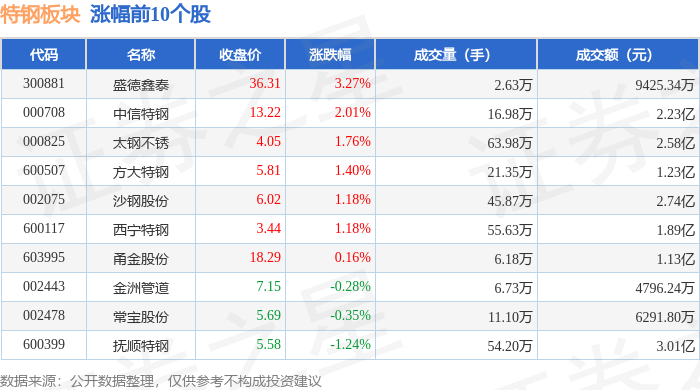
特钢板块9月12日涨0.76%,盛德鑫泰领涨,主力资金净流入6619.84万元
Zheng Xing Xing Ye Ri Bao· 2025-09-12 08:31
Market Performance - On September 12, the special steel sector rose by 0.76% compared to the previous trading day, with Shengde Xintai leading the gains [1] - The Shanghai Composite Index closed at 3883.69, up 0.22%, while the Shenzhen Component Index closed at 12996.38, up 0.13% [1] Individual Stock Performance - Shengde Login (300881) closed at 36.31, up 3.27% with a trading volume of 26,300 lots and a transaction value of 94.25 million [1] - CITIC Special Steel (000708) closed at 13.22, up 2.01% with a trading volume of 169,800 lots [1] - Taiyuan Iron & Steel (000825) closed at 4.05, up 1.76% with a trading volume of 639,800 lots [1] - Fangda Special Steel (600507) closed at 5.81, up 1.40% with a trading volume of 213,500 lots [1] - Shagang Group (002075) closed at 6.02, up 1.18% with a trading volume of 458,700 lots [1] - Xining Special Steel (600117) closed at 3.44, up 1.18% with a trading volume of 556,300 lots [1] - Jiao Jin Co. (603995) closed at 18.29, up 0.16% with a trading volume of 61,800 lots [1] - Jinzhou Pipeline (002443) closed at 7.15, down 0.28% with a trading volume of 67,300 lots [1] - Changbao Co. (002478) closed at 5.69, down 0.35% with a trading volume of 111,000 lots [1] - Fushun Special Steel (600399) closed at 5.58, down 1.24% with a trading volume of 542,000 lots [1] Capital Flow Analysis - The special steel sector saw a net inflow of 66.19 million from main funds, while retail investors experienced a net outflow of 78.48 million [2] - The main funds' net inflow for Taiyuan Iron & Steel was -53.34 million, while CITIC Special Steel had a net inflow of 34.88 million [3] - Shagang Group had a net inflow of 19.80 million from main funds, while retail investors had a net outflow of 24.90 million [3]