Neuralink

Search documents
业绩大幅预增股抢先看!
Zheng Quan Shi Bao Wang· 2026-01-05 03:47
Group 1 - Major market indices opened higher on the first trading day of 2026, with electronics and media sectors rising over 2%, while pharmaceuticals and non-bank financials also showed strong gains [1] - The brain-computer interface (BCI) concept surged, with the index rising over 10%, leading to a wave of stock price increases, including a 30% limit up for BeiYikang and 20% limit ups for Sanbo Brain Science, Meihao Medical, and Aipeng Medical [2] - Elon Musk announced that his BCI company Neuralink will start large-scale BCI output in 2026, planning to shift towards nearly fully automated surgeries [3] Group 2 - Open Source Securities reported that Neuralink's expectations for scaled production and automated surgical solutions signify a transition from clinical validation to commercial scalability for brain-computer interfaces [4] - Companies with positive earnings forecasts for 2025 have performed well, with C Strong rising over 10% and Salt Lake Shares and Ocean Biological both increasing over 7%. Over 40 companies have released earnings forecasts, with many expecting profit increases, including Transfar Zhilian, Baiao Saitu, and Tianci Materials, all projecting profit growth exceeding 100% [5] - Ocean Biological expects a net profit growth of 50.6% to 72.56 million for 2025 [5] Group 3 - Two new stocks are available for subscription this week, including Zhixin Co., which specializes in automotive welding parts and has become a primary supplier for major automotive manufacturers [7] - Kema Materials focuses on the research, production, and sales of dry friction plates and wet paper-based friction plates, aiming to develop new friction materials [8] Group 4 - As of December 31, 2025, the market's financing balance totaled 2.52 trillion, a decrease of 143.69 billion from the previous trading day [9] - 349 stocks received net financing purchases exceeding 10 million, with 34 stocks having net purchases over 1 billion [10] - China Satellite topped the list with a net purchase of 1.194 billion, followed by Xinwei Communication and Aerospace Electronics with net purchases of 525 million and 499 million, respectively [11]



A股午评:沪指收复4000点大关!创业板指涨2.15%,脑机接口概念现涨停潮
Ge Long Hui· 2026-01-05 03:41
(原标题:A股午评:沪指收复4000点大关!创业板指涨2.15%,脑机接口概念现涨停潮) 盘面上,脑机接口概念大面积涨停,创新医疗、三博脑科、美好医疗等超20股涨停,马斯克旗下 Neuralink将开始大规模生产脑机接口设备。保险板块大涨,中国太保、新华保险双双创新高。存储芯 片、贵金属、商业航天等板块走强,海南自贸区板块回调。 2026年首个A股交易日,三大指数强势大涨,截至午间收盘,沪指涨1.07%报4011.45点,深成指涨 1.87%,创业板指涨2.15%,北证50指数涨1.31%。沪深京三市半日成交额16489亿元,较上日放量3240 亿元,全市场超4000只个股上涨。 ...

ETF盘中资讯|脑机接口引爆,医疗股掀涨停潮,全市场最大医疗ETF放量冲高4%!三博脑科、美好医疗等多股20CM涨停
Jin Rong Jie· 2026-01-05 03:37
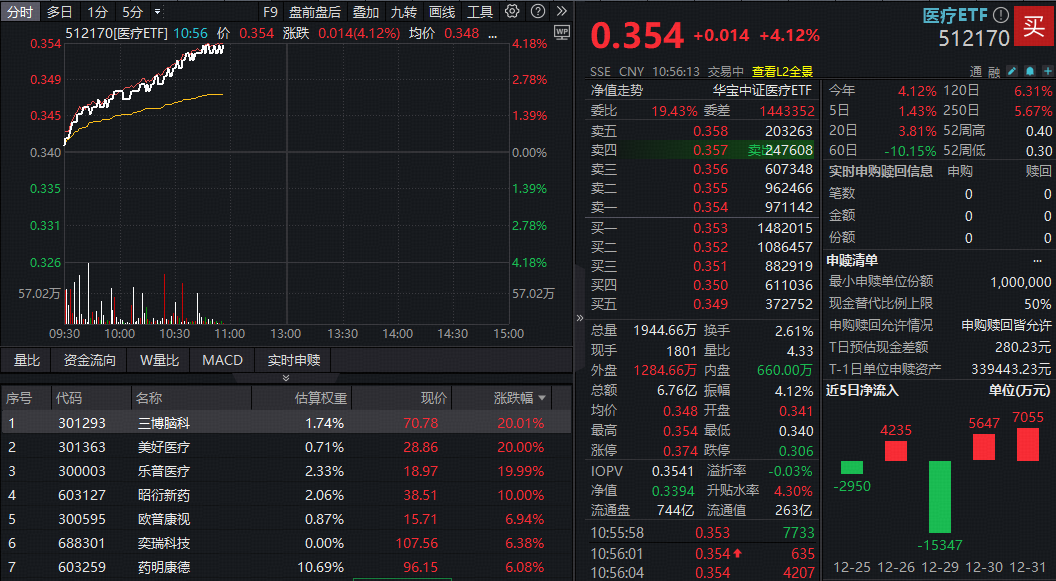
Core Viewpoint - The medical sector is experiencing a strong performance, with the largest medical ETF (512170) showing significant gains, driven by positive market sentiment and news regarding Neuralink's plans for large-scale production of brain-computer interface devices starting in 2026 [1][3]. Group 1: Market Performance - On January 5, 2026, the medical ETF (512170) opened high and rose over 4%, potentially marking the largest single-day gain in nearly three months, with real-time transactions exceeding 650 million yuan [1]. - All 50 constituent stocks of the medical ETF saw increases, with notable surges in brain-computer interface stocks, including Sanbo Brain Science, Meihua Medical, and Lepu Medical, which hit the daily limit of 20% [1]. - The CXO sector also performed strongly, with Zhaoyan New Drug reaching the daily limit and WuXi AppTec increasing by nearly 6% [1]. Group 2: Fund and Index Details - The medical ETF (512170) has a total scale exceeding 25.259 billion yuan, making it the largest medical and healthcare ETF in the market, serving as a significant industry benchmark [3]. - The ETF focuses on "medical devices + medical services," with a CXO weight exceeding 26%, and includes leading companies in aesthetic medicine, private hospitals, and medical information technology [3]. - The current price-to-earnings ratio of the underlying index for the medical ETF is 32 times, which is lower than over 70% of the time in the past decade, indicating a favorable cost-performance ratio for investors [1].



马斯克按下“量产键”!脑机接口掀涨停潮,又一风口来了?
Ge Long Hui· 2026-01-05 03:34
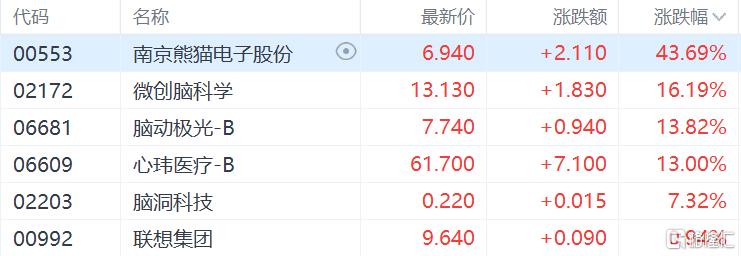
Core Viewpoint - Neuralink, founded by Elon Musk, is set to begin large-scale production of its brain-machine interface technology this year, marking a significant advancement in automated surgical procedures and bringing previously speculative technology into mass production [1][4]. Company Developments - Neuralink has announced that it will automate surgical processes, reducing the insertion time for its devices to 1.5 seconds and cutting manufacturing costs by 95% [4]. - As of September 2025, 12 patients with severe paralysis have successfully implanted Neuralink devices, enabling them to perform tasks such as gaming and social media interaction [5]. - The company raised $650 million (approximately 4.55 billion RMB) in a funding round completed in June [5]. Industry Trends - The brain-machine interface sector is experiencing a surge in interest and investment, with companies like阶梯医疗, 博睿康, and 芯智达 entering clinical validation stages [9]. - The Chinese government has included brain science and related research in its "14th Five-Year Plan," aiming for significant technological breakthroughs by 2027 [10]. - The market for brain-machine interfaces in China is projected to grow from 3.2 billion RMB in 2024 to over 5.5 billion RMB by 2027, with global market estimates reaching $40 billion by 2030 [11]. Market Response - Following Neuralink's announcement, stocks related to brain-machine interfaces surged, with notable increases in companies such as 南京熊猫电子股份 (up 43.69%) and 微创脑科学 (up 16.19%) [2][3]. - A-share market also saw significant gains, with multiple companies hitting the upper limit of their trading range [2]. Future Outlook - Neuralink's roadmap includes plans for motion decoding for patients with spinal injuries and visual encoding for those with vision impairments, potentially addressing mental health issues and enhancing cognitive abilities [6]. - The industry is expected to benefit from technological breakthroughs, policy support, and collaborative ecosystems, with a projected CAGR of 17% from 2025 to 2034 [11].


乐普医疗封板,医疗器械ETF大涨4.36%
Mei Ri Jing Ji Xin Wen· 2026-01-05 03:17
政策端也持续加码支持。国家药监局近期在北京召开脑机接口医疗器械工作推进会,明确表示将加快相 关产品的审评审批流程,推动创新器械更快上市应用。 国金证券指出,在医疗器械创新政策密集落地 背景下,脑机接口作为前沿交叉领域,正迎来从科研验证向临床及消费场景拓展的关键窗口期。 (文章来源:每日经济新闻) 医疗器械ETF(562600)大涨4.36%。截止2025年12月30日,医疗器械ETF脑机接口含量达20.91%。 消息面上,行业迎来多重催化。特斯拉CEO埃隆·马斯克近日在社交媒体透露,其旗下脑机接口公司 Neuralink计划于2026年启动脑机接口设备的"大规模生产"。这一表态被市场视为该技术迈向商业化的重 要信号。 与此同时,由OpenAI首席执行官Sam Altman联合创立的脑机接口初创公司Merge Labs宣布将分拆为独 立实体,专注于开发基于超声波的非侵入式脑信号读取技术。该方案无需植入电极,即可实现对大脑活 动的大范围、高精度解读,有望大幅降低技术门槛与临床风险。 早盘脑机接口概念小幅高开,随后震荡上行,截止10点57分,乐普医疗、美好医疗、翔宇医疗、伟思医 疗、迈普医学封板涨停。 ...

未来产业周报第4期:脑机接口产业化提速,机器人场景创新,氢能向电网“调节者”转变-20260105
Shenwan Hongyuan Securities· 2026-01-05 03:15
Group 1: Quantum Technology - The "quantum + supercomputing" integration innovation platform has been established in Chengdu, deploying China's first 550-qubit coherent optical quantum computer, achieving a synergy between classical high-performance computing and quantum computing [7][8] - The deployment of the 550-qubit quantum computer fills the gap in mid-western China for quantum computing capabilities and complements eastern regions like Hefei and Beijing [8] Group 2: Biomanufacturing - The first sugar science key laboratory in Beijing has been approved, co-established by Huaxi Biological and Peking University, focusing on precise manufacturing and functional applications of sugars [10][11] - Huaxi Biological aims to leverage this laboratory to enhance its capabilities in synthetic biology, expanding from hyaluronic acid production to comprehensive sugar biological research [11] Group 3: Hydrogen Energy and Nuclear Fusion - The world's first 30 MW pure hydrogen gas turbine has achieved stable operation, marking a significant step in hydrogen energy transitioning from a "power consumer" to a "grid regulator" [12][14] - The EAST nuclear fusion device has confirmed the existence of a density-free zone, providing critical physical evidence for efficient fusion reactor operation [18][19] - The ITER correction coil procurement package has been fully manufactured, showcasing China's 100% independent research and development capabilities in key components for nuclear fusion [22] Group 4: Brain-Computer Interface - Neuralink plans to begin mass production of brain-computer interface devices in 2026, aiming to automate surgical procedures and enhance device performance [24][25] - The "Beijing Brain One" system has been implanted in five spinal cord injury patients, with plans for clinical trials to start in mid-2026 [28][29] - The "Guangdong-Hong Kong-Macao Greater Bay Area Brain Science and Central Nervous System AI Innovation Alliance" has been launched, with a total fund of 1.16 billion yuan for brain science projects [30] Group 5: Embodied Intelligence - Woan Robot has been listed on the Hong Kong Stock Exchange, focusing on household scenarios with plans to launch a humanoid household robot in January 2026 [32][33] - The "Shangwei Qiyuan" brand has entered the personal robot market with the release of the world's first small-sized humanoid robot, emphasizing its application in research and interaction [37][38] Group 6: Future Industry Catalysts - A table has been compiled detailing key catalytic events for six future industries in 2026, including important conferences and technological milestones [40][41]
脑机接口板块,掀涨停潮
财联社· 2026-01-05 03:14
2026年A股开盘首日,脑机接口概念表现活跃。截至发稿,倍益康30CM涨停,三博脑科、翔宇医疗、美好医疗、爱朋医疗、诚益通、伟思医疗20cm 涨停,创新医疗、南京熊猫10CM涨停,博拓生物、狄耐克等涨超10%。 开源证券最新研报表示, 上述行业事件印证了脑机接口技术预计将在2026年迈向商业化,并从医疗刚需向AI应用、机器人等多领域渗透 。 Neuralink的规模化生产预期+自动化手术方案,以及Merge布局新一代超声波脑机接口技术具备双重意义。一方面,这标志着脑机接口从临 床验证阶段开始向商业化规模化阶段迈进,推动脑机接口从"医疗试验工具"到"可普及产品"的落地;另一方面,未来随着技术方案成熟度的 进一步提升,也将为Neuralink脑机接口与特斯拉Optimus人形机器人的协同应用奠定基础。 该机构进一步表示,脑机接口行业正处于技术突破、政策支持、机器人生态协同预期等多重因素驱动下的高增蓄势期,根据Precedence Research数据, 预计到2034年全球脑机接口市场规模将增长到约124亿美元 ,2025-2034年CAGR为17%。 在近期Neuralink规模化量 产预期和技术突破的催化下, ...
沪指重回4000点,脑机接口近20股涨停,存储芯片大爆发,千亿锂矿巨头创3年半新高
2 1 Shi Ji Jing Ji Bao Dao· 2026-01-05 03:11
Group 1: A-Share Market Performance - The A-share market opened higher on January 5, with all three major indices rising collectively, and the Shanghai Composite Index returning to the 4000-point mark for the first time in 34 trading days [1] - Insurance and precious metals sectors led the gains, with New China Life Insurance (601336) rising nearly 8% to reach a historical high, while China Ping An, China Pacific Insurance (601601), China Life Insurance (601628), and China Reinsurance (601319) also saw significant increases [1] Group 2: Brain-Computer Interface Sector - The brain-computer interface concept experienced a surge, with several companies hitting the daily limit up, including Meihua Medical (301363) and Aipeng Medical (300753), both reaching the 20% limit up, alongside other companies like Botao Bio and Aerospace Changfeng (600855) [1] - The surge was influenced by Elon Musk's announcement regarding Neuralink's plans to significantly increase brain device production by 2026 and innovate in implantation methods [1] Group 3: Lithium Mining and Storage Chip Sector - The lithium mining sector saw a strong rally, particularly in the salt lake lithium extraction direction, with Salt Lake Co. (000792) hitting the daily limit up and reaching a three-and-a-half-year high, while Cangge Mining (000408) rose nearly 6% to set a new historical high [2] - Storage chip concepts also strengthened, with Jiangbolong (301308) rising over 14% and Shanghai Xinyang (300236) increasing over 12%, driven by significant investments in AI infrastructure by major North American cloud service providers [2] Group 4: Storage Chip Market Forecast - Guojin Securities predicts a continued supply-demand imbalance in the global storage chip market for 2026, with DRAM supply expected to grow by 15% to 20% and demand by 20% to 25%, while NAND supply is projected to increase by 13% to 18% and demand by 18% to 23% [3] - The consumption of DRAM and NAND flash in the server sector is expected to surge by 40% to 50% year-on-year, with even faster growth in AI server applications [3] - Price forecasts for storage contracts indicate a potential increase of 30% to 40% in Q1 2026, with DDR5 RDIMM memory prices expected to rise over 40% and NAND flash prices anticipated to see double-digit percentage increases [3]



瘫痪8年,靠意念重夺人生!马斯克脑机2026年量产,不是科幻
创业邦· 2026-01-05 03:10
Core Viewpoint - Neuralink technology has the potential to help paralyzed individuals regain full body function, theoretically allowing them to walk again or restore movement, which is a significant advancement in medical technology [7][8][10]. Group 1: Technological Advancements - Neuralink acts as a communication bridge, connecting brain signals to other body parts, bypassing damaged areas in the neck or spine [7]. - The technology has shown promising early results in paralysis treatment and brain-computer interfaces, indicating that restoring lost motor function is becoming a feasible engineering and clinical challenge [12][13]. - An upgraded surgical robot was launched in 2025, enhancing the efficiency, safety, and cost-effectiveness of brain implant surgeries, aiming to reduce the procedure time to just a few minutes [20][21]. Group 2: Clinical Trials and Regulatory Progress - Neuralink has received "breakthrough device designation" from the FDA for its speech recovery technology, which is expected to expedite further development and review processes [16]. - International clinical trials have commenced in the Middle East, Canada, and the UK, with the first surgeries conducted outside the U.S. [17]. - As of September 2025, 12 severely paralyzed patients have undergone implantation, although long-term safety and efficacy data are still being accumulated [45]. Group 3: Financial Aspects - Neuralink completed a Series E funding round, raising $650 million, with a valuation of approximately $9 billion, reflecting investor confidence in brain-computer interface technology [22][23]. Group 4: Future Outlook - Neuralink plans to begin mass production of brain-computer interface devices in 2026, utilizing a simplified and nearly fully automated surgical process [27][32]. - The technology is expected to transition from experimental neuroscience to scalable clinical reality, potentially marking 2026 as a pivotal year for brain-computer interfaces [33][34]. Group 5: Challenges Ahead - The company faces multiple challenges, including regulatory approvals, clinical trial data accumulation, and potential complications such as surgical infections or electrode displacement [45][46]. - Engineering challenges remain, such as ensuring compatibility with anatomical variations and addressing long-term effects on brain tissue [48]. - Ethical concerns regarding privacy, autonomy, and the implications of human-machine integration are significant hurdles that need to be addressed [52].
沪指重回4000点,脑机接口近20股涨停,存储芯片大爆发,千亿锂矿巨头创3年半新高
21世纪经济报道· 2026-01-05 03:07
Market Overview - The A-share market opened higher on January 5, with the Shanghai Composite Index surpassing 4000 points for the first time in 34 trading days, reaching 4007.66 points, up by 38.82 points or 0.98% [1][2]. Brain-Computer Interface Sector - The brain-computer interface concept saw a surge, with stocks like Meihua Medical and Aipeng Medical hitting the daily limit, while nearly 20 stocks including Beiyikang and Sanbo Neuroscience also reached their limits. Other stocks like Guanhao Biological and Hanwei Technology rose over 10% [3][4]. Lithium Mining Sector - The lithium mining sector experienced fluctuations, with Salt Lake Holdings hitting the daily limit and reaching a three-and-a-half-year high. The company projected a net profit of 8.29 billion to 8.89 billion yuan for 2025, representing a year-on-year growth of 77.78% to 90.65% [5][6]. Storage Chip Sector - The storage chip sector strengthened, with stocks like Jiangbolong rising over 14% and Shanghai Xinyang over 12%. The demand for storage chips is expected to surge due to strong AI demand, with significant price increases projected for DDR4 and DDR5 memory chips [7][9]. AI Infrastructure Investment - Major North American cloud service providers, including Google, Meta, Microsoft, and Amazon AWS, are expected to invest a record $600 billion in AI infrastructure by 2026. This demand is anticipated to drive up storage chip prices significantly, with DDR4 and DDR5 memory prices expected to rise by 1800% and 500%, respectively [9].