呷哺呷哺

Search documents
145家火锅店去IPO了
投资界· 2025-06-18 07:47
Core Viewpoint - The article discusses the IPO of Banou International Holdings Limited, a hot pot restaurant chain, which is set to list on the Hong Kong Stock Exchange, highlighting its growth and market position in the competitive hot pot industry [1][21]. Company Overview - Banou was founded by Du Zhongbing in 2001 in Anyang, Henan, and has expanded significantly over the past two decades, now preparing for an IPO [1][5]. - The brand name "Banou" is inspired by the hardworking boatmen of Chongqing, symbolizing perseverance and dedication [5]. - Banou focuses on high-quality ingredients, particularly its signature dish featuring beef tripe and mushroom soup, which has helped it capture a significant market share [9][12]. Market Position - Banou is the third-largest brand in the Chinese hot pot market, holding a 0.4% market share, and is the largest quality hot pot brand with a 3.1% market share [9]. - As of 2024, Banou operates 145 stores across 39 cities, with a 74.7% increase in store count since the end of 2021 [9][10]. Financial Performance - Banou's revenue has shown significant growth, with reported revenues of RMB 1.433 billion in 2022, RMB 2.111 billion in 2023, and projected RMB 2.307 billion in 2024 [11][12]. - The company turned a profit in 2023, with a net profit of RMB 1.02 billion, up from a loss of RMB 0.52 billion in 2022 [12]. - The average customer spending ranges from RMB 138 to RMB 150, positioning Banou at a higher price point compared to competitors [10]. Expansion Strategy - Banou has adopted a direct-operated model, moving away from franchising to maintain control over quality and brand image [14]. - The company plans to continue its expansion, with a target of 145 stores by the end of 2024 [9]. Industry Context - The hot pot industry in Hong Kong is becoming increasingly competitive, with several brands vying for market share, including Xiabuxiabu and Haidilao [1][21]. - Banou's IPO comes at a time when other consumer brands from Henan, such as Mixue Ice City and Muyuansheng, are also gaining attention in the market [18][19].


河南,跑出一个火锅IPO
Xin Lang Cai Jing· 2025-06-18 07:31
Core Viewpoint - Banu International Holdings Limited has submitted its prospectus for an IPO on the Hong Kong Stock Exchange, marking a significant step in the competitive hotpot industry, where it aims to establish itself as a leading brand alongside existing giants [2][18]. Company Overview - Founded by Du Zhongbing in 2001, Banu started with its first hotpot restaurant in Anyang, Henan, and has since expanded to 145 locations across 39 cities in China [5][7]. - The brand emphasizes quality, focusing on fresh ingredients and a unique product offering centered around "Mao Du" (beef tripe) and mushroom soup, distinguishing itself from competitors like Haidilao [6][9]. Financial Performance - Banu reported revenues of RMB 1.433 billion, RMB 2.111 billion, and RMB 2.307 billion for the years 2022, 2023, and 2024 respectively, with a 25.7% increase in Q1 2025 revenue compared to the same period in 2024 [10][11]. - The company has transitioned from losses of RMB 0.52 billion in 2022 to profits of RMB 1.02 billion in 2023 and RMB 1.23 billion in 2024, indicating a strong recovery and growth trajectory [11]. Market Position - Banu holds a 0.4% market share in the Chinese hotpot market, ranking as the third-largest brand, and commands a 3.1% share in the quality hotpot segment, making it the largest quality hotpot company in China [9][10]. - The average customer spending at Banu is approximately RMB 138-150, positioning it at a higher price point compared to other hotpot brands [9][10]. Expansion Strategy - The company has aggressively expanded its footprint, with a 74.7% increase in store count from the end of 2021 to 2024, and plans to continue this growth trajectory [7][9]. - Banu has adopted a direct-operated model for all its restaurants, moving away from franchising to maintain control over product quality and brand image [13]. Industry Context - The hotpot industry in Hong Kong is experiencing a surge in IPO activity, with several brands vying for market share, including Leung Wong and Seven Star, indicating a competitive landscape [18][19]. - Banu's IPO is part of a broader trend of consumer-focused companies from Henan gaining attention in the market, reflecting the region's growing influence in the food and beverage sector [16][17].
巴奴火锅人均消费额走低,收入不及凑凑此前表现,凭什么闯上市?
Sou Hu Cai Jing· 2025-06-17 17:40
Core Viewpoint - Banu International Holdings Limited has submitted its prospectus for an IPO on the Hong Kong Stock Exchange, aiming to capitalize on the growing premium hot pot market in China, despite recent challenges faced by other restaurant brands in the same sector [3][4]. Company Overview - Banu is recognized as the largest premium hot pot brand in China by revenue, focusing on high-quality ingredients and a differentiated dining experience [3][4]. - The company operates a self-service model across its 145 restaurants in 39 cities, ensuring consistency in product and service quality [8]. Market Analysis - The premium hot pot market in China is projected to grow from RMB 602 billion in 2019 to RMB 741 billion by 2024, with a compound annual growth rate (CAGR) of 7.8% expected from 2024 to 2029 [4]. - Banu's positioning in the premium segment, defined as hot pot with an average spend of over RMB 120 per person, contrasts with the mass and budget segments [4]. Financial Performance - Banu's revenue for 2022, 2023, and 2024 is projected to be approximately RMB 14.33 billion, RMB 21.12 billion, and RMB 23.07 billion, respectively, with net profits turning positive in 2023 [4][6]. - The adjusted net profit margins are expected to improve from 2.9% in 2022 to 10.8% in 2025 [6]. Consumer Behavior - The average spending per customer at Banu has shown a decline, with figures of RMB 147, RMB 150, and RMB 142 for 2022, 2023, and 2024, respectively, indicating a potential challenge in maintaining its premium positioning [9][10]. - In first-tier cities, the average spending was higher than in second and third-tier cities, but it has also been decreasing, suggesting a shift in consumer spending habits [9][10]. Competitive Landscape - Banu's average customer spending of RMB 142 in 2024 is significantly higher than competitors like Haidilao (RMB 97.5) and other brands, positioning it as a leader in the premium hot pot segment [11]. - Despite Banu's revenue growth, the decline in average spending raises questions about its ability to sustain its premium brand image in the long term [13].

「港股IPO观察」“捂紧钱包时代”的餐饮IPO:巴奴赴港赶考,如何说服资本押注高端
Hua Xia Shi Bao· 2025-06-17 13:55
Core Viewpoint - Banu International Holdings Limited has submitted its prospectus to the Hong Kong Stock Exchange, revealing a significant expansion with 145 direct stores across 39 cities and projected revenue exceeding 2.3 billion yuan in 2024, but faces challenges with slowing profit growth and declining same-store sales [2][3][4]. Group 1: Financial Performance - Banu's revenue increased from 1.433 billion yuan in 2022 to 2.307 billion yuan in 2024, with Q1 2025 revenue reaching 709 million yuan [3]. - The company achieved a net profit of 102 million yuan in 2023, with a modest increase to 123 million yuan in 2024, indicating limited profit growth [3][4]. - Adjusted net profits for 2022, 2023, and 2024 were 41.455 million yuan, 143 million yuan, and 196 million yuan respectively, showing a significant slowdown in growth [3]. Group 2: Same-Store Sales Trends - Same-store sales in first-tier cities dropped by 14.8% in 2024, with declines of 8.4% and 9.1% in second-tier and lower-tier cities [3][4]. - The decline in same-store sales is attributed to changes in customer spending habits, with average spending per customer decreasing from 150 yuan in 2023 to 142 yuan in 2024 [4][8]. Group 3: Market Position and Strategy - Banu operates 53 stores in Henan and 92 stores in other regions, with 78.6% of its stores located in second-tier and lower-tier cities, where profit margins are higher [5]. - The company plans to enhance its brand image through advertising and marketing efforts, despite the challenges posed by a price-sensitive consumer base [9]. - Banu's attempt to launch a sub-brand "Chao Island" aimed at the budget market faced backlash due to quality issues, leading to the closure of all related restaurants [10][11]. Group 4: Industry Context - The restaurant industry in China is experiencing a structural shift, with increased consumer price sensitivity impacting both high-end and budget brands [8]. - Recent IPO trends in the restaurant sector indicate a focus on capital raising for expansion, particularly in lower-tier markets, with Banu's listing being part of a broader wave of restaurant brands seeking to capitalize on market opportunities [6][7].

吃货立功了!人均消费138元的火锅店,冲击IPO
Zhong Guo Ji Jin Bao· 2025-06-17 11:27
Core Viewpoint - Banu International Holdings Limited has officially submitted its listing application to the Hong Kong Stock Exchange, aiming to expand its operations and enhance brand recognition in the competitive hot pot market [1][6]. Company Overview - Banu's projected revenue for 2024 is 2.3 billion RMB, with a net profit of 123 million RMB [1][3]. - The company operates 145 directly managed stores across 39 cities in China, with approximately 80% located in second-tier and lower cities, and a significant presence in Henan province [1][2]. - The average customer spending at Banu is 138 RMB, although there has been a continuous decline in the average transaction value [2][3]. Market Position - According to Frost & Sullivan, Banu ranks third in the Chinese hot pot market by revenue, holding a market share of about 0.4% for 2024 [1][6]. - In the quality hot pot segment, Banu is the largest brand by revenue, capturing a market share of 3.1% [6]. Financial Performance - Banu's revenue figures for 2022, 2023, and 2024 are 1.433 billion RMB, 2.112 billion RMB, and 2.3 billion RMB, respectively, with profits of -5.19 million RMB, 102 million RMB, and 123 million RMB, indicating a profit margin increase from -0.4% to 5.3% [3]. - In Q1 2025, Banu reported a revenue of 709 million RMB, up from 564 million RMB in the same period last year, with a profit of 55.16 million RMB [3]. Expansion Plans - Banu plans to use the funds raised from the IPO to expand its restaurant network, enhance digital management and operations, strengthen brand building, and optimize its supply chain [6]. - The company aims to open approximately 52, 61, and 64 new restaurants annually from 2026 to 2028 [6]. Challenges and Competition - The hot pot market in China is highly competitive and fragmented, with the top five brands collectively holding about 8.1% of the market share [6]. - Banu faces challenges from price wars initiated by competitors like Haidilao and Xiaobuxiang, which have implemented discount strategies to attract consumers [7]. - The company must navigate maintaining sales and profitability while ensuring food quality and safety amidst fierce competition [7].
吃货立功了!人均消费138元的火锅店,冲击IPO!
中国基金报· 2025-06-17 11:20
Core Viewpoint - Banu International Holdings Limited has officially submitted its listing application to the Hong Kong Stock Exchange, aiming to expand its restaurant network and enhance operational efficiency in the competitive hot pot market [1][2]. Financial Performance - Banu's projected revenue for 2024 is 2.3 billion RMB, with a net profit of 123 million RMB [2][5]. - Revenue figures for 2022, 2023, and 2024 are 1.433 billion RMB, 2.112 billion RMB, and 2.3 billion RMB respectively, with profits of -5.19 million RMB, 102 million RMB, and 123 million RMB, indicating a profit margin increase from -0.4% to 5.3% [5]. - In Q1 2025, Banu reported revenue of 709 million RMB, up from 564 million RMB in the same period last year, with a profit of 55.16 million RMB [5]. Market Position - Banu ranks third in the Chinese hot pot market with a market share of approximately 0.4% based on 2024 revenue, and it holds the largest share in the quality hot pot segment at 3.1% [2][9]. - The hot pot market in China is highly competitive and fragmented, with the top five brands collectively holding about 8.1% of the market share [9]. Expansion Plans - Banu plans to use the funds raised from the IPO to expand its restaurant network, enhance digital management, strengthen brand building, and optimize the supply chain [9]. - The company aims to open approximately 52, 61, and 64 new restaurants annually from 2026 to 2028, focusing on penetrating lower-tier markets and enhancing supply chain capabilities in central China [9]. Operational Strategy - Banu operates 145 direct stores across 39 cities, with about 80% located in second-tier and lower cities, and a significant presence in Henan province [2][4]. - The average customer spending is 138 RMB, although there has been a decline in average transaction value [4]. Challenges and Controversies - Banu faced a controversy in 2023 regarding the sale of adulterated lamb products, leading to a public apology and compensation of approximately 8.354 million RMB to affected customers [7]. - The competitive landscape has intensified, with major brands like Haidilao and Xiaobuxiang engaging in price wars, raising questions about Banu's ability to maintain its quality positioning while expanding [10].

巴奴闯关港交所上市:自称为“品质火锅”第一,拉踩海底捞等同行
Sou Hu Cai Jing· 2025-06-16 17:22
Core Viewpoint - Banu International Holdings Limited, known for its hot pot brand "Banu Hairy Tofu Hot Pot," has submitted an application for an IPO on the Hong Kong Stock Exchange, positioning itself as a leading player in the quality hot pot market in China [1][3]. Company Overview - Banu is characterized as a "quality hot pot" enterprise, with its signature offerings being "hairy tofu + mushroom soup." The company claims to have created a unique concept and category within the hot pot market [3]. - According to a report by Frost & Sullivan, Banu is the largest hot pot brand in China by revenue in the quality hot pot segment [3]. Market Analysis - The quality hot pot market is defined as having an average spending of over RMB 120 per person, while the mass hot pot market ranges from RMB 60 to 120, and the budget market is below RMB 60 [3]. - The overall hot pot industry in China is projected to grow from RMB 518.8 billion in 2019 to RMB 619.9 billion by 2024, with a compound annual growth rate (CAGR) of 3.6%. The quality hot pot market is expected to grow from RMB 60.2 billion in 2019 to RMB 74.1 billion in 2024, with a CAGR of 7.8% [3][6]. Competitive Landscape - As of 2024, the top five players in the Chinese hot pot market hold approximately 8.1% of the market share, with Banu being the largest brand, projected to generate around RMB 2.3 billion in revenue [8][9]. - Banu's average spending per customer is reported to be RMB 142, significantly higher than competitors such as Haidilao (RMB 97.5) and Xiaobuxiang (RMB 54.8) [9]. Financial Performance - Banu's revenue for the fiscal years 2022, 2023, and 2024 is approximately RMB 1.433 billion, RMB 2.112 billion, and RMB 2.307 billion, respectively. The net profit for these years is reported as -RMB 5.19 million, RMB 101.72 million, and RMB 122.94 million [10][12]. - In Q1 2025, Banu's revenue reached approximately RMB 709 million, with a net profit of around RMB 55.16 million [10][12]. - The adjusted net profit for 2022, 2023, and 2024 is approximately RMB 41.45 million, RMB 143.74 million, and RMB 195.86 million, with adjusted net profit margins of 2.9%, 6.8%, and 8.5%, respectively [12].


汉堡王中国,门店将收缩
2 1 Shi Ji Jing Ji Bao Dao· 2025-06-13 02:04
21世纪经济报道记者贺泓源,实习生谭伊亭、李晴 报道 汉堡王将收缩在华门店。 2025年6月12日,汉堡王中国对外披露,其将关闭部分选址及运营不佳的门店。"这一调整预计会使2025 年汉堡王中国的门店总数有所下降。为抵消部分影响,汉堡王中国计划同步新增40至60家新餐厅。新门 店将战略布局于品牌基础稳固、增长动能明确的一、二线城市的核心商圈。"汉堡王称。 据汉堡王此前披露,截至2024年底,其在中国有1474家门店。 在今年一季报业绩会上,汉堡王母公司RBI集团CEO Josh Kobza表示,汉堡王中国预计在未来12个月内 关闭 些尚未盈利的餐厅,关店标准是平均年销售额不到30万美元(约合人民币215万元)。 汉堡王中国门店收缩背后,是餐饮业起伏加剧。 久谦中台数据显示,与2023年相比,除西餐(同比增长6%)、面包甜品(同比增长5%)和朝韩菜(同 比增长1%)外,其余品类店效普遍同比个位数下滑。在店效同比走低背景下,2024年闭店数攀升至409 万家,闭店率61.2%,均超2023年。 价格战也在走向激烈。各家年报显示,小菜园、九毛九、太二、怂火锅、海底捞、呷哺呷哺、凑凑等知 名餐饮品牌,客单价均在明显下 ...
汉堡王中国,门店将收缩丨消费参考
2 1 Shi Ji Jing Ji Bao Dao· 2025-06-13 02:00
Group 1 - Burger King China plans to close underperforming stores, expecting a decrease in total store count by June 2025, while simultaneously opening 40 to 60 new restaurants in key urban areas [1][2] - As of the end of 2024, Burger King China had 1,474 stores, with closures targeting those with annual sales below $300,000 (approximately 2.15 million RMB) [1][2] - The overall restaurant industry in China is experiencing increased volatility, with a significant rise in store closures, reaching 4.09 million in 2024, resulting in a closure rate of 61.2% [2] Group 2 - Despite the closures, Burger King maintains confidence in the Chinese market, noting positive early performance since RBI's acquisition [3][4] - RBI has invested over $100 million in strategic funding for Burger King China since acquiring full ownership in February [5] - RBI is collaborating with Morgan Stanley to identify long-term partners for Burger King China [6] Group 3 - The current contraction of Burger King in China appears to be a temporary adjustment, with expectations of returning to an expansion phase in the future [7]
名字带“山”的餐厅,越来越多了?
3 6 Ke· 2025-06-12 12:15
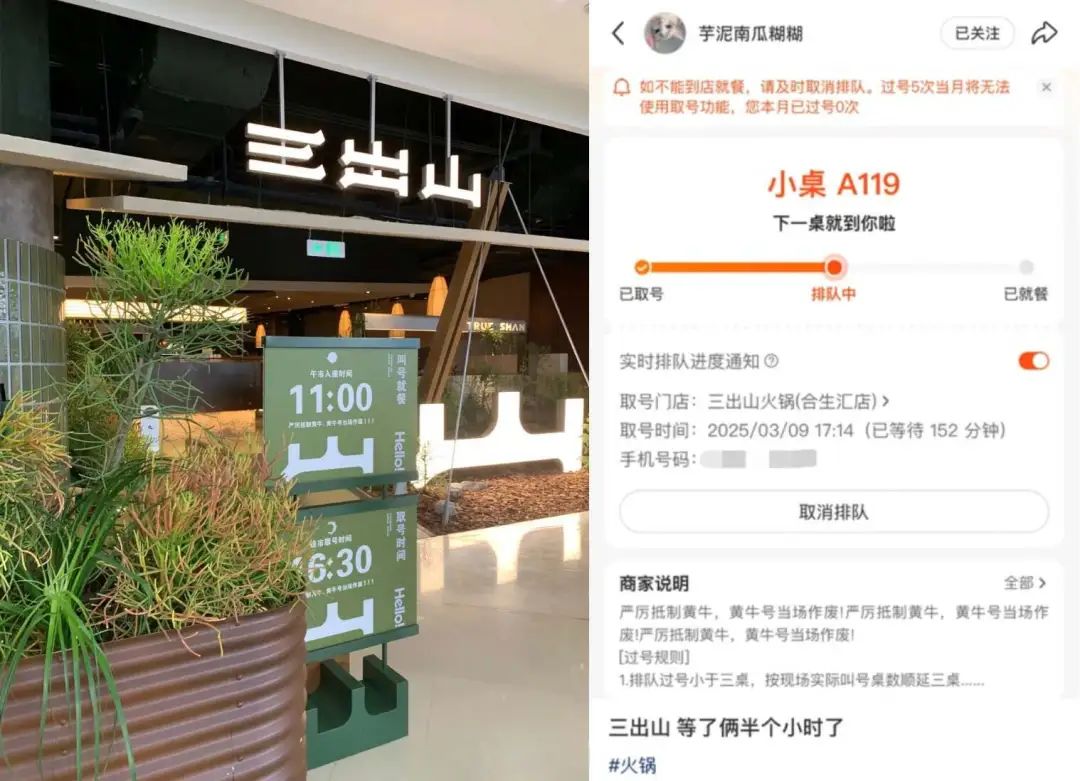
Core Insights - The emergence of "mountain wild hotpot" brands has rapidly gained popularity across major shopping malls, with brands like "San Chushan" and "Shan Huan Huan" expanding their presence significantly in a short time [1][3][19] - These brands share common characteristics, including a focus on mountain-themed decor and unique, often rare ingredients that emphasize a connection to nature [9][11][13] Brand Expansion - "Shan Huan Huan" opened 13 new stores in 13 cities within April 2025, bringing its total to 80 locations [1] - "San Chushan" increased its store count from 10 in November 2023 to 37 by April 2025 [1] Market Trends - The "mountain lifestyle" trend reflects urban consumers' desire to escape city life, with a growing interest in outdoor activities like camping and hiking [17][19] - Data from Meituan shows a 102% increase in searches related to "camping" among users aged 20-35 [17] Consumer Experience - The design of mountain wild hotpot restaurants aims to create an immersive experience reminiscent of nature, featuring earthy tones and natural elements [9][15] - The menu often includes unique mountain vegetables and ecological ingredients, with prices for some items comparable to meat dishes [11][21] Pricing and Market Position - The average consumer spending at popular mountain wild hotpot restaurants is around 130 yuan, contrasting with the overall decline in hotpot prices, which have dropped to an average of 59 yuan [21][24] - This pricing strategy allows new entrants to differentiate themselves in a highly competitive market, which is projected to reach 617.5 billion yuan in 2024 [24][26] Competitive Landscape - The hotpot market is increasingly saturated, with major brands like Haidilao and Xiaobai Xiaobai dominating the space [26][28] - New entrants are leveraging the mountain wild concept to carve out a niche, appealing to consumers seeking unique dining experiences [28]