步步高

Search documents
一般零售板块9月25日跌1.25%,赫美集团领跌,主力资金净流出4.06亿元
Zheng Xing Xing Ye Ri Bao· 2025-09-25 09:46
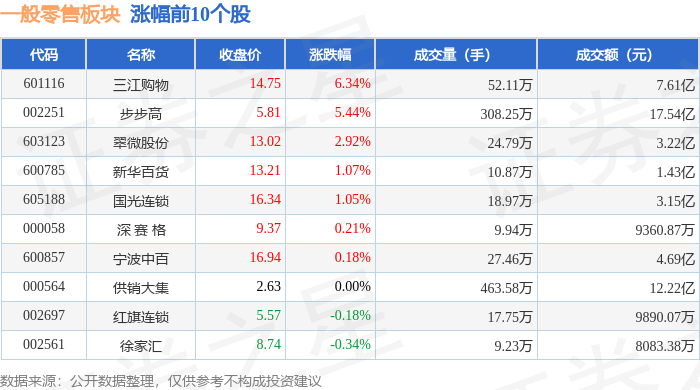
Market Overview - The general retail sector declined by 1.25% on September 25, with Hemei Group leading the losses [1] - The Shanghai Composite Index closed at 3853.3, down 0.01%, while the Shenzhen Component Index closed at 13445.9, up 0.67% [1] Stock Performance - Notable gainers in the general retail sector included: - Sanjiang Shopping (601116) with a closing price of 14.75, up 6.34% and a trading volume of 521,100 shares, totaling 760 million yuan [1] - Bubugao (002251) closed at 5.81, up 5.44% with a trading volume of 3,082,500 shares, totaling 1.754 billion yuan [1] - Hemei Group (002356) was the biggest loser, closing at 3.54, down 5.35% with a trading volume of 538,600 shares, totaling 194 million yuan [2] Capital Flow - The general retail sector experienced a net outflow of 406 million yuan from institutional investors, while retail investors saw a net inflow of 287 million yuan [2] - Specific stock capital flows included: - Bubugao had a net outflow of 59.6 million yuan from institutional investors, while retail investors contributed a net inflow of 91.5 million yuan [3] - Sanjiang Shopping saw a net inflow of 36.4 million yuan from institutional investors, but a net outflow of 24.8 million yuan from retail investors [3]


第一创业晨会纪要-20250925
First Capital Securities· 2025-09-25 07:17
Group 1: Industry Overview - The G7 and EU are considering setting a price floor for rare earth production and imposing taxes on certain exports from China to stimulate investment, which could help maintain high rare earth prices over the next two years [3] - China's rare earth smelting and separation capacity accounts for over 90% of global supply, indicating a significant reliance on Chinese production [3] - China's President Xi Jinping announced plans to increase domestic wind and solar power capacity to six times the 2020 level by 2035, with an average annual growth rate of around 8% expected over the next decade [3] Group 2: Company Performance - Anhui Wanwei's Q3 2025 earnings forecast indicates a net profit attributable to shareholders of between 340 million to 420 million yuan, representing a year-on-year growth of 69.8% to 109.8% [4] - The increase in profit is attributed to a more than 40% rise in PVA export volume and a 30% increase in acetic acid methyl ester exports, alongside a significant drop in raw material prices [4] - The company has successfully broken foreign monopolies in high-end materials, leading to a substantial improvement in profitability [4] Group 3: Advanced Manufacturing Sector - In the first seven months of 2025, approximately 7.76 million new cars with combined driving assistance features were sold, achieving a penetration rate of 62.6% [7] - The construction of 17 national-level testing demonstration zones and the promotion of 20 integrated vehicle-road-cloud pilot cities indicate significant infrastructure development [7] - The introduction of mandatory national standards for L2 driving assistance systems marks a transition towards a focus on system engineering and safety capabilities in the industry [7] Group 4: Consumer Sector - Bubu Gao reported a revenue of 2.129 billion yuan for the first half of 2025, a year-on-year increase of 24.45%, with a net profit turnaround from a loss of 84.32 million yuan to a profit of 11.67 million yuan [9] - The company's strategic adjustments and model innovations, including employee salary increases and operational optimizations, have significantly improved performance [9][10] - The closure of 74 loss-making stores and the focus on 59 core stores in Hunan have strengthened the company's competitive advantage [9]
华为WATCH GT 6系列正式发布:以技术革新推动运动健康功能体验升级
Huan Qiu Wang· 2025-09-24 11:10
Core Viewpoint - Huawei has officially launched the new generation of smart wearable products, the Huawei WATCH GT 6 series, which will be available for purchase starting September 24, 2025, with a starting price of 1488 yuan [1]. Product Features - The Huawei WATCH GT 6 series offers comprehensive and professional sports functions, addressing the pain points of outdoor sports enthusiasts by eliminating the need for multiple devices to monitor different data [3]. - The design features a "boundaryless geometric aesthetic," with a significantly reduced bezel and a high screen-to-body ratio, providing an immersive viewing experience [3]. - Available in two sizes, 41mm and 46mm, the series offers 10 color options, catering to both elegant and sporty styles [5]. - The EasyFit quick-release design allows users to easily change watch bands, making it versatile for various occasions [7]. Battery Life - The WATCH GT 6 series boasts an impressive battery life of up to 21 days, utilizing a high-density battery that increases capacity by 65% compared to the previous generation [8][10]. - The 46mm version features an 867mAh battery, while the 41mm version has a 540mAh battery, ensuring reliable power for daily use and outdoor activities [10]. Sports Functionality - The series includes advanced features for cycling, such as simulated power and cadence tracking, allowing users to access professional-level data without additional equipment [11]. - It supports third-party route imports and automatic recognition of cycling status, enhancing convenience for urban cyclists [13]. Health Monitoring - The upgraded "Xuanji" sensing system enhances health monitoring capabilities, including a detailed emotional health monitoring feature that can identify 12 different emotional states [16]. - New data metrics for cycling, such as slope and FTP data, provide a comprehensive analysis framework for users to evaluate their training [17]. - The series includes advanced cardiovascular health monitoring features, such as atrial fibrillation load statistics and arrhythmia analysis, marking a significant upgrade in health management tools [19]. Market Position - Huawei holds a 20.2% global market share in the wearable device sector, making it the leading brand in smartwatches, with a consistent top position in the Chinese market for six consecutive years [19]. - In the second quarter of 2025, Huawei shipped 7 million units, achieving a market share of 33.4%, reflecting a year-on-year growth of 16.6% [20]. Industry Impact - The launch of the WATCH GT 6 series showcases Huawei's leadership in battery life and integrated functionality in the smart wearable market, setting a new standard for precision and professionalism in the industry [23].

时隔快一百年,胖东来又把自有品牌带火了?
3 6 Ke· 2025-09-23 04:18
Core Insights - The article discusses the resurgence of private label brands in the retail industry, drawing parallels to the historical dominance of A&P in the early 20th century [1][25] - Major retailers are increasingly focusing on developing their own brands to gain competitive advantages and improve profit margins [3][12] Group 1: Market Trends - Large supermarkets are aggressively promoting their private label products, with some brands like 超盒算 NB achieving a 60% sales share from private labels [3] - The trend of retailers creating their own brands is not limited to traditional supermarkets; platforms like 叮咚买菜 are also venturing into private label products [5] - The success of private labels is evident in the performance of brands like 胖东来, which has a wide range of self-branded products [7] Group 2: Competitive Landscape - Traditional supermarkets are facing significant challenges, with many reporting losses and store closures, leading to a shift towards private label strategies as a means of survival [9][11] - The retail battle is increasingly centered around product strength, as traditional models struggle against e-commerce and new retail formats [11][12] - Retailers with strong supply chain management and product innovation capabilities are better positioned to succeed in the private label market [30][32] Group 3: Profitability and Cost Structure - Private label products can yield higher profit margins, with reported profits of 30%-40% compared to 10%-20% for branded products [16] - The cost breakdown of private label products shows that retailers can optimize pricing and quality by eliminating middlemen [19] - Successful private label brands can create a strong customer loyalty, as seen with brands that have become synonymous with their retailers [22] Group 4: Challenges and Considerations - Entering the private label market requires significant upfront investment and a deep understanding of consumer preferences [27][29] - Retailers must ensure quality control and supply chain reliability to avoid risks associated with private label products [30][32] - The article emphasizes that while private labels can be a lifeline for struggling retailers, they also require careful execution and market insight to avoid potential pitfalls [35]



14.91亿元资金今日流出商贸零售股
Zheng Quan Shi Bao Wang· 2025-09-22 10:24
Market Overview - The Shanghai Composite Index rose by 0.22% on September 22, with 11 industries experiencing gains, led by the electronics and computer sectors, which increased by 3.71% and 1.70% respectively [1] - The retail trade sector saw a decline of 1.31%, with a net outflow of 1.49 billion yuan in main funds [2] Fund Flow Analysis - The electronics industry had the highest net inflow of main funds, totaling 9.36 billion yuan, while the computer sector followed with a net inflow of 2.08 billion yuan [1] - A total of 27 industries experienced net outflows, with the power equipment sector leading at 4.66 billion yuan, followed by the pharmaceutical and biological sector with a net outflow of 3.37 billion yuan [1] Retail Sector Performance - In the retail sector, out of 97 stocks, 16 rose, including one that hit the daily limit, while 81 fell [2] - The top three stocks with the highest net outflow in the retail sector were Kuaijingtong, China Duty Free, and Bubugao, with net outflows of 359 million yuan, 128 million yuan, and 107 million yuan respectively [2] Notable Stocks - The stock with the highest net inflow in the retail sector was Aishide, with a net inflow of 39.89 million yuan, followed by Huazhi Wine and Ningbo Zhongbai with inflows of 34.24 million yuan and 20.50 million yuan respectively [5] - The retail sector's fund flow ranking highlighted significant outflows from several companies, including Kuaijingtong and China Duty Free, which saw declines of 9.20% and 1.26% respectively [2][3]



免税店概念下跌1.90%,5股主力资金净流出超5000万元
Zheng Quan Shi Bao Wang· 2025-09-22 10:17
Group 1 - The duty-free store concept declined by 1.90%, ranking among the top declines in the concept sector, with companies like Lingnan Holdings, Zhongxin Tourism, and Youhao Group experiencing significant drops [1] - The duty-free store sector saw a net outflow of 709 million yuan from major funds today, with 26 stocks experiencing net outflows, and 5 stocks seeing outflows exceeding 50 million yuan [2] - The stock with the highest net outflow was China Duty Free, with a net outflow of 128 million yuan, followed by Bubugao, Zhongxin Tourism, and Lingnan Holdings, with net outflows of 107 million yuan, 96.7 million yuan, and 58.9 million yuan respectively [2] Group 2 - The top stocks in the duty-free store concept with significant net outflows included China Duty Free (-1.26%), Bubugao (-2.08%), Zhongxin Tourism (-4.93%), and Lingnan Holdings (-6.95%) [3] - Other notable stocks with net outflows included Wangfujing (-2.07%), Youa Shares (-1.29%), and Tibet Zhufeng (-1.40%) [3] - Conversely, stocks with net inflows included Caesar Travel (+1.19%), Hainan Airport (-0.49%), and Rizhao Port (-1.85%) [3]


业绩复苏迹象明显,盈利能力有所提升
Caixin Securities· 2025-09-22 03:45
Report Investment Rating - The report does not provide a specific investment rating for the industry. Core Viewpoints - Hunan's capital market overall strength ranks among the top in the six central provinces, with leading asset scale, strong equity financing, active innovation sectors, and the Hunan 50 Index performing well [3]. - Hunan's listed companies showed strong performance in H1 2025, with high revenue and net profit growth rates and improved profitability [3]. - The structure of Hunan's listed companies has obvious highlights, with different performance in different sectors, industries, regions, and leading companies [3]. Summary by Directory 1. Hunan Capital Market Overview - As of the end of June 2025, Hunan had 147 A-share listed companies, with a total market value of 1,639.476 billion yuan. The securitization rate was 30.80%, higher than the average in the six central provinces [4]. - In H1 2025, Hunan's listed companies had a total asset of 3.10 trillion yuan, ranking first in the six central provinces, and a net asset of 0.91 trillion yuan, ranking second [4]. - In H1 2025, Hunan's listed companies achieved equity financing of 4.322 billion yuan, ranking 13th in the country and second in the six central provinces [5]. - By the end of H1 2025, Hunan had 17 and 38 listed companies on the Science and Technology Innovation Board and the Growth Enterprise Market respectively, with good performance in terms of market value, revenue, and net profit [5][6]. - From the beginning of 2025 to September 17, the Hunan 50 Index rose by 20.97%, outperforming the CSI 300 by 5.31 percentage points [7]. 2. Hunan Listed Companies' 2025 Interim Report Overview - In H1 2025, Hunan's listed companies' total revenue was 452.418 billion yuan, with a year-on-year growth rate of 5.89%, ranking sixth in the country and first in the six central provinces [9]. - In H1 2025, Hunan's listed companies' total net profit was 31.966 billion yuan, with a year-on-year growth rate of 12.12%, ranking eighth in the country and second in the six central provinces [10]. - In H1 2025, the average ROE of Hunan's listed companies was 3.51%, an increase of 0.23 percentage points compared to H1 2024, mainly due to the improvement in profitability [11]. 3. Performance of Hunan's Listed Companies in Different Sectors in H1 2025 - In H1 2025, Hunan's GEM-listed companies had the highest revenue and net profit growth rates, while Hunan's North Exchange and Shanghai-Shenzhen Main Board-listed companies had stronger profitability [12][13]. 4. Contribution of Different Industries to Hunan's Listed Companies' Performance Improvement in H1 2025 - In terms of absolute contribution, non-ferrous metals, electronics, power equipment, machinery, and non-bank finance were the main drivers of Hunan's listed companies' revenue and net profit growth, while media and steel dragged down the revenue, and food and beverage, media, and national defense and military industry dragged down the net profit [15][16]. - In terms of industry growth rate, non-ferrous metals, environmental protection, commerce and retail, and power equipment had relatively high performance growth rates [17]. 5. Contribution of Different Regions to Hunan's Listed Companies' Performance Improvement in H1 2025 - In terms of absolute value, Changsha, Zhuzhou, Xiangtan, and Yueyang were the main regions for Hunan's listed companies' performance improvement, accounting for 95.87% and 94.36% of the revenue and net profit growth respectively [18][19]. - In terms of performance growth rate, Xiangtan, Shaoyang, Chenzhou, and Yueyang had relatively high revenue growth rates, and Chenzhou, Yueyang, Huaihua, and Hengyang had relatively high net profit growth rates [19]. 6. Performance Improvement of Leading Companies in Hunan in H1 2025 - In H1 2025, the top six listed companies in terms of revenue increment contribution were Hunan Gold, Lens Technology, Hunan Yueneng, Anker Innovations, Founder Securities, and CRRC Times Electric, contributing 111.52% of the total revenue increment [20]. - In H1 2025, the top seven listed companies in terms of net profit increment contribution were Founder Securities, Zoomlion, Valin Steel, Lens Technology, New Wellful, BBK, and Anker Innovations, contributing 82.12% of the total net profit increment [20][21].
2025年10大热门加盟项目!普通人如何抓住连锁加盟黄金赛道?
Sou Hu Cai Jing· 2025-09-22 01:39
Core Insights - The franchise market in China is experiencing explosive growth in 2025, transitioning from a phase of reckless expansion to one focused on refined operations and digital empowerment [1] - The hard discount market surpassed 200 billion yuan in 2024, while the restaurant chain rate exceeded 49%, indicating a shift towards brand-oriented and digitalized franchise operations [1] - The franchise industry faces both opportunities from policy support and consumer upgrades, as well as challenges from intensified competition and compliance requirements [1] Franchise Market Trends - The emergence of professional and super franchisees is notable, with over 30% of participants at the 2025 Beijing exhibition being experienced investors and institutional investors [1] - Super franchisees typically manage more than five stores, generating annual revenues exceeding 10 million yuan, and possess strong market insight and diverse marketing channels [1] Restaurant Sector Highlights - Pointing to the success of "Dian Ti Lei Jiao Pig's Foot Rice," which ranks first in the 2025 annual top 10 fast food franchise brands, the brand offers a unique dining experience with a "0 yuan franchise fee" and a gross profit margin of 60% [2] - "Shu Yi Shu Er Spicy Noodle" stands out with a mere 3% closure rate amidst a 56% closure rate in the restaurant industry, appealing to small investors with low risk and high return [4] - "Tasting China Hamburger" is recognized for its localized innovation in Western fast food, boasting over 8,000 stores nationwide, nearing KFC's scale [5] Retail Sector Developments - "Super Box NB" offers two franchise models, ensuring product cost advantages through direct factory connections and self-pricing, with a 60% share of private label products [8] - "Ji Xiao Guo Fruit Store" leverages smart store systems to provide a competitive platform for entrepreneurs, enhancing customer experience through intelligent services [9] Service Sector Innovations - Community smart health services provide integrated solutions for elderly care, with a 25% annual return rate on a 500,000 yuan investment [12] - The rental of new energy light logistics vehicles aligns with national carbon neutrality policies, offering lower operational costs compared to fuel vehicles [13] Emerging Franchise Opportunities - The pet service sector is gaining traction, with "Chong Pang Pang" opening its first store in Shanghai, combining shopping, experience, and social interaction [14] - The cultural and entertainment sector is witnessing accelerated growth, with various categories like sports, KTV, and internet cafes thriving [16] Strategic Recommendations for Franchisees - New entrepreneurs are advised to choose brands with low investment thresholds, standardized operations, and comprehensive training support, such as "0 yuan franchise fee" models [17] - Experienced investors may consider becoming super franchisees to achieve economies of scale [17] - Precise site selection and digital operations are critical for success, with brands like "Shu Yi Shu Er" utilizing data-driven models to avoid common pitfalls [18] Risk Management and Success Factors - Franchisees should prioritize brands with third-party audit reports and transparent operational metrics to mitigate risks [20] - Continuous learning and adaptation to local market conditions are essential for franchise success, emphasizing the importance of operational efficiency and customer loyalty [24][25] - The future of the franchise market will depend on the ability to cultivate capable super franchisees and maintain quality control and service standards [27]

步步高荟聚店焕新迎客 长沙已“胖改”6家店
Chang Sha Wan Bao· 2025-09-21 09:46
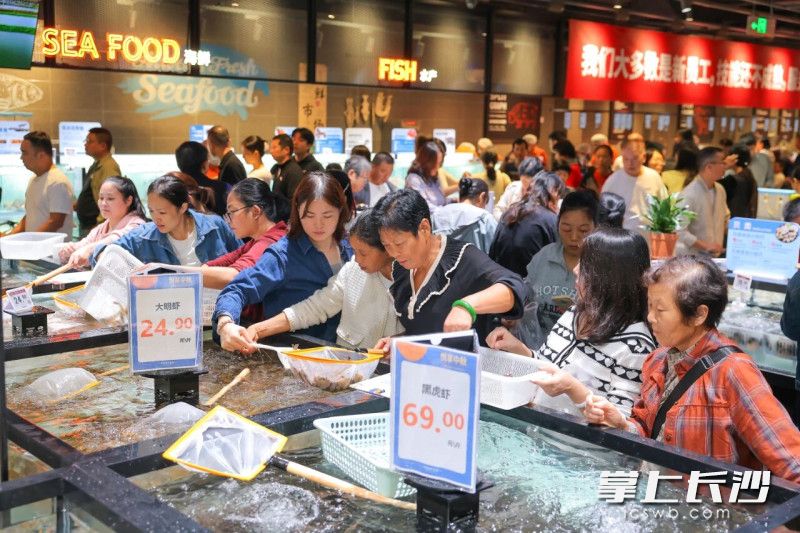
上午9时28分,随着商场大门缓缓开启,人流如开闸洪水般涌入店内。生鲜区内,顾客们里三层外三层地围在明厨 亮灶前,观看面点师傅现场制作精美点心;烘焙区飘来阵阵奶香,BL焙特莱芙烘焙柜台前很快排起长龙;水产区 中高低档水产品一应俱全,选购的顾客络绎不绝,新增的鲜味厨房,加工全程透明可视,现场挑现场做,开业第 一周海鲜免费加工。称重台前很快排起十余米的长队,每个人的购物车里都堆满了新鲜食材。 长沙晚报掌上长沙9月21日讯(全媒体记者 刘捷萍)9月21日,胖东来帮扶指导的步步高超市长沙荟聚店重新开门 迎客。至此,长沙已"胖改"6家步步高。 服务方面,门店打造了设施完善的顾客休息区,配备洗手台、纸巾、烘手器、护手霜、直饮水等便民设施。在调 味品等柜台,特意增设了放大镜,方便老年客群查看商品信息。针对散装食品,清晰标注"每斤约几颗",解决了 顾客选择时的焦虑问题。店内还设置了试穿拖鞋的专用鞋套、试穿鞋凳,以及易碎品打包处、海鲜打包加冰处 等,充分满足顾客在购物过程中的多样需求。 据悉,今年3月以来,步步高超市调改、重开了长沙的丽发新城店、荟聚店。截至目前,步步高已成功完成全省20 家门店调改工作,其中,长沙6家,分别是梅 ...
36氪精选:罗永浩大战贾国龙,预制菜闷声发大财
日经中文网· 2025-09-20 00:33
Core Viewpoint - The recent surge in stock prices of pre-prepared food companies in A-shares is attributed to the upcoming national food safety standards for pre-prepared dishes, which will provide a unified identity and safety baseline for the industry [12][13]. Industry Overview - The pre-prepared food industry in China has a history dating back to the 1990s, with significant developments occurring between 2000 and 2005 when many current leading companies were established [13]. - Regulatory frameworks for pre-prepared foods have only begun to take shape in recent years, with standards being introduced by various governmental bodies [13][14]. Market Dynamics - The stock prices of companies such as Deli Foods, Longda Food, and Huifa Foods have seen increases of over 5%, with Deli Foods hitting a 10.10% rise [7][11]. - The rise in stock prices is linked to the public's renewed interest in the pre-prepared food debate, sparked by recent comments from industry figures [12]. Consumer Perception - There is a disconnect between the regulatory definition of pre-prepared foods and consumer understanding, leading to concerns about food safety and transparency [14]. - Consumers express frustration over the lack of knowledge regarding the preparation of their meals, reflecting a deeper societal issue of time constraints and the desire for authentic dining experiences [14][17]. Operational Trends - The adoption of pre-prepared foods is becoming widespread among restaurants, as they are more cost-effective than hiring chefs and allow for a diverse menu without extensive culinary skills [16]. - The rise of central kitchens and cold chain logistics post-2008 has facilitated the expansion of pre-prepared foods, standardizing offerings across various dining establishments [16].