
中国太平

Search documents
重点关注保险负债端开门红预期,收并购案例有望提升券业集中度
SINOLINK SECURITIES· 2025-11-23 11:36
Investment Rating - The report suggests a focus on three main investment lines, particularly highlighting the potential for significant growth in the securities and insurance sectors [2][4]. Core Insights - The report indicates that the recent merger activities among major securities firms, such as the planned absorption of Dongxing Securities and Xinda Securities by CICC, are expected to enhance industry concentration and catalyze valuation recovery in the brokerage sector [1][43]. - It emphasizes the strong performance of listed brokers in Q3, with a current price-to-book ratio (PB) of 1.34x, recommending brokers with solid fundamentals but mismatched valuations [2]. - The report also highlights the promising growth prospects in the multi-financial sector, particularly for the Hong Kong Stock Exchange, which is expected to benefit from deepening connectivity and increased activity from A-share companies listing in Hong Kong [2]. Summary by Sections Securities Sector - The report notes a significant merger in the securities industry, with CICC planning to merge with Dongxing Securities and Xinda Securities, which is the third major merger in 2024, following the mergers of Guotai Junan and Haitong Securities, and Guoxin Securities acquiring Wanhe Securities [1]. - It highlights the expected impact of this merger on industry concentration and valuation recovery for the brokerage sector [1]. Insurance Sector - The report discusses the recent guidelines issued by the China Actuarial Society regarding the expense allocation for life insurance products, which aims to enhance the scientific and reasonable pricing of insurance products [3]. - It anticipates a double-digit growth in new premium income in the short term, supported by a decrease in liability costs and improved industry concentration in the long term [4]. - The report recommends focusing on leading insurance companies with strong business quality and low liability costs, as well as those undergoing transformation towards dividend insurance [4]. Market Review - The report provides a market review indicating that the CSI 300 index fell by 3.8%, with the non-bank financial sector declining by 4.4%, underperforming the index [10]. - It notes the performance of various sub-sectors, with securities and insurance stocks experiencing declines of 4.9% and 3.0%, respectively [10]. Data Tracking - The report includes data on brokerage activities, noting a decrease in average daily A-share trading volume to 18,650 billion yuan, a decline of 8.7% [15]. - It also highlights significant growth in the issuance of equity public funds and bond underwriting, with IPO and refinancing raising 902 billion and 8,623 billion yuan, respectively, in October 2025 [15].
中国太平(00966.HK):冯占武获委任为非执行董事
Ge Long Hui· 2025-11-21 09:52
Core Viewpoint - China Taiping (00966.HK) announced the resignation of non-executive directors Guo Zhaoxu and Zhang Cui due to reaching retirement age, which may impact the company's governance structure and risk management oversight [1] Group 1 - Guo Zhaoxu will no longer serve as a member of the Risk Management Committee following his resignation [1] - Zhang Cui will no longer serve as a member of the Audit Committee and the Risk Management Committee after her resignation [1] - Feng Zhanwu has been appointed as a non-executive director and a member of the Risk Management Committee [1]
中国太平(00966):冯占武获委任为非执行董事及风险管理委员会成员
智通财经网· 2025-11-21 09:50
Group 1 - The company announced that non-executive directors Guo Zhaoxu and Zhang Cui will resign due to reaching retirement age, effective from November 21, 2025 [1] - Following their resignation, Guo will no longer serve as a member of the Risk Management Committee, and Zhang will no longer serve as a member of both the Audit Committee and the Risk Management Committee [1] - Feng Zhanwu has been appointed as a non-executive director and a member of the Risk Management Committee [1]
中国太平(00966) - 董事名单与其角色和职能
2025-11-21 09:46
中國太平保險控股有限公司董事會(「董事會」)成員載列如下。 執行董事 尹兆君先生 董事長 李可東先生 副董事長及總經理 那豔芳女士 (於香港註冊成立之有限公司) (股份代號:966) 董事名單與其角色和職能 非執行董事 C 有關委員會的主席 M 有關委員會的成員 中國香港,2025 年 11 月 21 日 羅范椒芬女士 劉怡女士 邵善波先生 蔡洪平先生 董事會設立 4 個委員會。下表提供各董事會成員在這些委員會所擔任的職位: | | 委員會 | | 提名薪酬 | 風險管理 | 戰略與投資 | | --- | --- | --- | --- | --- | --- | | | | 審計委員會 | 委員會 | 委員會 | 委員會 | | 董事 | | | | | | | 尹兆君先生 | | | | | C | | 李可東先生 | | | | M | M | | 那豔芳女士 | | | M | M | M | | 胡興國先生 | | M | | | M | | 周梁剛先生 | | | | | M | | 馮占武先生 | | | | M | | | 羅范椒芬女士 | | M | M | | | | 劉怡女士 | | ...
中国太平(00966) - 非执行董事变更
2025-11-21 09:44
香港交易及結算所有限公司及香港聯合交易所有限公司對本公告的內容概不負責,對其準確性或完整性亦不發 表任何聲明,並明確表示,概不對因本公告全部或任何部份內容而產生或因倚賴該等內容而引致的任何損失承 擔任何責任。 (於香港註冊成立之有限公司) (股份代號:966) 非執行董事 公告 非執行董事變更 中國太平保險控股有限公司(「本公司」,連同其附屬公司統稱「本集團」)董事會(「董事會」) 謹此宣佈下列有關本公司非執行董事及董事會附屬委員會成員變動,由 2025 年 11 月 21 日 起生效。 非執行董事辭任 本公司非執行董事郭兆旭先生(「郭先生」)及張翠女士(「張女士」)因已達退休年齡,辭任 本公司非執行董事職務。辭任後,郭先生將不再擔任本公司風險管理委員會成員;及張女士 將不再擔任本公司審計委員會及風險管理委員會成員。郭先生及張女士已確認彼等與董事會 並無任何意見分歧及並無任何與彼等辭任有關之事宜需要通知香港聯合交易所有限公司 (「聯交所」)及本公司股東。 委任非執行董事 本公司進一步宣佈馮占武先生(「馮先生」)獲委任為本公司非執行董事及風險管理委員會成 員。 馮先生的履歷載列如下: 馮占武先生,52歲,自20 ...
港股收评:阶段新低!科技、金融拖累市场,半导体重挫
Ge Long Hui· 2025-11-21 08:46
Market Overview - The Hong Kong stock market experienced significant declines, with the Hang Seng Tech Index dropping by 3.21%, while the Hang Seng Index and the China Enterprises Index fell by 2.38% and 2.45%, respectively, reaching new lows for the period [1][2]. Sector Performance - Major sectors such as large technology stocks, financials (including banks, insurance, and brokerage), and state-owned enterprises faced collective pressure, negatively impacting market sentiment. Notable declines included Baidu down nearly 6% and Alibaba down 4.65% [2][3]. - The semiconductor sector saw substantial losses, with companies like JD Health dropping over 8%, and SMIC and Huahong Semiconductor both falling over 6% [5][6]. - The lithium battery sector also faced declines, with Ganfeng Lithium down over 12% and Tianqi Lithium down over 11% [8][15]. - Conversely, some retail stocks showed resilience, with certain real estate stocks like R&F Properties, Country Garden, and Longfor Group rising against the trend [2]. Individual Stock Movements - JD Health reported a decline of 8.60%, closing at 62.15 HKD, while SMIC and Huahong Semiconductor fell by 6.39% and 6.09%, respectively [6][11]. - Ganfeng Lithium's stock price dropped to 50.90 HKD, marking a 12.47% decrease, while Tianqi Lithium fell to 47.16 HKD, down 11.93% [8][15]. - The advertising and promotion sector saw activity, with companies like Runge Interactive rising over 10% [14]. Market Sentiment and Future Outlook - The market sentiment was influenced by external factors, including concerns over potential overheating in AI investments, as highlighted by a report on Nvidia that affected the AI hardware sector [9]. - Looking ahead, the macroeconomic environment is expected to improve with the potential for a more accommodative global liquidity situation, driven by anticipated interest rate cuts by the Federal Reserve [18].

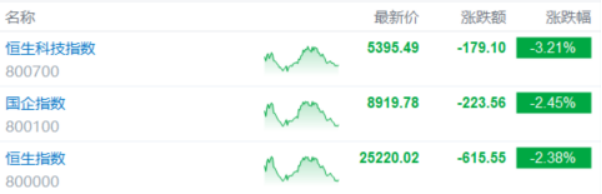
港股收评:三大指数齐创阶段新低,恒指大跌2.38%,科技金融齐挫,行业板块尽数走低
Ge Long Hui· 2025-11-21 08:20
Core Viewpoint - Major global stock markets experienced significant declines due to cooling expectations of Federal Reserve interest rate cuts, leading to global liquidity concerns and investor worries about an artificial intelligence bubble, compounded by a sharp drop in Bitcoin [1] Market Performance - Hong Kong's three major indices saw substantial declines, with the Hang Seng Tech Index dropping as much as 3.8% and ultimately closing down 3.21%. The Hang Seng Index and the China Enterprises Index fell by 2.38% and 2.45%, respectively, marking new lows for the period [1] - Large-cap technology stocks, major financial stocks (including banks, insurance, and brokerage firms), and state-owned enterprises collectively pressured market sentiment, with Baidu down nearly 6% and Alibaba down 4.65% [1] Sector Performance - Concerns over the artificial intelligence bubble led to significant declines in the semiconductor chip sector, while solar, gaming, biotechnology, gold, lithium battery, Apple concept, automotive, and coal stocks also fell [1] - Conversely, certain retail stocks showed gains, and some real estate stocks rose due to rumors, with R&F Properties, Country Garden, and Longfor Group bucking the trend [1] - Despite the overall market downturn, over 40 stocks still saw gains of more than 10%, with the small-cap stock Rongtai Group experiencing a doubling in intraday gains [1]
险企今年以来发债超700亿元 永续债成资本补充主力
Zhong Guo Zheng Quan Bao· 2025-11-20 20:09
Core Viewpoint - Insurance companies are accelerating capital replenishment as the transition period for the second phase of the solvency regulation approaches its end, with 19 companies issuing capital supplementary bonds or perpetual bonds totaling over 70 billion yuan this year, with nearly 70% being perpetual bonds [1][2] Group 1: Capital Supplementation Trends - As of November 20, 2023, 19 insurance companies have issued capital supplementary bonds or perpetual bonds, with a total issuance scale of 741.7 billion yuan, slightly down from the previous year but still at a high level [1][2] - Half of the issuing companies opted for perpetual bonds, with a total issuance close to 500 billion yuan, representing nearly 70% of the total [2] - Major issuers of perpetual bonds include Ping An Life (13 billion yuan), Taiping Life (9 billion yuan), ICBC-AXA Life (7 billion yuan), Taikang Life (6 billion yuan), and Sunshine Life (5 billion yuan) [2] Group 2: Cost of Issuance and Debt Management - The average coupon rate for the bonds issued this year is below 3%, with the highest at 2.8% and the lowest at 2.15% [2][3] - Some insurance companies are redeeming old bonds while issuing new ones to lower financing costs, as seen with China Merchants Jinhe Life redeeming an 8 billion yuan bond with a higher interest rate [3] Group 3: Regulatory Context and Future Outlook - The issuance of bonds is primarily driven by the need to enhance solvency and meet stricter regulatory requirements under the second phase of solvency regulations, which has seen a decline in solvency ratios [3] - The transition period for these regulations has been extended to the end of 2025, prompting insurance companies to expedite capital replenishment efforts [3] - Industry experts suggest that insurance companies should diversify their capital replenishment channels and improve their profitability and capital management efficiency for sustainable development [3]
月内超150亿元!险企发债“补血”迎小高潮
Guo Ji Jin Rong Bao· 2025-11-20 15:48
Core Viewpoint - Insurance companies are increasingly issuing perpetual bonds and capital supplementary bonds to enhance their capital and solvency, with a total issuance exceeding 15 billion yuan since November [1][2]. Group 1: Bond Issuance Trends - The total bond issuance by insurance companies has decreased compared to last year but remains at a high level, with a notable preference for perpetual bonds [1][2]. - In November, several insurance companies accelerated their bond issuance, including Zhongyou Life (1.27 billion yuan), Yingda Taihe Life (2.5 billion yuan), Zhongzheng Property Insurance (4 billion yuan), Ping An Property Insurance (6 billion yuan), and others [2]. - The primary purpose of these bond issuances is to supplement capital and enhance the companies' solvency to support sustainable business development [2]. Group 2: Factors Influencing Bond Issuance - The surge in bond issuance is attributed to multiple factors, including a favorable regulatory approval timeline and the need to address the impact of new accounting standards on solvency ratios [3]. - The relatively low financing costs have also encouraged insurance companies to issue bonds, with coupon rates ranging from 2.15% to 2.40%, significantly lower than the previous years' rates around 3.5% [3][4]. Group 3: Perpetual Bonds as a Financing Tool - Perpetual bonds have emerged as a new tool for capital supplementation, allowing insurance companies to meet regulatory capital requirements without a fixed maturity [5]. - The issuance of perpetual bonds has gained momentum since the regulatory framework was established in 2022, with major companies like Taikang Life leading the way [5][6]. - The total issuance of perpetual bonds in 2023 reached 35.77 billion yuan, with projections for 2024 indicating further growth [6]. Group 4: Long-term Capital Strategies - While bond issuance provides short-term capital relief, the long-term solution lies in enhancing the insurance companies' internal capital generation capabilities [7]. - Companies are encouraged to focus on high-quality development, optimize business structures, and improve operational efficiency to reduce reliance on external capital [7]. - Strengthening asset-liability management and leveraging technology for operational efficiency are essential for sustainable growth in the insurance sector [7].



以中长期稳健增值为目标 险资系私募基金接连启航
Zhong Guo Zheng Quan Bao· 2025-11-19 20:13
Core Insights - Sunshine Life Insurance, a subsidiary of Sunshine Insurance, has signed a fund contract with Sunshine Hengyi and China Merchants Bank Qingdao Branch, marking a significant step in launching a pilot fund project with an investment of 20 billion yuan [1] - Multiple insurance capital-backed private equity funds have been established this year, focusing on the secondary market and aiming for medium to long-term stable asset appreciation, thus facilitating the long-term investment reform of insurance funds [1][2] - The establishment of these funds is expected to enhance the interaction between insurance capital and the capital market, leveraging the advantages of insurance funds as long-term investors [1][4] Fund Establishment and Management - Sunshine Hengyi has completed its business registration and is in the process of signing contracts and filing for the pilot fund, which is expected to have a total scale of 20 billion yuan, fully subscribed by Sunshine Life Insurance [1][2] - As of now, seven insurance capital-backed private equity fund companies have been established, including those from Taikang Insurance, China Pacific Insurance, and China Life Insurance [2] - The funds are primarily focused on large-cap blue-chip stocks and high-dividend targets, with a strategy that emphasizes long-term capital attributes and stable returns [2][3] Investment Strategy and Focus - The investment scope of the proposed private equity fund includes equity assets, fixed income assets, and cash management tools, with a focus on stocks from the CSI 300 Index and related ETFs [3] - The investment philosophy of these funds includes a focus on high-dividend assets, stable operations, and sectors aligned with national development strategies, such as high-end manufacturing and artificial intelligence [3][4] - The insurance capital-backed private equity funds are expected to adopt a long-term holding strategy to optimize asset-liability matching and reduce market volatility impacts on profit statements [4][5] Regulatory and Market Context - The establishment of these funds aligns with the regulatory push for increasing long-term capital inflows into the market, as outlined in the implementation plan by several financial authorities [3][4] - The pilot fund initiative has already seen three batches of funds totaling 222 billion yuan, expanding the scope of participating institutions beyond large insurance companies [3][4] - The long-term investment strategy is aimed at supporting the healthy development of the capital market and enhancing the stability of insurance companies' investment capabilities [5]