
雀巢

Search documents
两年内裁员1.6万人!雀巢回应
Sou Hu Cai Jing· 2025-10-17 19:14
Core Viewpoint - Nestlé has announced a plan to cut approximately 16,000 jobs globally as part of its "Growth Acceleration" cost-saving initiative, aiming to enhance operational efficiency and drive business transformation [1][2]. Group 1: Job Cuts and Cost-Saving Measures - The job cuts will include around 12,000 white-collar positions across all functions and regions, with an additional 4,000 positions being eliminated through productivity improvements in production and supply chain [2]. - The company expects to save CHF 1 billion annually by the end of 2027, doubling its initial target of CHF 500 million, with total cost-saving goals raised from CHF 2.5 billion to CHF 3 billion [2]. Group 2: Financial Performance and Growth - For the first nine months of 2025, Nestlé reported an organic growth rate (OG) of 3.3%, with a real internal growth rate (RIG) of 0.6% and a pricing contribution of 2.8%. The organic growth rate for Q3 reached 4.3% [2][3]. - Coffee and confectionery segments were the main contributors to organic growth, driven primarily by pricing strategies, with some markets experiencing double-digit growth [3]. Group 3: Regional Performance - All regions contributed positively to organic growth, with developed markets showing an organic growth rate of 2.1% and emerging markets at 5.2%, mainly driven by pricing [3]. - The Greater China region underperformed, with a Q3 organic growth rate of -10.4%, continuing a downward trend from Q2, and a nine-month organic growth rate of -6.1% [3]. Group 4: Future Outlook and Leadership Changes - Nestlé anticipates that organic sales growth for 2025 will outperform 2024, despite challenges from high year-on-year comparisons in Q4 [4]. - The new CEO, Philipp Navratil, emphasizes the importance of driving business growth through real internal growth rates, with ongoing investments aimed at achieving this goal [4].



巨头宣布:裁员1.6万人,其中1.2万是白领!新任CEO:树立绩效导向思维!前任CEO因与直接下属谈恋爱被解雇
Mei Ri Jing Ji Xin Wen· 2025-10-17 16:35
Core Insights - Nestlé's third-quarter performance is under scrutiny due to recent leadership changes, with a new CEO taking charge during a critical transformation period [1][6] - The company reported a sales figure of 65.869 billion Swiss francs for the first three quarters, with an organic growth rate of 3.3% [1] - The new CEO, Mark Schneider, emphasized a performance-driven culture and the need to avoid market share loss [6][7] Financial Performance - For the third quarter, Nestlé achieved an organic growth rate of 4.3%, with an internal growth rate of 1.5% [1] - The Asia-Pacific region, particularly Greater China, continues to be a drag on overall growth, contributing negatively to the organic growth rates [3][4] - The company plans to cut approximately 16,000 jobs globally over the next two years, aiming to enhance agility and performance [4][5] Market Dynamics - The stock price of Nestlé rose by over 9% following the earnings report, marking the largest single-day increase since 2008 [3] - The organic growth rate in emerging markets was 5.2%, while developed markets saw a growth rate of 2.1% [3] - E-commerce sales experienced a significant organic growth of 13.2%, indicating a shift in consumer purchasing behavior [3] Strategic Initiatives - The new CEO outlined four key priorities: internal growth rate focus, profitable investment portfolio, performance culture, and transformation efficiency [6] - The company is shifting its focus in Greater China to drive consumer demand rather than reducing trade inventory levels [3][4] - The leadership changes and job cuts are part of a broader strategy to streamline operations and improve efficiency [5][6]
雀巢四款广州“老朋友”,入选“食在广州”榜单
Nan Fang Du Shi Bao· 2025-10-17 13:50
Core Insights - The "Eat in Guangzhou" brand event highlights the recognition of Nestlé Ice Cream's classic products, which have been integrated into local culture and consumer preferences over the past two decades [1][4][5] Group 1: Brand Recognition - Nestlé Ice Cream's four classic products were officially certified by the "Eat in Guangzhou" initiative, which evaluates food safety, consumer feedback, and brand innovation [1][2] - This certification marks Nestlé Ice Cream as one of the first foreign food brands to receive the "Eat in Guangzhou" title, indicating a successful blend of global quality and local culinary culture [2][5] Group 2: Quality Assurance - The production of Nestlé Ice Cream products involves nearly 200 inspections covering materials, processes, and final products to ensure high quality [2] - Nestlé employs a smart transport management system to address logistics challenges, ensuring that products maintain their quality during distribution [2] Group 3: Cultural Integration - Nestlé Ice Cream has been a part of Guangdong's market for over 20 years, evolving from a simple product to a significant cultural symbol for generations [4][5] - The classic products not only represent nostalgic memories for consumers but also reflect the international resonance of Cantonese lifestyle and cuisine [5][6] Group 4: Historical Context - The Guangzhou factory, established in 1986, has been pivotal in creating iconic ice cream products that resonate with local consumers [7] - Since 1999, the factory has focused on developing flavors that cater to local tastes, contributing to its longstanding popularity among consumers [7]

雀巢:两年裁员16000人
Guo Ji Jin Rong Bao· 2025-10-17 11:27
Core Insights - Nestlé is undergoing significant changes, including a global workforce reduction of 16,000 employees, approximately 6% of its total workforce, as part of a cost optimization plan initiated by the new CEO, Philipp Navratil [1][4] Financial Performance - For the first nine months of the year, Nestlé reported global sales of CHF 65.9 billion, a year-on-year decline of 1.9%. Excluding currency fluctuations, the organic growth rate was 3.3% [4] - The Greater China region, which is Nestlé's second-largest market, faced notable challenges, with an organic growth rate of -6.1% and a pricing contribution rate of -3.2%, indicating a decline in both volume and price [4] - In contrast, the Asia, Oceania, and Africa (AOA) region, excluding Greater China, showed a healthier performance with an organic growth rate of 5.3% and a pricing contribution rate of 4% [4] Management Changes - Following the dismissal of former CEO Laurent Freixe due to a breach of conduct, Philipp Navratil took over on September 1 [4] - The CEO of Nestlé China, Zhang Xiqiang, resigned in April for personal reasons, and was succeeded by Kais Marzouki, who has made swift adjustments to the team, including the departure of key personnel in the pet food and coffee divisions [6] - Strategic adjustments are being made in the Chinese market, including a reduction in SKU and a focus on eliminating inefficient product categories and investments [6]
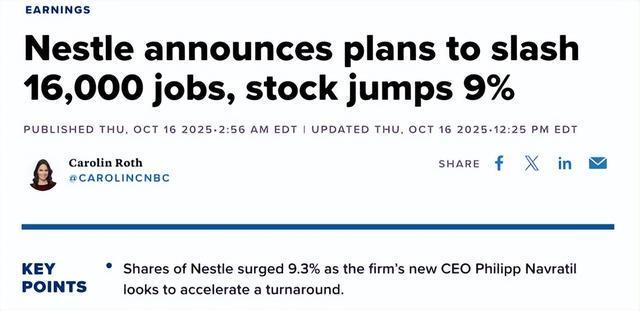
雀巢业绩超预期 新CEO计划裁员1.6万人
Huan Qiu Wang Zi Xun· 2025-10-17 08:09
Group 1 - The core viewpoint of the article highlights Nestlé's third-quarter organic sales growth of 4.3%, surpassing analyst expectations of 3.7% [1][3] - For the first nine months of 2025, Nestlé reported sales of 65.87 billion Swiss francs, with an organic growth rate of 3.3%, slightly above the market expectation of 3.2% [1][3] Group 2 - To revitalize performance and restore investor confidence, Nestlé announced plans to cut approximately 16,000 jobs, representing 6% of its global workforce [3] - The company raised its cost-saving target from 2.5 billion Swiss francs to 3 billion Swiss francs by the end of 2027 [3] - New CEO Philipp Navratil emphasized the need for rapid changes within the company, indicating that difficult decisions regarding workforce reduction are necessary [3] - Navratil also stated that all business units will undergo continuous evaluation, focusing on brand growth, return rates, and market leadership [3] - Following the positive performance and organizational changes, Nestlé's stock price increased by 9.3%, marking the largest single-day gain since 2007 [3]
黄金,全球首个超30万亿美元资产
21世纪经济报道· 2025-10-17 06:32
Core Insights - Gold has reached a total market capitalization of over $30 trillion, becoming the first global asset to surpass this milestone [2][3] - The recent surge in gold prices has led to significant increases in domestic gold jewelry prices, with some brands seeing daily increases of up to 36 yuan per gram [1] Market Performance - On October 16, gold prices rose by 2.85% to $4,326.48 per ounce, while COMEX gold futures increased by 3.4% to $4,344.3 per ounce [1] - The current market cap of gold is approximately $30.469 trillion, significantly higher than other major assets like NVIDIA and Microsoft [3] Investor Sentiment - A recent Bank of America survey indicated that 43% of investors view "going long on gold" as the most crowded trade, surpassing the 39% for "long on US tech giants" [5] - Despite this sentiment, many fund managers have low gold positions, with 39% reporting near-zero exposure, suggesting potential for further investment [5] Market Drivers - The primary drivers for the influx of capital into gold include the dovish stance of the Federal Reserve and rising geopolitical risks, such as increased tariffs from the US government [5] - Goldman Sachs has raised its gold price target for the end of 2026 to $4,900 per ounce, reflecting a bullish outlook on gold [5] Investment Strategies - Experts recommend dollar-cost averaging as a prudent strategy for ordinary investors to mitigate risks associated with gold price volatility [7] - The strategy of regular, fixed investments in gold can help smooth costs and reduce the risk of making poor timing decisions [7]

双11咖啡暴涨800%和雀巢宣布全球裁员1.6万人,市场两重天?
Sou Hu Cai Jing· 2025-10-17 05:45
Group 1 - The first wave of sales for Double 11 in the domestic market has shown significant growth, with Taobao flash sales seeing multiple categories increase by over 200% year-on-year, and coffee orders growing by 800% [2] - Nestlé announced a global layoff of 16,000 employees, which represents about 6% of its total workforce of 277,000, indicating the company is facing multiple challenges despite the rising market demand [2][4] - The paradox of increasing market demand alongside Nestlé's layoffs highlights a shift in consumer preferences and operational strategies, particularly influenced by emerging consumption trends [2][4] Group 2 - The surge in coffee orders is attributed to a new consumption concept driven by daily coffee shop and tea house experiences, as well as promotional subsidies from delivery platforms [3] - Emotional tags related to coffee consumption, such as "healing afternoon" and "office companion," have gained popularity, surpassing traditional keywords, which explains the 800% growth in coffee orders [3] - Technological advancements in coffee production, such as freeze-dried coffee, have improved taste and accessibility, allowing consumers to stock up during sales events like Double 11 [4] Group 3 - Coffee has evolved beyond a beverage to become an essential part of daily life, with portable coffee products seeing increased demand in outdoor activities [5] - The rise in sales of home coffee kits and related products indicates the growing trend of creating "home coffee corners," reflecting a shift in consumer behavior towards coffee as a necessity rather than a luxury [5] - Nestlé's CEO has stated that the company will prioritize growth driven by sales volume and increase investments to achieve this goal, while also facing challenges related to global tariffs and cost pressures [5]

杰富瑞上调雀巢目标价至81瑞士法郎
Ge Long Hui· 2025-10-17 04:39
Group 1 - Jefferies raised Nestlé's target price from 77 Swiss francs to 81 Swiss francs [1]
国元证券晨会纪要-20251017
Guoyuan Securities· 2025-10-17 02:31
Core Insights - The report highlights a significant decline in the US manufacturing sector, with the Philadelphia Fed Manufacturing Index dropping to -12.8, the lowest since April 2023 [4] - Concerns over a credit crisis in the US have led to a market capitalization loss exceeding $100 billion for bank stocks [4] - Spot gold prices have reached a historic high, surpassing $4,300 per ounce [4] - TSMC reports stronger-than-expected demand for AI, indicating robust growth potential in the semiconductor industry [4] Economic Data Summary - The Baltic Dry Index closed at 1997.00, down 1.24% [5] - The Nasdaq Composite Index closed at 22,562.54, down 0.47% [5] - The Dow Jones Industrial Average closed at 45,952.24, down 0.65% [5] - Brent crude oil prices fell to $61.02, down 1.44% [5] - The US dollar index decreased by 0.32% to 98.35 [5] - The Hang Seng Index closed at 25,888.51, down 0.09% [5] - The Shanghai Composite Index closed at 3,916.23, up 0.10% [5]
《美国股市观察:区域性忧虑》 --- U.S. EQUITIES COLOR_ REGIONAL WORRIES
2025-10-17 01:46
Summary of Key Points from the Conference Call Industry Overview - The conference call primarily discusses the U.S. equities market, with a focus on regional banks and macroeconomic factors affecting the market dynamics [1][2][4]. Core Insights and Arguments - **Market Performance**: - S&P 500 Index decreased by 63 basis points, closing at 6,629 points, with a market-on-close buying amount of $3.7 billion [2][4]. - Nasdaq 100 Index fell by 36 basis points to 24,657 points, while the Russell 2000 Index dropped significantly by 204 basis points to 2,468 points [2][4]. - The Dow Jones Industrial Average declined by 65 basis points, closing at 45,952.22 points [2][4]. - Total trading volume across U.S. exchanges reached 22.4 billion shares, exceeding the year-to-date daily average of 17.2 billion shares [2][4]. - **Volatility and Economic Indicators**: - The VIX index surged by 2011 basis points to 24.98, indicating increased market volatility [2][4]. - WTI Crude oil prices fell by 137 basis points to $57.46 per barrel, while gold prices rose by 263 basis points to $4,317 [2][4]. - The U.S. 10-year Treasury yield decreased by 5 basis points to 3.97% [2][4]. - **Regional Banks Under Pressure**: - Regional banks (ZION, WAL, JEF) faced significant pressure due to weaknesses in credit provisioning, marking the second worst day for the group since the Silicon Valley Bank incident in March 2023 [4][15]. - There is heightened concern regarding non-depository financial institution (NDFI) credit exposure, with increased inquiries about loan risks [5][4]. - **Macroeconomic Factors**: - The Federal Reserve's stance has turned more hawkish than expected, with implications for interest rate cuts [4][5]. - Ongoing government shutdown concerns are contributing to market unease, with traders becoming increasingly cautious [4][5]. Other Important Insights - **Investor Sentiment**: - There is a notable increase in calls from generalists inquiring about the financial sector, indicating rising concern and interest in the dynamics of regional banks [5][4]. - The market is experiencing a shift in private credit anxiety towards regional banks, reflecting broader concerns in the financial sector [5][4]. - **Upcoming Economic Data**: - Key macroeconomic indicators to be released include U.S. cross-border investment, housing starts, industrial production, and Eurozone CPI [9][4]. - A significant expiration of options is anticipated, with an estimated $1.9 trillion of SPX options and $760 billion of single stock options set to expire [9][12]. - **Sector Performance**: - Consumer staples have shown strong performance, driven by better-than-expected earnings from companies like Nestle, which rose by 8% [6][8]. This summary encapsulates the critical points discussed in the conference call, highlighting the current state of the U.S. equities market, particularly focusing on regional banks and macroeconomic influences.