
广汇能源

Search documents
广汇能源股份有限公司关于完成工商变更登记并换发营业执照的公告
Zhong Guo Zheng Quan Bao - Zhong Zheng Wang· 2025-11-08 00:17
Core Points - The company has completed the registration of changes to its business license, reflecting a new registered capital of RMB 6,392,002,964 [1] - The board of directors approved several resolutions regarding the repurchase of shares and amendments to the company's articles of association [1] - The updated business license includes the company's unified social credit code and details about its operational scope, including gas operations and hazardous chemicals [1] Summary by Sections - **Company Resolutions** - The board approved the change of share repurchase purposes and the cancellation of shares, along with amendments to the articles of association [1] - **Business License Update** - The company has received a new business license from the Urumqi Economic and Technological Development Zone Market Supervision Administration [1] - The updated business license includes the company's name, type, address, legal representative, and registered capital [1] - **Operational Scope** - The company is involved in various activities, including gas operations, coal sales, import and export of goods, and technology services [1]

石油石化行业11月7日资金流向日报
Zheng Quan Shi Bao Wang· 2025-11-07 09:00
Market Overview - The Shanghai Composite Index fell by 0.25% on November 7, with 14 out of the 28 sectors rising, led by basic chemicals and comprehensive sectors, which increased by 2.39% and 1.45% respectively [1] - The oil and petrochemical sector ranked third in terms of daily gains, rising by 1.38% [2] Fund Flow Analysis - The main funds in the two markets experienced a net outflow of 40.396 billion yuan, with six sectors seeing net inflows [1] - The basic chemicals sector had the highest net inflow of funds, totaling 5.943 billion yuan, while the power equipment sector saw a net inflow of 4.253 billion yuan [1] - The electronic sector had the largest net outflow, with 10.212 billion yuan, followed by the computer sector with a net outflow of 10.005 billion yuan [1] Oil and Petrochemical Sector Details - In the oil and petrochemical sector, 31 out of 47 stocks rose, while 13 fell, with a net outflow of 28.2 million yuan for the sector overall [2] - The top three stocks with net inflows were Hengli Petrochemical (600346) with 73.2639 million yuan, Sinopec (China Petroleum) with 53.4997 million yuan, and Zhun Oil (002207) with 24.1862 million yuan [2][3] - The stocks with the largest net outflows included Guanghui Energy (600256) with 56.4624 million yuan, China Petroleum with 45.0856 million yuan, and Unified Shares (600506) with 43.3798 million yuan [2][3]





广汇能源(600256) - 广汇能源股份有限公司关于完成工商变更登记并换发营业执照的公告
2025-11-07 08:30
本公司董事会及全体董事保证本公告内容不存在任何虚假记 载、误导性陈述或者重大遗漏,并对其内容的真实性、准确性和完 整性承担法律责任。 经广汇能源股份有限公司(简称"公司")董事会第九届第十五、 十六、十八次会议及 2024 年年度股东大会、2025 年第二次临时股东 大会分别审议通过《关于变更部分回购股份用途并注销暨减资的议 案》《关于提前终止回购公司股份的议案》及《关于修订<公司章程> 部分条款的议案》等相关事项,公司的注册资本变更为人民币 6,392,002,964 元。(具体内容详见公司 2025-043、044、058、064、 068 及 074 号等公告) 近日,公司已完成相关工商变更登记手续,并取得乌鲁木齐经济 技术开发区市场监督管理局换发的《营业执照》。变更后的公司《营 业执照》登记信息如下: 证券代码:600256 证券简称:广汇能源 公告编号:2025-087 广汇能源股份有限公司 关于完成工商变更登记并换发营业执照的公告 统一社会信用代码:9165000071296668XK 名称:广汇能源股份有限公司 类型:其他股份有限公司(上市) 住所:新疆乌鲁木齐市经济技术开发区上海路 16 号 ...
油气ETF(159697)冲击3连涨,欧洲燃气电厂负荷率已达20%
Sou Hu Cai Jing· 2025-11-07 02:07
Group 1 - The core viewpoint indicates that the National Petroleum and Natural Gas Index (399439) has shown a positive trend, with a 0.53% increase, and several component stocks have also risen significantly, such as Lanstone Heavy Industry (603169) up by 10.05% [1] - Engie CEO's statement highlights that European gas power plants are increasingly utilized to compensate for renewable energy supply gaps, with the load factor reaching 20% this year compared to 15% last year [1] - Dongwu Securities projects a favorable outlook for 2025, citing supply easing, cost optimization for gas companies, and a continued adjustment of pricing mechanisms alongside increasing demand [1] Group 2 - As of October 31, 2025, the top ten weighted stocks in the National Petroleum and Natural Gas Index (399439) include major companies such as China National Petroleum (601857) and China Petroleum & Chemical (600028), collectively accounting for 65.09% of the index [2] - The Oil and Gas ETF (159697) closely tracks the National Petroleum and Natural Gas Index, reflecting the price changes of publicly listed companies in the oil and gas sector [1][3]




国泰海通:25Q3煤企业绩环比改善显著 板块底部配置价值正逐步凸显
智通财经网· 2025-11-06 06:17
Core Viewpoint - The coal prices are expected to continue to decline year-on-year until the third quarter of 2025, but there has been a significant recovery in coal prices on a quarter-on-quarter basis in Q3 2025, leading to improved performance for coal companies. The supply constraints from production policies and the upcoming winter demand are expected to support coal prices, indicating a potential bottoming out of coal company performance [1][10]. Summary by Sections Coal Price and Company Performance - In Q3 2025, coal prices showed a significant quarter-on-quarter recovery, with Qinhuangdao power coal (Q5500, Shanxi origin) averaging 672 RMB/ton, up 6.47%, and Beijing-Tangshan coking coal averaging 1562 RMB/ton, up 18.76% [2]. - The 28 coal companies monitored by Guotai Junan achieved a total revenue of 302.30 billion RMB in Q3 2025, a quarter-on-quarter increase of 11%, and a net profit attributable to the parent company of 31.61 billion RMB, up 21% [2]. - Year-to-date performance for these companies showed a total revenue of 856.22 billion RMB, down 15.5% year-on-year, and a net profit of 113.46 billion RMB, down 28.1% year-on-year [3]. Cost and Expense Analysis - Total expenses for the 28 coal companies decreased by 3.1% year-on-year to 60.77 billion RMB in the first three quarters of 2025, with management expenses down 5.6% [4]. - The expense ratio increased to 12.20%, up 1.24 percentage points year-on-year, influenced by the decline in revenue [4]. Cash Flow and Debt - Operating cash flow for the 28 coal companies totaled 179.73 billion RMB, down 21% year-on-year, while interest-bearing debt increased by 21.46% to 573.07 billion RMB [8]. - The average asset-liability ratio was 51.3%, a slight decrease of 0.2 percentage points year-on-year [8]. Inventory and Receivables - The average accounts receivable turnover days increased to 31 days, up 19.5% year-on-year, indicating weakened collection capabilities [9]. - Inventory turnover days also increased to 28 days, reflecting a 20% year-on-year rise [9]. Investment Recommendations - The coal sector is characterized by low valuations, high dividend yields, and strong cash flow, presenting a bottoming investment opportunity [10][11]. - Key companies to watch include China Shenhua, Shaanxi Coal, and China Coal Energy, among others, categorized by stability and elasticity in coal prices [12].




油气ETF(159697)涨近1%,采暖季来临天然气需求增加
Xin Lang Cai Jing· 2025-11-06 05:46
Group 1 - The core viewpoint of the news is that the natural gas demand is expected to increase with the arrival of the winter heating season, leading to a rise in the National Petroleum and Natural Gas Index and related stocks [1] - As of November 6, 2025, the National Petroleum and Natural Gas Index (399439) rose by 1.01%, with significant increases in stocks such as Jereh (002353) up 4.70% and Shandong Gas (603318) up 4.12% [1] - A meeting was held on October 28 to discuss the natural gas supply and demand for the heating season, involving experts from various organizations including national pipeline companies and gas firms [1] Group 2 - Dongwu Securities forecasts a relaxed supply in 2025, with cost optimization for gas companies and a continued adjustment of pricing mechanisms [1] - The top ten weighted stocks in the National Petroleum and Natural Gas Index as of October 31, 2025, include major companies like China National Petroleum (601857) and China Petroleum & Chemical (600028), accounting for 65.09% of the index [2] - The importance of energy self-sufficiency is highlighted, with a focus on companies that possess gas production capabilities and long-term resource contracts [1]

煤炭行业2026年度投资策略:煤炭反内卷重塑价值,周期与红利攻守兼备
KAIYUAN SECURITIES· 2025-11-05 05:45
Core Insights - The coal industry is expected to undergo a "reverse involution" process in two stages, focusing on reasonable price operation and supply-side reform, driven by energy structure transformation and carbon neutrality policies [3][10][14] - The price of thermal coal is projected to experience four target stages, with coking coal prices expected to recover in relation to thermal coal [4][20] - The dual attributes of coal as both a cyclical and dividend stock make it a preferred asset for market allocation, with specific stocks identified for investment based on cyclical logic, dividend potential, diversification, and growth [5][9] Industry Innovation - The first stage of the reverse involution involves production reduction to stabilize coal prices, utilizing measures such as production checks and environmental regulations [10][14] - The second stage focuses on capacity reduction and structural adjustment to solidify the results of the first stage, enhancing the quality and concentration of production capacity [14][17] Price Judgement - The recovery of thermal coal prices is expected to follow a path that includes restoring central and local long-term contracts, achieving a profit-sharing line for coal and power enterprises, and approaching the breakeven point for power plants [4][20] - The target prices for coking coal are linked to the ratio of coking coal to thermal coal prices, with specific price targets set for different recovery stages [4][20] Investment Strategy - The coal sector is characterized by both cyclical and dividend attributes, making it a valuable asset in the current economic context [5][9] - Four main investment lines are identified: cyclical logic (e.g., Jin控煤业, 兖矿能源), dividend logic (e.g., 中国神华, 中煤能源), diversification (e.g., 神火股份, 电投能源), and growth logic (e.g., 新集能源, 广汇能源) [5][9] Domestic Supply - New coal production capacity is limited, with a significant focus on maintaining existing mines and enhancing operational efficiency rather than expanding capacity [26][27] - The coal production in Xinjiang is expected to increase significantly, with projections indicating that it may surpass that of Shaanxi by 2025 [27][32] Domestic Demand - The demand for thermal coal is anticipated to rise due to economic recovery and seasonal peaks, with power plants maintaining high consumption levels [53][55] - Non-electric coal demand is expected to benefit from policies supporting coal chemical projects, with significant increases in coal consumption anticipated in the chemical, construction, and metallurgy sectors [61][62]
煤炭行业度“寒冬” 广汇能源迎底部反转机遇
Zheng Quan Shi Bao Wang· 2025-11-04 03:49
Core Viewpoint - The coal sector in A-share listed companies has confirmed a cyclical bottom, with supply-demand dynamics showing signs of reversal, leading to a release of downward risks [2][4]. Group 1: Financial Performance - In Q3 2025, the SW coal sector reported revenues of 297.9 billion yuan, a year-on-year decline of 16.5%, and a net profit attributable to shareholders of 27.6 billion yuan, down 30.3% year-on-year [2]. - Guanghui Energy's Q3 2025 report showed revenues of 22.53 billion yuan and a net profit of 1.012 billion yuan, impacted by declining sales prices of main products, but cash flow from operating activities increased by 6.14% year-on-year to 4.315 billion yuan [2][3]. - The company's Q3 sales gross margin was 16.35%, up 3.41 percentage points from Q2, marking the best performance for the third quarter in three years [3]. Group 2: Production and Market Dynamics - Guanghui Energy's coal production in the first three quarters reached 38.68 million tons, a year-on-year increase of 78.64%, while coal sales were 40.03 million tons, up 39.92% [6]. - The overall coal production in the country showed a decline, with 13 out of 23 coal-producing provinces reporting a year-on-year decrease [5][6]. - The company is focusing on enhancing the quality of coal production and has established a "coal-chemical-oil" production model, with significant growth in the production and sales of high-quality coal and coal tar products [6]. Group 3: Market Outlook - The upcoming winter is expected to be colder due to the La Niña phenomenon, which may increase coal demand for heating, as evidenced by a rise in daily coal consumption by power generation companies [7][8]. - Analysts predict that coal prices are likely to rise in Q4 2025 due to tight supply and strong demand, with a potential recovery in coal prices expected in 2026 [7][8]. - Guanghui Energy is adjusting its sales strategy to focus on local consumption and expanding its market reach beyond regional boundaries, which is expected to enhance profitability [8].

油气ETF(159697)红盘向上,摩根士丹利上调油价预期
Sou Hu Cai Jing· 2025-11-04 02:56
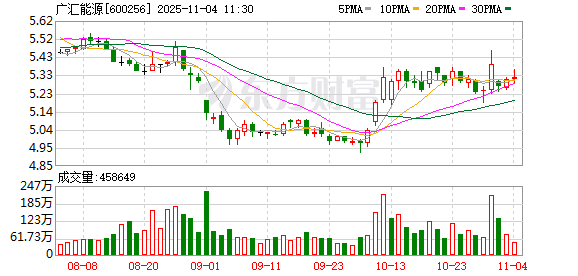
Group 1 - The core viewpoint of the news is that the OPEC+ decision to pause production increases in Q1 2026 has led Morgan Stanley to raise its short-term oil price forecast, specifically increasing the Brent crude oil futures price expectation from $57.50 to $60 per barrel [1] - The National Petroleum and Natural Gas Index (399439) has shown a slight increase of 0.04%, with significant gains in constituent stocks such as Fuan Energy (5.03%), Lansi Heavy Industry (4.59%), and others [1] - The oil and gas ETF (159697) closely tracks the National Petroleum and Natural Gas Index, reflecting the price changes of publicly listed companies in the oil and gas sector [1] Group 2 - As of October 31, 2025, the top ten weighted stocks in the National Petroleum and Natural Gas Index include major companies like China National Petroleum (601857), Sinopec (600028), and CNOOC (600938), which collectively account for 65.09% of the index [2] - The regional pricing fluctuations and potential future policies from OPEC+ are highlighted as factors that could impact upstream and midstream sectors positively, depending on demand recovery and supply adjustments [1]
国家能源集团哈密煤制油配套1500万吨煤矿项目获批:新疆周报(20251027-20251102)-20251103
Huachuang Securities· 2025-11-03 13:46
Investment Strategy - The report emphasizes that Xinjiang is positioned as a frontier hub benefiting from the shift from coastal economies to the Belt and Road Initiative, enhancing its geopolitical advantage [7] - The coal chemical industry in Xinjiang is expected to thrive due to favorable external conditions, including rising coal prices and strategic resource allocation [7][8] - The focus is on two main investment themes: coal chemical investments and state-owned enterprise reforms in Xinjiang [7][11] Xinjiang Index Situation - The Xinjiang Index is reported at 125.30, with a week-on-week decrease of 0.52%, while the Xinjiang Coal Chemical Investment Index is at 124.22, down 0.50% [13] - The top three gainers this week include Hangyang Co., Ltd. (up 12.22%), Daqo New Energy Corp. (up 11.38%), and Unification Enterprise (up 6.57%) [13][14] Key Data Tracking - Key coal prices in Xinjiang include Q5000 mixed coal at 100 CNY/ton, Q5200 mixed coal at 215 CNY/ton, and main coking coal at 700 CNY/ton [20] - In September 2025, the coal railway dispatch volume from state-owned key coal mines was 3.109 million tons, a year-on-year decrease of 1.77%, while the raw coal output was 43.563 million tons, down 2.57% year-on-year [20] Key News and Company Announcements - The National Energy Group's coal-to-oil project in Hami, with a total investment of 13.284 billion CNY, has been approved, marking the start of substantial construction [4][33] - The Xinjiang New Industry Group's coal-to-natural gas project, with an investment of 15.5 billion CNY, has also received approval, aiming for an annual production capacity of 2 billion cubic meters [33][38] Overview of Key Coal Chemical Projects - The report outlines significant coal chemical projects in Xinjiang, including a coal-to-natural gas project with a total investment of 167.93 billion CNY and a production capacity of 20 billion cubic meters per year [38][39] - The total planned capacity for coal chemical projects in Xinjiang includes 41.6 billion cubic meters for coal-to-natural gas, 5 million tons for coal-to-oil, and 945 million tons for coal-to-olefins, with a total investment of 962.8 billion CNY [40][41]

