智元机器人

Search documents
上海一个月5家AI企业上市
第一财经· 2026-01-09 00:54
Core Viewpoint - Shanghai's AI industry is entering a "harvest period" with five AI companies listed in one month, indicating a robust ecosystem that integrates hardware, software, and applications, unlike other cities that focus on singular breakthroughs [3][4]. Group 1: AI Industry Growth - In the past 30 days, five AI companies from Shanghai have gone public, showcasing a unique "listing wave" that reflects the city's comprehensive AI industry chain [3]. - Shanghai is building a complete ecosystem from "brain" (computational algorithms) to "blood" (data) and "limbs" (embodied intelligence), which is not seen in other cities [3][4]. - The AI industry in Shanghai is projected to exceed 550 billion yuan in scale by 2025, with a growth rate of over 30% [5]. Group 2: Major AI Companies - MiniMax, established in early 2022, is a representative of Shanghai's local AI model companies, achieving the fastest IPO globally with a workforce where 73.8% are R&D personnel [5][6]. - MiniMax's model, MiniMax-M2, has a code generation speed twice that of its U.S. counterpart Claude, at only 8% of the cost, demonstrating significant efficiency [5][6]. - By September 2025, MiniMax had 212 million personal users, with 73.1% of its revenue coming from overseas, highlighting its global expansion [6][8]. Group 3: GPU and Computational Power - Shanghai is recognized as China's "GPU capital," with four major GPU companies successfully listed, indicating a strong foundation for AI technology [10][12]. - The local integrated circuit industry has been developing for decades, positioning Shanghai as a leader in the global semiconductor landscape [12][13]. - The city has established a complete integrated circuit industry chain, fostering numerous leading enterprises across various segments [13]. Group 4: Embodied Intelligence and Robotics - Human-shaped robots are seen as the ideal carriers for embodied intelligence, with significant milestones achieved in mass production [15][17]. - Shanghai's local robotics companies are rapidly scaling up production, with plans for substantial increases in output capacity [17][18]. - The city is enhancing its embodied intelligence training facilities and supporting the establishment of unified training standards across regions [18][19].


上海一个月5家AI企业上市,5500亿产业“护城河”全链开花
Di Yi Cai Jing· 2026-01-09 00:09
Group 1 - Shanghai is building a complete AI ecosystem, unlike other cities that focus on single breakthroughs, with five AI companies listed in one month, indicating the industry is entering a "harvest period" [1] - The five listed AI companies in Shanghai, including MiniMax, have high technological content, supported by a comprehensive industrial chain that includes hardware, software, algorithms, and applications [1][2] - By 2025, Shanghai's AI industry is expected to exceed 550 billion yuan in scale, with a growth rate of over 30%, reflecting significant revenue and profit increases among major enterprises [2] Group 2 - MiniMax, established in early 2022, is a representative of Shanghai's local AI model companies, achieving the fastest IPO globally, with a high proportion of R&D personnel [3] - MiniMax's model, MiniMax-M2, has a code generation speed twice that of its competitors at a fraction of the cost, showcasing its efficiency [3][6] - Shanghai has developed a model algorithm innovation system with a structure of "1 open-source base model + 3 commercial base models + N innovative models" [6] Group 3 - Shanghai is recognized as China's "GPU capital," with four major GPU companies listed, indicating a robust foundation for AI technology [7][11] - The integrated circuit industry in Shanghai has been developing for decades, ranking fourth globally and first in mainland China, supporting the AI industry's growth [7][11] - The city has established a complete integrated circuit industry chain, fostering leading enterprises in various segments, including chip design and manufacturing [11] Group 4 - Human-shaped robots are seen as the ideal carriers for embodied intelligence, with significant production milestones achieved by local companies [12][14] - Shanghai's robot companies have rapidly scaled production, supported by a well-established supply chain in the Yangtze River Delta region [14][15] - The city is enhancing the effectiveness of embodied intelligence training facilities and building a high-quality data set for training [15]
2025年人形机器人出货量公布:中国公司远超特斯拉等美企
Feng Huang Wang· 2026-01-08 23:45
Group 1 - The global humanoid robot shipment reached approximately 13,000 units last year, predominantly from Chinese manufacturers, significantly outpacing companies like Tesla and Figure AI from the US [1] - According to Omdia, the leading humanoid robot manufacturer, Zhiyuan Robotics, shipped an estimated 5,168 units last year, followed by Yushutech and UBTECH [1] - The humanoid robot market is still in its early competitive stage but is expected to experience explosive growth over the next few decades, with projections indicating a rise to 648 million units by 2050 [1] Group 2 - Chinese humanoid robots are priced significantly lower than their Western counterparts, with Yushutech's entry-level model priced at $6,000 and Zhiyuan's simplified version at approximately $14,000 [2] - Omdia forecasts that global humanoid robot shipments will grow to 2.6 million units by 2035, with applications expanding into industrial manufacturing, commercial services, and eventually household scenarios [2] - The integration of AI technology is enabling robots to perform complex tasks, which is driving their adoption across various sectors such as manufacturing, logistics, healthcare, and customer service [1]


原本是马斯克脑子里最疯狂的蓝图,怎么就被中国抢先干成了?
Sou Hu Cai Jing· 2026-01-08 23:30
Core Viewpoint - China is reportedly leading the way in the mass production of humanoid robots, potentially ahead of the United States, which raises questions about the feasibility of a future where robots are ubiquitous, as envisioned by figures like Elon Musk [1][11]. Group 1: Industry Developments - China has made significant strides in humanoid robotics, with companies like Zhiyuan Robotics producing their 5,000th robot and UBTECH planning to manufacture over 10,000 units in the next two years [3][5]. - The robots being produced are not merely prototypes but are capable of performing real work, such as sorting in logistics with nearly 100% accuracy [3]. Group 2: Competitive Advantage - China's rapid progress in robotics is attributed to its need to address labor shortages due to an aging population, making robotics a crucial part of its long-term planning [5]. - The country benefits from a robust manufacturing base, being the only nation with a complete industrial system, which allows for lower production costs compared to foreign competitors [5]. Group 3: Strategic Approach - The advancement in robotics is characterized by a balanced approach, avoiding reckless expansion while focusing on sustainable growth and industry standards [7]. - Research indicates that by 2050, China could capture over half of the global market share in the robotics industry, despite current shortcomings in core chips and algorithms [7]. Group 4: Future Outlook - The current landscape shows a clear distinction between the visionary goals set by Musk and the practical advancements being made in China, which are gradually transforming technological aspirations into reality [10]. - China's proactive measures in the robotics sector reflect a deep understanding of future trends, positioning the country favorably in the ongoing technological competition [10].

股市必读:模塑科技(000700)1月8日董秘有最新回复
Sou Hu Cai Jing· 2026-01-08 16:46
董秘最新回复 投资者: 董秘您好,请问贵公司在人形机器人领域与国内头部机器人公司宇树机器人、众擎机器人、 智元机器人等是否存在合作?贵公司在汽车零部件领域是特斯拉的供应商,以后是否也有可能进入特斯 拉机器人供应链? 截至2026年1月8日收盘,模塑科技(000700)报收于14.82元,上涨0.82%,换手率11.49%,成交量105.46 万手,成交额15.6亿元。 交易信息汇总资金流向 投资者: 公司在脑机接口方面怎么布局。 投资者: 请问截止2025年12月31日股东人数是多少? 来自交易信息汇总:1月8日主力资金净流入6675.7万元,呈现明显吸筹迹象。 董秘: 尊敬的投资者您好:基于商业保密要求,公司不便透露具体客户信息,请以公司公告为准。感 谢您的关注! 投资者: 贵公司很多医疗方向的子公司,请问这些医疗公司或医院或医疗投资公司,有没有脑机这方 面的或者临床工作或研究或技术储备或这相关行业的战略投资 董秘: 尊敬的投资者您好:公司下属明慈医院为心血管三级专科医院,公司目前没有脑机相关业务、 技术及投资。感谢您的关注! 董秘: 尊敬的投资者您好:公司目前没有脑机相关业务,感谢您的关注! 董秘: 尊敬 ...


中国人形机器人集体闪耀CES 剑指全球市场拓展
Zhong Guo Jing Ying Bao· 2026-01-08 15:24
Core Insights - The 2026 CES in Las Vegas will feature over 1,000 Chinese companies, making them the largest overseas exhibitor group, with a significant focus on humanoid robotics [1] - Chinese humanoid robot companies are showcasing their flagship products and demonstrating practical applications, indicating a strong presence in the global humanoid robotics industry [1][4] Group 1: Company Participation and Innovations - Accelerated Evolution showcased its Booster K1 robots, which performed interactive dances and achieved sales of several units on the first day of CES [2] - Zhiyuan Robotics presented a full range of robot products, including the Lingxi X2 and the newly launched Q1, emphasizing their commitment to building an embodied intelligence ecosystem [3] - Star Motion Epoch displayed multiple products and has established partnerships with nine of the top ten global tech companies, delivering over 600 units, including a significant order in logistics worth nearly 50 million yuan [3][6] Group 2: Market Expansion and Global Strategy - The participation of Chinese humanoid robots at CES reflects their ambition to expand into overseas markets and achieve commercial growth [5] - Star Motion Epoch reported that half of its 500 million yuan in orders come from overseas markets, highlighting its global outreach strategy [6] - Songyan Power aims to establish a presence in key markets such as North America and Europe, planning to achieve significant market expansion by the second quarter of 2026 [7] Group 3: Industry Trends and Competitive Advantages - The humanoid robot industry in China is experiencing a surge, with a projected exponential growth in global production in 2026 [8] - Chinese companies have achieved a localization rate of 50%-70% for core components, with manufacturing costs significantly lower than their Western counterparts, enhancing their competitive edge in the international market [8]
CES,被中国人形机器人“玩儿成主场”
2 1 Shi Ji Jing Ji Bao Dao· 2026-01-08 13:38
Core Insights - Humanoid robots have become the main attraction at CES 2023, with Chinese companies dominating the exhibition space [1][2] - A total of 38 humanoid robot booths were reported, with 21 from Chinese enterprises, showcasing their advancements and capabilities [1] - Companies are leveraging CES to enhance their visibility and demonstrate their technological prowess in humanoid robotics [4][5] Group 1: Company Participation - Notable Chinese companies such as Yushu Technology, ZhiYuan Robotics, and ZhongQing Robotics showcased their products, including dynamic demonstrations of their humanoid robots [2][3] - Other companies, not primarily focused on humanoid robots, also presented their robotic solutions, indicating a broader interest in robotics technology [2][5] - New entrants in the industry are using CES to establish their brand presence and showcase their innovations [4] Group 2: Technological Advancements - The humanoid robots displayed at CES have shown improvements in motion control, with enhanced dynamic capabilities and reduced error rates [7] - Yushu Technology's G1 robot has undergone significant algorithm updates, improving its stability and ability to perform complex movements [7] - The industry is witnessing a shift towards more sophisticated applications of humanoid robots, with potential for commercialization in various sectors [8] Group 3: Market Trends - The U.S. market remains open to humanoid robots, providing opportunities for Chinese companies to expand their presence [8] - Companies are exploring partnerships with U.S. firms for personalized development of robotic solutions [8] - Despite advancements, the practical applicability and versatility of humanoid robots are still under exploration, with ongoing research into artificial general intelligence (AGI) [9]
一座城市的长期主义:用产业生态撑起下一个技术支点
远川研究所· 2026-01-08 13:37
Core Insights - The article discusses the evolution of Silicon Valley from an agricultural region to a global technology hub, driven by successive waves of technological innovation and the emergence of key companies in the semiconductor, computing, internet, and AI sectors [2][4]. Group 1: Historical Development of Silicon Valley - Before the 1950s, Santa Clara Valley was known as the "World's Fruit Basket" and not the tech hub it is today [2]. - The IPOs of Intel and AMD in 1971 and 1972 marked the beginning of a significant investment wave in the semiconductor industry, providing crucial funding for expansion and R&D [2]. - Apple's IPO in 1980 raised over $100 million, the largest since Ford's in 1956, signaling the start of the personal computing and enterprise IT era [2]. Group 2: Emergence of Key Tech Companies - Adobe, founded in 1982, represented a novel business model in software licensing [3]. - Cisco, Nvidia, Yahoo, and Google were established in the 1980s and 1990s, contributing to the diversification of Silicon Valley's tech landscape [3]. Group 3: Transition to AI Era - Nvidia has become a core player in AI computing, with its market value rising from $100 billion three years ago to over $4 trillion today [4]. - Google has diversified into cloud computing, AI applications, and AI chips, solidifying its position as a leading internet company [4]. - OpenAI, founded in 2015, has emerged as a top-tier company in the AI era [4]. Group 4: Shanghai's AI Industry Development - Shanghai has seen a surge in AI companies, with five firms going public within a month, including MuXi and BiRan Technology [6]. - The city is fostering a comprehensive AI ecosystem, from semiconductor design to application deployment, creating a positive feedback loop in the industry [9][10]. Group 5: Infrastructure and Support for AI Startups - Shanghai's AI startups benefit from a complete supply chain within a 10-kilometer radius, facilitating rapid innovation and production [10]. - The city has established a robust semiconductor industry cluster, providing essential support for AI development [10]. Group 6: Policy and Resource Allocation - Shanghai's policy shift aims to provide entrepreneurs with clearer pathways and more security, enhancing resource responsiveness [14][16]. - Initiatives like the "1 yuan office space" and "targeted apartments" are designed to extend the cash flow lifespan of startups [14]. Group 7: Talent and Ecosystem - Shanghai's talent pool, supported by local universities and international recruitment, is a significant advantage for AI startups [17]. - The city's industrial ecosystem combines manufacturing and services, allowing for unique flexibility in AI application development [20]. Group 8: Long-term Vision - The article emphasizes that the competition among cities in technology is a long-term endeavor, requiring a resilient infrastructure to support ongoing innovation [19][21]. - Shanghai is focused on aligning research, funding, regulations, and market needs to build a strong foundation for future technological waves [21].



智元机器人发布AI大模型开源仿真平台Genie Sim 3.0
Xin Lang Cai Jing· 2026-01-08 13:22
Core Insights - Zhiyuan Robotics launched the open-source simulation platform Genie Sim 3.0 at CES, powered by a large language model [2][4] - Genie Sim 3.0 integrates 3D reconstruction and visual generation, enabling the creation of high-fidelity digital twin environments [2][4] - Developers can generate thousands of training and testing scenarios within minutes by inputting natural language commands [2][4] Data and Features - The company also released a comprehensive simulation dataset containing over ten thousand hours of real robot operation scenarios, covering more than 200 tasks [2][4] - The dataset includes multi-sensor information such as RGB-D, stereo vision, and full-body joint states, addressing various generalization dimensions like background, layout, lighting, and noise [2][4]
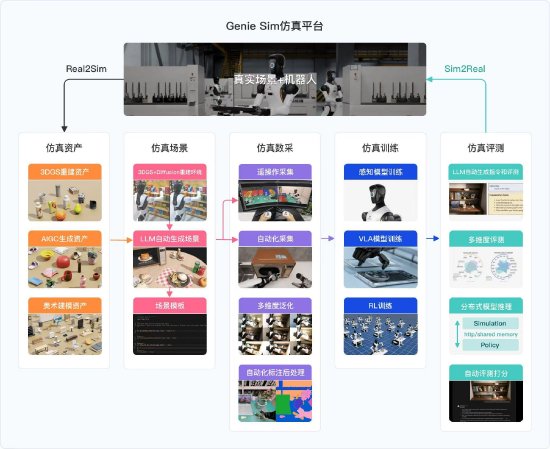
【太平洋科技-每日观点&资讯】(2026-01-09)
远峰电子· 2026-01-08 13:08
Market Overview - The major indices showed mixed performance with the STAR Market 50 index up by 0.82% and the ChiNext index down by 0.82% [1] - The TMT sector led the gains, particularly in communication equipment and military electronics, while the communication network equipment and printed circuit board sectors faced declines [1] Domestic News - CINNO reported that Chenxian Optoelectronics has developed a 0.12-inch Micro-LED micro-display using semiconductor-level hybrid bonding technology, meeting key requirements for mass production [2] - Jihai officially launched the G32M3101 series high-performance motor control SoC, integrating MCU, LDO, and gate driver into a single chip to reduce system costs and improve efficiency [2] - Lexin partnered with Bosch Sensortec to introduce an AI interactive solution, utilizing Bosch's MEMS sensors and algorithms alongside Lexin's Wi-Fi 6 IoT chip [2] - Beijing Chaoyang Hospital implemented VR technology to alleviate preoperative anxiety in over 100 patients, resulting in significant reductions in anxiety scores and improved postoperative satisfaction [2] Overseas News - PetaRay and Quanta Computer launched a commercially viable AR headset utilizing PetaRay's LiFiD light field technology for natural alignment of virtual content with real objects [3] - TrendForce reported that NVIDIA will adjust the HBM4 specifications for the Rubin platform, delaying the mass production timeline to early 2026 due to increased speed requirements and AI demand [3] - Mobileye announced the acquisition of Mentee Robotics to enhance its autonomous driving system with advancements in visual-language-motion technology [3] - Samsung Display and Intel developed SmartPower HDR™ technology to reduce OLED panel power consumption by up to 22% in HDR mode for laptops [3] AI News - The Chinese Academy of Sciences and CreateAI team built a 4D world model NeoVerse from monocular videos, enabling efficient reconstruction without prior camera pose knowledge [4] - Zhiyuan Robotics unveiled the first LLM-driven open-source simulation platform Genie Sim 3.0 at CES, significantly improving simulation scene construction efficiency [4] - Xidian University released VoiceSculptor, a model allowing high flexibility in controlling voice attributes through natural language instructions [4] - Lenovo launched Qira, a personal AI super agent capable of summarizing notifications and coordinating tasks, designed for high personalization and offline operation [4] Industry Tracking - Jitian Starship developed a remote sensing optical payload achieving 0.5-meter resolution, planning to launch 22 satellites this year to enhance earth observation capabilities [5] - Zhenghe Industrial introduced the world's first chain-type dexterous hand with 17 degrees of freedom, achieving high precision and load capacity [5] - Yunnan First People's Hospital successfully performed the first two brain-machine interface surgeries in Southwest China, implanting rechargeable, closed-loop brain stimulators for Parkinson's patients [5] - The Ministry of Industry and Information Technology outlined plans for AI in manufacturing, aiming for significant advancements in core technologies and application scenarios by 2027 [5]