格力电器

Search documents
服饰、家电、家纺三大产业 保温保暖新品迭出满足消费者多元化需求
Shang Hai Zheng Quan Bao· 2026-01-20 18:53
Core Insights - The "warm economy" is gaining traction in the consumer market, driven by increased demand for insulation and heating products amid significant temperature drops and snowfall across various regions in China [1][2] Group 1: Industry Trends - The apparel, home appliance, and home textile sectors are leading the charge in the "warm economy," with companies innovating to meet diverse consumer needs for warmth and comfort [1][5] - Brands like Bosideng are focusing on technological advancements and design innovations, such as "far-infrared heating technology" and high-quality down materials, to attract younger consumers [2][4] - The home appliance sector is seeing a rise in smart and personalized heating products, with companies like Gree and Midea emphasizing features like rapid heating and energy efficiency [5] Group 2: Consumer Behavior - Consumers are increasingly prioritizing product functionality and quality, inquiring about material specifications and performance metrics when purchasing winter apparel [4][7] - There is a shift from basic warmth to a focus on aesthetics and suitability for specific scenarios, indicating a more nuanced consumer demand for heating solutions [7] Group 3: Market Dynamics - Investor interest in "cold wave" and "heating" concepts is rising, with inquiries about companies' strategies and product offerings in the insulation market [6] - Companies are adapting to market changes by diversifying their product lines and enhancing their technological capabilities, as seen with brands like Rainbow Group and Antarctic E-commerce [6][7] - Despite the short-term boost in demand due to weather conditions, companies recognize the need for long-term competitiveness through innovation and brand management [7]


赢家通吃格局突变,日本制造业跌落,谁将主宰中美欧新战局
Sou Hu Cai Jing· 2026-01-20 18:06
Core Viewpoint - The decline of Japanese manufacturing, once a symbol of quality and technology, is attributed to a combination of historical missteps, internal stagnation, and external pressures, leading to a significant loss of market share to competitors from China, the US, and Europe [1][20]. Group 1: Historical Context - The decline of Japanese manufacturing can be traced back to events like the Toshiba incident in the 1980s, which led to severe sanctions and a loss of international standing in high-end industrial equipment and electronics [3][4]. - Japanese companies such as Hitachi and Panasonic faced fierce competition from South Korean firms like Samsung and LG, ultimately leading to their exit from key markets like televisions and semiconductors [4][8]. Group 2: Internal Challenges - The internal promotion system and reliance on traditional advantages have made Japanese companies slow to respond to global competition, resulting in management rigidity and a lack of innovation [6][9]. - The economic bubble burst in the 1990s led to a prolonged period of stagnation, with reduced R&D investment and a shift in talent away from engineering to finance and services, further eroding innovation capabilities [11][13]. Group 3: External Pressures - The US-Japan semiconductor agreement in the 1980s significantly hampered Japan's semiconductor industry, allowing South Korea's Samsung to rise as a dominant player in the global market [8][9]. - The current global manufacturing landscape is characterized by a push for reshoring in the US and Europe, which is attracting investments away from Japan, exacerbating its industrial hollowing [15][16]. Group 4: Competitive Landscape - Chinese companies, such as BYD, are rapidly advancing in sectors like electric vehicles, effectively outpacing traditional Japanese automakers like Toyota and Honda [6][18]. - Japanese brands are losing ground in both emerging and developed markets, as Chinese firms leverage lessons from Japanese manufacturing while being more responsive to local market demands [18][20].
制造业企业加速向“智”迈进
Zheng Quan Ri Bao· 2026-01-20 16:25
Core Insights - The exhibition "Building a Strong Nation Road - Achievements of China's Manufacturing during the 14th Five-Year Plan" showcases significant advancements in China's manufacturing sector, particularly in core technologies, industrial foundations, and innovation ecosystems [1] - During the 14th Five-Year Plan, China's manufacturing industry has enhanced its role as a "ballast," with steady increases in innovation investment and optimization of industrial structure [1] - By the end of 2025, China aims to establish 4.83 million 5G base stations and achieve an artificial intelligence core industry scale exceeding 900 billion yuan [1] Company Highlights - Gree Electric Appliances, a representative of China's manufacturing enterprises, has established three core areas: "Industrial Foundation," "Intelligent Manufacturing," and "Better Life" [1] - Gree's leading intelligent factory has achieved a 200% increase in production efficiency compared to traditional factories, with a digital coverage rate of 100% [1] - The factory employs over 2,000 industrial robots, all developed in-house, to perform critical tasks such as welding [2] Technological Breakthroughs - A significant number of key core technologies in China's manufacturing sector have achieved breakthroughs, impacting various supply chains including new materials and basic components [3] - Taiyuan Iron and Steel Group has developed the world's thinnest stainless steel foil, measuring only 0.015 mm, which is used in high-end applications like foldable smartphones and electric vehicle batteries [3][4] - The "Cangyuan" shield machine, with a diameter of 16.66 meters and a domestic technology localization rate of 98%, represents a major achievement in China's construction machinery [4] Financial and Industrial Development - The integration of technological and industrial innovation is driving China's manufacturing sector from large to strong [4] - The Ministry of Industry and Information Technology reported that financing cooperation has deepened, with a cumulative financing amount exceeding 1.3 trillion yuan, providing strong financial support for "Chinese Intelligent Manufacturing" and the modernization of the industrial system [4]

广汽,紧急辟谣!
Zhong Guo Ji Jin Bao· 2026-01-20 14:49
Core Viewpoint - GAC Group officially refuted rumors that half of its automotive chips will be replaced by products from Gree Electric, clarifying that this statement is not true [1] Group 1: Company Statements - On January 15, GAC Group's Chairman, Feng Xingya, visited Gree Electric, where discussions focused on the integration of "people, vehicles, and home" for smart ecological development and industrial collaboration [2] - Both Feng Xingya and Gree Electric's Chairman, Dong Mingzhu, shared insights on their discussions via social media, emphasizing deep exchanges on industrial synergy and full-scenario integration [2][4] - GAC Group stated that any specific progress in collaboration with Gree Electric regarding the "people, vehicles, and home" smart ecosystem will be announced through official channels [7] Group 2: Industry Developments - Gree Electric is expanding its chip business, with plans to mass-produce silicon carbide chips for household appliances and later for photovoltaic storage and logistics vehicles by 2026 [8] - Gree's subsidiary, Zhuhai Gree Electronic Components Co., is engaged in manufacturing third-generation semiconductor silicon carbide wafers and has capabilities for producing high-reliability household and automotive-grade chips [8] - GAC Group has established a comprehensive automotive chip product matrix, having launched 12 automotive chips covering various fields, with partners including ZTE, Rixin Technology, and others [8]

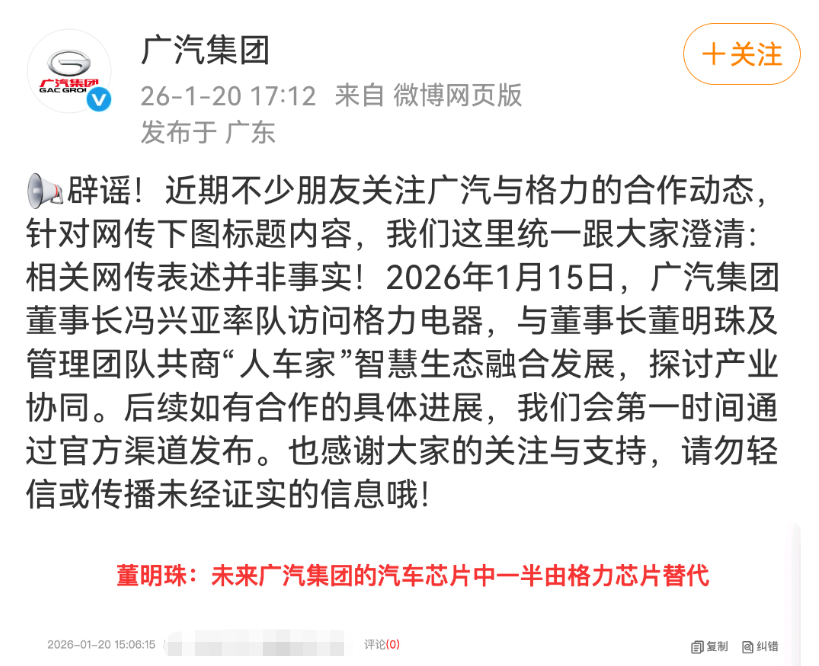
广汽,紧急辟谣!
中国基金报· 2026-01-20 14:42
Core Viewpoint - GAC Group officially refuted claims that "half of the automotive chips in the future will be replaced by Gree products," stating that this information is not accurate [2][4]. Group 1: Company Statements - On January 15, GAC Group's chairman, Feng Xingya, visited Gree Electric, where Gree's chairman, Dong Mingzhu, hosted the meeting [2][4]. - Both parties discussed "smart integration of people, vehicles, and homes," focusing on industrial synergy and collaboration [4][7]. - GAC Group emphasized that any specific progress in cooperation with Gree Electric will be announced through official channels [10]. Group 2: Chip Business Developments - Gree Electric has plans to mass-produce silicon carbide chips for photovoltaic storage and logistics vehicles by 2026, following the production of chips for home appliances [12]. - GAC Group has established a comprehensive automotive chip product matrix, launching 12 automotive chips that cover various fields such as computing, control, power, drive, sensing, and analog [12]. - GAC Group's chip ecosystem initiative includes partnerships with companies like ZTE, Horizon Robotics, and Huahong Semiconductor, aiming to build a collaborative automotive chip ecosystem [12].

广汽回应一半汽车芯片将由格力供应
2 1 Shi Ji Jing Ji Bao Dao· 2026-01-20 14:28
Group 1 - The core point of the article is that GAC Group's chairman, Feng Xingya, visited Gree Electric, leading to rumors about Gree supplying half of GAC's automotive chips, which GAC officially denied [1][2]. - GAC Group emphasized that the visit was to discuss the integration of "people, vehicles, and home" and potential industrial collaboration, and any future cooperation details will be announced through official channels [1]. - Gree Electric has been expanding its capabilities in chip production, having established an IPM power module production line in 2010 and a chip design company in 2018, with plans for a silicon carbide chip factory expected to produce 240,000 six-inch wafers annually by the end of 2023 [2]. Group 2 - Gree Electric's silicon carbide chip factory began construction in December 2022, with a target for product line completion by the end of 2023, and aims to achieve cumulative chip sales exceeding 300 million by 2025 [2].
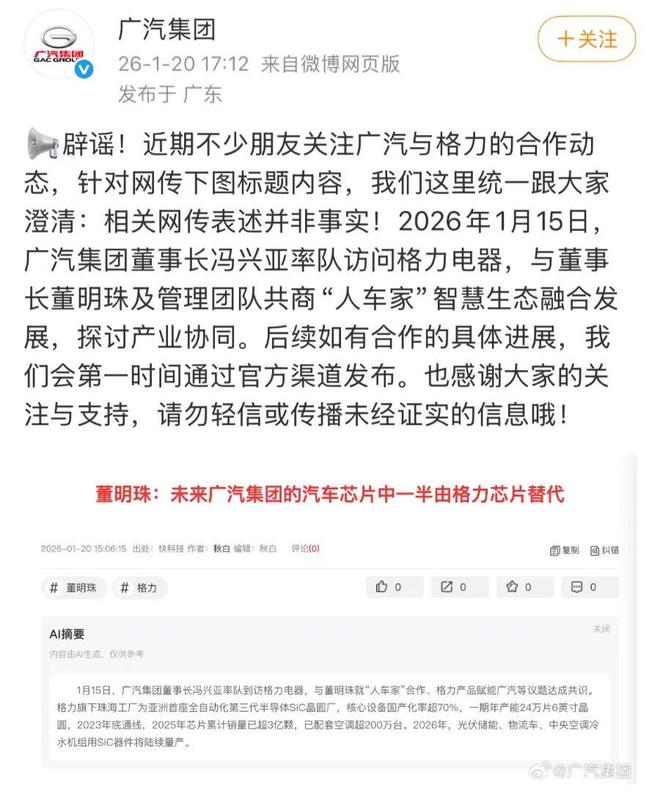
“50%汽车芯片由格力产品替代”?广汽否认
新华网财经· 2026-01-20 14:21
Core Viewpoint - GAC Group clarified that the claim of "50% of automotive chips being replaced by Gree products" is not factual, and any future cooperation will be announced through official channels [2] Group 1 - GAC Group Chairman Feng Xingya visited Gree Electric, discussing the integration of "vehicle-home" smart ecosystems and exploring industrial collaboration [3] - During the visit, Feng introduced a model of the Haobo vehicle, which contains 1,004 chips, all of which have Chinese intellectual property rights [3] - Gree's Chairman Dong Mingzhu expressed interest in contributing 500 chips to future vehicle models, to which Feng responded with plans to incorporate Gree's automotive chips [3]

广汽回应一半汽车芯片将由格力供应
21世纪经济报道· 2026-01-20 14:21
广汽集团表示,1月15日,广汽集团董事长冯兴亚率队访问格力电器,与董事长董明珠及管理 团队共商"人车家"智慧生态融合发展,探讨产业协同。后续如有合作的具体进展,将会第一时 间通过官方渠道发布。请勿轻信或传播未经证实的信息。 记者|叶映橙 见习记者林健民 编辑|谢珍 1月20日,21财经《辟谣财知道》注意到,有报道称,1月15日,广汽集团董事长冯兴亚率队 到访格力电器,格力电器董事长董明珠接待时笑言,未来广汽的汽车芯片中一半由格力产品替 代。相关信息在各大网络平台上传播,受到市场关注。 对此,1月20日, 广汽集团官方微博发文辟谣,称近期不少朋友关注广汽与格力的合作动态, 网传"未来广汽的汽车芯片中一半由格力产品替代",相关表述并非事实。 出品丨21财经客户端 21世纪经济报道 编辑|黎雨桐 见习编辑林芊蔚 SFC 公开资料显示,格力电器2010年建立IPM功率模块生产线,2018年设立格力零边界公司做芯片 设计。2023年,格力电器设立电子元器件公司,主要从事碳化硅芯片的设计、流片及模块封装 和测试等业务。格力的碳化硅芯片工厂,2022年12月打桩,2023年年底产品通线,一期规划6 英寸碳化硅晶圆年产能24 ...
“50%汽车芯片由格力产品替代”?广汽回应
Di Yi Cai Jing· 2026-01-20 13:07
Core Viewpoint - GAC Group refuted claims that 50% of its automotive chips would be replaced by Gree products, stating that such assertions are not factual and that any future cooperation will be announced through official channels [1] Group 1: Company Developments - GAC Group's Chairman, Feng Xingya, visited Gree Electric five days prior to the statement, discussing the integration of smart ecosystems in the automotive sector with Gree's management team [1] - During the visit, Feng introduced a model of the Haobo vehicle, which contains 1,004 chips, all of which have Chinese intellectual property rights [1] - Gree's Chairman, Dong Mingzhu, expressed ambitions for future collaboration, suggesting that 500 chips could be sourced from Gree [1] - Feng responded positively, indicating a goal to incorporate Gree's automotive chips into GAC vehicles in the future [1]
“50%汽车芯片由格力产品替代”?广汽回应
第一财经· 2026-01-20 12:57
1月20日,广汽集团回应"50%汽车芯片由格力产品替代"一事时表示,相关网传表述并非事实,后 续如有合作的具体进展,公司会第一时间通过官方渠道发布。 5天前,广汽集团董事长冯兴亚率队访问格力电器,与董明珠及管理团队共商"人车家"智慧生态融合 发展,探讨产业协同。 期间,冯兴亚介绍昊铂一款车型时称,该车型的一个版本有1004颗芯片,这些芯片的知识产权都是 中国的。董明珠表示:"将来有500个是我的。"冯兴亚则回应,下一步争取把格力的汽车芯片装上 车。 编辑:小羊 ...