大疆

Search documents
酝酿8年,美国对大疆发禁令,中方采取行动,74吨稀土禁售美国
Xin Lang Cai Jing· 2025-12-26 03:28
特别声明:以上文章内容仅代表作者本人观点,不代表新浪网观点或立场。如有关于作品内容、版权或其它问 题请于作品发表后的30日内与新浪网联系。 ...
专精特新第一城,为什么是深圳
2 1 Shi Ji Jing Ji Bao Dao· 2025-12-26 03:21
Core Viewpoint - Shenzhen has emerged as a vibrant hub for technological innovation, supported by a comprehensive financial service system that enhances the financing accessibility for technology-driven SMEs and directs financial resources towards key sectors like AI, semiconductors, and biomedicine [1][2][9] Group 1: Financial Support Mechanisms - Shenzhen's financial support for technology innovation has evolved beyond mere capital injection to a collaborative mechanism that stimulates vitality, diversifies risks, and accompanies growth [2] - The People's Bank of China in Shenzhen has introduced various financial products such as "Tengfei Loan," "Technology Startup Pass," and "Cross-Border Loan" to address the financing needs throughout the entire lifecycle of technology enterprises [3][5] - "Tengfei Loan" incorporates future revenue sharing into credit relationships, allowing banks to provide longer-term loans to high-growth tech companies, with 146 companies signing agreements totaling 8.63 billion yuan by November 2025 [3][4] Group 2: Innovative Financial Products - "Technology Startup Pass" has helped 5,037 enterprises secure loans totaling 8 billion yuan by utilizing data from social security, tax, and intellectual property to identify potential tech companies [5] - "Cross-Border Loan" facilitates rapid financing for growth-oriented companies lacking collateral, serving nearly 70 enterprises with a total of 200 million yuan [5] - The financial products are designed to support companies from the seed stage to growth, ensuring that they do not dilute ownership while receiving necessary funding [4][9] Group 3: Ecosystem Optimization - Shenzhen is building a collaborative "technology-industry-finance" ecosystem, enhancing the "stock-loan-debt-insurance-exchange" linkage in its financial service system [6][7] - The "Kowloon Technology Innovation Cooperation Zone" has pioneered the "Science and Technology Exchange" pilot program to facilitate cross-border flow of research funds, significantly improving the efficiency of foreign-funded research institutions [6][7] - The "Thousand Billion Financing Plan" in Nanshan District aims to alleviate financing difficulties for tech companies by creating a comprehensive service system that includes risk-sharing mechanisms [7][8] Group 4: Long-term Investment and Growth - Private equity firms are increasingly participating in funding rounds for tech companies, with tools like the "Technology Board" and risk-sharing instruments providing stable, low-cost funding sources [9] - The continuous growth in the number of "specialized, refined, distinctive, and innovative" enterprises and R&D investment in Shenzhen is supported by a financial service system that acts as a "co-builder" and "accompanying runner" for tech companies [9]
专精特新第一城,为什么是深圳
21世纪经济报道· 2025-12-26 03:06
Core Viewpoint - Shenzhen has emerged as a vibrant hub for technological innovation, supported by a comprehensive financial service system that covers the entire lifecycle of enterprises, enhancing their growth and development [1][2][13]. Financial Support System - Shenzhen's financial support for technology enterprises includes innovative products like "Tengfei Loan," "Technology Startup Pass," and "Cross-Border Loan," which cater to the financing needs from the seed stage to growth [5][8][10]. - As of October 2025, the balance of technology loans in Shenzhen has exceeded 2.2 trillion yuan, with the issuance of technology innovation bonds ranking among the top in the country [2][13]. Innovative Financial Products - "Tengfei Loan" incorporates future revenue sharing into credit relationships, allowing banks to provide longer-term loans to high-growth tech companies without diluting their equity [5][6]. - "Technology Startup Pass" utilizes data from social security, tax, and intellectual property to identify potential tech enterprises, enabling banks to lend earlier and in smaller amounts [6][7]. - "Cross-Border Loan" facilitates rapid financing for growing enterprises lacking collateral by leveraging a collaborative model among local credit platforms, government financing institutions, and banks [8][10]. Ecosystem Optimization - Shenzhen is building a collaborative "technology-industry-finance" ecosystem, enhancing the "stock-loan-bond-insurance-exchange" linkage to support tech innovation [10][12]. - The "Kowloon Technology Innovation Cooperation Zone" promotes cross-border collaboration and has attracted over 200 high-end research projects and 1.5 million researchers [11][12]. - The "Thousand Billion Financing Plan" in Nanshan District aims to alleviate financing difficulties for tech enterprises by establishing a multi-tiered risk-sharing mechanism [11][12]. Conclusion - The combination of innovative financial products and a supportive ecosystem positions Shenzhen as a leader in nurturing specialized and innovative enterprises, with a financial service system that acts as a "co-builder" and "companion" throughout the innovation process [13].


科技日报:美国无人机产业不会因贸易保护主义而强大
Ke Ji Ri Bao· 2025-12-26 00:36
Core Viewpoint - The FCC's announcement to add all non-U.S. manufactured drone systems and key components to a "regulated list" is primarily aimed at restricting Chinese drone products under the guise of national security risks [1][2][3]. Group 1: Regulatory Actions - The FCC's ban means that the U.S. will no longer import new foreign drones and related components, only allowing the sale of previously approved older products [1]. - The ban is seen as a culmination of years of efforts to curb Chinese drone influence in the U.S. market, with China accounting for 70% to 80% of the global civilian drone market and 90% of the U.S. consumer market [1]. Group 2: Security Claims - The term "national security risk" is viewed as a pretext for banning Chinese drones, despite multiple tests by U.S. agencies confirming the safety and data privacy of DJI products [2]. - Various assessments from reputable firms have consistently validated the data security measures of Chinese drones, indicating that they meet U.S. and EU cybersecurity standards [2]. Group 3: Economic Implications - The U.S. government's actions are perceived as a means to protect and promote the domestic drone industry by limiting foreign competition, which could stifle innovation and increase costs for U.S. consumers [3][4]. - A survey indicated that 43% of U.S. drone users believe the ban will have a severely negative impact on their businesses, with some users stockpiling drones and components in anticipation of supply issues [4]. Group 4: Market Dynamics - The absence of Chinese components could lead to a significant increase in costs for U.S. drone users, potentially making non-Chinese drones up to ten times more expensive [4]. - The restriction on Chinese products is expected to hinder technological advancement and cost reduction in the U.S. drone industry, leading to a decline in competitiveness [4].
这场大会藏着在万亿赛道“起飞”的三个密码
Xin Lang Cai Jing· 2025-12-26 00:35
Core Viewpoint - The article discusses the rapid development of the low-altitude economy in China, particularly in Guangdong, which is expected to become a leader in this sector by leveraging innovation, safety, and regional collaboration. Group 1: Innovation as a Driving Force - Innovation is identified as the core driving force behind the development of the low-altitude economy, highlighted by the presence of groundbreaking technologies such as the world's first mass-produced flying car and hydrogen-powered drones at the conference [1] - Guangdong, as the largest province in China's low-altitude economy, houses over 30% of the national low-altitude industry chain enterprises, including major players like DJI, EHang, and Xpeng, with an industry scale exceeding 100 billion [1] - The establishment of multiple low-altitude testing platforms in Guangdong significantly shortens the innovation cycle and supports research and development in the sector [1] Group 2: Safety as a Foundation - Safety is emphasized as a prerequisite for the low-altitude economy to thrive, with the conference announcing new policies for infrastructure, technology innovation, and management services [2] - Guangdong has developed a robust infrastructure network, including 64 general airports, over 1,400 takeoff and landing points, and nearly 700 drone flight routes, laying a solid foundation for low-altitude operations [2] - The construction of a comprehensive low-altitude intelligent network, integrating communication, navigation, monitoring, meteorology, computing power, and countermeasures, enhances the operational capabilities of the low-altitude economy [2] Group 3: Regional Collaboration - The conference was jointly organized by the governments and institutions of Guangdong, Hong Kong, and Macau, signaling strong regional collaboration [3] - The Guangdong-Hong Kong-Macau Greater Bay Area is positioned as a testing ground for logistics, emergency rescue, and cross-border commuting, facilitating regulatory alignment and innovation [3] - Initiatives such as the world's first cross-sea eVTOL route demonstration and the launch of pilot projects for regulatory sandboxes in Hong Kong exemplify the collaborative efforts to create a cohesive low-altitude economy network [3]
背离开放的安全保护行不通
Jing Ji Ri Bao· 2025-12-25 22:04
Core Viewpoint - The U.S. Federal Communications Commission (FCC) has added all foreign-manufactured drone systems and their key components to a "untrusted supplier list" under the guise of "national security," specifically targeting Chinese company DJI, which restricts its products from being imported and sold in the U.S. This action reflects a broader trend of the U.S. misusing the concept of national security to suppress foreign companies and disrupt market operations [1][2]. Group 1: Industry Impact - The drone industry is highly globalized, relying on international collaboration for research, manufacturing, and application, which has led to rapid innovation through competition and technology exchange [1]. - The U.S. decision to label all non-American manufactured drones as "risky" undermines market mechanisms and competition rules, disregarding the industry's development principles and consumer needs [1][3]. Group 2: Evidence and Market Reaction - U.S. claims of "security risks" lack factual support, as Chinese drone products, including those from DJI, have been widely used in various sectors such as agriculture, emergency rescue, and film production, passing evaluations from multiple authoritative third-party organizations [2]. - Reports indicate that many U.S. drone operators and commercial users are stockpiling Chinese drones and components, expressing concerns to lawmakers about the lack of reliable alternatives, highlighting the disconnect between the U.S. government's actions and industry realities [2]. Group 3: Long-term Consequences - The U.S. strategy of creating trade barriers and administrative restrictions to support its domestic drone industry contradicts the principles of technological development, which thrive on standard recognition, collaborative rules, and healthy competition [3]. - Historical evidence shows that blocking and suppressing competition does not halt technological progress but instead raises costs and reduces efficiency, ultimately weakening the domestic industry's innovation capacity and international competitiveness [3]. - The U.S. approach disrupts fair competition and undermines the stability of global supply chains, eroding international trust in the U.S. market environment [3].
【限时优惠】FINE展报名火热!产业终端+半导体+热管理+先进电池+轻量化与可持续+科技创新成果.....
DT新材料· 2025-12-25 16:05
2026未来产业新材料博览会 中国未来产业崛起引领全球新材料创新发展 2026年6月10-12日 上海新国际博览中心 新材料是未来高新技术产业发展的基石和先导,新材料的突破将加速未来产业变革! 2026未来产业新材料博览会(上海) (Future Industries New Materials Expo 2026,简称" FINE 2026 "),由 「 DT新材料 」 主办的 第十届国际碳材料产业博览 会 (Carbontech 2026)、 第七届热管理产业博览会 (iTherM 2026)和 新材料科技创新博览会 (AMTE 2026)三大展重磅升级而来,旨在打造一个以未来产业终端为 引领、立足国际视野的新材料领域标杆展会。 FINE 2026 , 以 50,000平 展区 与 超过 300场 战 略与前沿科技报告,全景呈现应用于人工智能、智算/数据中心、具身智能、低空经济、航空航天、智能汽车、 AI消费电子、量子科技、6G、脑机接口、新能源、生物制造等产业的热门创新成果, 并重点聚焦 未来产业五大共性需求(先进半导体、先进电池、轻量化、 低碳可持续、热管理) , 呈现从终端、部件、材料、技术装备到前 ...

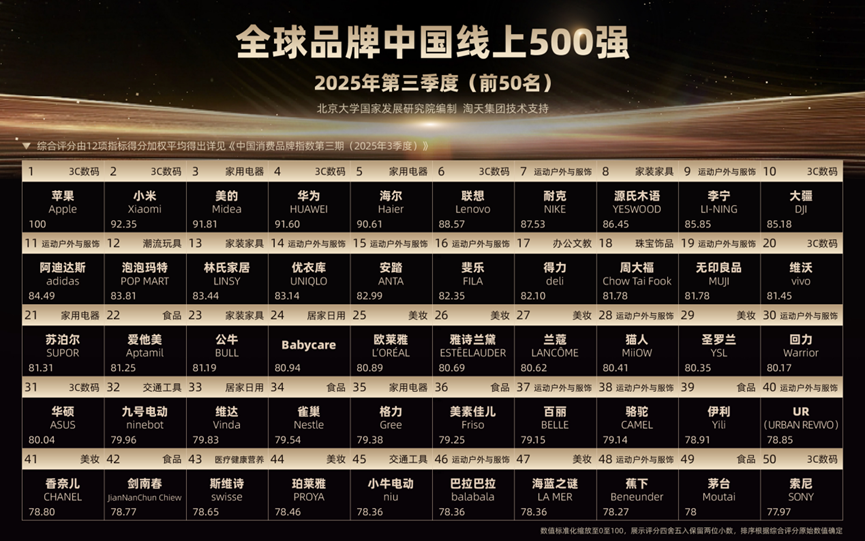
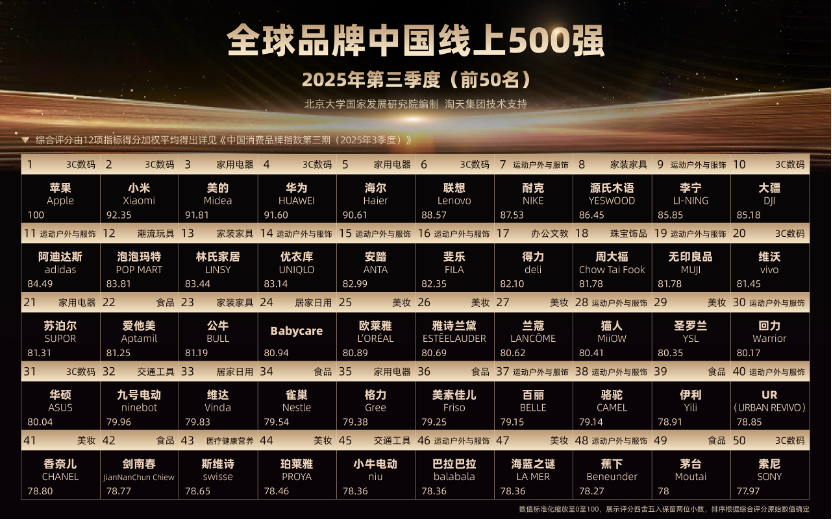
最新“全球品牌中国线上500强”季度榜单出炉 大疆首次进入前10、泡泡玛特上升显著
Zheng Quan Ri Bao Wang· 2025-12-25 11:44
Core Insights - The latest quarterly "China Online Consumption Brand Index" (CBI) and the "Global Brand China Online Top 500" (CBI500) were released, indicating a continued rise in online consumer brand purchasing power [1][3] - The CBI for the third quarter of 2025 is reported at 62.65, reflecting a year-on-year increase of 0.92%, suggesting a growing preference for branded products among online consumers [3] Industry Performance - The CBI series indicates that industries such as women's clothing, 3C smart products, daily beauty, outdoor sports, pet supplies, men's clothing, and home furnishings have shown year-on-year growth in consumption quality [4] - The increase in consumption quality is attributed to Taobao's operational strategies, which have focused on supporting original clothing brands and improving the business environment for merchants [4] Brand Rankings - DJI entered the top ten for the first time, driven by strong performance in new product sales and brand search volume, particularly in the action camera and drone sectors [4] - Pop Mart ranked twelfth, marking a significant rise in brand influence due to its series of original IPs, despite fluctuations in the trendy toy industry [4] Consumer Trends - The CBI series aims to promote high-quality online consumption by encouraging competition based on quality and innovation rather than cost [5] - The shift towards quality competition is seen as essential for creating a positive market cycle that ultimately enhances the quality of life for consumers [5]



UTC关停,国标落地:CAAC执照成无人机从业唯一“硬通货”
Qi Lu Wan Bao· 2025-12-25 10:15
无人机行业"野蛮生长"的时代正式落幕。随着大疆UTC培训体系逐步关停,以及两项强制性国家标准对"谁能飞、谁在 飞"作出硬性规定,中国民用航空局(CAAC)颁发的无人机执照,已从过去的"加分项"跃升为从业者不可或缺的"唯 一合法身份证"和行业"硬通货"。变革已至,持证与否,将直接决定从业者的生存空间与发展上限。 一、合规新时代:无证寸步难行,持证价值凸显 政策的"紧箍咒"正迅速收紧。新规之下,无证"黑飞"已不仅是违规,更是明确的违法行为。 1.法律高压线:无证飞行代价高昂 作为国家法定的唯一权威资质,CAAC执照是商业飞行合法的"准生证"。2026年5月1日起施行的两项国标,标志着监 管将覆盖飞行全链条。届时,无证操作不仅将被处以五千元至十万元的罚款,情节严重者还将面临禁考两年的严厉处 罚。在国家电网、南方电网等大型企业的招标及日常作业中,CAAC执照已成为强制性准入门槛。 2.职业分水岭:持证者领跑高薪赛道 行业的规范化,正将市场红利加速导向持证的专业人才。低空经济催生出海量岗位,但高薪机会几乎仅向持证者开 放。据主流招聘平台数据,无人机相关岗位平均月薪已稳居万元以上。其中,持有CAAC超视距驾驶员(机长)执 ...

“中国线上消费品牌指数”同比继续增长,女装、运动户外等行业品质升级加速
Di Yi Cai Jing· 2025-12-25 08:41
Core Insights - The latest quarterly "China Online Consumption Brand Index" (CBI) indicates a continued preference for brand goods among online consumers, with a CBI score of 62.65, reflecting a year-on-year increase of 0.92% [1] - DJI and Pop Mart have shown rapid growth, with DJI entering the top 10 of the "Global Brand China Online 500" list for the first time, ranking 10th, while Pop Mart ranks 12th [1] Industry Performance - The CBI index has shown significant growth in sectors such as women's clothing, 3C electronics, daily beauty products, outdoor sports, pet supplies, men's clothing, and home furnishings, indicating a heightened consumer focus on quality and brand [4] - The women's clothing sector saw a notable increase of over 5 points in its index, suggesting a rapid upgrade in brand and quality, driven by Taobao's support for original clothing brands [4] - The food and trendy toy sectors experienced a year-on-year decline in their CBI scores, attributed to cyclical fluctuations and policy constraints affecting the high-end liquor market [5] Brand Rankings - The top five brands in the "Global Brand China Online 500" list remain consistent with Apple, Xiaomi, Midea, Huawei, and Haier [6] - Brands like DJI and Pop Mart have risen significantly in rankings due to innovative product offerings and strong consumer engagement, with DJI entering the top 10 and Pop Mart achieving a new high at 12th place [8] Consumer Behavior Trends - Seasonal demand and product innovation are key drivers for brand ranking improvements, with brands like DJI enhancing user experience through differentiated product features [8] - The CBI series emphasizes quality and innovation, aiming to shift the market focus from cost competition to quality and brand differentiation, ultimately enhancing consumer living standards [9]