潮玩IP

Search documents
QuestMobile 2025年中国营销市场洞察·行业篇:从卖产品到创价值,2025年五大消费主题重塑营销逻辑
QuestMobile· 2026-03-31 01:57
Core Insights - The article discusses the evolving trends in the Chinese marketing landscape leading up to 2025, highlighting shifts in consumer behavior driven by emotional, experiential, aesthetic, health, and smart consumption [3][4][12]. Emotional Consumption - Emotional consumption focuses on emotional resonance, social currency, and community identity, with brands creating emotional assets through storytelling and IP collaborations [17][19]. - The search rates for emotional consumption reached 20.3% in December 2025, indicating its significance in consumer decision-making [5]. Experiential Consumption - Experiential consumption emphasizes unique processes and feelings, with industries like tourism and outdoor activities integrating experience into their marketing strategies [36][38]. - The sportswear industry is shifting from selling products to promoting outdoor lifestyle experiences, with key content interactions in 2025 showing significant engagement in outdoor activities [61][62]. Aesthetic Consumption - Aesthetic consumption is characterized by consumers' willingness to pay a premium for beauty, impacting industries such as beauty and luxury goods [70][72]. - In December 2025, beauty-related content interactions reached 26.1%, showcasing the importance of aesthetics in consumer choices [6][74]. Health Consumption - Health consumption is increasingly integrated into daily life, with consumers prioritizing long-term health and wellness over reactive healthcare [95][97]. - The health management market is evolving, with brands focusing on daily health solutions and lifestyle integration [99][101]. Smart Consumption - Smart consumption is driven by technological innovation, enhancing efficiency, safety, and convenience in consumer experiences [113][114]. - The rise of AI applications is making smart services more accessible, with significant growth in user engagement and market penetration [118][120].


连续两日回购“稳”股价!超级大牛股,突然出手!离场还是抄底?
券商中国· 2026-03-27 15:34
Core Viewpoint - After a significant drop in stock price, Pop Mart (09992.HK) initiated a share buyback program, spending approximately HKD 2.99 billion to repurchase 1.98 million shares, marking the second consecutive day of substantial buybacks totaling nearly HKD 9 billion over two days [1][2][5]. Group 1: Buyback Details - On March 27, Pop Mart repurchased shares at prices ranging from HKD 149.4 to HKD 153, with a total expenditure of about HKD 2.99 billion [2]. - The previous day, March 26, the company announced a buyback of 3.94 million shares for approximately HKD 6 billion, with prices between HKD 148.4 and HKD 157.8 [5]. Group 2: Stock Performance and Financial Results - Following the release of its 2025 annual report on March 25, which showed total revenue of HKD 37.12 billion (up 184.7% year-on-year) and adjusted net profit of HKD 13.08 billion (up 284.5% year-on-year), Pop Mart's stock plummeted by 22.51%, the largest intraday drop since April 2025 [6]. - The stock continued to decline by over 10% on March 26, but showed signs of recovery on March 27, closing slightly down by 0.73% [6]. Group 3: Analyst Opinions and Ratings - Over 20 brokerages have released reports on Pop Mart since March 26, with mixed opinions. Some maintain a "buy" rating, citing the stock's decline as a buying opportunity, while others have downgraded their ratings, expressing concerns about further downside potential [8]. - Bullish analysts, including Guojin Securities and Guohai Securities, maintain "buy" ratings, highlighting the company's leadership in IP commercialization and growth potential in overseas markets [8]. - Conversely, bearish analysts, such as Haitong International and招商证券 (Hong Kong), have downgraded their ratings, citing concerns over performance and growth sustainability, with some suggesting the stock may have further downside [9][10].


泡泡玛特涨近3% 近日宣布将伦敦定为欧洲总部所在地 持续挖掘IP创意价值
Zhi Tong Cai Jing· 2026-02-02 01:47
Core Viewpoint - Pop Mart (09992) has announced the establishment of its European headquarters in London, with plans to open 27 new stores across Europe, including 7 in the UK, which will create over 150 jobs in the region [1] Group 1: Company Expansion - The CEO of Pop Mart, Wang Ning, revealed the company's strategy to expand its presence in Europe by opening new stores in key locations such as Birmingham, Cardiff, and Oxford Street in London [1] - The investment in the UK is part of a broader plan to integrate global creative resources and enhance collaboration with talented artists in Europe [1] Group 2: Strategic Importance - Wang Ning emphasized that London is a vital hub for global creative ecosystems, making it an ideal location for the brand to establish its European base and deepen its global market penetration [1] - The establishment of the European headquarters is aimed at promoting the exchange and integration of Chinese and foreign pop culture [1]
港股异动 | 泡泡玛特(09992)涨近3% 近日宣布将伦敦定为欧洲总部所在地 持续挖掘IP创意价值
智通财经网· 2026-02-02 01:43
Core Viewpoint - Pop Mart (09992) has announced the establishment of its European headquarters in London, with plans to open 27 new stores across Europe, including 7 in the UK, which will create over 150 jobs in the region [1]. Group 1: Company Expansion - Pop Mart's stock rose by 2.86% to 230 HKD, with a trading volume of 428 million HKD [1]. - The CEO, Wang Ning, highlighted London as a key location for the brand's European operations, emphasizing its role in integrating global creative resources [1]. Group 2: Job Creation and Market Strategy - The new stores in the UK will include flagship locations in Birmingham, Cardiff, and Oxford Street in London [1]. - The establishment of the European headquarters aims to enhance collaboration with talented artists and to explore the creative value of IP, promoting cultural exchange between China and foreign markets [1].
个性年货走俏,点燃消费新动能
Xin Lang Cai Jing· 2026-01-31 12:17
Core Insights - The article highlights the transformation of the Chinese New Year goods market, shifting from traditional items to more personalized and emotionally resonant products, reflecting an upgrade in consumer income and changing consumption concepts [1][2]. Group 1: Market Trends - The market for emotional consumption has reached several trillion yuan, with growth rates significantly outpacing traditional consumption sectors [1]. - Emotional consumption is characterized by consumers seeking emotional experiences, social expression, and cultural value beyond basic material needs [2]. Group 2: Consumer Behavior - The shift from survival-based consumption to development and enjoyment-oriented consumption emphasizes the importance of personal and cultural needs [2]. - Modern life’s fast pace and changing social relationships have made consumption a means for emotional regulation and psychological compensation [2]. Group 3: Product Innovation - Companies are encouraged to innovate and customize products to meet diverse emotional demands, ensuring that offerings resonate with consumers [3]. - The integration of emotional value into product design and service delivery is essential for creating a positive consumer experience and fostering a sustainable market [3].
核心是能够找到多少“预期差”!淡水泉赵军与陶冬最新对话,细谈2026年投资机会
聪明投资者· 2026-01-19 07:03
Core Viewpoint - The dialogue emphasizes a pragmatic and optimistic investment approach, focusing on identifying and leveraging "expectation gaps" in low-attention assets as key investment opportunities for 2026 [4][6]. Group 1: Market Outlook for 2026 - Investor sentiment towards Chinese assets is warming, with expectations for a "slow bull" market emerging as macroeconomic and geopolitical concerns become less pressing [5][9]. - The market logic is shifting from valuation recovery to profit-driven growth, necessitating a more nuanced understanding of industry and company performance [5][9]. - Liquidity is expected to be a significant supportive factor for the stock market, with both institutional and individual investors showing increased willingness to allocate funds to equities [13][14]. Group 2: Investment Opportunities - The focus for the next 6-12 months is on identifying "expectation gaps" in various sectors, particularly in low-attention assets that have not been fully recognized by the market [6][16]. - Key areas of interest include AI applications, innovative pharmaceuticals, and new consumer trends, with a particular emphasis on structural opportunities that arise from supply-demand constraints [7][22]. - The commodity bull market narrative is being driven by AI and material demand, with potential investment opportunities in mining and exploration sectors expected to yield significant returns [25]. Group 3: Consumer Trends - The concept of "new consumption" is evolving, with structural changes in consumer demographics and preferences creating new investment opportunities [27][28]. - The "people, place, and goods" framework is used to analyze consumption opportunities, highlighting the importance of understanding consumer behavior and market connections [28][29]. - Sustainable growth in consumer sectors is anticipated, particularly in areas that cater to younger and older demographics, as well as products that enhance personal satisfaction [30][31]. Group 4: Risk Management and Investment Strategy - The importance of recognizing crowded trades and consensus risks is emphasized, as these can lead to market volatility when expectations shift [32]. - Developing investment contingency plans and maintaining a proactive approach to market changes are crucial for navigating uncertainties [33]. - The company advocates for a team-based investment approach, leveraging diverse expertise to adapt to complex market scenarios [37].
穿透消费分化迷雾:CBI品牌榜中的“真增长”挖掘
Ge Long Hui· 2026-01-15 11:25
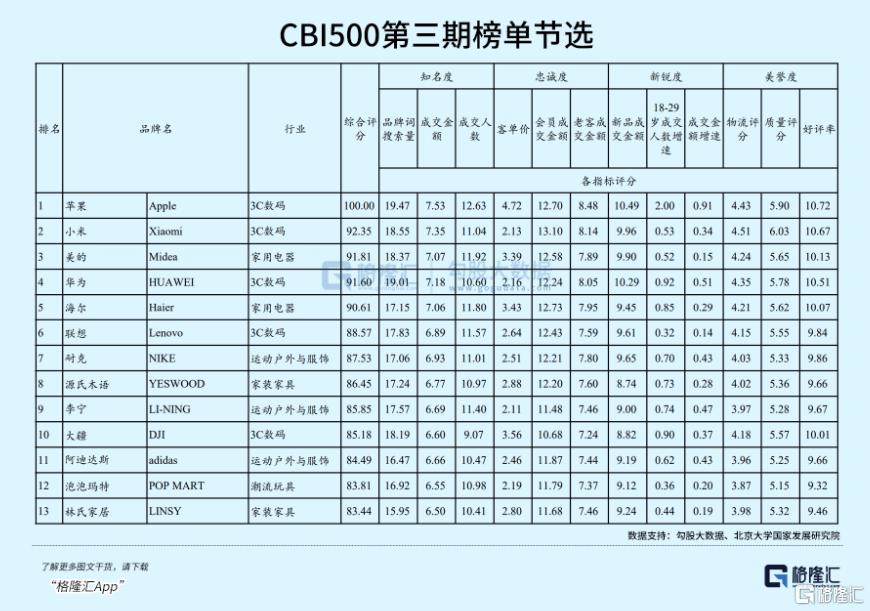
Group 1 - The Chinese consumer market has shown a steady recovery since 2025, with a year-on-year growth of 6.8% in retail sales of consumer goods in the first three quarters, contributing 53.5% to economic growth [1] - The recovery trend in the consumer sector is not uniform, with traditional brands struggling due to lack of innovation, while new brands are breaking through with technological advancements and innovative models [1] - The need for a quantitative evaluation tool to identify structural opportunities in the market has led to the development of the "China Online Consumption Brand Index (CBI)" and the "Global Brand China Online Top 500 List (CBI500)" by Peking University [2] Group 2 - The CBI500 list is based on real consumer data from Taobao and Tmall, utilizing a comprehensive brand quality indicator that includes new product capability, user reviews, and search popularity [2][5] - The top five brands in the CBI500 list—Apple, Xiaomi, Midea, Huawei, and Haier—demonstrate a "stronger gets stronger" logic, maintaining competitive advantages through balanced performance across various dimensions [6][8] - DJI has achieved significant growth, moving from a score of 78.53 to 85.18, entering the top ten for the first time, driven by continuous technological innovation and market expansion [9][12] Group 3 - Pop Mart has shown strong resilience in the collectible toy sector, climbing from 31st to 12th place in the CBI500 list, with leading scores in loyalty and customer spending [14][17] - The growth logic of Pop Mart is based on deep insights into emotional consumption needs, utilizing an IP matrix and a robust membership system to create a strong emotional connection with consumers [17] - The differentiation in the consumer market has created opportunities for brands that adapt to trends, as seen with Fenjiu's rise in rankings due to its "youthful" strategy targeting younger consumers [22][23] Group 4 - The CBI list serves as a data-driven tool for observing the consumer market, helping investors identify brands that capture product innovation opportunities and possess anti-cyclical potential [27][29] - The evaluation logic of the CBI list helps to avoid misleading short-term sales data, focusing instead on loyalty and reputation metrics to identify brands that achieve sustainable growth [27][29] - The current economic recovery phase presents a critical window for brand restructuring and value selection, emphasizing the importance of understanding consumer behavior changes [26][29]





新消费行业周报(2026.1.5-2026.1.9):四部门鼓励每年最多开展四次春秋游,支持发放文旅消费券、电影券;毛戈平与LVMH旗下基金达成战略合作-20260110
Hua Yuan Zheng Quan· 2026-01-10 08:27
Investment Rating - The industry investment rating is "Positive" (maintained) [4] Core Viewpoints - The report highlights the encouragement from four departments to conduct up to four spring and autumn tours annually, supporting the issuance of cultural and tourism consumption vouchers and movie vouchers. This initiative aims to enhance cultural consumption among workers and stimulate the tourism and hospitality sectors [3][6]. - The strategic partnership between Mao Geping and L Catterton Asia Advisors is expected to facilitate global market expansion and optimize capital structure, indicating a strong growth potential for high-end retail channels [3][6]. - The report emphasizes the importance of understanding new consumer narratives shaped by younger generations, suggesting that companies with strong brand value and innovative capabilities, such as Mao Geping and others, are likely to experience significant growth [21]. Summary by Relevant Sections Industry Performance - The new consumption sector showed positive performance with the beauty care index increasing by 2.55%, the retail index by 4.23%, and the social services index by 4.71% during the week of January 5 to January 9, 2026 [9]. Key Industry Data - In November, retail sales for clothing and textiles increased by 3.5% year-on-year, cosmetics by 6.1%, gold and silver jewelry by 8.5%, and beverages by 2.9% [12][16]. Investment Analysis Opinions - The report recommends focusing on high-quality domestic brands in beauty care, such as Mao Geping and Shangmei, head brands in traditional gold jewelry like Laopu Gold and Chaohongji, companies with successful IP operations like Pop Mart in the trendy toy sector, and strong tea brands like Mixue Group and Guming in the ready-to-drink tea market [21].

内需消费板块或将“结构性崛起”
Sou Hu Cai Jing· 2026-01-02 00:20
Group 1 - The core viewpoint is that the A-share market is expected to continue its upward trend in 2026, shifting from "expected overshoot" to "profit realization" as the main driver of market pricing [2][5] - The investment opportunities are identified in the new productivity sectors (electronics, high-end equipment) and midstream manufacturing and upstream resource products [3][5] - The market structure in 2025 showed a significant divergence, with technology growth stocks leading the way, as the Sci-Tech 50 and ChiNext indices rose nearly 40% and about 50% respectively, outperforming blue-chip indices [4] Group 2 - The investment strategy should focus on sectors with strong profit certainty, moving from a narrative-driven approach to one based on profit verification [5][6] - The consumer sector is expected to experience a "structural rise" rather than a full recovery, with traditional consumption facing challenges despite potential rebounds in valuation [6][7] - The recommendation for asset allocation includes prioritizing new productivity sectors and cyclical products benefiting from PPI recovery, while maintaining low-volatility dividend assets as a base [8]

创金合信基金魏凤春:“盈利驱动”接棒 看好新质生产力和中游制造
Sou Hu Cai Jing· 2026-01-01 23:47
Core Viewpoint - The A-share market is expected to continue its upward trend in 2026, driven by a shift in market logic towards profit-driven growth, with a focus on new productive forces and midstream manufacturing [5][6]. Market Performance in 2025 - In 2025, the A-share market showed a strong performance, with the Shanghai Composite Index rising nearly 20% and the ChiNext Index increasing by approximately 50% [5]. - The technology growth stocks led the market, significantly outperforming blue-chip indices like the Shanghai 50 and CSI 300 [5]. Structural Changes in Market Dynamics - The structural divergence in the market was attributed to three main factors: a shift towards technology growth, a consensus narrative around tech innovation, and policy guidance that favored sectors with research barriers and growth potential [5][6]. - The market's focus shifted from liquidity-driven expectations to profit realization, with performance certainty becoming the core basis for valuation [6]. Investment Opportunities for 2026 - Investment strategies should focus on sectors benefiting from cyclical resonance, particularly in new productive forces (electronics, high-end equipment) and midstream manufacturing [6]. - The approach should follow the logic of "offensive relies on profit, defensive relies on liquidity," with a focus on dividend-paying state-owned enterprises as a base [6]. Consumer Sector Outlook - The consumer sector is expected to experience a "structural rise" in 2026 rather than a full recovery, with new consumption trends emerging as the main line of growth [7][8]. - Traditional consumption sectors, such as high-end liquor, may see a rebound due to valuation recovery rather than a significant improvement in end-demand [8]. Asset Allocation Strategy - The recommended asset allocation strategy emphasizes "offensive relies on profit, defensive relies on liquidity, and structural focus on divergence" [9]. - In the stock market, priority should be given to new productive forces and cyclical goods benefiting from PPI recovery, while maintaining low-volatility dividend assets as a foundation [9]. - For bonds, a strategy focusing on low volatility and narrow fluctuations is advised, with an emphasis on short-term high-rated credit bonds [9]. - Gold is suggested as a strategic allocation to hedge against extreme risks, supported by geopolitical risks and expectations of Federal Reserve easing [9].