浦发银行

Search documents
多家银行扎堆发卫星上天
2 1 Shi Ji Jing Ji Bao Dao· 2026-01-21 11:25
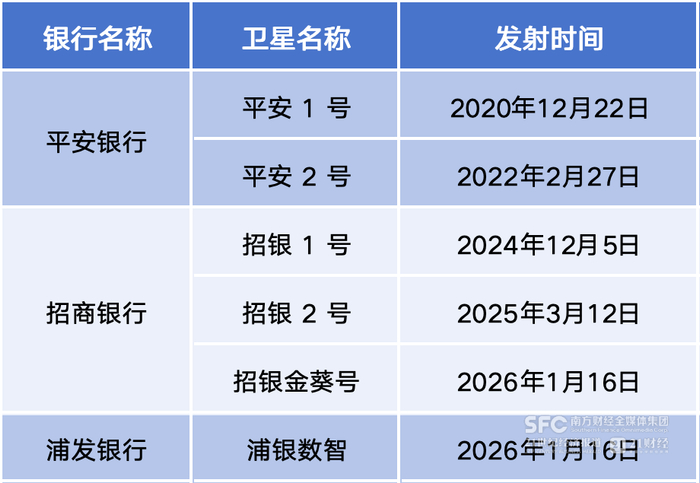
Core Viewpoint - The recent successful launch of satellites by major banks in China, including China Merchants Bank and Shanghai Pudong Development Bank, signifies a strategic shift towards utilizing satellite technology for enhancing financial services and risk management in the banking sector [1][2][5]. Group 1: Satellite Launches and Developments - China Merchants Bank launched the "Zhaoyin Jinkui" satellite on January 16, 2026, as part of the "Tianqi Constellation," which aims to enhance global coverage and communication capabilities [1][5]. - Shanghai Pudong Development Bank's "Puyin Shuzhi" satellite was also launched on the same day, contributing to the "Tianqi Constellation" [5]. - Previous satellite launches by Ping An Bank include "Ping An 1" in December 2020 and "Ping An 2" in February 2022, indicating a growing trend among banks to invest in satellite technology [2][3]. Group 2: Business Logic Behind Satellite Investments - Banks are leveraging satellite technology for remote monitoring of collateral and project progress, significantly improving post-loan management efficiency and reducing credit risk [2][8]. - The ability to maintain business continuity during extreme scenarios, such as natural disasters, is enhanced through satellite communication technology [13]. - By participating in satellite launches, banks are aligning with national strategies and expanding their financial services to support the commercial space industry [14]. Group 3: Applications of Satellite Technology in Banking - Satellite technology allows for real-time monitoring of agricultural and industrial activities, addressing information asymmetry in lending [8][10]. - The integration of satellite data into risk management systems has improved the accuracy of monitoring construction projects, with a reported precision of over 95% in tracking project progress [9][11]. - The use of satellite technology in supply chain finance helps overcome challenges faced by small and medium enterprises, enabling better access to credit [10][12]. Group 4: Future Prospects and Innovations - The ongoing development of satellite technology is expected to further penetrate various banking operations, enhancing risk prevention capabilities in sectors like agriculture and logistics [14][15]. - Innovations such as the "Dashanque" system by WeBank utilize satellite imagery and AI to assess agricultural productivity, providing tailored credit solutions to farmers [15]. - The trend of banks investing in satellite technology reflects a broader commitment to technological innovation and improved service delivery in the financial sector [16].




1月20日贷款财政贴息四项政策点评:“一揽子”贷款财政贴息政策影响几何?
EBSCN· 2026-01-21 11:17
Investment Rating - The report maintains a "Buy" rating for the banking industry, indicating an expected investment return exceeding the market benchmark index by more than 15% over the next 6-12 months [29] Core Insights - The "package" loan interest subsidy policies aim to stimulate consumption and investment, focusing on enhancing effective domestic demand through financial and fiscal collaboration [2][7] - The new policies are expected to significantly increase the scale of interest subsidies compared to previous measures, with a projected subsidy scale of approximately 1000 to 2000 billion yuan for 2026 [17][19] Summary by Sections Loan Subsidy Policies - The policies include four main areas: subsidies for small and micro enterprises, equipment updates, service industry operators, and personal consumption loans, with a focus on key industries such as new energy vehicles and medical equipment [4][6] - The subsidy rate for small and micro enterprise loans is set at 1.5 percentage points, with a maximum loan amount of 50 million yuan per entity, potentially providing up to 150,000 yuan in subsidies [4][6] - The equipment update loan subsidy has been increased from 1% to 1.5%, expanding the scope to include technology innovation loans and related fields [4][6] - The personal consumption loan subsidy has removed previous restrictions, allowing for broader eligibility and a maintained subsidy rate of 1% [5][6] Economic Impact - The policies are designed to alleviate financial burdens on small and micro enterprises, encouraging investment and job stability, particularly in high-tech and essential service sectors [7][8] - The expected increase in loan demand from these sectors is anticipated to support the overall credit recovery in the economy, particularly for retail and service industries [7][8] Market Outlook - The report suggests that the coordinated fiscal and monetary policies will positively impact the banking sector's loan volume and pricing, particularly benefiting banks focused on small and micro enterprises and retail finance [23] - The banking sector has seen a decline in stock performance, and the new policies are expected to act as a catalyst for recovery, especially in the context of the "opening red" period for banks [23]
财政部印发财政金融协同促内需一揽子政策
Sou Hu Cai Jing· 2026-01-21 11:08
Core Viewpoint - The Ministry of Finance has introduced a comprehensive policy package aimed at promoting domestic demand through support for private investment and consumer spending, consisting of six specific measures. Group 1: Support for Small and Micro Enterprises - A loan interest subsidy policy for small and micro enterprises has been established, offering a 1.5% interest subsidy on eligible fixed asset loans for a maximum term of 2 years, with a loan cap of 50 million yuan and a maximum subsidy of 1.5 million yuan [5] - A special guarantee plan for private investment in small and micro enterprises has been set up, with a scale of 500 billion yuan over two years, increasing the guarantee coverage ratio to 40% and raising the individual guarantee limit from 10 million yuan to 20 million yuan [8] Group 2: Bond Risk Sharing Mechanism - A risk-sharing mechanism for bonds issued by private enterprises has been established, with the Ministry of Finance coordinating with the People's Bank of China to provide credit enhancement support for bond issuance by private enterprises and private equity investment institutions [10] Group 3: Equipment and Service Sector Support - The equipment renewal loan interest subsidy policy has been optimized to include loans for technology innovation and various new sectors, maintaining a 1.5% subsidy rate for a term of 2 years [12] - The service industry loan interest subsidy policy has been extended to the end of 2026, increasing the maximum subsidy per loan from 10,000 yuan to 100,000 yuan and adding support for digital, green, and retail sectors [14] Group 4: Consumer Loan Support - The personal consumption loan interest subsidy policy has been extended to the end of 2026, including credit card installment payments and removing restrictions on the consumption sector and individual loan subsidy caps [17] Group 5: Implementation and Future Steps - The Ministry of Finance plans to leverage the first quarter's consumption peak by coordinating central policies with local financial policies to maximize the benefits of the central fiscal policy and ensure rapid and effective implementation [19]

多家银行扎堆发卫星上天
21世纪经济报道· 2026-01-21 11:06
Core Viewpoint - The article discusses the recent satellite launches by major Chinese banks, highlighting their strategic shift towards utilizing satellite technology for enhancing financial services and risk management [1][4]. Group 1: Satellite Launches and Their Purpose - Three major banks, China Merchants Bank, Shanghai Pudong Development Bank, and Ping An Bank, have successfully launched satellites as part of their strategic initiatives to integrate satellite technology into their operations [4][5]. - The "Zhaoyin Jinqi" satellite launched by China Merchants Bank is designed to enhance global communication capabilities and improve data transmission efficiency, forming a comprehensive low-orbit satellite communication matrix [4][6]. - The "Puyin Shuzhi" satellite, launched simultaneously, is part of the "Tianqi Constellation" and aims to improve the performance and revisit time of the satellite network [4][6]. Group 2: Business Logic Behind Satellite Utilization - Banks are leveraging satellite technology for remote monitoring of collateral and project progress, significantly enhancing post-loan management efficiency and reducing credit risk [7][8]. - The use of satellite technology allows banks to gather unique spatial data, which can transform risk control and business models, addressing issues of information asymmetry in lending [7][9]. - For instance, China Merchants Bank has integrated remote sensing technology into its risk management system, achieving over 95% accuracy in monitoring construction progress of mortgage properties [8][9]. Group 3: Applications in Extreme Scenarios - In extreme scenarios such as natural disasters, satellite communication technology provides a solution to maintain business continuity when ground communication networks fail [12][13]. - China Merchants Bank has tested low-orbit satellite links for disaster recovery, establishing a foundation for an integrated emergency communication network [12][13]. Group 4: Supporting National Strategy and Commercial Space Industry - By participating in satellite launches, banks are aligning with national strategies and expanding financial services to support the commercial space industry [13][14]. - The banks are developing various services and products tailored to the needs of the commercial space sector, such as satellite leasing and financing solutions [14]. Group 5: Broader Industry Impact - The trend of banks utilizing satellite technology is expanding beyond a few players, with other banks also exploring applications in agriculture, environmental monitoring, and supply chain finance [14]. - Innovations such as satellite remote sensing applications are being adopted to enhance risk management and service delivery in various sectors, indicating a shift towards integrating advanced technologies in traditional banking practices [14].

《Brand Finance 2026年全球品牌价值500强》榜单发布:13家中国银行业品牌上榜,工行建行中行农行位列前20
Xin Lang Cai Jing· 2026-01-21 10:48
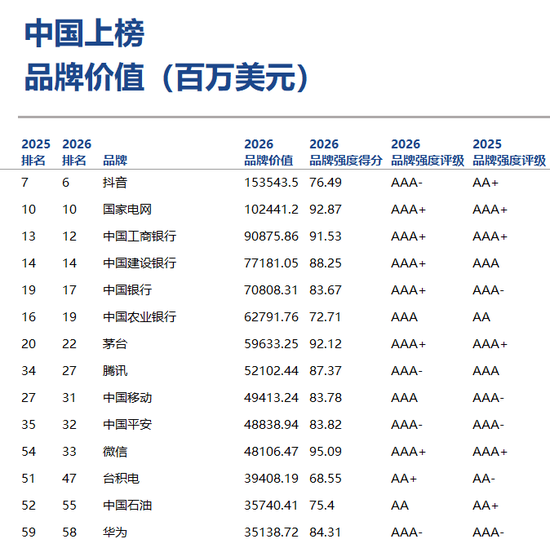
1月21日金融一线消息,当地时间1月20日,《Brand Finance 2026年全球品牌价值500强榜单报告》在瑞 士达沃斯正式发布。 《Brand Finance 2026年全球品牌价值500强榜单报告》显示,银行业凭借79个品牌,为总价值贡献了 12.5%。其中,13家中国银行品牌以4170亿美元总价值占据行业鳌头,同比增长1.4%。 中国工商银行在榜单中的排名为第12名,凭借908.8亿美元的品牌价值和91.5分的品牌强度指数稳居全球 银行品牌榜首,获得AAA+评级。 上榜的中国银行品牌还有中国建设银行(排名14)、中国银行(排名17)、中国农业银行(排名19)、 招商银行(排名74)、中信银行(排名128)、中国邮政储蓄银行(排名134)、交通银行(排名 167)、上海浦东发展银行(排名272)、兴业银行(排名274)、中国民生银行(排名404)、中国光大 银行(排名461)、恒生银行(排名462)。 | 2025 2026 | | | 2026 2026 | 2026 | 2025 | | --- | --- | --- | --- | --- | --- | | 排名 | 排名 品牌 | | ...




因流动资金贷款“三查”不到位等,浦发银行杭州分行被罚475万元
Bei Jing Shang Bao· 2026-01-21 09:48
Group 1 - The core point of the article is that the Hangzhou branch of Pudong Development Bank was fined 4.75 million yuan due to violations related to the management of working capital loans and personal business loans [1] Group 2 - The regulatory body involved is the Zhejiang Regulatory Bureau of the National Financial Supervision Administration [1] - The penalties also include warnings issued to several responsible individuals within the bank [1]
信托概念下跌1.09%,主力资金净流出17股
Zheng Quan Shi Bao Wang· 2026-01-21 09:18
Group 1 - The trust concept sector declined by 1.09%, ranking among the top declines in concept sectors, with companies like Huaguang Huaneng, Delong Huineng, and Maoye Commercial experiencing significant drops [1][2] - Among the trust concept stocks, three companies saw price increases, with Hongda Co., New Huangpu, and Jianyuan Trust rising by 1.80%, 1.10%, and 0.34% respectively [1][2] - The trust concept sector experienced a net outflow of 381 million yuan, with 17 stocks facing net outflows, and six stocks seeing outflows exceeding 30 million yuan [2][3] Group 2 - The top net outflow stock was Zhongyou Capital, with a net outflow of 105 million yuan, followed by Guowang Yingda and Huaguang Huaneng with net outflows of 89.28 million yuan and 68.60 million yuan respectively [2][3] - The leading stocks for net inflow in the trust concept sector included Hongda Co., Guotou Investment, and Zhejiang Dongfang, with net inflows of 45.47 million yuan, 18.86 million yuan, and 13.57 million yuan respectively [2][3] - The trading volume for Zhongyou Capital was 0.60%, while Guowang Yingda had a trading volume of 1.29%, indicating varying levels of investor activity within the sector [3]


股份制银行板块1月21日跌1.78%,中信银行领跌,主力资金净流出1.38亿元
Zheng Xing Xing Ye Ri Bao· 2026-01-21 08:54
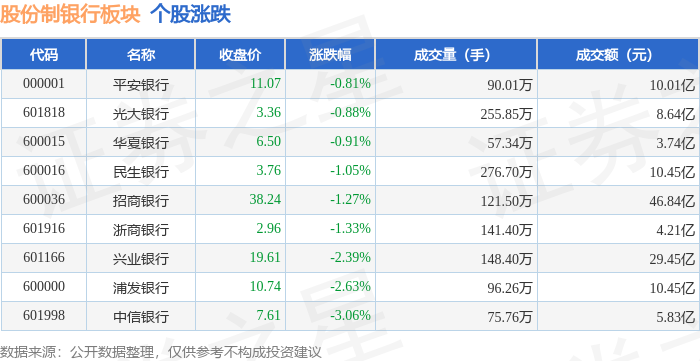
证券之星消息,1月21日股份制银行板块较上一交易日下跌1.78%,中信银行领跌。当日上证指数报收于 4116.94,上涨0.08%。深证成指报收于14255.12,上涨0.7%。股份制银行板块个股涨跌见下表: | 代码 | 名称 | 收盘价 | 涨跌幅 | 成交量(手) | 成交额(元) | | --- | --- | --- | --- | --- | --- | | 000001 | 平安银行 | 11.07 | -0.81% | 90.01万 | 10.01亿 | | 601818 | 光大银行 | 3.36 | -0.88% | 255.85万 | 8.64亿 | | 600015 | 华夏银行 | 6.50 | -0.91% | 57.34万 | 3.74亿 | | 600016 | 民生银行 | 3.76 | -1.05% | 276.70万 | 10.45 Z | | 600036 | 招商银行 | 38.24 | -1.27% | 121.50万 | 46.84亿 | | 601916 | 浙商银行 | 2.96 | -1.33% | 141.40万 | 4.21亿 | | 601166 | ...




金融之善:浦发银行如何铸就可持续发展新标杆
Xin Lang Cai Jing· 2026-01-21 08:43
Core Insights - The article highlights the unique approach of Shanghai Pudong Development Bank (SPDB) in implementing sustainable development principles, transitioning from financial services to deeper social responsibilities, and achieving an upgrade in MSCI ESG rating from A to AA by 2025 [1][10]. Group 1: Sustainable Practices - SPDB's sustainable practice framework is characterized by a three-tier evolution logic: from public welfare actions to strategic integration, and finally to governance internalization, showcasing a new model of symbiotic development between financial enterprises and society [1][10]. - The bank has engaged in various public welfare initiatives, including the "Chasing Light Cabin" project, which focuses on improving living conditions for underprivileged minors by providing tailored support packages and ongoing assistance [3][5]. Group 2: Financial Integration - SPDB's public welfare actions are not isolated charitable acts but are integrated with its core financial operations, enhancing the synergy between its financial services and social responsibilities [7][9]. - The bank has developed a comprehensive financial service model that includes commercial banking, investment banking, and various financial products, serving over 250,000 technology enterprises with a technology finance loan balance exceeding 1 trillion yuan [7][8]. Group 3: Environmental and Social Governance (ESG) - SPDB has established a clear ESG governance framework, integrating ESG principles into its strategic development, risk management, and consumer protection processes [10][11]. - The bank's commitment to ESG is reflected in its executive compensation policies, which link performance metrics to sustainable development goals, thereby incentivizing management to prioritize ESG considerations [10][11]. Group 4: Recognition and Future Outlook - SPDB's efforts in ESG have been recognized with improved ratings from various agencies, including an upgrade to AA by MSCI and AAA by Huazheng, indicating its enhanced capabilities in sustainable development management [12]. - The bank's strategic shift from profit-oriented to value-driven operations signifies a broader transformation within the Chinese banking sector, aiming to create a feasible path for financial institutions to support the real economy and promote social equity [12].

太猛了!6700亿半导体巨头飙涨超13%!成交额A股第一!贵金属集体暴动,板块都要涨停了...
雪球· 2026-01-21 08:34
Market Overview - A-shares experienced a high and then a pullback, with the Shanghai Composite Index closing up 0.08%, the Shenzhen Component Index up 0.7%, and the ChiNext Index up 0.54%. The STAR Market 50 Index surged by 3.53%. The total trading volume in the Shanghai and Shenzhen markets was 2.6 trillion yuan, a decrease of 177.1 billion yuan from the previous trading day, with over 3,000 stocks in the green [2]. Semiconductor Sector - The semiconductor sector saw a significant rebound, with the 670 billion yuan giant Haiguang Information rising over 13%, becoming the top traded stock in A-shares. Other stocks like Longxin Zhongke and Zhishang Technology hit the 20% limit up, while Huahong Semiconductor and SMIC rose over 4% [4][5]. - Multiple factors have driven the semiconductor sector's strength, including TSMC's announcement of record revenue and profit growth due to AI chip demand, and a major technological breakthrough in domestic semiconductor equipment [8]. Precious Metals - The precious metals sector experienced a collective surge, nearing limit up, with stocks like Hunan Silver, Sichuan Gold, and Zhaojin Gold hitting the limit up, while others like Zhongjin Gold and Shandong Gold rose over 8% [10]. - Gold prices reached a high of 4,888 USD per ounce before retreating slightly but remained above 4,850 USD. Domestic gold jewelry prices are generally above 1,440 yuan per gram [12]. Banking Sector - The banking sector faced declines, with major state-owned banks like China Construction Bank and Industrial and Commercial Bank of China dropping over 2%. The overall banking index fell by 1.18% [15][16]. - Factors contributing to the banking sector's underperformance include a shift in capital towards high-growth sectors and pressure on interest margins. However, some banks like Shanghai Pudong Development Bank reported positive earnings, indicating potential recovery [17].