中国南方电网有限责任公司

Search documents
14家电力央企“一把手”年薪公布
Di Yi Cai Jing Zi Xun· 2026-01-22 15:39
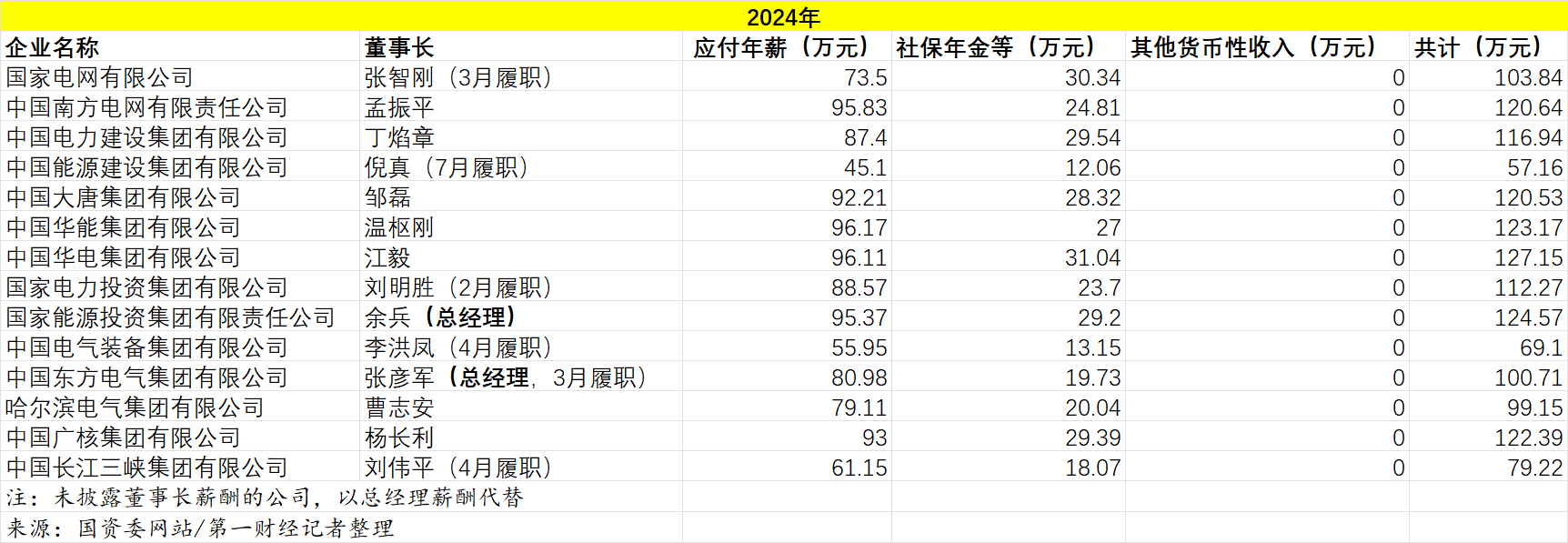
Core Insights - The State-owned Assets Supervision and Administration Commission (SASAC) recently released the salary information for central enterprise leaders for 2024, including 14 power companies [2] - The salaries consist of three components: base salary, social insurance and other monetary income [2] Salary Overview - The total salaries for the leaders of the 14 power central enterprises range from 79 million to 97 million yuan, with most leaders earning below 1 million yuan [4] - The highest salary is held by the chairman of China Huaneng Group, with a total salary of 123.17 million yuan, followed closely by the chairmen of China Huadian Group and China Southern Power Grid [4][5] Year-on-Year Salary Changes - The total salaries of most power enterprise leaders have increased compared to 2023, with growth rates ranging from 0.5% to 5% [4][6] - The chairman of China Datang Group saw the highest salary increase of 4.60%, attributed to reduced coal costs leading to significant profit growth [6] Performance and Profitability - The decline in coal prices has positively impacted the profitability of thermal power companies, with notable profit increases reported by China Datang Group, China Huadian Group, and China Huaneng Group [6] - China Huadian Group's listed company reported a net profit of 57.03 billion yuan, a year-on-year increase of 26.11%, while China Huaneng Group's listed company reported a net profit of 101.35 billion yuan, up 20.01% [6]

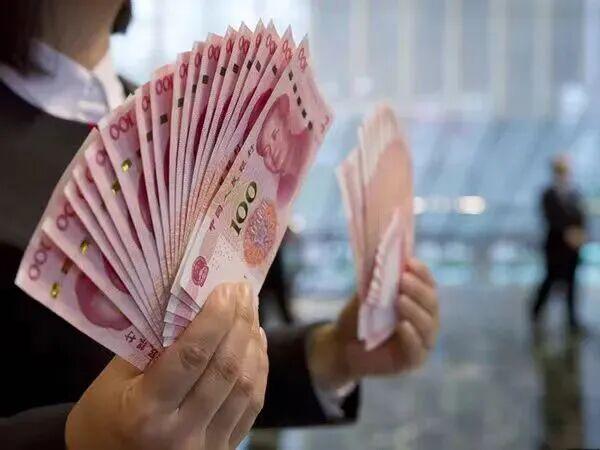
14家电力央企“一把手”年薪公布
第一财经· 2026-01-22 15:37
Core Viewpoint - The article discusses the salary information of central enterprise leaders in the power sector for 2024, highlighting the compensation structure and the performance-related increases in salaries due to favorable market conditions [3][5]. Salary Information - The total salary for central enterprise leaders consists of three components: annual salary, social insurance and pension contributions, and other monetary income [3]. - The annual salaries of the leaders of 14 power central enterprises range from 73.5 million to 96.17 million yuan, with most leaders earning below 1 million yuan [4][5]. Top Earners - The highest-paid leader is Wen Shugang from China Huaneng Group, with an annual salary of 96.17 million yuan, followed by Jiang Yi from China Huadian Group at 96.11 million yuan and Meng Zhenping from China Southern Power Grid at 95.83 million yuan [5][6]. - The total income rankings, including social insurance and other benefits, show Jiang Yi, Yu Bing, and Wen Shugang as the top three earners with total salaries of 127.15 million yuan, 124.57 million yuan, and 123.17 million yuan respectively [5][6]. Salary Growth - Most power central enterprise leaders experienced salary increases in 2024, with growth rates ranging from 0.5% to 5% compared to 2023 [5][6]. - The highest salary increase was observed for the chairman of China Datang Group, with a 4.60% rise, while China Huadian Group and China Huaneng Group also saw significant increases of 4.01% and 3.28% respectively [7]. Performance Drivers - The increase in salaries is attributed to a decline in coal prices, which reduced fuel costs for thermal power companies, thereby enhancing profitability [7]. - China Datang Group reported a net profit of 4.506 billion yuan, a significant increase of 229.70% year-on-year, while China Huadian Group and China Huaneng Group also achieved record profits with net profit growth exceeding 20% [7].

14家电力央企“一把手”年薪公布,业绩助推薪酬整体上涨,这几家工资领跑
Di Yi Cai Jing· 2026-01-22 14:07
Core Insights - In 2024, the chairpersons of China Huadian Corporation and China Huaneng Group lead the salary rankings among state-owned power enterprises [1][3] - The State-owned Assets Supervision and Administration Commission (SASAC) recently released the salary information for central enterprise leaders, including 14 power companies [1][2] Salary Overview - The salary structure for central enterprise leaders consists of three components: base salary, employer contributions to social insurance, enterprise annuities, supplementary medical insurance, and housing provident fund, along with other monetary income [1] - The chairperson of China Huaneng Group, Weng Shugang, has the highest payable annual salary at 961,700 yuan, followed closely by Jiang Yi of China Huadian Corporation at 961,100 yuan, and Meng Zhenping of China Southern Power Grid at 958,300 yuan [2][3] Salary Trends - Nearly half of the chairpersons or general managers in the 14 power central enterprises took office mid-year in 2024, with their payable annual salaries not exceeding 900,000 yuan [2] - The total annual salaries for the chairpersons of these enterprises generally range from 790,000 yuan to 970,000 yuan [2] Year-on-Year Salary Changes - The total annual salaries for most power enterprise leaders have increased compared to 2023, with year-on-year growth rates ranging from 0.5% to 5% [4] - The chairpersons of China Datang Group, China Huadian Group, and China Huaneng Group saw the highest salary increases, with respective growth rates of 4.60%, 4.01%, and 3.28% [6] Performance Impact - The increase in salaries is attributed to the decline in coal prices, which has significantly reduced fuel costs for thermal power companies, enhancing profitability [5] - China Huadian Group and China Huaneng Group reported record performances in 2024, with net profit growth exceeding 20% for their core listed companies [7]


香港债券市场全景及投资价值分析
Huachuang Securities· 2026-01-20 12:08
1. Report Industry Investment Rating There is no information provided about the industry investment rating in the report. 2. Core Viewpoints of the Report - In 2026, the mainland bond market is expected to maintain a low - interest - rate environment. "Going outbound" to seek high - coupon bonds remains one of the main demands of non - bank institutions. The new "Southbound Connect" policy may be gradually implemented, so investors can actively focus on the Hong Kong bond market to further explore investment value [2]. - The expansion of the "Southbound Connect" mechanism will significantly broaden the channels for non - bank institutions such as securities firms, funds, insurance companies, and bank wealth management to participate in the Hong Kong bond market. It is recommended to focus on the investment opportunities of dim sum bonds, which have been continuously expanding in recent years, and Chinese - funded US dollar bonds with a large outstanding scale [8]. 3. Summary According to the Table of Contents 3.1 Hong Kong Bond Market Development History and Outstanding Structure Characteristics 3.1.1 Development History: From Dominated by US Dollar Bonds to the Rise of RMB Bonds - The Hong Kong bond market can be divided into three development stages. Before 2015, it was in a slow - development stage, with the issuance scale growing from $100 million in 1989 to $103.3 billion in 2014, mainly corporate bonds. After the launch of the "Government Bond Program" in 2009, the issuance scale of government bonds began to increase [3][15]. - From 2015 - 2021, it experienced rapid development, with the issuance scale growing from $188.5 billion to $499.4 billion. The proportion of government bonds increased, mainly due to the growth of Hong Kong government retail bonds. US dollar bonds also grew rapidly because of the relaxation of overseas debt issuance regulations by the mainland [3][16]. - Since 2022, the total market has been in a stable development stage, but the internal structure has changed. The scale of US dollar bonds has decreased significantly due to tightened mainland regulations and the Fed's interest - rate hikes, while RMB bonds have developed rapidly due to China's loose monetary environment and central government policies [4][17]. 3.1.2 Outstanding Structure Characteristics: Chinese Issuers Account for 80%, and the Financial Industry Dominates - As of the end of 2024, the outstanding scales of Hong Kong dollar bonds, offshore RMB bonds, and G3 currency bonds in the Hong Kong bond market were $195.5 billion, $173.2 billion, and $565.6 billion respectively, with corporate bonds accounting for over 70% in each category [24]. - Currently, the total outstanding bond scale in the Hong Kong market is about $1.05 trillion. About 80% of the issuers are from China, about 65% of the remaining maturities are within 3 years, the financial industry accounts for half of the market, and the currency is mainly US dollars [4][25]. 3.2 Hong Kong Bond Market Liquidity and Investor Participation - In terms of liquidity, before the end of 2020, the average daily trading volume of bonds托管 and settled by the CMU system was stable at around HK$5 billion. Since 2021, the launch of the "Southbound Connect" and the increase in the issuance of RMB bonds have promoted the trading volume to increase to HK$20 - 25 billion, and the average daily turnover rate has risen from about 0.5% to around 1% [5][37]. - In terms of investor structure, asset management institutions, banks, and hedge funds hold 75%, 9%, and 7% of the outstanding bond balances with available holder data respectively. Holders are mainly distributed in the United States, Luxembourg, and China, and foreign - funded enterprises such as BlackRock, Nomura, and HSBC have relatively large management scales [5][41][44]. 3.3 Participation Opportunities in the Hong Kong Bond Market under the Expansion of the Bond "Southbound Connect" Mechanism 3.3.1 Chinese - funded Overseas Bonds: There are Obvious Excess Spreads, with Priority Focused on - Dim sum bonds: There are opportunities for spread compression in various types of urban investment bonds and high - grade industrial bonds. The outstanding dim sum bonds in the Hong Kong market are 1,376, with a balance of about 1.47 trillion yuan. The excess spreads of high - grade urban investment and industrial bonds are mostly between 100 - 150BP, and the spreads of low - grade urban investment bonds are mostly between 200 - 400BP [50]. - Chinese - funded US dollar bonds: The excess spreads of all varieties compared with domestic bonds are over 200BP. There are 1,066 outstanding Chinese - funded US dollar bonds in the Hong Kong market, with a balance of about $352.7 billion. The excess spreads of high - grade urban investment and industrial bonds are mostly between 200 - 300BP, and those of low - grade bonds are over 300BP [53]. - Sub - varieties investment suggestions: For urban investment overseas bonds, select bonds with a maturity of less than 3 years, a yield of over 4%, a subject rating of AA+ or above, and a bond balance of over 300 million yuan/dollars. For industrial overseas bonds, focus on central and state - owned enterprise bonds, and be cautious about the real - estate industry. For financial overseas bonds, pay attention to the overseas bonds of industries such as banks and AMCs [9][57][58]. 3.3.2 Overseas Bonds of Hong Kong, Macao, Taiwan, and Foreign - funded Enterprises: Focus on High - Quality Entities with Large Outstanding Scales and High Coupons - Consider overseas bonds issued by Hong Kong, Macao, Taiwan, and foreign - funded enterprises with large outstanding scales and high coupon yields, such as Hong Kong Mortgage Corporation Limited, Hong Kong Airport Authority, and Qatar Petroleum. These bonds generally have an average yield or coupon rate of over 3% and have certain allocation value. However, credit research and risk screening of the issuers are required before investment [6][10][62].
南方电网召开2026年工作会议
Zhong Guo Dian Li Bao· 2026-01-19 03:08
Core Viewpoint - The Southern Power Grid Company held its fourth employee representative conference and 2026 work meeting, focusing on the implementation of national strategies and the company's development goals, aiming to contribute significantly to China's modernization and national rejuvenation efforts [1][4]. Group 1: Meeting Overview - The conference was guided by Xi Jinping's thoughts on socialism with Chinese characteristics for a new era, emphasizing the importance of aligning with the decisions of the Party Central Committee and the State Council [1]. - The meeting included a work report by Chairman Meng Zhenping, who highlighted the company's achievements in 2025 and the successful completion of major objectives [3][4]. Group 2: Achievements and Characteristics - In 2025, the company faced multiple challenges but achieved significant results, including the successful completion of its strategic goals for the "14th Five-Year Plan" [4]. - Seven notable characteristics of the company's work in the past year were identified, including commitment to national strategies, green low-carbon transformation, technological integration, and deepening reforms [4]. Group 3: Future Goals and Strategies - For the "15th Five-Year Plan" period, the company aims to achieve breakthroughs in major strategic tasks and elevate key areas to new heights [5]. - The company plans to focus on high-quality development, aligning its strategies with national needs and enhancing its operational capabilities [6][7]. Group 4: Implementation and Action Plans - The company emphasized the need for all departments to unify their thoughts and actions with the decisions made during the meeting, ensuring effective implementation of the outlined strategies [6]. - Specific actions include enhancing strategic planning, ensuring accountability for targets, and fostering a culture of efficiency and innovation [6][8].
国资委公开80多家央企负责人薪酬
Sou Hu Cai Jing· 2026-01-17 13:14
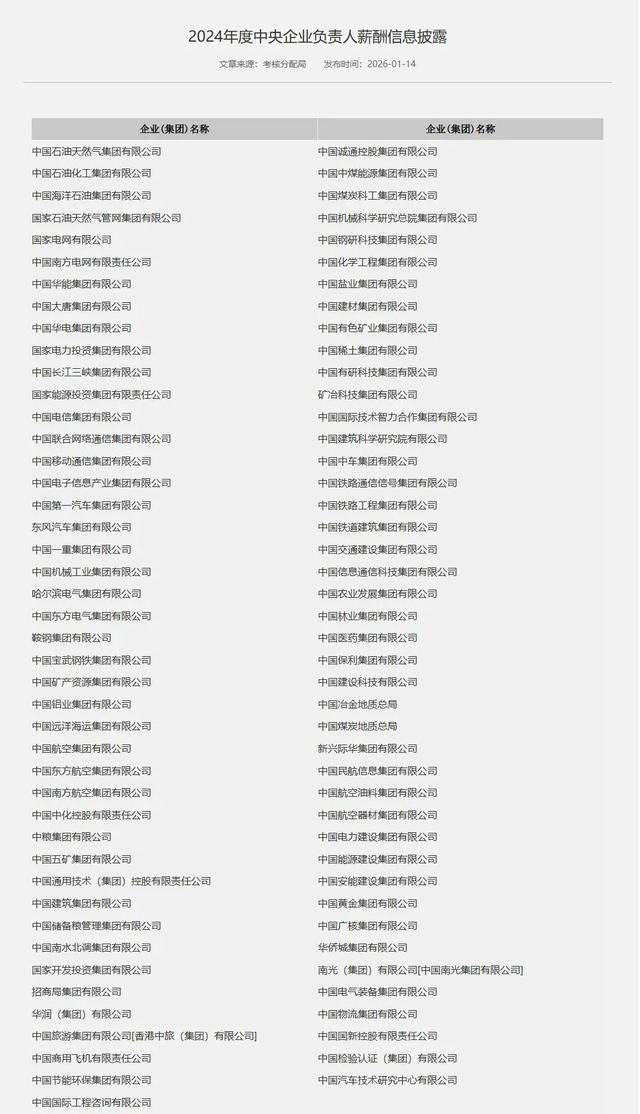
Core Viewpoint - The State-owned Assets Supervision and Administration Commission (SASAC) disclosed the salary information of over 80 central enterprise leaders for the year 2024, indicating a stable salary range without extreme high salaries, showcasing significant industry differentiation [1][5]. Group 1: Salary Disclosure - The disclosure of salary information is part of SASAC's ongoing efforts to enhance transparency in key areas and respond to public concerns [2]. - The overall salary of central enterprise leaders in 2024 remains within a stable range, characterized by "top leaders leading, median concentration, and low compliance," with no extreme high salary phenomena observed [5]. Group 2: Salary Rankings - The top tier of salaries is dominated by leaders from telecommunications and energy central enterprises, with China Mobile's former chairman Yang Jie leading with a pre-tax salary of 1.2582 million yuan, followed by China Telecom and China Unicom chairmen with salaries of 1.2160 million yuan and 1.2101 million yuan respectively [6]. - In the energy sector, PetroChina's chairman Dai Houliang and general manager Hou Qijun both have an annual salary of 978,500 yuan, ranking first among energy central enterprises [7]. - Other notable salaries include China Huaneng Group's chairman Wen Shugang at 961,700 yuan and State Power Investment Corporation's chairman Yu Bing at 953,700 yuan, both of whom are also in the top tier [8]. Group 3: Salary Distribution - The second tier includes core central enterprises in electricity, construction, and automotive industries, with notable figures such as State Grid's chairman Zhang Zhigang earning 735,000 yuan and China National Nuclear Corporation's chairman Yang Changli earning 930,000 yuan [15]. - The third tier consists of central enterprises with strong public welfare attributes, such as China Forestry Group's chairman Shan Zhongli and Overseas Chinese Town Group's chairman Zhang Zhenggao, both earning 438,500 yuan, which is below the average level for central enterprises [16]. Group 4: Salary Variability - Within the same industry, the salary differences among central enterprise executives are manageable, with the highest annual salary for energy central enterprise chairmen (PetroChina at 978,500 yuan) and the lowest (National Pipeline Network at 872,900 yuan) showing a difference of about 100,000 yuan [20].




海南省政府与南方电网公司在粤签署“十五五”深化战略合作协议
Zheng Quan Shi Bao Wang· 2026-01-17 12:08
Core Viewpoint - The Hainan provincial government and China Southern Power Grid signed a strategic cooperation agreement to enhance energy infrastructure and support the construction of the Hainan Free Trade Port, with a planned investment of 46 billion yuan during the 14th Five-Year Plan period [1]. Group 1: Strategic Cooperation - The agreement aims to implement the "三区一中心" strategic positioning and the strategic deployment of the Hainan Free Trade Port [1]. - The focus will be on advancing the construction of a new power system in Hainan and accelerating the Hainan-Guangdong power flexible interconnection project [1]. Group 2: Investment and Infrastructure - The planned investment of 46 billion yuan will significantly increase the investment in Hainan's power grid [1]. - By 2030, the goal is to achieve county-level coverage of 220 kV substations in Hainan, enhancing the infrastructure and power support capabilities [1].
信用债周度观察(20260112-20260116):信用债发行量整体环比上升,各行业信用利差整体上行-20260117
EBSCN· 2026-01-17 10:58
Report Industry Investment Rating No relevant content provided. Core View of the Report - From January 12 to January 16, 2026, the issuance volume of credit bonds increased overall on a month - on - month basis, and the credit spreads of various industries also showed an overall upward trend [1]. Summary According to the Directory 1. Primary Market 1.1 Issuance Statistics - During January 12 - 16, 2026, a total of 342 credit bonds were issued, with a total issuance scale of 331.801 billion yuan, a month - on - month increase of 6.25%. Among them, 156 industrial bonds were issued, with a scale of 171.1 billion yuan (a 26.40% month - on - month increase, accounting for 51.57% of the total); 162 urban investment bonds were issued, with a scale of 92.801 billion yuan (a 33.19% month - on - month decrease, accounting for 27.97%); 24 financial bonds were issued, with a scale of 67.9 billion yuan (a 78.68% month - on - month increase, accounting for 20.46%) [1][11]. - The average issuance term of credit bonds this week was 2.67 years. The average issuance term of industrial bonds was 2.11 years, urban investment bonds was 3.40 years, and financial bonds was 1.68 years [1][13]. - The average issuance coupon rate of credit bonds this week was 2.17%. The average issuance coupon rate of industrial bonds was 2.04%, urban investment bonds was 2.33%, and financial bonds was 1.87% [2][17]. 1.2 Cancellation of Issuance Statistics - Five credit bonds were cancelled for issuance this week [23]. 2. Secondary Market 2.1 Credit Spread Tracking - By industry, in the Shenwan primary industries, the largest upward movement in the credit spread of AAA - rated industries was in real estate, up 6.9BP; the largest upward movement in the AA + - rated industries was in electrical equipment, up 12.3BP, and the largest downward movement was in leisure services, down 0.4BP; the largest upward movement in the AA - rated industries was in leisure services, up 21.6BP [3]. - By region for urban investment bonds, the largest upward movement in the AAA - rated credit spread was in Anhui, up 6.2BP; the largest upward movement in the AA + - rated was in Xinjiang, up 6BP, and the largest downward movement was in Henan, down 1.8BP; the largest upward movement in the AA - rated was in Shanghai, up 3BP, and the largest downward movement was in Guangxi, down 0.5BP [3]. - Overall, credit spreads in various sectors such as coal, steel, urban investment, non - urban investment, state - owned enterprises, and private enterprises showed an upward trend, while regional urban investment credit spreads showed mixed trends [25]. 2.2 Trading Volume Statistics - The total trading volume of credit bonds was 1521.829 billion yuan, a month - on - month increase of 8.40%. The top three types of credit bonds in terms of trading volume were commercial bank bonds, corporate bonds, and medium - term notes. Specifically, the trading volume of commercial bank bonds was 506.172 billion yuan (an 8.35% month - on - month increase, accounting for 33.26%); corporate bonds was 398.637 billion yuan (an 8.05% month - on - month increase, accounting for 26.19%); medium - term notes was 362.973 billion yuan (a 19.35% month - on - month increase, accounting for 23.85%) [4][27]. 2.3 Actively Traded Bonds This Week - The report selected the top 20 urban investment bonds, industrial bonds, and financial bonds in terms of trading volume this week for investors' reference [29].
80多家央企负责人薪酬披露
Nan Fang Du Shi Bao· 2026-01-17 07:34
Core Insights - The State-owned Assets Supervision and Administration Commission (SASAC) disclosed the salary information of over 80 central enterprise leaders for the year 2024, indicating a stable salary range without extreme high salaries [1][2] Group 1: Salary Distribution - The overall salary of central enterprise leaders in 2024 remains stable, characterized by a "top-tier leading, median concentration, and low-tier compliance" pattern, with significant industry differentiation [5][16] - The top tier of salaries is dominated by telecommunications and energy central enterprises, with China Mobile's former chairman leading with a pre-tax salary of 1.2582 million yuan [5][6] - In the energy sector, the chairman of China National Petroleum Corporation (CNPC) and the general manager both received an annual salary of 978,500 yuan, ranking them first among energy central enterprises [6][7] Group 2: Salary Comparisons - The second tier includes core central enterprises in electricity, construction, and automotive industries, with notable figures such as the chairman of State Grid earning an annual salary of 735,000 yuan [12] - The salary range for the five major power generation group chairmen is concentrated between 880,000 and 960,000 yuan, indicating a relatively balanced distribution [16] - The third tier consists of central enterprises with strong public welfare attributes, such as the chairman of China Forestry Group earning 438,500 yuan, which is below the average level for central enterprises [13][15] Group 3: Specific Salary Figures - The chairman of China Merchants Group received an annual salary of 946,400 yuan, while the chairman of China Resources Group earned 951,200 yuan, both placing them in the top tier [8][11] - The chairman of China National Offshore Oil Corporation (CNOOC) received an annual salary of 966,900 yuan, ranking second in the energy sector [6][12] - The salary gap between the highest and lowest paid chairmen in the energy sector is approximately 100,000 yuan, indicating controlled salary differences within the same industry [16]
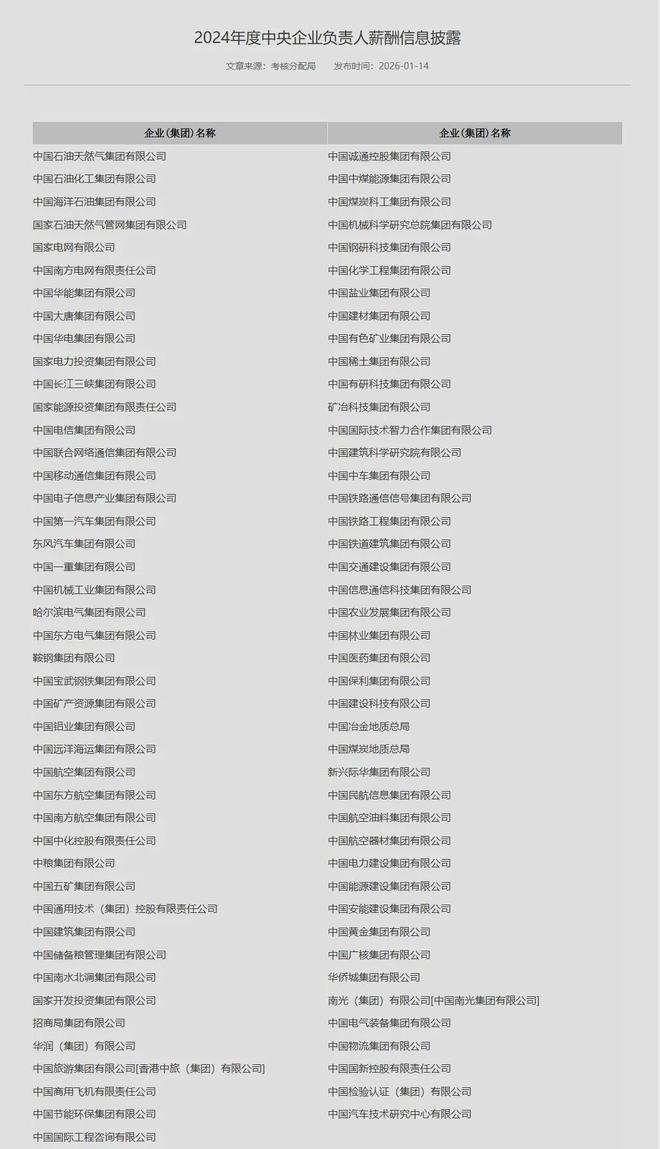
80多家央企“一把手”2024年年薪披露:最高近百万元, 能源通信行业居前
Hua Xia Shi Bao· 2026-01-17 05:17
Core Viewpoint - The recent disclosure of salary information for over 80 central enterprises by the State-owned Assets Supervision and Administration Commission (SASAC) highlights the structure, level, and distribution of executive compensation, reflecting a commitment to transparency and accountability in state-owned enterprises [2][3]. Salary Structure and Distribution - The highest annual salary for a central enterprise leader in 2024 is 978,500 yuan, held by the chairman of PetroChina, Dai Houliang, followed closely by the former chairman of China Mobile at 972,100 yuan and the former chairman of CNOOC at 966,900 yuan, all from the energy and communication sectors [3]. - Overall, the salary distribution among central enterprise leaders shows a clear stratification, closely related to the industry characteristics and operational challenges, with energy and communication sectors leading in compensation [4]. - Leaders of energy and power central enterprises, such as Huaneng Group and China Southern Power Grid, have salaries exceeding 950,000 yuan, while those in construction, manufacturing, and logistics typically earn between 600,000 and 950,000 yuan, and those in public service sectors earn between 400,000 and 600,000 yuan [3][4]. Industry Differences - There are significant salary disparities among central enterprises based on industry, with energy and communication sectors commanding higher salaries due to their monopolistic nature and substantial impact on the national economy, while sectors like forestry and pharmaceuticals, which focus on social welfare, tend to have lower compensation levels [4]. - Some central enterprises involved in overseas operations, such as China Resources Group, have additional overseas allowances that increase their overall compensation, with the highest total compensation reaching 1,351,200 yuan [4]. Salary Reform and Mechanism - The salary structure for central enterprise leaders consists of a basic salary, performance-based salary, and long-term incentive income, with performance evaluations directly influencing compensation [5][9]. - The 2024 salary determination aligns with the SASAC's performance reform direction, ensuring that compensation is closely tied to performance, with a significant portion of salaries being variable based on performance outcomes [9][10]. - The mechanism for salary determination includes comprehensive assessments of various factors, including safety, social responsibility, and innovation, with penalties for significant operational failures [10]. Transparency and Accountability - The recent salary disclosure is part of ongoing efforts to enhance transparency and accountability in central enterprises, with detailed public reporting of executive names, positions, salaries, and benefits [10]. - To improve public trust, it is suggested that the disclosure should also include the rationale behind salary structures and performance evaluations, not just the figures [10].