
华润啤酒

Search documents
宁德时代、洛阳钼业、老铺黄金入选,恒生指数成分股扩容至90只
Huan Qiu Lao Hu Cai Jing· 2026-02-14 04:09
Group 1 - The Hang Seng Index Company announced the quarterly review results for the Hang Seng Index series, with adjustments to be implemented after market close on March 6, 2026, and effective from March 9, 2026 [1] - The Hang Seng Index will include three new stocks: CATL, Luoyang Molybdenum, and Laopu Gold, increasing the number of constituent stocks from 88 to 90 [1] - CATL, a global leader in power and energy storage batteries, reported a revenue of 283.07 billion yuan for the first three quarters of 2025, a year-on-year increase of 9.28%, and a net profit of 49.03 billion yuan, up 36.2% [1] Group 2 - Luoyang Molybdenum, a leading non-ferrous metal company, saw its stock price rise by 12.25% since 2026, closing at 21.72 HKD on February 13, 2026, with a revenue of 145.49 billion yuan for the first three quarters of 2025, a decrease of 5.99%, and a net profit of 14.28 billion yuan, an increase of 72.61% [2] - Laopu Gold, focusing on high-end traditional gold jewelry, had the highest stock price increase among the new constituents, rising 18.16% since the beginning of 2026, with a closing price of 738.50 HKD on February 13, 2026, and a revenue of 12.35 billion yuan for the first half of 2025, a year-on-year increase of 250.95%, and a net profit of 2.27 billion yuan, up 285.76% [2] - The inclusion of quality companies from the new energy, non-ferrous metals, and new consumption sectors in the Hang Seng Index reduces reliance on traditional industries, optimizing the index's industry structure and representation [2] Group 3 - The Hang Seng China Enterprises Index will maintain 50 constituent stocks, adding Beike-W and Horizon Robotics-W while removing China Resources Beer and Mengniu Dairy [3] - The Hang Seng Composite Index will see a significant adjustment, adding 53 stocks including East Asia Bank, WeRide, and Woan Robotics, while removing 28 stocks such as Shui On Land and Pacific Basin Shipping, increasing the total number of constituent stocks from 507 to 532 [3]
恒生指数,重大调整!
Xin Lang Cai Jing· 2026-02-14 01:04
Core Viewpoint - The Hang Seng Index will undergo changes, increasing its constituent stocks from 88 to 90, with the inclusion of Ningde Times, Luoyang Molybdenum, and Laopu Gold, while Zhongsheng Holdings will be removed. This change will take effect on March 9, 2026 [1][6]. Group 1: Index Changes - The Hang Seng Index will increase its constituent stocks from 88 to 90, adding Ningde Times (03750.HK), Luoyang Molybdenum (03993.HK), and Laopu Gold (06181.HK), while removing Zhongsheng Holdings [1][6]. - The Hang Seng China Enterprises Index will maintain 50 stocks, adding Beike (02423.HK) and Horizon Robotics (09660.HK), while removing China Resources Beer (00291.HK) and Mengniu Dairy (02319.HK) [2][7]. - The Hang Seng Composite Index will increase from 507 to 532 stocks, removing 28 stocks and adding 53 new ones, including East Asia Bank, Rusal, and JD Industrial [2][7]. Group 2: Market Outlook - Despite recent adjustments in the Hong Kong stock market, particularly with major stocks like Tencent, Meituan, and Alibaba experiencing significant declines, institutional and investor expectations for the market remain high, with continued investments in related ETFs [1][6]. - Recent liquidity shocks have affected the technology sector, but the fundamental outlook remains unchanged, suggesting a potential rebound as the market stabilizes [3][8]. - The consumer sector in Hong Kong is expected to benefit from improving economic conditions, with traditional industries undergoing transformation and leading to potential valuation recovery [5][9].
白酒稳基盘、低度酒寻增量:中国酒类市场的结构分化与投资机会
QYResearch· 2026-02-14 00:48
Core Insights - The Chinese alcoholic beverage market is projected to reach USD 254.1 billion by 2032, with a CAGR of 6.63% during the forecast period [2] - The market is highly concentrated, with baijiu (Chinese liquor) expected to account for 78.57% of revenue by 2025, significantly higher than beer (11.22%) and other categories [2] Market Structure - Baijiu dominates the market, while beer is experiencing a shift towards premiumization and craft options, and low-alcohol/no-alcohol products are gaining traction among new consumer demographics [2] - The structure indicates that the base of the market is determined by baijiu, but growth and structural changes are driven by the premiumization of beer and the penetration of low-alcohol products [2] Technical Features and Product Classification - The alcoholic beverage industry is characterized by a combination of raw material systems, fermentation/distillation processes, aging systems, blending capabilities, and packaging/channel adaptation, which ultimately contribute to brand premium and price segmentation [5] - Baijiu is defined by solid-state fermentation and aging techniques, leading to high margins and strong brand characteristics, but also slower capacity ramp-up and sensitivity to inventory and pricing [5] - Beer is the most industrialized, focusing on scale and channel efficiency, with recent competition shifting towards high-end and craft products [5] Competitive Landscape - The Chinese market shows a concentration in baijiu, with leading companies like Kweichow Moutai and Wuliangye dominating the high-end segment, while regional players seek growth through local market penetration [7] - The beer market is characterized by competition among major players like Tsingtao Brewery and China Resources Snow Breweries, focusing on product upgrades and channel penetration [8] - The wine and yellow wine markets are smaller, where brand and channel efficiency are more critical than scale [9] Future Trends and Challenges - Over the next 3-5 years, the market is expected to stabilize with baijiu, while beer will focus on premiumization and low-alcohol/no-alcohol products will drive growth [17] - Challenges include consumer segmentation, price pressure, raw material cost fluctuations, and stricter regulatory requirements [20]

恒指季检结果公布:宁德时代、洛阳钼业、老铺黄金染蓝 恒指成分股增加至90只


Zhi Tong Cai Jing· 2026-02-14 00:31
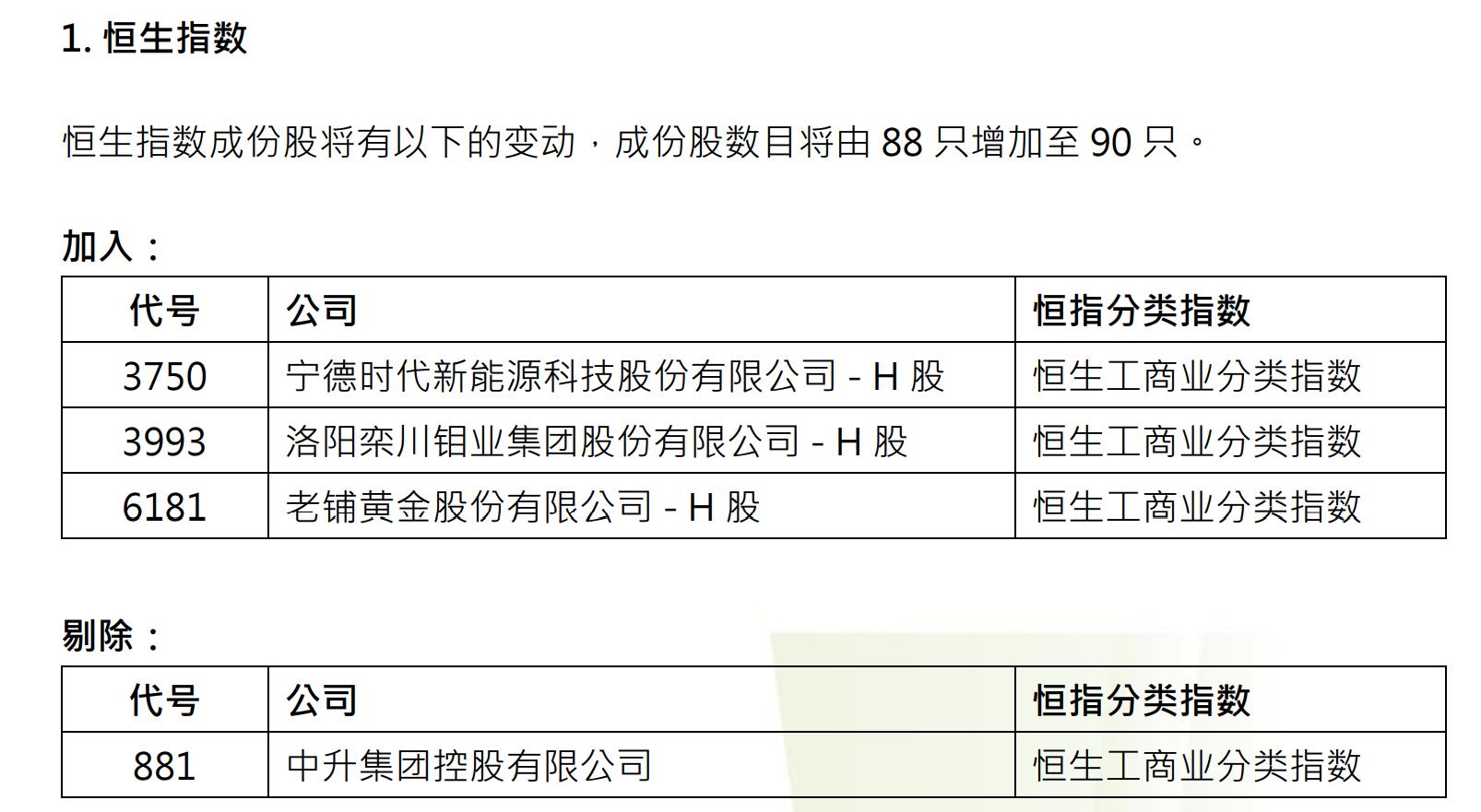
Group 1: Hang Seng Index - Ningde Times (300750) (03750), Luoyang Molybdenum (603993) (03993), and Laopu Gold (06181) will be included in the Hang Seng Index, increasing the number of constituent stocks from 88 to 90 [1][2]. Group 2: Hang Seng China Enterprises Index - Beike-W (02423) and Horizon Robotics-W (09660) will be added to the Hang Seng China Enterprises Index, while China Resources Beer (00291) will be removed, maintaining the total number of constituent stocks at 50 [5]. Group 3: Hang Seng Composite Index - East Asia Bank (00023) and Guofu Quantum (00290) will be included in the Hang Seng Composite Index, with the number of constituent stocks increasing from 507 to 532 [9][10].
恒生指数重磅调整!宁德时代、洛阳钼业、老铺黄金被纳入
Mei Ri Jing Ji Xin Wen· 2026-02-13 14:19
Group 1 - The Hang Seng Index Company announced the quarterly review results for the Hang Seng Index series, effective from March 9, 2026, after market close on March 6, 2026 [1] - The Hang Seng Index will add three stocks: Contemporary Amperex Technology Co., Limited (03750), Luoyang Molybdenum Co., Ltd. (03993), and Laopuhuang Co., Ltd. (06181), while removing Zhongsheng Group Holdings Limited (00881), increasing the number of constituent stocks from 88 to 90 [1] - Laopuhuang has seen a significant price increase, with a cumulative rise of nearly 20% since the beginning of 2026 [1] Group 2 - The Hang Seng China Enterprises Index will maintain 50 constituent stocks, adding Beike-W (02423) and Horizon Robotics-W (09660), while removing China Resources Beer (00291) and Mengniu Dairy (02319) [2] - The Hang Seng Composite Index will add 53 stocks, including Bank of East Asia (00023), and remove 28 stocks, including Shui On Land (00272), increasing the number of constituent stocks from 507 to 532 [5] - The Hang Seng Technology Index will not change, maintaining 30 constituent stocks [6] Group 3 - The total assets under management for products tracking the Hang Seng Index series is approximately $117.7 billion as of December 2025 [6] - The adjustments in index constituents may trigger passive fund rebalancing, potentially leading to increased trading volume for related stocks as the effective date approaches [6] - The inclusion of new economy enterprises in sectors like renewable energy, new consumption, and biotechnology is expected to enhance the growth potential and investment attractiveness of the indices, reducing the weight of traditional industries [6]

盘后,港股突发!恒生指数,重大调整!
券商中国· 2026-02-13 13:42
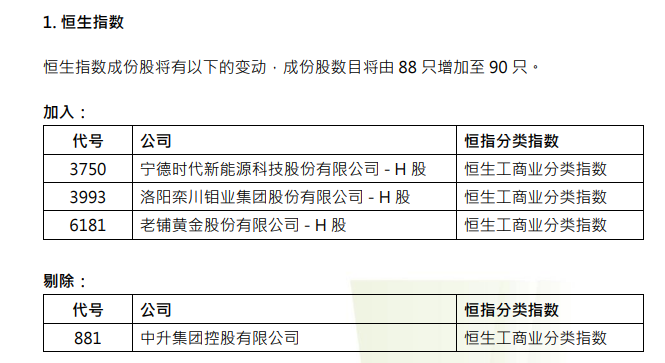
Core Viewpoint - The Hang Seng Index will undergo changes with the number of constituent stocks increasing from 88 to 90, including the addition of Ningde Times, Luoyang Molybdenum, and Laopu Gold, while Zhongsheng Holdings will be removed. This change will take effect on March 9, 2026 [1][2]. Group 1: Hang Seng Index Changes - The Hang Seng Index Company announced the quarterly review results on February 13, 2026, with changes effective after market close on March 6, 2026 [1]. - The total assets under management for passive products tracking the Hang Seng Index series is approximately $117.7 billion, which is beneficial for newly added constituents as they will attract passive fund inflows [1]. Group 2: Other Index Changes - The Hang Seng China Enterprises Index will maintain 50 constituent stocks, with Beike and Horizon Robotics added, while China Resources Beer and Mengniu Dairy will be removed [2]. - The Hang Seng Composite Index will increase from 507 to 532 constituent stocks, with 53 stocks added and 28 stocks removed, including notable additions like East Asia Bank and JD Industrial [2]. Group 3: Market Outlook - Recent weakness in the Hang Seng Technology Index is attributed to a liquidity shock, but the fundamental outlook remains unchanged, suggesting a "buy the dip" strategy may be effective [3]. - The current support from southbound funds is expected to stabilize valuations in the Hong Kong market, despite ongoing uncertainties regarding U.S. Federal Reserve policies [3][4]. - The market may experience volatility in the short term, with a focus on sectors such as technology, non-bank financials, and dividend-paying stocks [4].

宁德时代被纳入!港股,重大调整!
证券时报· 2026-02-13 12:39
Core Viewpoint - The Hong Kong stock market is undergoing significant adjustments in its major indices, with changes in constituent stocks for the Hang Seng Index and other related indices [2][4][8]. Group 1: Hang Seng Index Adjustments - The Hang Seng Index will increase its constituent stocks from 88 to 90, adding Ningde Times (03750), Luoyang Molybdenum (03993), and Laopu Gold (06181), while removing Zhongsheng Group (00881) [2][4]. - Laopu Gold has shown a strong performance, with a cumulative increase of nearly 20% since the beginning of 2026 [4]. Group 2: Hang Seng China Enterprises Index Changes - The Hang Seng China Enterprises Index will maintain 50 constituent stocks, adding Beike-W (02423) and Horizon Robotics-W (09660), while removing China Resources Beer (00291) and Mengniu Dairy (02319) [6]. Group 3: Hang Seng Composite Index Changes - The Hang Seng Composite Index will add 53 stocks, including East Asia Bank (00023), and remove 28 stocks, increasing its total from 507 to 532 [8]. - The Hang Seng Technology Index will remain unchanged at 30 constituent stocks [8]. Group 4: Market Performance Analysis - Since the beginning of 2026, the Hang Seng Index has risen by 3.65%, while the Hang Seng Technology Index has decreased by 2.82% [10]. - In 2025, both indices saw increases, with the Hang Seng Index up by 27.77% and the Hang Seng Technology Index up by 23.45% [10]. - Among the 88 constituent stocks of the Hang Seng Index, 69 have risen, 18 have fallen, and 1 has remained flat since the end of 2025 [10]. Group 5: Notable Stock Performances - The top performers since the beginning of 2026 include New World Development (41.18%), Techtronic Industries (31.92%), and Pop Mart (31.81%) [11]. - Conversely, the worst performers include Trip.com (-24.22%), Meituan (-20.47%), and NetEase (-13.47%) [11].

恒指季检结果公布:宁德时代(03750)、洛阳钼业(03993)、老铺黄金(06181)染蓝 恒指成分股增加至90只
智通财经网· 2026-02-13 10:36
Group 1: Hang Seng Index Changes - CATL (宁德时代, 03750), Luoyang Molybdenum (洛阳钼业, 03993), and Laopu Gold (老铺黄金, 06181) will be included in the Hang Seng Index, increasing the number of constituent stocks from 88 to 90 [1][2]. Group 2: Hang Seng China Enterprises Index Changes - Beike-W (贝壳-W, 02423) and Horizon Robotics-W (地平线机器人-W, 09660) will be added to the Hang Seng China Enterprises Index, while China Resources Beer (华润啤酒, 00291) will be removed, maintaining a total of 50 constituent stocks [4][5]. Group 3: Hang Seng Composite Index Changes - East Asia Bank (东亚银行, 00023) and Guofu Quantum (国富量子, 00290) will be added to the Hang Seng Composite Index, increasing the number of constituent stocks from 507 to 532 [8][9].
百威亚太在中国不好卖了,销量连跌两年
Jin Rong Jie· 2026-02-13 09:05
Core Viewpoint - Budweiser is facing unprecedented growth pressure in the Chinese market, with declining sales and profits reported in its latest earnings report [1][2]. Financial Performance - Budweiser APAC reported a revenue of $5.764 billion (approximately 39.787 billion RMB) for 2025, a year-on-year decrease of 6.1% [1]. - Beer sales reached 7.966 billion liters, down 6.0% year-on-year [1]. - The profit attributable to equity holders was $489 million (approximately 3.375 billion RMB), a significant decline of 32.6%, marking a low point in net profit over recent years [1]. Market Challenges - The company has experienced a continuous decline in key metrics, with beer sales and revenue in China dropping by 8.6% and 11.3% respectively in 2025 [2]. - The decline is attributed to a slowdown in high-end dining and entertainment channels, which have traditionally been strong for Budweiser [2]. - The company has been slow to adapt to new retail and e-commerce channels, with a lower proportion of non-on-premise sales compared to competitors [2]. Strategic Initiatives - Budweiser is increasing investments in non-on-premise channels and enhancing its sales team capabilities, particularly in Guangdong [2]. - The company is also focusing on marketing its core sub-brands, including new endorsements for Harbin Beer to strengthen connections with younger consumers [2]. Cost Pressures - Increased investments to support distributors and brand promotion in emerging channels have created additional profit pressures for Budweiser [3]. - The company plans to maintain high-intensity marketing and channel investments in 2026, coinciding with the World Cup events [3]. Industry Context - The domestic beer industry is entering a contraction phase, with local brands accelerating their premiumization and channel transformation, increasing pressure on international giants like Budweiser [3][4]. - Competitors such as Yanjing Beer and Chongqing Beer are forecasting significant profit growth, with Yanjing expected to achieve a net profit of 1.584 billion to 1.742 billion RMB, a year-on-year increase of 50%-65% [3][4]. Leadership Focus - CEO Cheng Yanjun has emphasized the need to reignite growth and rebuild market share in China as a primary task [4].
2025年四季度基本符合预期:百威亚太
citic securities· 2026-02-13 07:24
Group 1: Financial Performance - 2025 Q4 organic revenue decreased by 4% year-on-year, with total revenue down 6% to $1.1 billion, 2% lower than market consensus[5] - Standardized EBITDA fell by 26.8% to $167 million, with an organic decline of 24.7%[6] - Net loss attributable to shareholders was $105 million, worse than the expected loss of $30 million due to higher tax expenses[12] Group 2: Regional Insights - Revenue in China declined by 11.4%, with sales down 3.9% and revenue per hectoliter decreasing by 7.7%[12] - South Korea's revenue remained flat, with low single-digit sales decline, benefiting from a strong brand mix[12] - India experienced double-digit revenue growth driven by premium product offerings, enhancing overall market share[12] Group 3: Market Trends and Risks - Economic recovery, product upgrades, and favorable summer weather are expected to boost beer sales[7] - Risks include slower-than-expected premiumization, loss of market share in the high-end segment, and unexpected cost inflation[8] - The company maintains a dividend payout of $750 million, with a payout ratio of 153% and a dividend yield of 5.3%[12]