
指数成分股调整

Search documents
增持民生银行后,贝莱德闪退了
Xin Lang Cai Jing· 2026-03-10 10:59
Core Viewpoint - BlackRock has reduced its stake in Minsheng Bank, indicating a potential shift in investor sentiment towards the bank amid recent stock performance issues and index exclusion [1][5][12]. Group 1: Shareholding Changes - On March 3, BlackRock sold 10.308193 million shares of Minsheng Bank at a price of HKD 4.0415 per share, totaling approximately HKD 41.66 million, reducing its holding to about 497 million shares, or 5.97% [1][12]. - Prior to the reduction, on February 13, BlackRock had increased its stake by purchasing 1.814 million shares at an average price of HKD 4.1662 per share, raising its holding from 5.98% to 6.00% [2][13]. - The rapid succession of buying and selling within a month suggests a strategy of adjusting positions and possibly mitigating losses [4][5]. Group 2: Stock Performance and Market Reaction - Following the announcement of being removed from the FTSE China 50 Index, Minsheng Bank's stock experienced significant declines, with A-shares dropping 2.04% and H-shares falling 3.01% on March 4 [5][6]. - The removal from the index typically indicates a change in market performance or fundamentals, leading to a cautious outlook from investors [6]. Group 3: Financial Performance - For the first three quarters of 2025, Minsheng Bank reported operating revenue of CNY 108.509 billion, a year-on-year increase of 6.74%, but net profit attributable to shareholders decreased by 6.38% to CNY 28.542 billion, indicating revenue growth without profit growth [8][14]. - As of September 30, 2025, the bank's total assets were CNY 7.87 trillion, reflecting a modest growth of 0.74% compared to the end of 2024 [8][14]. - The bank's loan and advance balances were CNY 4.44 trillion, down 0.31% year-on-year, with corporate loans increasing by 1.58% to CNY 2.72 trillion, while personal loans decreased by 3.17% to CNY 1.71 trillion [8][14]. Group 4: Asset Quality Concerns - As of September 30, 2025, Minsheng Bank's non-performing loans totaled CNY 65.857 billion, an increase of 0.38% from the end of the previous year, with a non-performing loan ratio of 1.48%, up 0.01 percentage points [9][15]. - The bank's non-performing loans are primarily concentrated in the real estate, manufacturing, and leasing and business services sectors [10][16].

恒生指数重磅调整!宁德时代、洛阳钼业、老铺黄金被纳入
Mei Ri Jing Ji Xin Wen· 2026-02-13 14:19
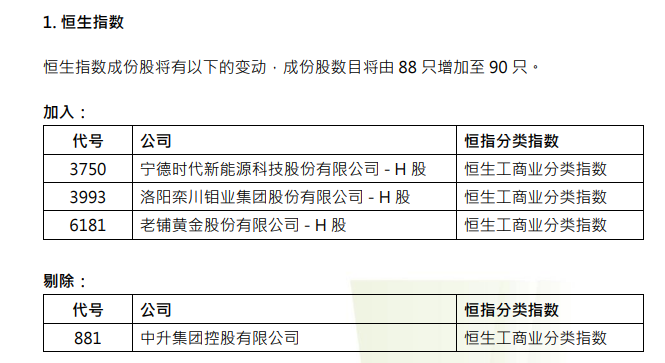
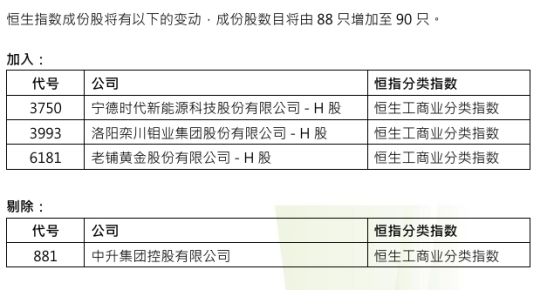
Group 1 - The Hang Seng Index Company announced the quarterly review results for the Hang Seng Index series, effective from March 9, 2026, after market close on March 6, 2026 [1] - The Hang Seng Index will add three stocks: Contemporary Amperex Technology Co., Limited (03750), Luoyang Molybdenum Co., Ltd. (03993), and Laopuhuang Co., Ltd. (06181), while removing Zhongsheng Group Holdings Limited (00881), increasing the number of constituent stocks from 88 to 90 [1] - Laopuhuang has seen a significant price increase, with a cumulative rise of nearly 20% since the beginning of 2026 [1] Group 2 - The Hang Seng China Enterprises Index will maintain 50 constituent stocks, adding Beike-W (02423) and Horizon Robotics-W (09660), while removing China Resources Beer (00291) and Mengniu Dairy (02319) [2] - The Hang Seng Composite Index will add 53 stocks, including Bank of East Asia (00023), and remove 28 stocks, including Shui On Land (00272), increasing the number of constituent stocks from 507 to 532 [5] - The Hang Seng Technology Index will not change, maintaining 30 constituent stocks [6] Group 3 - The total assets under management for products tracking the Hang Seng Index series is approximately $117.7 billion as of December 2025 [6] - The adjustments in index constituents may trigger passive fund rebalancing, potentially leading to increased trading volume for related stocks as the effective date approaches [6] - The inclusion of new economy enterprises in sectors like renewable energy, new consumption, and biotechnology is expected to enhance the growth potential and investment attractiveness of the indices, reducing the weight of traditional industries [6]



重要指数调整!宁德时代、洛阳钼业、老铺黄金被纳入
Shang Hai Zheng Quan Bao· 2026-02-13 13:25
Core Viewpoint - The Hang Seng Index Company announced the quarterly review results for the Hang Seng Index series, with changes effective from March 9, 2026, increasing the number of constituent stocks from 88 to 90, including the addition of CATL, Luoyang Molybdenum, and Laopuhuang, while Zhongsheng Group was removed [1]. Group 1: Index Adjustments - The number of constituent stocks in the Hang Seng Index will increase to 90, with CATL, Luoyang Molybdenum, and Laopuhuang being added [1]. - Zhongsheng Group will be removed from the Hang Seng Index [1]. - The Hang Seng China Enterprises Index will maintain 50 constituent stocks, with Beike-W and Horizon Robotics-W added, while China Resources Beer and Mengniu Dairy were removed [3]. Group 2: Market Impact - The total number of constituent stocks in the Hang Seng Composite Index will rise to 532, with over 50 companies including Cygnus H shares and WeRide-W added, and nearly 30 companies such as Yuexiu Property Trust and Shenzhou Holdings removed [5]. - The total assets under management for products tracking the Hang Seng Index series is approximately $117.7 billion as of December 2025 [5]. - The adjustments in index constituents may lead to concentrated passive fund rebalancing, potentially increasing trading volume for related stocks as the effective date approaches [5].
【立方早知道】“阿里系”减持两家A股公司/理想汽车发布首款AI智能眼镜/摩尔线程明日上市
Sou Hu Cai Jing· 2025-12-04 02:37
Group 1 - Alibaba's major shareholders, including Hangzhou Haoyue, are reducing their stakes in YTO Express and Meikailong, with Meikailong's major shareholder planning to sell up to 130,641,979 shares, representing 3% of the total share capital, valued at approximately 345 million yuan [1] - YTO Express announced that Hangzhou Haoyue transferred 39.925 million shares between November 10 and November 27, 2025, accounting for 1.16% of the total share capital [1] Group 2 - Guizhou Bailing's actual controller, Jiang Wei, is under investigation by the China Securities Regulatory Commission for insider trading and violations related to stock transfers, although this investigation does not affect the company's operations [3] Group 3 - The People's Bank of China emphasizes the need to address "involution" in the financial industry and improve the transmission mechanism of monetary policy, advocating for better coordination between monetary policy and fiscal and industrial policies [4] Group 4 - FTSE Russell announced changes to the FTSE China A50 Index, including the addition of Luoyang Molybdenum and Sungrow Power, while removing Jiangsu Bank and SF Express, effective December 22, 2025 [6] Group 5 - In November, retail sales of passenger vehicles in China decreased by 7% year-on-year, totaling 2.263 million units, while the retail sales of new energy vehicles increased by 7% year-on-year, reaching 1.354 million units [7] Group 6 - The London Metal Exchange reported a significant increase in copper delivery applications, with a rise of 50,575 tons, marking the largest increase since 2013 [8] Group 7 - Over 20 cities in China have suspended or adjusted their vehicle replacement subsidy programs as the fourth batch of 69 billion yuan in national subsidies is being consumed [9] Group 8 - Li Auto launched its first AI smart glasses, Livis, priced at 1,999 yuan, with a government subsidy reducing the price to 1,699 yuan for orders placed by December 31 [10] Group 9 - Anyang Iron and Steel's subsidiary plans to apply for a trust loan of up to 600 million yuan, while Longbai Group has received approval for a 4 billion yuan technology innovation bond [12] Group 10 - The Hong Kong Securities and Futures Commission has suspended trading of Daxian Education due to serious exaggeration of bank balances in its financial statements [13] Group 11 - Moore Threads is set to be listed on the Science and Technology Innovation Board on December 5, 2025 [14] Group 12 - High Energy Environment plans to apply for an initial public offering of H-shares on the Hong Kong Stock Exchange to enhance its global strategy [15] - Wanlong Optoelectronics is planning a major asset restructuring involving the acquisition of control over Zhejiang Zhongkong Information Industry Co., with trading suspended [16] Group 13 - Baiwei Storage reported a reduction of 4.646 million shares by the National Integrated Circuit Industry Investment Fund II, decreasing its stake from 7.9033% to 6.9078% [17]



金融工程快评:2025年12月沪深核心指数成分股调整冲击测算
Guoxin Securities· 2025-11-30 09:48
Quantitative Models and Construction Methods Model Name: Index Component Adjustment Impact Model - **Model Construction Idea**: The model aims to measure the impact of index component adjustments on stock prices, considering the scale of passive products tracking the index and the average trading volume of the stocks[7][8][9]. - **Detailed Construction Process**: - The model calculates the impact of index adjustments using the following formula: $$ \mathrm{effect}_{s} = \frac{\sum_{i}^{m} wt_{in} * index_{-}scale_{i} - \sum_{i}^{n} wt_{out} * index_{-}scale_{i}}{avg_{-}amt_{s}} $$ where: - \( wt_{in} \) represents the buy weight of the stock in the index - \( wt_{out} \) represents the sell weight of the stock in the index - \( index_{-}scale_{i} \) represents the total scale of passive products tracking the index - \( avg_{-}amt_{s} \) represents the average daily trading volume of the stock over the past two weeks[7][8][9]. - **Model Evaluation**: The model effectively quantifies the potential trading impact on stocks due to index adjustments, providing valuable insights for identifying trading opportunities[7][8][9]. Model Backtesting Results - **Index Component Adjustment Impact Model**: - **Net Buy Scale**: - Shenghong Technology: 48.65 billion CNY[10] - Dongshan Precision: 47.91 billion CNY[10] - Guangqi Technology: 34.87 billion CNY[10] - **Impact Coefficient**: - Shenghong Technology: 0.57[10] - Dongshan Precision: 1.31[10] - Guangqi Technology: 3.37[10] Quantitative Factors and Construction Methods Factor Name: Impact Coefficient - **Factor Construction Idea**: The impact coefficient measures the potential impact on a stock's price due to changes in its index weight, considering the net adjustment scale and the stock's average trading volume[9][10][11]. - **Detailed Construction Process**: - The impact coefficient is calculated using the formula: $$ \text{Impact Coefficient} = \frac{\text{Net Adjustment Scale}}{\text{Average Daily Trading Volume}} $$ where: - Net Adjustment Scale is the net buy or sell scale of the stock due to index adjustments - Average Daily Trading Volume is the stock's average trading volume over the past two weeks[9][10][11]. - **Factor Evaluation**: The impact coefficient provides a clear measure of the potential price impact on stocks due to index adjustments, helping investors identify stocks that may experience significant price movements[9][10][11]. Factor Backtesting Results - **Impact Coefficient**: - **Stocks with Impact Coefficient > 2**: - Tower Group: 8.69[12] - Jiangzhong Pharmaceutical: 8.44[12] - Shanxi Drum Power: 6.99[12] - **Stocks with Impact Coefficient < -2**: - Deep Expressway: -15.65[14] - Wanhe Electric: -13.30[14] - Tianyoude Wine: -10.52[14]





指数成分股定期调整预测:9支个股或将调入沪深300指数
Western Securities· 2025-11-17 13:19
- The report focuses on predicting the periodic adjustments of major broad-based indices, including CSI 300, CSI A500, STAR 50, CSI 500, and ChiNext Index, to capture short-term trading opportunities arising from passive fund rebalancing effects[1][9][11] - The prediction framework is constructed based on the index compilation rules and historical adjustment characteristics, incorporating a "historical excluded stocks" elimination mechanism to enhance prediction stability[5][15][19] - For the CSI 300 Index, the prediction is based on the index's compilation rules, which prioritize market capitalization rankings to select constituent stocks, reflecting the overall performance of market leaders[13][15] - For the CSI A500 Index, the selection process includes market capitalization screening and industry balance constraints, ensuring that the industry distribution of constituent stocks aligns with the CSI All Share Index[13][17][19] - The STAR 50 Index prediction is based on its compilation rules, selecting the top 50 stocks from the STAR Market with large market capitalization and good liquidity, while also applying the "historical excluded stocks" elimination mechanism[25][26] - The CSI 500 Index focuses on capturing the performance of mid-cap stocks outside the CSI 300 Index, with its sample space excluding the predicted constituents of the CSI 300 Index[27][28][33] - The ChiNext Index uses data from the past six months for its periodic adjustments, with the prediction framework considering the unique characteristics of the index[34][36] - The report provides detailed predictions for stocks likely to be included or excluded from each index in the December 2025 periodic adjustments, based on historical data and the respective index compilation rules[15][17][19][26][33][36]
2025年12月沪深300、上证50和科创50等指数调整名单预测
Shenwan Hongyuan Securities· 2025-11-08 12:42
- The report predicts adjustments to the constituent stocks of major indices, including CSI 300, CSI 500, CSI 1000, CSI 2000, SSE 50, and STAR 50, based on publicly available index compilation rules and data [5][10][16][18][20] - CSI 300 Index is constructed by selecting the top 50% stocks based on average daily trading volume over the past year, followed by the top 300 stocks ranked by average daily market capitalization, while adhering to a 10% adjustment limit, priority for old samples, and a 20% buffer zone rule [5] - The adjustment prediction for CSI 300 Index involves calculating the average daily market capitalization and trading volume of A-shares over the past year, excluding stocks with suspension, violations, or financial reporting issues [5] - The report defines a "shock coefficient" to measure the price impact and duration caused by passive index fund rebalancing, calculated as: $ Shock Coefficient = (Passive Buy Amount - Passive Sell Amount) / Average Daily Trading Volume $ This coefficient is applied to assess the impact of adjustments on stocks [6][9] - CSI 500 Index is constructed by excluding CSI 300 constituent stocks and the top 300 stocks by average daily market capitalization over the past year, followed by removing the bottom 20% stocks by average daily trading volume, and selecting the top 500 stocks by market capitalization, adhering to a 10% adjustment limit, priority for old samples, and a 10% buffer zone rule [10] - CSI 1000 Index is constructed by excluding CSI 800 constituent stocks, the top 300 stocks by market capitalization, and stocks with insufficient liquidity (bottom 20% by trading volume), selecting the top 1000 stocks by market capitalization over the past year [16] - CSI 2000 Index is constructed by excluding CSI 800 and CSI 1000 constituent stocks, the top 1500 stocks by market capitalization, and selecting the top 2000 stocks by market capitalization over the past year [16] - SSE 50 Index is constructed by selecting the top 50 stocks by market capitalization and liquidity from the Shanghai Stock Exchange, adhering to adjustment rules similar to other indices [18] - STAR 50 Index is constructed by selecting the top 50 stocks by market capitalization from STAR Market, excluding stocks with delisting risks, major violations, or low liquidity (bottom 10% by trading volume) [20] - The report predicts adjustments to the STAR 50 Index, with two stocks, Aojie Technology-U and Shengke Communication-U, being added [20] - The shock coefficients for the predicted adjustments are calculated for each stock, with the highest coefficients observed for stocks such as Guangqi Technology and Ningbo Port in CSI 300, and Sheneng Shares and Suzhou Supor in CSI 500 [7][11][19][21]





【广发金工】关注指数成分股调整的投资机会
广发金融工程研究· 2025-11-06 00:32
Core Viewpoint - The article emphasizes the growing recognition of index-based investment among investors, highlighting the potential investment opportunities arising from significant changes in index constituents due to the periodic rebalancing of major indices like the SSE 50, CSI 300, and CSI 500 [1][4]. Group 1: Index Fund Growth - The total scale of passive index funds (including ETFs and off-market passive index funds) reached 4.5 trillion yuan as of October 31, with 2,294 funds, while enhanced index funds totaled 265.3 billion yuan, surpassing the scale of equity mixed funds at 2.53 trillion yuan [2][15]. - The total scale of equity ETFs grew from approximately 200 billion yuan in 2014 to 3.72 trillion yuan by October 2025, indicating significant growth [15]. Group 2: Historical Adjustment Effects of Index Constituents - Historical analysis from 2019 to mid-2025 shows that stocks added to indices tend to outperform the index in the two weeks prior to their inclusion, while those removed tend to underperform [2][24]. - The average excess return for stocks added to the index in the two weeks before inclusion was 4.89%, with a success rate of 66.67% [25]. Group 3: Latest Adjustment Impact Estimation - The expected adjustments for December 2025 indicate that the SSE 50 will adjust 4 stocks with an estimated passive buy amount of 5.5 billion yuan, the CSI 300 will adjust 10 stocks with an estimated net buy of 24.5 billion yuan, and the CSI 500 will adjust 50 stocks with an estimated buy of 3.3 billion yuan [3][33].

2025年12月沪深核心指数成分股调整预测【国信金工】
量化藏经阁· 2025-11-06 00:08
Core Viewpoint - The article emphasizes the increasing acceptance of index investing among investors, leading to a significant growth in the scale of index funds, which reached a total of 4.44 trillion yuan as of September 30, 2025 [8][11]. Index Fund Growth - As of September 30, 2025, there are 1,521 passive equity index funds with a total scale of 4.44 trillion yuan [8]. - The scale of index funds tracking major indices such as CSI 300, CSI A500, and SSE 50 are 1.21 trillion yuan, 217.4 billion yuan, and 188.6 billion yuan respectively [11]. Index Component Adjustments - Regular adjustments to index components are conducted by China Securities Index Company and Shenzhen Securities Information Company every June and December, which can create trading opportunities if the adjustments are substantial [14]. - The article provides predictions for component adjustments in six major indices: CSI 300, SSE 180, SSE 50, Sci-Tech 50, ChiNext Index, and CSI 500, offering investment references for investors [14]. Predictions for Major Indices - **CSI 300 Index**: Predictions include the addition of 11 stocks such as Huadian New Energy and the removal of 11 stocks including Xingyu Co., Ltd. [2][15]. - **SSE 180 Index**: Predictions indicate the addition of 7 stocks including Huadian New Energy and the removal of 7 stocks such as COSCO Shipping Energy [3][16]. - **SSE 50 Index**: Predictions suggest the addition of 4 stocks including SAIC Motor and the removal of 4 stocks such as China Mobile [4][17]. - **Sci-Tech 50 Index**: Predictions include the addition of 2 stocks such as Aojie Technology and the removal of 2 stocks including Huaxi Biological [5][18]. - **CSI 500 Index**: Predictions indicate the addition of 50 stocks including Electric Power Investment and the removal of 50 stocks such as China Great Wall Technology [6][20]. - **ChiNext Index**: Predictions suggest the addition of 8 stocks including Changsheng Bearing and the removal of 8 stocks such as Huaxia Eye Hospital [7][22].




金融工程专题研究:2025年12月沪深核心指数成分股调整预测
Guoxin Securities· 2025-11-05 14:02
- The report predicts adjustments to the constituent stocks of six major indices: CSI 300, SSE 180, SSE 50, STAR 50, ChiNext Index, and CSI 500, based on the index compilation rules[2][19][20] - For the CSI 300 Index, 11 stocks including Huadian New Energy, Shenghong Technology, and Rockchip Micro will be added, while 11 stocks including Xingyu Co., Trina Solar, and Foster will be removed[3][21] - For the SSE 180 Index, 7 stocks including Huadian New Energy, Rockchip Micro, and Shengmei Shanghai will be added, while 7 stocks including COSCO Shipping Energy, Lu'an Environmental Energy, and Trina Solar will be removed[4][24] - For the SSE 50 Index, 4 stocks including SAIC Motor, Huadian New Energy, and Northern Rare Earth will be added, while 4 stocks including China Mobile, Aluminum Corporation of China, and Poly Developments will be removed[5][26] - For the STAR 50 Index, 2 stocks including Aojie Technology and Shengke Communication will be added, while 2 stocks including Huaxi Bio and Hangcai Co. will be removed[6][28] - For the ChiNext Index, 8 stocks including Changsheng Bearing, Wancheng Group, and Changxin Bochuang will be added, while 8 stocks including Huaxia Eye, Yihualu, and Origin Water will be removed[7][31] - For the CSI 500 Index, 50 stocks including Electric Power Investment Energy, Trina Solar, and Supor will be added, while 50 stocks including Tuojing Technology, China Great Wall, and Jinghe Integration will be removed[8][35]
