赢创

Search documents
共享中国大市场 共创发展新机遇——写在第八届中国国际进口博览会开幕之际
Xin Hua Wang· 2025-11-04 17:08
Group 1 - The China International Import Expo (CIIE) is the world's first national-level exhibition focused on imports, showcasing China's commitment to high-level opening-up and providing global market opportunities [1][5][28] - The eighth CIIE will feature participation from 155 countries and regions, with over 4,108 foreign enterprises exhibiting, marking record highs in both exhibition area and number of companies [4][5] - The event serves as a platform for international procurement, investment promotion, cultural exchange, and open cooperation, reflecting China's role in providing stability and certainty to the global economy [7][28] Group 2 - The CIIE has facilitated significant business opportunities, with past expos generating over $500 billion in intended transactions and showcasing around 3,000 new products and technologies [5][28] - Major global companies, including L'Oréal and various Fortune 500 firms, are participating, indicating the expo's importance in connecting international businesses with the Chinese market [4][5] - The event is expected to introduce 461 new products, technologies, and services, highlighting the innovation and growth potential within the Chinese market [17][20] Group 3 - The expo emphasizes the importance of collaboration and mutual growth, with companies like DoTerra and Evonik expanding their presence in China due to the opportunities presented by the CIIE [11][15][16] - The CIIE is seen as a bridge for global innovation to enter the Chinese market, with many companies establishing local R&D centers and production facilities as a result of their participation [22][24] - The event aligns with China's broader economic strategy, which includes plans to import over $15 trillion in goods and services during the 14th Five-Year Plan period, contributing significantly to global economic growth [35][37]


第八届进博会|共享中国大市场 共创发展新机遇——写在第八届中国国际进口博览会开幕之际
Xin Hua She· 2025-11-04 15:56
Core Insights - The China International Import Expo (CIIE) serves as a significant platform for global trade, showcasing China's commitment to high-level opening-up and providing vast opportunities for international businesses [1][3][17] - The eighth CIIE features participation from 155 countries and regions, with over 4,108 foreign enterprises exhibiting, marking record highs in both exhibition area and number of companies [2][3] - The event has facilitated substantial business interactions, with past expos generating over $500 billion in intended transactions and showcasing around 3,000 new products and technologies [3][20] Group 1: Participation and Scale - The eighth CIIE will host 290 Fortune 500 companies and industry leaders, highlighting the event's global significance [2] - The exhibition area exceeds 430,000 square meters, reflecting a growing interest from international businesses [2][3] - Countries like Thailand, UAE, Nigeria, Georgia, Sweden, and Colombia are participating as guest countries, indicating a diverse international presence [5] Group 2: Business Opportunities - Companies like doTERRA have seen significant growth in China, with plans to make it their largest market by 2030, showcasing the potential for foreign businesses in the Chinese market [5] - The expo has enabled companies to transition from exhibitors to investors, with many firms expanding their operations in China [10][14] - The event is a bridge for global innovation, allowing companies to quickly convert exhibits into market-ready products [13][21] Group 3: Innovation and Technology - The eighth CIIE will feature 461 new products and technologies, including innovations in medical devices and AI, emphasizing China's role as a hub for global innovation [11][12] - Companies are leveraging the expo to introduce cutting-edge technologies, such as humanoid robots and advanced medical equipment, to the Chinese market [11][13] - The event supports the introduction of new industries and consumption patterns, including low-altitude economy and digital health [12][20] Group 4: Economic Impact - China is projected to import over $15 trillion in goods and services during the 14th Five-Year Plan, contributing approximately 30% to global economic growth [20] - The expo is a key platform for promoting trade and investment, with a focus on mutual benefits and cooperation among nations [3][17] - The participation of companies from developing countries has increased significantly, reflecting China's commitment to inclusive growth [20]
关厂、出售!两大化工巨头同日宣布调整业务
Zhong Guo Hua Gong Bao· 2025-11-04 09:09
Group 1 - BASF announced the integration of its Asian PolyTHF business into its Shanghai Caojing site and will cease production at its Ulsan facility in South Korea, with the closure expected to be completed by 2026 [1] - The decision is part of BASF's global production strategy assessment aimed at enhancing competitiveness in response to structural changes in the global chemical fiber market, including severe overcapacity [1] - After the Ulsan plant closure, BASF will continue to produce PolyTHF at its sites in China, Germany, and the USA, with a total capacity of 250,000 tons per year [1] Group 2 - Evonik announced the sale of its betaine business in Indonesia to Aekyung Chemical, marking a step towards its transformation into a sustainable specialty chemicals supplier [1] - Evonik has been gradually divesting its global betaine-related assets, having sold its business in Milton Keynes, UK, in August 2020, and its Virginia, USA, business in August 2022 [2] - Despite the divestitures, Evonik will continue its betaine operations in Europe and Latin America, as betaine is widely used in personal care products and other consumer goods [2]

赢创推出功能性胶囊材料
Zhong Guo Hua Gong Bao· 2025-11-04 03:05
Core Insights - Evonik has launched EUDRACAP colon, the first functional ready-to-use capsule material specifically designed for the ileum-colon region, addressing the growing market demand for precise delivery of sensitive active ingredients [1] Group 1: Product Overview - EUDRACAP colon is suitable for delivering sensitive active ingredients such as live biopharmaceuticals, oral biologics, proteins, peptides, and nucleotides [1] - The product aims to facilitate the development of innovative drugs for serious diseases like obesity, AIDS, or cystic fibrosis, as well as for localized delivery in colorectal cancer and infections [1] Group 2: Company Innovation - EUDRACAP colon is the latest innovation in Evonik's oral drug delivery functional capsule platform, which is continuously expanding [1] - The platform also includes EUDRACAP enteric for targeted release in the upper small intestine, EUDRACAP Select for customized CDMO services, and EUDRACAP preclinic for early development stages [1]
赢创日本气相氧化铝工厂投产
Zhong Guo Hua Gong Bao· 2025-11-03 02:16
Core Insights - Evonik has officially launched its first advanced gas-phase alumina production plant "Alu5" in Yokkaichi, Japan, marking a significant milestone in the company's strategic layout with an investment of several tens of millions of euros aimed at better serving the Asian market [1] Group 1: Production and Capacity - The commissioning of the Alu5 plant not only enhances production capacity but also represents a strategic deployment to serve Asian customers, ensuring a stable supply of high-performance alumina and accurately responding to market demands [1] Group 2: Product Offering - The new plant will produce Evonik's advanced AEROXIDE gas-phase alumina solutions, specifically developed for ultra-thin coating technologies, which significantly improve the performance and durability of products in various fields such as electric vehicles, consumer electronics, and sustainable powder coatings [1] Group 3: Sustainability and Regional Impact - The Alu5 plant is a crucial pillar of Evonik's growth strategy in Asia, enabling localized production that shortens delivery times, reduces carbon footprints, and reinforces the commitment to ensuring regional supply, driving sustainable innovation, and building long-term partnerships [1]
行业聚焦:全球半导体用湿电子化学品市场头部企业份额调研(附Top 10 厂商名单)
QYResearch· 2025-10-30 02:40
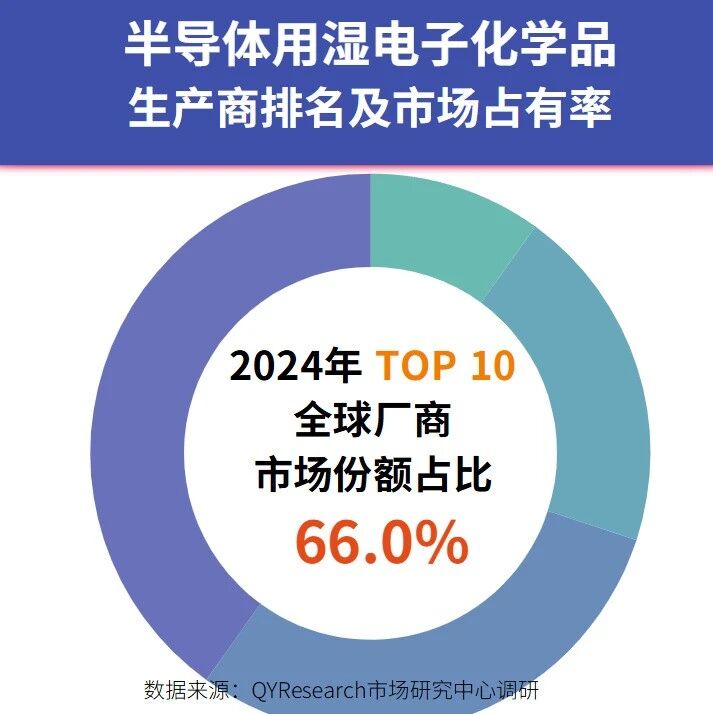
Core Viewpoint - The semiconductor wet electronic chemicals market is projected to reach $2.81 billion by 2031, with a compound annual growth rate (CAGR) of 7.4% in the coming years [2]. Market Overview - The global production of semiconductor wet electronic chemicals is expected to reach 1.2 million tons in 2024, with an average price of $1,300 per ton and a gross margin of approximately 30% [4]. - The top ten manufacturers are estimated to hold about 66.0% of the market share in 2024 [4]. Market Drivers and Opportunities - The rapid growth of the semiconductor industry is a key driver for the wet chemical market, fueled by the increasing demand for high-performance semiconductor chips due to the proliferation of electronic products like smartphones and computers [9]. - Technological advancements and innovations in semiconductor manufacturing processes are critical growth drivers, especially as device sizes shrink below 10 nanometers, necessitating ultra-pure chemicals and specialized formulations [9]. - Government policies supporting the domestic wet chemical industry, such as financial subsidies and tax incentives, positively impact market growth [9]. Market Trends - There is a rising demand for higher purity levels in wet chemicals as semiconductor nodes shrink to 7 nanometers and below, leading to the development of specialized formulations and purification processes [11]. - Approximately 70% of semiconductor manufacturers have adopted advanced cleaning steps using specialized wet chemicals like hydrogen peroxide to ensure the quality and performance of semiconductor chips [11]. - The use of AI-controlled quantitative feeding systems is increasing, with about 45% of semiconductor manufacturers implementing these systems to enhance accuracy and efficiency in chemical feeding [11].
德国化工凉了?巨头集体跑路,10万岗位蒸发,中国化工杀出重围
Sou Hu Cai Jing· 2025-10-28 14:37
Core Viewpoint - The German chemical industry is facing a critical survival challenge due to rising costs and increased competition, leading to significant job losses and potential economic decline in traditional industrial regions [1][3][10]. Cost Pressures - The reliance on cheap Russian natural gas, which previously accounted for 40% of energy consumption in chemical production, has been disrupted, causing energy costs to triple for some companies [3][5]. - The carbon trading system in the EU adds further financial strain, with companies like INEOS facing carbon offset costs that consume up to 80% of their net profits [5][12]. Job Losses - Major companies are announcing large-scale layoffs, with Evonik cutting 2,000 jobs globally, including 1,500 in Germany, and BASF reducing traditional production capacity by 20% [8][10]. - The German Chemical Association (VCI) reports that approximately 100,000 direct jobs are at risk, with potential knock-on effects leading to over 400,000 job losses in related sectors [9][10]. Policy and Industry Conflict - The conflict between climate policy and industrial survival is intensifying, with calls from opposition parties to relax carbon trading rules to support struggling companies [12][15]. - The North Rhine-Westphalia economy minister insists on maintaining the carbon trading system as essential for industrial modernization, despite the immediate challenges [14][15]. Transition Efforts - Companies are attempting to pivot towards greener alternatives, with Shell focusing on biofuels and BASF investing €5 billion in a green chemical park to reduce carbon emissions by 60% [17][19]. - The EU has approved €5 billion in industrial decarbonization subsidies for Germany, aiming to support the chemical and metallurgy sectors while developing a hydrogen supply network [19]. Competitive Landscape - German chemical firms are under pressure from competitors in Asia and the Middle East, where natural gas costs are significantly lower, allowing for more competitive pricing [5][7]. - Chinese chemical companies have rapidly gained market share, reaching 28% globally in 2023, further squeezing the market for German firms [5][17].
投资吸引力下降,内外部压力重重,巨量资金转移海外引德国担忧
Huan Qiu Shi Bao· 2025-10-27 22:55
Core Insights - The article highlights the alarming trend of German companies increasingly relocating investments overseas, with over €200 billion leaving Germany annually over the past five years, primarily due to high energy costs, external competition, and U.S. tariff policies [1][6][7]. Group 1: Investment Trends - 70% of energy-intensive companies in Germany are shifting investments abroad, with 31% actively moving production outside Europe and 42% preferring to invest in other European countries rather than Germany [1][4]. - The total outflow of investments from Germany has reached €34.52 billion over the past decades, with an average annual outflow exceeding €200 billion [6][7]. Group 2: Economic Challenges - The German economy is facing stagnation, with GDP expected to remain flat from the end of 2021 to the end of 2024, primarily due to a 4.2% decline in exports from 2022 to 2024 [2][3]. - The chemical giant Bayer reported a sixfold increase in net losses in Q2, amounting to €199 million, reflecting the broader struggles within the German industrial sector [2]. Group 3: Factors Influencing Investment Decisions - High energy costs driven by EU climate policies and rising carbon certificate prices are significant burdens for companies, leading to calls for the cancellation of CO2 fees [4][5]. - Political uncertainty and a lack of confidence in government reforms are causing businesses to hesitate in investing domestically, with 80% of surveyed companies expressing pessimism about improvements in the business environment [4][5]. Group 4: Global Competition - The U.S. tariff policies under the Trump administration are exerting additional pressure on Germany's energy-intensive industries, with companies like Schott adjusting their investment strategies to favor locations outside Germany [5][8]. - The competitive landscape is shifting, with emerging markets like China and India becoming more attractive for investment, as evidenced by BASF's new production facility in Guangdong, China [8].

世界级研发中心扎堆落户,中国医疗创新加速输出全球
Di Yi Cai Jing· 2025-10-26 11:15
Group 1 - Leading multinational medical companies are evolving from mere technology providers to significant co-creators in China's healthcare ecosystem [1] - AstraZeneca has launched a new global strategic R&D center in Beijing, which includes an AI and data science center to accelerate the transition of early drug research results to clinical development [2] - Medtronic's newly established digital healthcare innovation base in Beijing will focus on developing AI and big data-based disease management solutions [2] Group 2 - Pfizer has opened an R&D open innovation center in Shanghai, aimed at supporting local universities, biotech companies, hospitals, and clinical research institutions to expedite innovation [2] - Pfizer's CEO highlighted that China has captured 30% of the global drug development market over the past decade due to its rapid R&D processes [2][3] - The number of innovative drug pipelines in China has increased from approximately 60 a decade ago to around 1,200 today, with Chinese biopharmaceutical companies recruiting clinical trial patients 2 to 5 times faster than their U.S. counterparts [3] Group 3 - Multinational medical giants are increasing R&D and supply chain localization investments in China, leading to the emergence of numerous therapies originating from Chinese innovation [4] - The upcoming China International Import Expo will serve as a significant platform for multinational companies to participate in building a health ecosystem in China [4] - Boehringer Ingelheim plans to invest over 5 billion RMB in R&D in China over the next five years, aiming for synchronized global approvals for new drugs and indications [4] Group 4 - Gilead Sciences is actively advancing local R&D, with 16 ongoing projects, including 10 in oncology and 6 in non-oncology, aiming for synchronized global development [5] - Gilead's projects include initiatives to improve HIV treatment success rates in collaboration with local health associations [4][5]


杜邦、霍尼韦尔、3M,再拆分!
DT新材料· 2025-10-20 16:05
Core Insights - DuPont, Honeywell, and 3M are undergoing significant business restructuring, focusing on separating their high-growth segments from slower-growing ones to enhance operational efficiency and market competitiveness [2][3][5] DuPont - DuPont's board approved the spin-off of its electronic business into a standalone company named Qnity Electronics, which will focus on semiconductor technology and industrial solutions [2] - Qnity Electronics signed a long-term strategic agreement with SK Hynix for the supply of chemical mechanical polishing pads, indicating strong market demand in the semiconductor sector [2] - The restructuring aims to optimize resource allocation and improve valuation, as the electronic business is expected to grow rapidly compared to other segments like water services [3] Honeywell - Honeywell's board has approved the spin-off of its Solstice Advanced Materials division, which will focus on high-growth specialty materials benefiting from global energy transitions and AI computing demands [3] - The Solstice division will consist of two main business units: Refrigerants and Applications Solutions, projected to generate $2.7 billion in sales in 2024, and Electronics and Specialty Materials, expected to achieve $1 billion in sales [4] - The overall sales for Solstice in 2024 are anticipated to reach $3.8 billion, with a net profit of $600 million and an adjusted EBITDA of $1.1 billion [4] 3M - 3M is evaluating the divestiture of parts of its safety and industrial segment, aiming to streamline operations and focus on higher-growth areas [5] - The company has previously spun off its healthcare business, creating Solventum Corporation, and is now looking to optimize its business portfolio further [5] - 3M faces ongoing legal challenges related to PFAS contamination, which could impact cash flow, while its safety and industrial segment has shown low profitability and growth [5] Industry Trends - Major corporations are increasingly restructuring and optimizing their business models to focus on core competencies and high-growth areas, as seen with BASF, Evonik, and Solvay [5] - The trend reflects a broader industry shift towards enhancing resource utilization and cost efficiency in response to competitive market dynamics [5]